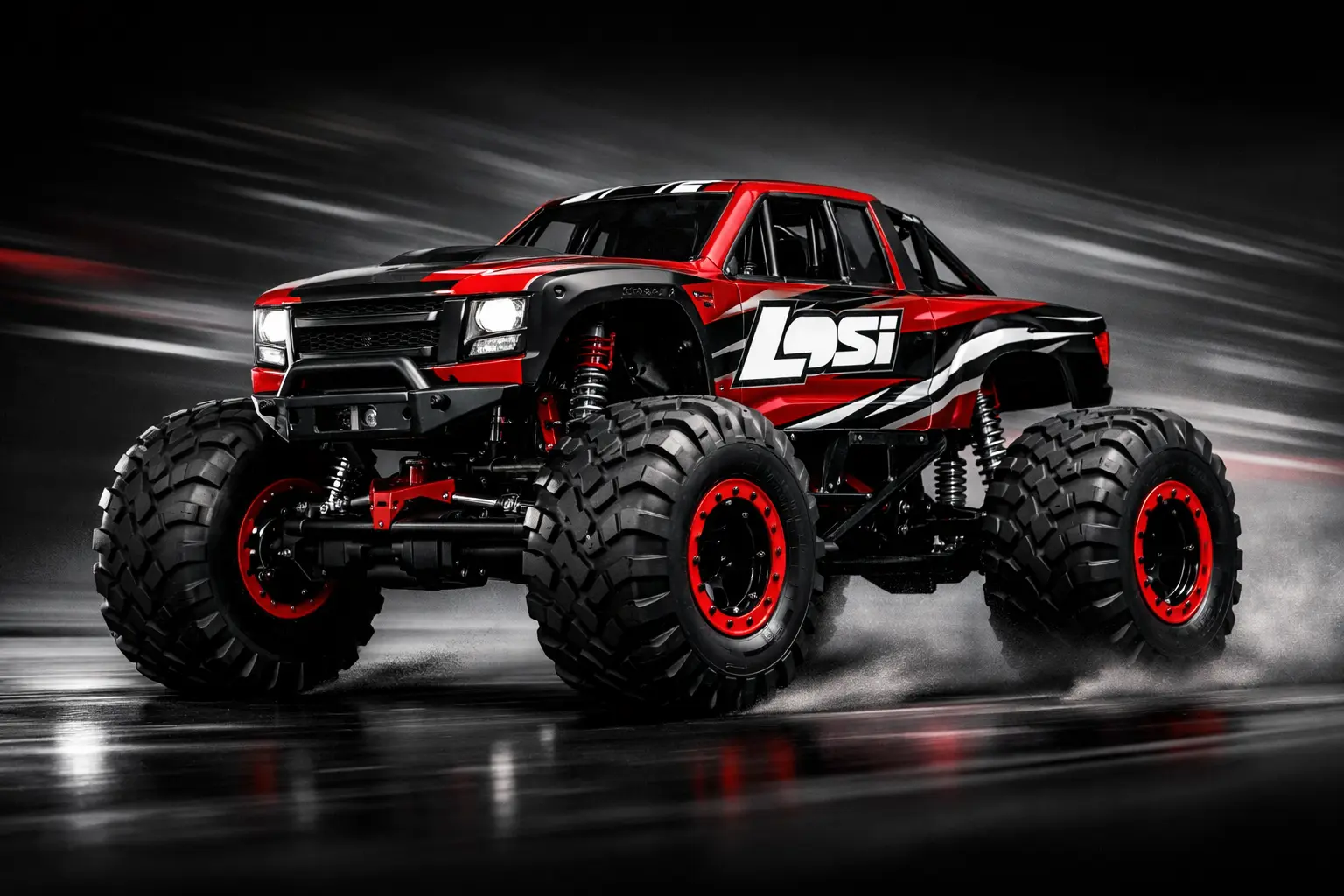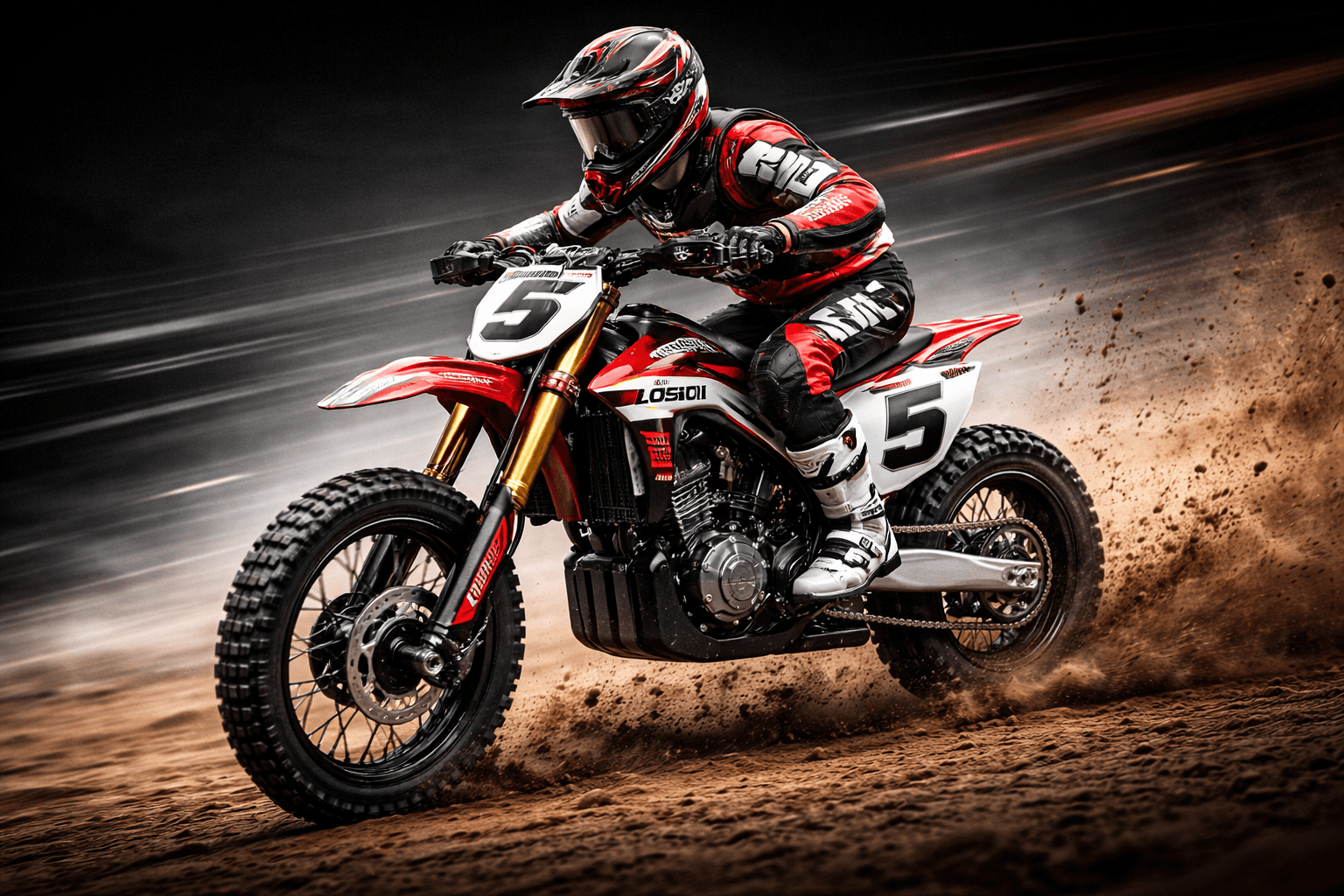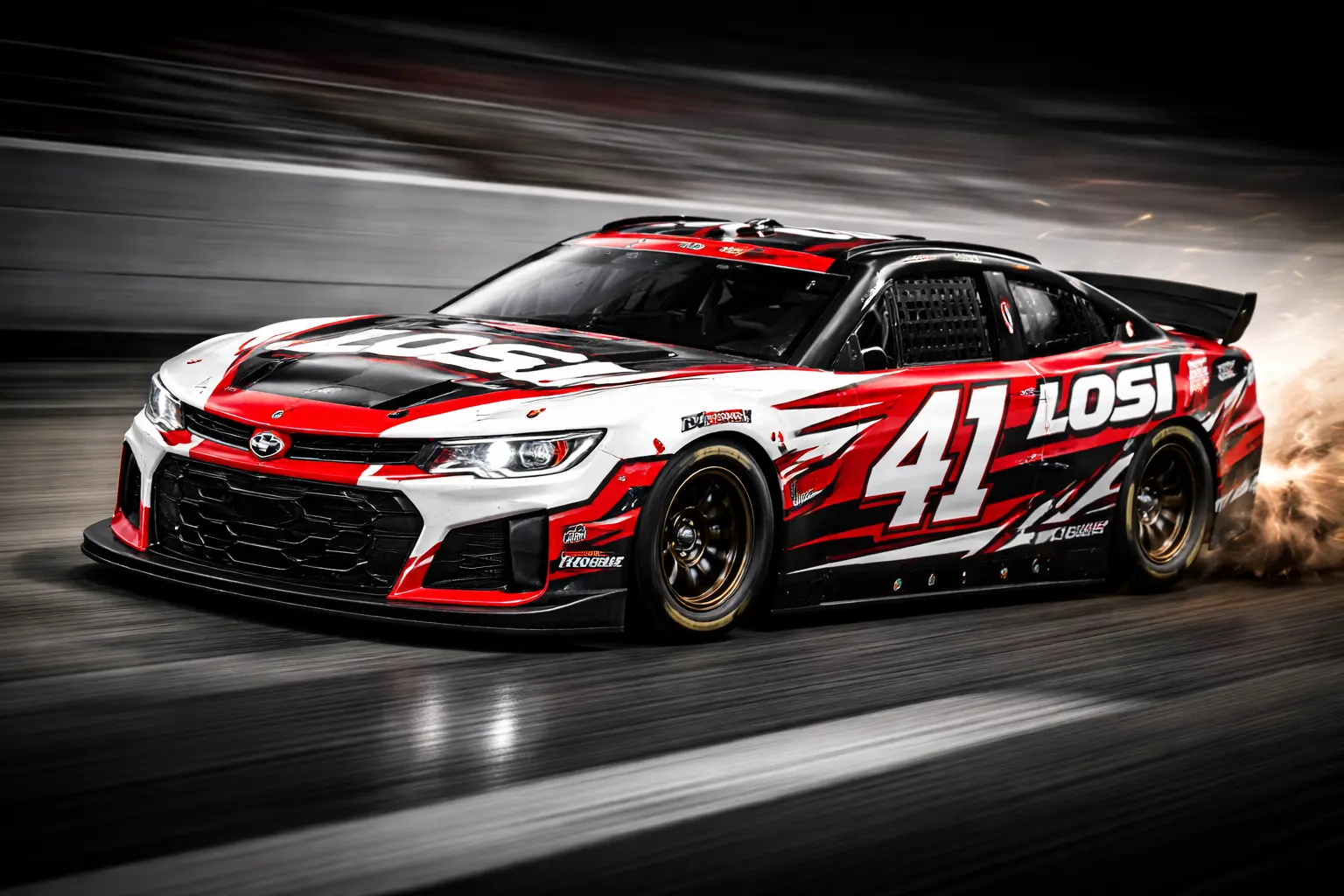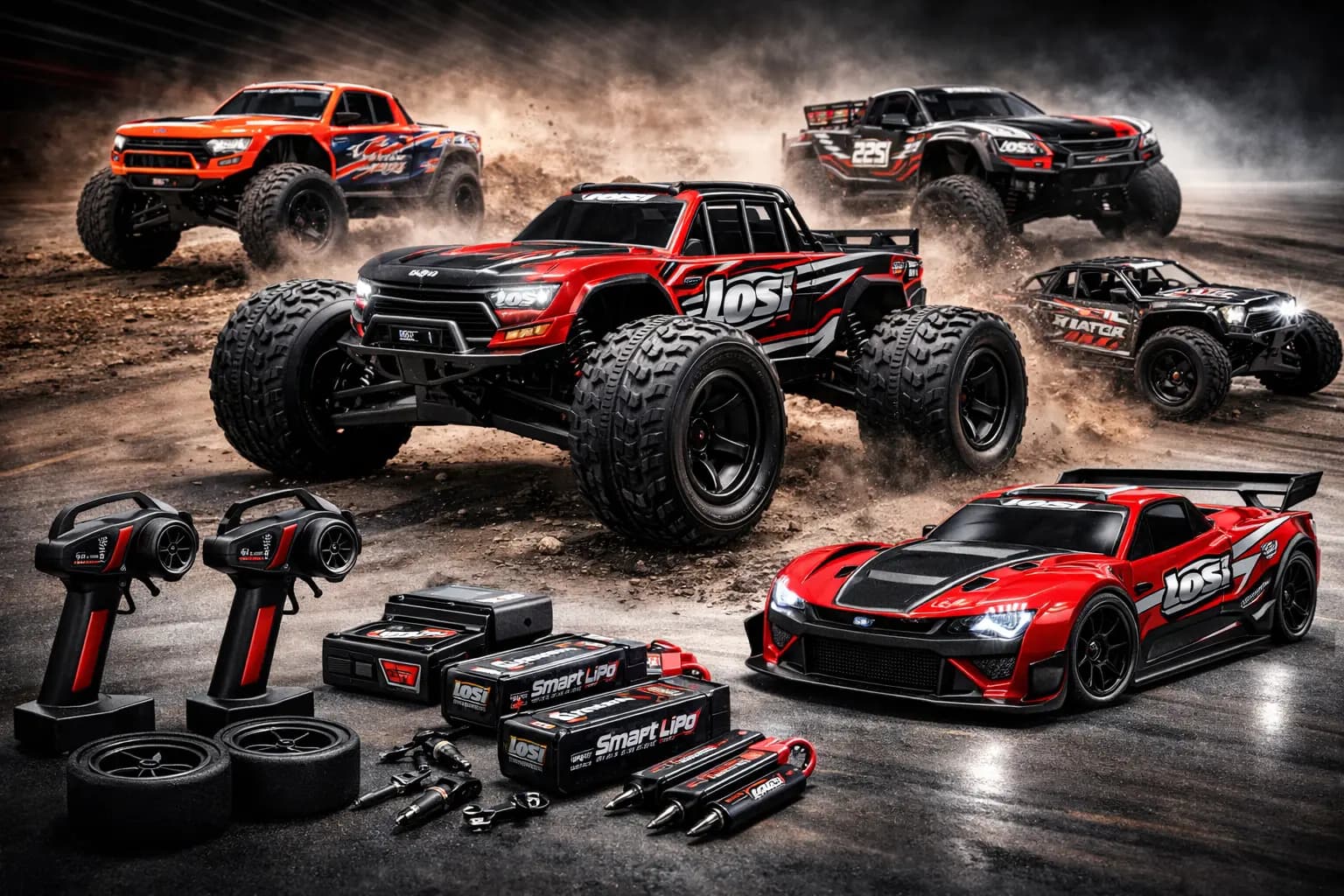
Losi is the brand that builds what nobody else will. While Traxxas and Arrma fight over the same monster truck and short course categories, Losi quietly owns entire segments of the RC market — the only hobby-grade RC motorcycle, the only solid-axle monster truck, licensed NASCAR oval racers, sprint cars, and retro buggies pulled straight from the 1980s. That willingness to go where competitors won't is what makes Losi one of the most interesting brands in the hobby.
Founded in the 1980s and acquired by Horizon Hobby in 2000, Losi carries deep racing DNA. The same company that won IFMAR World Championships and ROAR Nationals now makes RTR vehicles for backyard bashers, scale enthusiasts, and racers alike. Their competition arm, Team Losi Racing (TLR), still dominates at the national level, and that engineering trickles down into every consumer model they produce. Losi doesn't have the biggest lineup — they have the most unique one.
This guide covers every current Losi model, who each one is built for, and how to pick the right one for your driving style and budget.
This article contains affiliate links. If you purchase through these links, we may earn a small commission at no extra cost to you. This helps support rccarsguide.com.
Losi's DNA — Where Racing Heritage Meets Innovation
The Losi story starts in Colton, California, where Gil Losi Sr. and his son Gil Losi Jr. ran a skateboard company. When a nearby skatepark installed an RC track, Gil Sr. started selling homemade aftermarket parts — pinions, spur gears, hop-ups for Tamiya and Yokomo cars — out of the skatepark's snack bar. What began as a side hustle grew into the "Ranch Pit Shop" hobby store, then into one of the most storied names in RC racing.
Gil Jr. was already winning world championships before Team Losi ever built a car. He won the 1981 Modified 1/10 Off-Road World Championship, took titles in 1982 with a Kyosho Scorpion, and captured the 1985 IFMAR 4WD Buggy World Championship. He even contributed to the design of Team Associated's legendary RC10. When a distribution deal with Associated fell through, Gil Sr. took a loan on his house to fund the first Team Losi vehicle — the JRX2, released in 1988. That rear-motor 2WD buggy with its innovative 5-link rear suspension changed off-road racing forever.
The wins kept stacking. The Losi XX won the brand's first IFMAR World Championship in 1993. The XX-4 made Team Losi the first U.S. company in 4WD buggy competition. After Horizon Hobby acquired the company in 2000, the brand split into two arms: TLR for competition kits and Losi for RTR consumer models. TLR's 22 platform has won national titles across three continents, and their team claimed eight ROAR National Championship titles in 2022 alone.
What makes Losi different today isn't just that heritage — it's the philosophy. They produce fewer models than Arrma or Traxxas, but every single one fills a niche that nobody else serves. Solid axles on the LMT when everyone else does independent suspension. Licensed NASCAR bodies when nobody else does oval racing. A motorcycle that actually balances on two wheels. That's Losi's DNA: race-bred engineering applied to categories nobody else dares to attempt.
Mini & Micro Scale — The Budget Racers
Losi's mini lineup is where most people discover the brand, and for good reason. The Mini-B is arguably the best first RC racing experience you can buy under $200. Built on scaled-down TLR 22 platform geometry — the same suspension design winning national championships at full scale — it's not a toy pretending to be a race car. It's a race car that happens to be small.
The Mini-B comes in brushed (around $150) and brushless (around $200) versions, both 1/16-scale 2WD buggies with threaded oil-filled shocks, a 1.5mm 6061-T6 aluminum chassis, and metal gear transmissions. Both include battery and charger — genuinely ready to run. The brushed version is perfect for learning, while the brushless version adds enough speed to be competitive at indoor carpet racing events, which are exploding in popularity at hobby shops across the country. There's also a Mini-B Pro Roller for around $110–120 if you want to build up a custom competition setup.
The Mini-T 2.0 offers the same quality in a stadium truck body, available in brushed (around $140) and brushless (around $180) configurations. The Mini Drag Car takes the platform in a completely different direction — a 1/16-scale 1970 Chevelle with a Firma 6000Kv brushless system, licensed Mickey Thompson tires, LED lights, and an adjustable wheelie bar for around $200.
At even smaller scale, the Micro-B (1/24) gives you all-metal gears and outdrives in a package that fits on a kitchen table for around $120–130. It's a surprisingly capable little machine for the price.
For upgrades and tips on getting the most out of Losi's smallest machines, check out our Best Losi Micro-B & Micro-T Upgrades guide.
The LMT Platform — Solid-Axle Monster Trucks
The LMT is where Losi's engineering philosophy shines brightest. Every other RC monster truck on the market — Traxxas Maxx, Arrma Kraton, you name it — uses independent suspension. The LMT is the only one that replicates the solid-axle, 4-link suspension architecture of real Monster Jam trucks. That difference isn't cosmetic. Solid axles produce authentic torque twist, natural wheelies from weight transfer, and that signature bouncing chassis behavior that makes full-size monster trucks so spectacular to watch.
The LMT 2.0, released in early 2025, took everything great about the original and added Spektrum's DRIVE Technology — Dynamic Response Intelligent Vehicle Envelope. Three transmitter-toggled driving modes let you hold wheelies, pull stoppies, ride on two wheels in "bicycle" mode, or just drive normally. The system works through the Spektrum Firma 3668 2800Kv brushless motor and 130A Smart ESC, paired with a DX3 transmitter and custom 6-channel receiver. Eight shocks with internal springs (no external coils) give it a scale-accurate look that matches real monster trucks, complete with molded replica shock reservoirs.
The LMT 2.0 runs on 2S or 3S LiPo, hits 35+ mph on 3S, rolls on officially licensed 2.6-inch BKT tires, and features a powder-coated 6061-T6 aluminum twin vertical plate chassis. Current body options are Grave Digger and Son-uva Digger, both officially licensed by Monster Jam. Pricing sits around $700–750 depending on retailer and sales. Battery and charger are sold separately.
The Mini LMT brings that same solid-axle formula down to 1/18 scale for $250–300, with four Monster Jam bodies available — Grave Digger, Son-uva Digger, Megalodon, and Zombie. It's brushed, includes battery and charger, and has become one of Losi's biggest sellers. The solid axle design works brilliantly at this scale, and the powder-coated aluminum chassis handles abuse like a champ.
For deeper dives on these platforms, check out our Losi LMT Review, Losi King Sling Review, and Losi Mini LMT Review.
Desert Trucks & Trail Rigs
Losi's desert and trail segment draws heavily from real off-road motorsport, and it shows in the licensed bodies, suspension design, and overall engineering. These are 1/10-scale vehicles built on the proven Tenacity (TEN) platform and Baja Rey architecture, all running Spektrum Firma Smart ESCs and brushless power.
The Baja Rey is the flagship here — a 1/10 4WD desert truck with a licensed Ford Raptor body, independent front suspension paired with a 4-link live rear axle, and enough speed to crack 50 mph on 3S. It captures the look and feel of full-size desert racing better than anything else on the market at this price point (around $480). The newer RZR Rey, released in 2025, brings an officially licensed Polaris RZR Pro R body with BFGoodrich KM3 tires on Raceline wheels and a new independent rear trailing arm suspension for around $450.
For rock racing and trail driving, the Hammer Rey U4 and Lasernut U4 cover different approaches to Ultra4-style racing. The Hammer Rey (around $500) uses licensed Currie Enterprises bodywork and BFGoodrich tires, while the Lasernut U4 (around $500) offers full independent suspension and 3S–4S compatibility with AVC stability control. Both are legitimate rock racers that can handle technical terrain and high-speed desert sections.
The Tenacity DB Pro (desert buggy) and Tenacity TT Pro (trophy truck) share the same platform and pricing (around $380 each), offering 50+ mph on 3S with licensed Lucas Oil, Fox Racing, or Brenthel liveries. They're the most affordable entry into Losi's 1/10 brushless lineup and deliver serious performance for the money.
All models in this segment require separate battery and charger purchases with IC5 connectors. For detailed breakdowns, see our Losi Baja Rey 2.0 Review, Losi Rock Rey Review, Losi Lasernut U4 Review, and Losi Tenacity DB Pro vs TT Pro comparison.
Oval Racing — NASCAR & Sprint Cars
This is where Losi truly stands alone. No other RC brand produces licensed NASCAR stock cars, sprint cars, or a cohesive oval racing platform. Losi owns this entire segment, and they keep expanding it.
The 1/12 NASCAR RC Race Car ($170–210 depending on sales) is a brushed AWD on-road car that comes with battery and charger included. It hits 20+ mph out of the box and delivers surprisingly realistic oval racing behavior on smooth surfaces. The 2025 season brought nine officially licensed driver liveries spanning Chevrolet (Chase Elliott #9 NAPA, Kyle Larson #5 Valvoline, William Byron #24 Raptor, Ross Chastain #1 Busch Light), Ford (Joey Logano #22 Shell-Pennzoil, Ryan Blaney #12 Advance Auto Parts), Toyota (Christopher Bell #20 DeWalt), and retro schemes (Dale Earnhardt Jr. #8 Budweiser, RCR #3 GM Goodwrench). These make fantastic display pieces, but they're even better when you grab a few friends and lay down a taped oval on a parking lot or carpet.
The 22S Sprint Car, launched in March 2025, is something truly special — a 1/10-scale 2WD brushless sprint car built on TLR 22 platform geometry. At $350–400 (depending on whether you get the battery/charger combo), it runs a Spektrum Firma 3300Kv motor, licensed Hoosier soft-compound tires, and removable front and rear wings for winged or non-winged class racing. The aluminum chassis and hand-painted driver figure add serious shelf appeal, and it hits 25+ mph on 2S. A growing community of carpet and dirt oval racers is building around this platform.
The 22S '69 Camaro No Prep Drag Car ($330–340 without battery) rounds out the motorsport lineup with a dedicated drag racing machine. The Firma 6500Kv motor, 500,000cSt diff oil for locked rear behavior, licensed Mickey Thompson tires, and adjustable wheelie bar make this a purpose-built quarter-mile weapon. A roller version at $220 serves builders who want to drop in their own electronics.
For deeper coverage, see our Losi NASCAR Complete Guide, Losi 22S Sprint Car Review, Losi 22S Drag Car Review, Best RC Sprint Cars, and RC Racing Complete Guide.
The Promoto-MX — RC's Most Unique Vehicle
The Promoto-MX isn't just Losi's most unique product — it's the most unique vehicle in the entire RC hobby. A 1/4-scale RC motorcycle that actually balances, turns, and recovers from crashes on two wheels. Before the Promoto, hobby-grade RC motorcycles simply didn't exist in any meaningful way. Now they're one of the hottest segments in the hobby.
The stabilization system is what makes it work. A steel flywheel spinning at 22,000+ RPM on the brushless motor creates gyroscopic force, while Spektrum's patent-pending MS6X 6-axis electronic stabilization continuously calculates the bike's position relative to gravity. Adjustable lean bars prevent excessive lean angles and help the bike right itself after crashes. A servo-driven front brake with a steel rotor and caliper, a chain drive with 70 steel roller pins, and a front crash structure that compresses on impact round out the engineering.
Four variants are currently available. The Promoto-MX FXR (red, $500) and Club MX (blue, $500) are off-road dirt bike configurations without battery. The Pro Circuit (green, $550) includes battery and charger. The newest addition, the Promoto-SM FXR Supermoto released in January 2025, brings the platform to pavement with smaller wheels, increased lean angle, and rubber lean bar tires for $550–600 depending on the battery combo. All variants hit 40+ mph on 2S LiPo.
What makes the Promoto truly remarkable is its gateway effect. It draws in motorcycle enthusiasts, motocross fans, and people who never would have bought a traditional RC car. The riding experience is unlike anything else in the hobby — genuinely challenging to master, endlessly rewarding, and an absolute showstopper at any RC meetup.
Read our full Losi Promoto-MX Review for setup tips and riding impressions.
The JRX2 — Retro Done Right
The Mini JRX2 is a love letter to RC racing history. The original 1988 JRX2 was the car that put Team Losi on the map — a rear-motor 2WD buggy that revolutionized the hobby with its graphite plate chassis and 5-link rear suspension. The 1/16-scale Mini JRX2 faithfully recreates that design with the same rear-motor layout, 5-link rear suspension geometry, era-correct tire tread patterns, and box art color schemes that will hit you with a wave of nostalgia if you were racing in the late '80s.
At around $120–130 with battery and charger included, it's one of the most affordable Losi models in the lineup. The fiberglass chassis and 42-turn brushed motor keep it accessible for casual fun, and three color schemes are available to match original box art. A limited-edition Mini JRXT racing monster truck variant also exists on the same platform for those who want the retro treatment in a truck body.
The Mini JRX2 is perfect for two kinds of people: racers who grew up with the original and want to relive those memories, and newcomers who want an affordable, well-built 2WD buggy with genuine racing pedigree. Either way, it delivers.
See our Losi JRX2 Review for the full breakdown.
Batteries & Getting Started
Every current Losi brushless model ships with a Spektrum Firma Smart ESC, which means they're designed around the Spektrum Smart battery ecosystem. Smart batteries contain a microchip that stores chemistry, cell count, capacity, temperature, and charge history — plug one into a Smart charger and it configures everything automatically. Smart G2 batteries even eliminate the separate balance lead entirely, handling cell balancing through the main IC connector. If you pair a Smart transmitter like the DX3 included with most models, you get real-time telemetry on the screen — battery voltage, current draw, motor RPM, and vehicle speed.
That said, third-party batteries work perfectly fine. Any LiPo matching your model's voltage range (2S or 3S for most, 4S for the Lasernut, up to 8S for large scale) with a compatible connector will deliver full performance. You lose automatic charge detection, one-plug balancing, and transmitter telemetry, but speed and power are identical. Brands like Gens Ace, CNHL, and Ovonic offer excellent LiPo packs at 40–60% less than Spektrum Smart batteries, which is worth considering — especially if you're buying multiple packs.
Most full-size Losi models (1/10 and up) use IC5 connectors, while mini and micro models use IC2 or IC3. Budget around $55–100 for a Smart battery and $60–150 for a Smart charger if you want to stay in the ecosystem, or pick up a quality third-party charger and batteries for less.
For everything you need to know about batteries, chargers, and motor types, check out our RC LiPo Battery Guide, Best RC Car Battery Chargers, and Brushed vs Brushless RC Motors.
Losi vs Traxxas vs Arrma
This isn't about declaring a winner — it's about understanding what each brand does best so you can pick the right one.
Traxxas is the ecosystem play. Massive parts availability at virtually every hobby shop and many big-box retailers, features like Training Mode for beginners, and a lineup that covers nearly every mainstream RC category. If you want the easiest ownership experience with the widest support network, Traxxas delivers that better than anyone. Their weakness is innovation — the model lineup has been relatively static, and they lean heavily on incremental updates to proven platforms.
Arrma, also owned by Horizon Hobby like Losi, is the bashing value king. Aggressive designs, competitive pricing, and vehicles built specifically to absorb punishment. The Kraton, Notorious, and Felony are excellent machines for their respective categories. Arrma's weakness is the same thing that makes them strong — they play in the same categories as everyone else, so you're always comparing apples to apples.
Losi is the niche specialist. If you want a monster truck, Arrma and Traxxas both offer more options. If you want a desert truck, an RC motorcycle, an oval racer, a sprint car, or a solid-axle monster truck that drives like the real thing — Losi is often the only choice. Their lineup is smaller but more distinctive, and the competition heritage means everything they build drives with a precision that enthusiasts notice immediately. The tradeoff is parts availability — not as widespread as Traxxas — and higher price points on some models.
The simple version: Traxxas for the broadest ecosystem, Arrma for bashing value, Losi for unique motorsport experiences nobody else offers. For detailed head-to-head comparisons, read our Traxxas vs Arrma breakdown and Best RC Car Brands Ranked guide.
Which Losi Should You Buy?
Picking the right Losi depends entirely on what excites you about RC. Here's how to think about it by profile.
If you're buying your first RC or shopping on a budget, the Mini-B (brushed at $150, brushless at $200) or Mini-T 2.0 are hard to beat. Battery and charger included, genuine racing DNA, and a massive community of fellow owners sharing tips and upgrades. The Mini JRX2 at around $120 is another excellent starter if you prefer the retro aesthetic.
If monster trucks are your thing, the LMT 2.0 is the definitive RC monster truck experience — solid axles, DRIVE Technology, and licensed Monster Jam bodies for around $700–750. If that's too steep, the Mini LMT ($250–300) gives you the same solid-axle formula at 1/18 scale with battery included.
For desert racing and trail driving, the Baja Rey 2.0 (around $480) delivers the best overall package, while the Tenacity DB Pro or TT Pro (around $380 each) offer tremendous value with 50+ mph performance. The RZR Rey ($450) is worth a look if you're into licensed UTV styling.
Racing and oval enthusiasts should look at the 22S NASCAR ($170–210 with battery) for casual fun or the 22S Sprint Car ($350–400) for more serious competition. The drag car ($330–340) fills a completely different niche but is equally unique.
If you want something totally different from every other RC vehicle in existence, the Promoto-MX ($500–600) is an experience you can't get anywhere else. It draws crowds, challenges your skills, and genuinely feels like riding a motorcycle via remote control.
For broader recommendations across all brands, see our guides to the Best RC Cars for Beginners and Best RC Trucks & Bashers.
Frequently Asked Questions
Q: Is Losi a good RC brand?
Losi is an excellent RC brand with a competition heritage stretching back to the 1980s. Every model in their current lineup is built on engineering developed through decades of winning ROAR Nationals and IFMAR World Championships. Build quality is consistently praised by the RC community, and the Spektrum Smart electronics integration across the lineup is among the best in the industry. The brand is owned by Horizon Hobby, one of the largest and most reputable companies in the hobby space.
Q: Is Losi owned by Horizon Hobby?
Yes. Horizon Hobby acquired Losi in 2000. The brand now operates alongside Arrma, Axial, and Spektrum under the Horizon Hobby umbrella. The competition side of the brand operates as Team Losi Racing (TLR), which produces race kits separately from Losi's RTR consumer models. Gil Losi Jr., the founder's son, returned to TLR in a consulting role around 2019.
Q: What's the best Losi RC car for beginners?
The Mini-B brushed ($150 with battery and charger) is the go-to recommendation. It's affordable, genuinely fast enough to be exciting, built on real racing geometry, and has a massive community for tips and support. The Mini-T 2.0 is equally good if you prefer a stadium truck body. Both are true ready-to-run packages — charge the included battery and you're driving in minutes.
Q: Are Losi parts easy to find?
Losi parts are readily available through Horizon Hobby's website (which features interactive exploded-view diagrams for every model), AMain Hobbies, Tower Hobbies, and authorized HobbyTown dealers. The aftermarket ecosystem from companies like Hot Racing, GPM, and HackFab is growing quickly. Parts availability is good overall, though not quite as ubiquitous as Traxxas parts, which you can find at big-box retailers and virtually every hobby shop.
Q: Is Losi better than Traxxas?
Neither is objectively "better" — they serve different philosophies. Losi offers competition-bred engineering, licensed motorsport bodies, and unique vehicle categories (motorcycle, solid-axle monster truck, oval racers) that Traxxas doesn't touch. Traxxas offers broader parts availability, more retail presence, and beginner-friendly features like Training Mode. If you value unique motorsport experiences and racing pedigree, Losi edges ahead. If you prioritize the easiest possible ownership experience with maximum aftermarket support, Traxxas has the advantage.
Q: What batteries do Losi RC cars use?
Current Losi vehicles use LiPo batteries with Spektrum IC connectors — IC5 for full-size models (1/10 and up), IC2 or IC3 for mini and micro scale. Most 1/10-scale models run 2S or 3S LiPo, the Lasernut supports up to 4S, and large-scale models go up to 8S. Spektrum Smart batteries offer automatic charge configuration and telemetry features, but any standard LiPo with the correct voltage and connector will work at full performance. Check our RC LiPo Battery Guide for detailed recommendations.
Final Thoughts
Losi's strength has always been doing what nobody else will. That philosophy produced the only RC motorcycle worth owning, the only solid-axle monster truck that drives like the real thing, the only licensed NASCAR oval racers, and a sprint car that created an entirely new racing class. If you want an RC experience that's genuinely different from what everyone else at the track or the bash spot is running, Losi is where you'll find it.
For most people getting started with Losi, the Mini-B on Amazon is the smartest first purchase — affordable, complete in the box, and a gateway to one of the hobby's most interesting ecosystems. If you've got the budget and want something that stops traffic, the LMT 2.0 on Amazon is an absolute beast.
Explore our full library of Losi reviews and guides to find the perfect model for your driving style.