Bashing is fun. Racing is addictive. There's a moment — usually somewhere around your third club night — when the difference becomes crystal clear. The competition, the pressure of a standing start, the respect you earn from other drivers by simply showing up consistently — it changes the hobby entirely.
This guide covers every major RC car racing discipline, what you need to get started, how to find a track near you, and which car to buy for your chosen class.
This post contains affiliate links. If you make a purchase through these links, we may earn a commission at no extra cost to you.
Why Race? The Case for Organized RC Racing
If you've been bashing in parking lots and backyards, I'm not here to tell you that's wrong — it's a great time. But organized RC car racing does something bashing can't: it makes you dramatically better, faster, because competition is the ultimate driving coach.
When you're trying to keep up with the guy in front of you, you find lines you never would have tried on your own. You brake later. You apex better. You learn to read a track. Within a few months of regular club racing, your lap times will drop in ways that would have taken years of solo bashing to achieve.
The community is the other piece. I showed up to my first club race with a stock Traxxas Slash and zero idea what I was doing. I finished dead last in every qualifier. But by the end of the night, three different guys had given me setup tips, and I was hooked. RC racers — almost universally — want more people at the track. They'll share setup knowledge, lend you a part, or help you rebuild a broken diff between mains. It's one of the most welcoming communities in motorsport, real or miniature.
Structured classes keep things fair. Whether you're racing a $220 RTR or a $500 race-prepped machine, you're competing against people on equivalent equipment. And you don't need to spend a fortune to be competitive in a spec class — more on that below.
RC Racing Disciplines Explained
RC car racing isn't one thing — it's a family of disciplines as different from each other as oval stock car racing is from Formula 1. Here's how they break down.
Off-Road Racing (Buggy & Truck)
Off-road is the most popular RC racing discipline worldwide, and for good reason: it's demanding, it's exciting to watch, and nearly every RC club in America runs some version of it. The core classes revolve around buggies — low-slung, purpose-built race cars designed for dirt, loam, and clay surfaces — in 1/10 and 1/8 scale, in both 2WD and 4WD configurations.
At the 1/10 scale level, 2WD buggy is considered the purest test of driving skill. Without four-wheel drive to bail you out, car control becomes everything. The Associated B7 ($300–$350 kit, Check Price on Amazon and TLR 22 5.0 are the dominant platforms. Step up to 4WD for more corner speed and stability — the TLR 22X-4 ($370–$430 kit, Check Price on Amazon and Tekno EB410.2 are top competitive choices.
For 1/8 scale electric and nitro, the Tekno EB48 2.1 ($430–$500 kit, Check Price on Amazon and Losi 8IGHT-X Elite ($550–$650 kit, Check Price on Amazon represent the top tier of club and regional competition.
Off-road racing in the US is governed by ROAR (Remotely Operated Auto Racers), which sanctions regional and national-level events and maintains the official rulebook. Most club tracks follow ROAR-style classes even if they're not formally sanctioned.
Oval Racing (NASCAR, Sprint Cars, Late Models)
If off-road is the global standard, oval racing is America's discipline. It's huge in the Midwest and Southeast in particular, where the culture of full-scale oval racing translates perfectly into RC. Banked clay dirt ovals and smooth carpet ovals are the two main surfaces, each demanding different setups and driving styles.
The accessible nature of oval racing is its biggest selling point. Cars are simpler than off-road buggies — fewer setup variables, easier maintenance — and the cost of entry is lower. Popular classes include Short Course oval (Traxxas Slash, Losi 22S SCT, ~$220–$260 RTR, Check Price on Amazon, Sprint Car (the Losi 22S Sprint Car, ~$240–$290 RTR, Check Price on Amazon, Late Model, and the beloved RC NASCAR class.
Losi dominates this segment. Their 22S platform — shared across the Sprint Car, Drag, SCT, and Dirt Oval variants — is the closest thing to a spec platform in American oval RC racing. Their NASCAR RTR (~$220–$280, Check Price on Amazon is the de facto standard for RC NASCAR oval classes. For a full breakdown of what makes the Losi NASCAR such a compelling package, check our Losi NASCAR guide.
I got into oval racing almost by accident — a buddy dragged me to a dirt oval night at our local track. The Losi 22S Sprint Car on a banked clay track is one of the purest racing experiences I've had in any RC discipline. The way you have to feather the throttle through the cushion in the corners, the loose-in feeling when you get it wrong — it's genuinely addictive.
On-Road / Touring Car Racing
Touring car racing is the precision discipline. Run on smooth surfaces — polished carpet, asphalt, and occasionally polished concrete — 1/10 touring cars are grippy, low, and extraordinarily sensitive to setup changes. A half-degree of camber adjustment can transform lap times. If you love data and tinkering as much as driving, this is your world.
Top platforms include the XRAY T4 2024 (~$380–$440 kit, Check Price on Amazon, Yokomo BD12, and Tamiya's TRF series. While touring car is more dominant in Europe and Asia, it has a devoted following in the US, particularly in the GT and pan-car classes. It also connects naturally to RC drift cars, which run similar platforms adapted for angle rather than grip.
If you care about millimeter-level precision in your driving and your setup, touring car will challenge you unlike anything else in RC racing.
RC Drag Racing
RC drag racing has exploded in the last several years, fueled in part by the "no-prep" movement that mirrors its full-scale counterpart. The concept is simple: two cars, a straight line, and whoever gets to the end first wins. The execution is anything but simple.
At competitive levels, these cars are running 100+ mph on 1/10 scale drag strips, with insane power outputs that demand razor-sharp tuning of tires, suspension, and electronics. The Associated DR10 ($280–$340 RTR, Check Price on Amazon, Losi 22S Drag Car ($240–$280 RTR, Check Price on Amazon, and the Arrma Infraction are the most common competitive platforms.
Events vary from casual bracket racing (where you predict your own elapsed time and consistency wins) to heads-up shootouts. The barrier to entry on driving skill is lower than off-road — drag racing rewards mechanical preparation, reaction time, and car setup over raw corner-speed talent. That makes it a surprisingly accessible entry point for newer racers who want to compete quickly.
There's nothing in RC racing quite like lining up side by side under the Christmas tree lights, staging, and launching hard off the line. The RC drag community is also particularly active on YouTube and social media, which makes it easy to find events and connect with other racers.
RC Dirt Oval / Short Course Racing
Short course truck racing and dirt oval are where a huge number of club racers get their start — and for many, never need to go further. The racing is tight, the cars are robust, and many tracks run what amounts to a "Slash spec" or "Senton spec" class where nearly any RTR short course truck qualifies.
The "run what you brung" mentality at many local dirt ovals means you can show up with a well-used Traxxas Slash 4x4 (~$370–$430 RTR, Check Price on Amazon and be competitive on your first night, especially once you're on the right tire compound. As you improve, short course classes are also available at the national level through ROAR-sanctioned events.
This is where most people find their feet in organized RC racing. The crashes are big, the action is constant, and nobody cares if your body is beat up.
Rock Racing / Ultra4
Rock racing is the newest competitive discipline gaining real traction. Based on the full-scale Ultra4 format — think King of the Hammers — RC rock racing combines the technical crawling skills of a trail rig with the full-throttle aggression of a racing buggy. Purpose-built rock racing rigs like the Axial Capra navigate technical obstacles and natural terrain features at speed, competing on time and completion.
It's still a smaller community than the established oval and off-road classes, but the events are growing, the builds are spectacular, and the culture is its own thing entirely. If you come from the crawling side of the hobby and want a competitive outlet, rock racing is worth exploring.
How to Find an RC Track Near You
Finding a local track is easier than you might think — and usually the most important step in getting started with RC car racing.
Start with RCTracks.io and RCSoup.com — both maintain searchable directories of RC tracks across the US, organized by state and discipline. They're not always perfectly up to date, but they'll get you close.
Your local hobby shop is often the best resource. The guys behind the counter race, know who races, and know which tracks are active versus which closed two years ago. Even if they don't have a track in-store, they'll point you in the right direction.
Facebook groups are invaluable — search "[your city] RC racing" or "[your city] RC track" and you'll almost always find a group of active racers who can tell you exactly where, when, and what class to bring. These communities are also where you'll hear about informal practice sessions and non-sanctioned events.
For formal competition, the ROAR track finder lists all officially sanctioned tracks by state — useful if you're looking for regional or national-level competition.
And when in doubt: Google Maps, search "RC track near me" or "hobby shop with RC track." Between these methods, there's a track within driving distance of almost everywhere in America.
What You Need to Start Racing
The Car
The most important decision — and the one most people get wrong. Don't buy the car you think looks coolest; buy the car that fits the most popular class at your specific local track. Call the track or ask in the Facebook group before you spend a dollar. The right answer is different in every region.
Transponder
Most clubs use AMB/MyLaps transponders for lap timing. Some tracks rent or lend them; others require you to own one. They run roughly $40–$80 and are non-negotiable for timed racing. Ask your local track before buying — they may have a specific model requirement.
Batteries & Charger
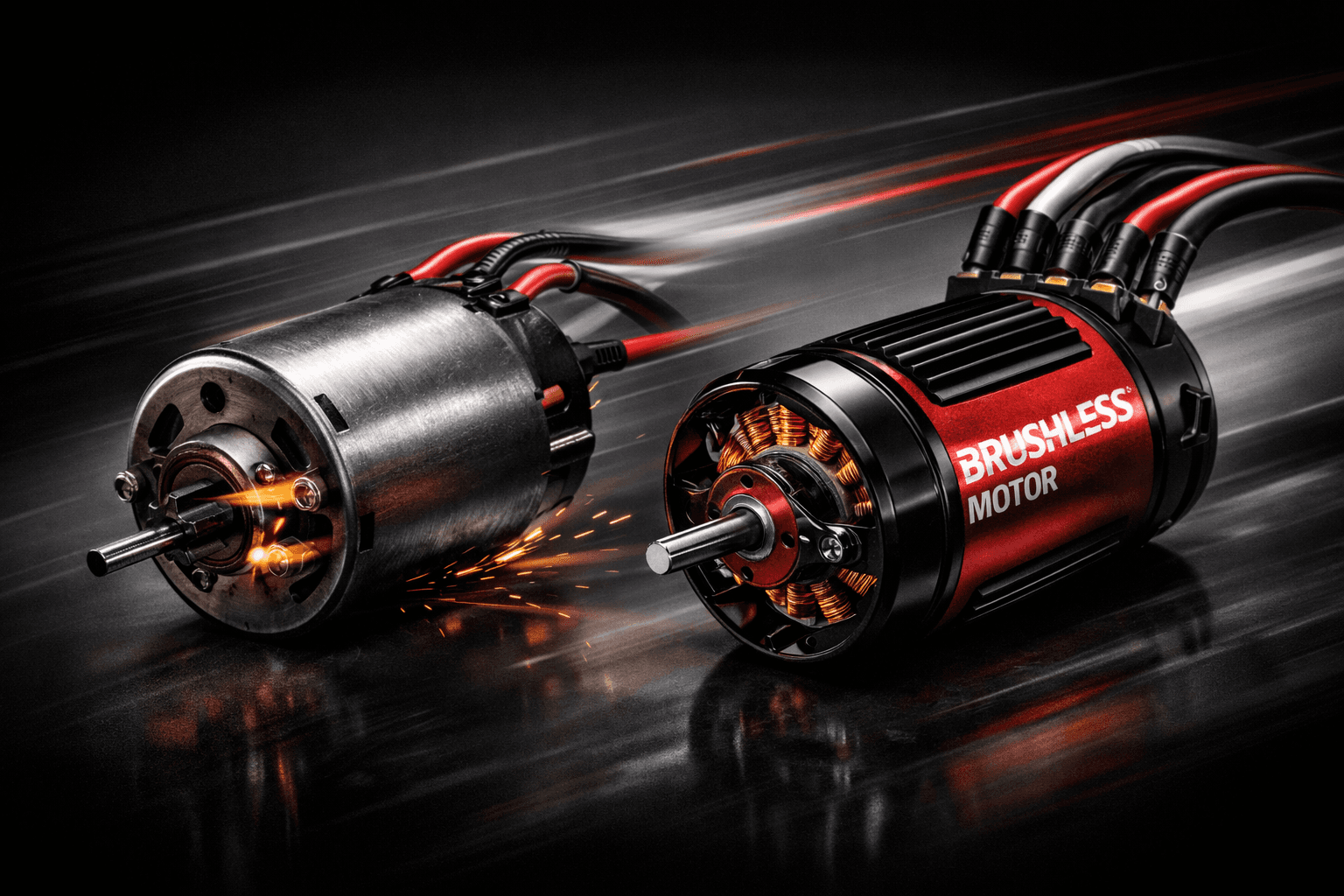
Race-legal batteries vary by class — many spec classes mandate a specific cell count and capacity to keep competition fair. Don't buy a pile of random LiPos; find out what your class requires. You'll want at least two race packs so you can charge one while you run the other. Pair them with a quality balance charger — our charger guide covers the best options at every price point. For motors, understanding the difference between brushed and brushless systems matters for picking the right power setup for your class.
Tires
Tires are arguably the single most impactful setup element in RC racing. The wrong compound on the wrong surface can put you a second a lap off the pace regardless of how well your car is tuned. Ask what compound and insert other frontrunners are running at your track before you buy. Don't assume the tires that came on your RTR are race-ready.
Pit Setup
You don't need much at first. A basic pit stand (keeps your car off the table, protects the antenna and body), a set of hex drivers, a few basic wrenches, thread lock, CA glue, and a handful of the most commonly broken parts for your specific car. Shock shafts, pivot balls, and a spare servo saver cover 80% of race-day repairs.
Mindset
You will be slow at first. This is universal, non-negotiable, and completely fine. Everyone at your track was slow at first. The goal for your first several club nights isn't to win — it's to finish consistently, learn the track, and absorb as much setup knowledge as you can from the people around you. Show up, be friendly, be willing to marshal, and the knowledge will come to you.
Popular Racing Classes & What to Buy
| Class | Scale | Type | Best Car | Price Range | Difficulty |
|---|---|---|---|---|---|
| 2WD SCT (Slash Spec) | 1/10 | Short Course RTR | Traxxas Slash 4x4 / Losi 22S SCT | $220–$430 | Beginner |
| 1/10 2WD Buggy | 1/10 | Off-Road Kit | Associated B7 / TLR 22 5.0 | $300–$350 | Intermediate |
| 1/10 4WD Buggy | 1/10 | Off-Road Kit | TLR 22X-4 / Tekno EB410.2 | $370–$430 | Intermediate |
| 1/8 Electric Buggy | 1/8 | Off-Road Kit | Losi 8IGHT-XE Elite / Tekno EB48 2.1 | $430–$650 | Advanced |
| Sprint Car | 1/10 | Oval RTR | Losi 22S Sprint Car | $240–$290 | Beginner–Intermediate |
| NASCAR Oval | 1/10 | Oval RTR | Losi NASCAR RTR | $220–$280 | Beginner |
| Drag Racing | 1/10 | Drag RTR | Associated DR10 / Losi 22S Drag | $240–$340 | Beginner–Intermediate |
| Touring Car | 1/10 | On-Road Kit | XRAY T4 / X4 / Tamiya TRF | $380–$440 | Advanced |
RC Racing on a Budget — How to Start Cheap
You don't need to spend big to find out whether you love RC car racing. The smartest approach is to start in the cheapest competitive class at your local track, race for a season, and upgrade only once you know exactly what the car needs and exactly what your driving needs.
The Traxxas Slash spec class — where it exists — is one of the cheapest entry points in the hobby. A used Slash in good condition can be had for $150–$200 from a veteran racer who upgraded, and with the right tires and a transponder, you're racing for under $300 all-in. For newer options, the Losi 22S SCT (~$220–$260, Check Price on Amazon offers purpose-built race geometry right out of the box at a similar price point.
Realistically, plan on $300–$500 to be properly race-ready in a spec class — that includes the car, two battery packs, a charger, a transponder, and a starting supply of spare parts. That's comparable to one decent weekend of bashing upgrades, for a season of organized competition. Our beginner's guide covers entry-level car selection if you're starting completely fresh.
The used market is your friend. Competitive racers upgrade constantly — new car versions, new platforms, new classes. That means gently used, well-maintained race cars hit the Facebook groups and local club sales tables every season. A $350 kit car that a seasoned racer has properly broken in and set up is often a better value than a new RTR.
Don't blow your budget on a top-tier kit car and a full pit setup before you've been to your first club night. Watch a race night first. Then show up with the most accessible car for the most popular class. Everything else comes in time.
FAQ
Q: How do I find RC car racing near me?
Start with RCTracks.io or RCSoup.com for a directory of local tracks, then check Facebook groups by searching your city name plus "RC racing." Your local hobby shop is usually the most reliable source — they know which tracks are actually active, which nights to show up, and which class to bring.
Q: How much does it cost to start RC racing?
Budget $300–$500 to be properly race-ready in a beginner-friendly spec class. That covers a car, two LiPo packs, a balance charger, a transponder, and basic spares. Competitive open-class racing costs more — $600–$1,000 or beyond — but you shouldn't be there until you know exactly what you need.
Q: What's the most popular RC racing class?
At the club level in the US, 1/10 2WD short course (Slash-style) and 1/10 2WD buggy are the most universally offered classes. Nearly every club track runs at least one of them. Oval classes — especially NASCAR and Sprint Car — are increasingly popular, particularly in the Midwest and Southeast.
Q: Do I need a special car for RC racing?
It depends entirely on the class. Spec classes often accept any legal RTR, so a stock Traxxas Slash or Losi 22S SCT qualifies as-is. Open classes, like 1/10 or 1/8 buggy, expect purpose-built race kit cars with race-spec electronics. Always confirm with your local track what's legal before you buy.
Q: What is ROAR in RC racing?
ROAR — Remotely Operated Auto Racers — is the official sanctioning body for organized RC racing in the United States. They maintain the rulebook for competitive classes, sanction regional and national championships, and maintain a directory of member tracks. Most serious club racing in the US follows ROAR rules even at non-sanctioned events, so understanding their class structure is useful regardless of where you race.
Conclusion
There's a version of this hobby where you drive alone in a parking lot and never talk to another RC person. That version is fine. But the version where you line up on a starting grid, feel the pressure of qualifying, and then come back week after week to go faster and race cleaner — that version is something else entirely.
Just show up to a club night and watch. Don't even bring a car the first time if you're not sure. Watch how the racing works, talk to people in the pit lane, and I promise you'll be back the next week with a car in hand. The track is where this hobby gets serious, gets social, and gets genuinely rewarding.
Ready to hit the oval? Check out our Losi NASCAR guide for the best entry points into oval racing, or our Losi 22S Sprint Car review if dirt oval is more your speed. For off-road, start with our beginner's guide to RC cars and find your first platform.
See you at the track.