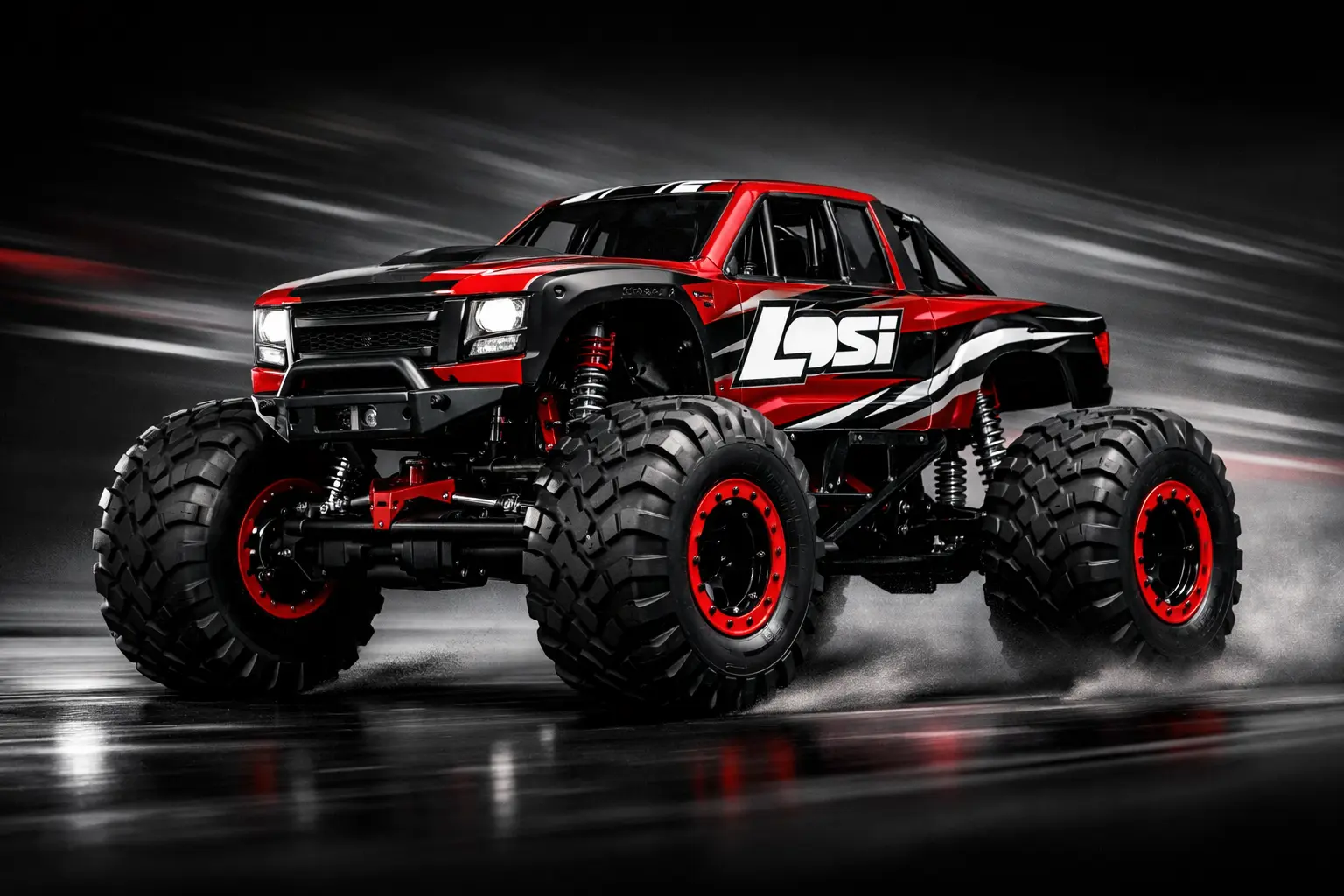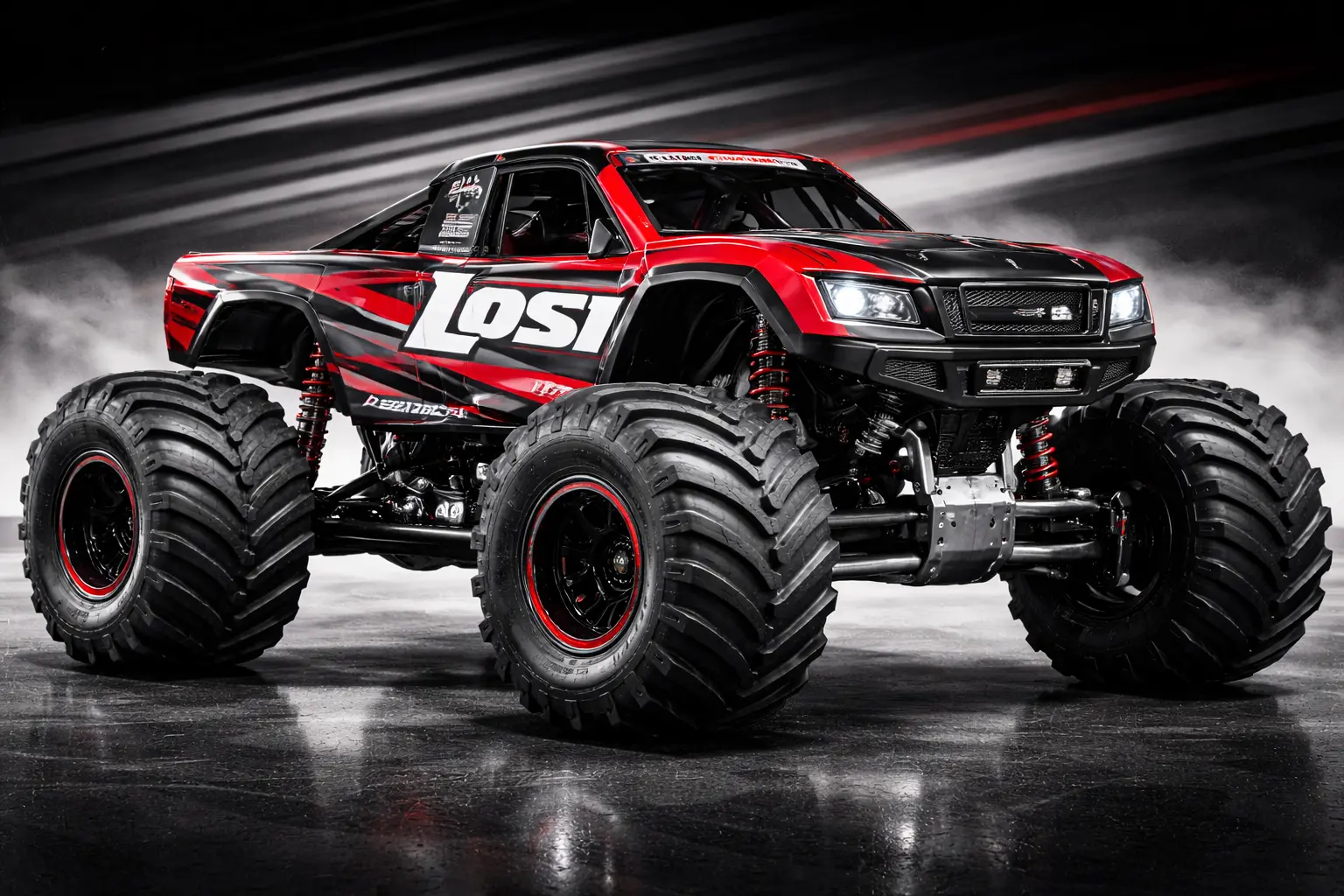
The Losi LMT is the only RC monster truck that actually drives like a real Monster Jam truck — not just one that looks like one. Solid axles, 4-link suspension, licensed Grave Digger and Son-uva Digger bodies, and a price under $750. If you’re in the market for a serious 1/8-scale monster truck or already own one and want to squeeze every ounce of performance out of it, this guide has everything you need.
This post contains affiliate links. If you make a purchase through these links, we may earn a commission at no extra cost to you.
Losi LMT Specs at a Glance
The current model is the LMT 2.0 (LOS04028), released in 2025. Here’s what you get out of the box:
| Spec | LMT V1 (LOS04021) | LMT 2.0 (LOS04028) |
|---|---|---|
| Price | $599.99 (phasing out) | $749.99 |
| Scale | 1/8 drivetrain | 1/8 drivetrain |
| Motor | Firma 3660, 3150Kv BL | Firma 3668, 2800Kv BL |
| ESC | Firma 130A Smart | Firma 130A Smart |
| Servo | Stock ~15kg (brass gears) | Spektrum S680, steel gear, 25T |
| Radio | DX3 + SR315 3ch | DX3 Smart + DRIVE 6ch receiver |
| Battery | 2S–3S LiPo, IC5 | 2S–4S LiPo, IC5 |
| Drive system | 4WD solid axle, 4-link | 4WD solid axle, 4-link |
| Shocks | 4x coil-over, oil-filled | 8x internal spring + reservoir |
| Wheelbase | 13.5” (342.9mm) | Extended (TBC) |
| Weight (no battery) | 10.9 lbs | ~11+ lbs |
| Top speed | 35+ mph (3S) | 45+ mph (4S) |
| Tires | Licensed BKT 2.6”/3.5” | Licensed BKT, wider offset |
| Chassis | 6061-T6 aluminum | Powder-coated 6061-T6 aluminum |
👉 Check current price on Amazon
What Makes the Losi LMT Different
Most “monster trucks” in the RC world are just touring cars or truggy-style platforms with big tires slapped on. They look the part but behave nothing like the real thing. The LMT takes a fundamentally different approach — one that’s rare at any price point outside the Primal RC Raminator (which costs $4,000+).
Solid Axle Design
Every Monster Jam truck in the real world runs solid axles with 4-link suspension, and the LMT replicates this exactly. What does that mean in practice? It means the front and rear axles are rigid beams — no independent suspension, no virtual pivot points. When one wheel hits an obstacle, the whole axle moves with it.
For bashing and jumping, this creates a very specific driving experience. The truck rolls over rough terrain with its weight low and planted rather than bouncing independently. Wheelies are genuinely easy to hold because the rear axle acts as a single pivot point. And when you land a jump, the whole truck absorbs impact evenly rather than each corner flexing independently.
I remember the first time I pitched a V1 LMT into a steep dirt face expecting it to bounce off at an awkward angle — and it just climbed it. The 4-link geometry keeps the tires loaded even when the nose is pointed skyward. That’s physics you can’t get from independent suspension regardless of how much money you spend.
The 4-link also makes the LMT an unexpectedly capable slow-speed crawler. Pop it down to a gentle roll over rocky terrain and it’ll walk over stuff that would high-center a truggy. It’s not a purpose-built crawler, but that capability makes it versatile in ways competitors aren’t.
Licensed Monster Truck Bodies
Both the Grave Digger and Son-uva Digger liveries are officially licensed — meaning the paint schemes, graphics, and proportions are accurate to the real vehicles. For anyone who grew up watching Monster Jam, this matters enormously. The 2.0 adds color-matched powder-coated chassis plates and faux beadlock wheel rings that significantly sharpen the scale appearance.
The 2.0 also introduces Freestyle Mode via the integrated DRIVE gyro receiver — a system that assists with sustained wheelies, stoppies, and two-wheel bicycle maneuvers by automatically adjusting throttle and braking to hold the balance point. It’s a genuine game-changer for anyone who wants to replicate Monster Jam freestyle runs.
If you’re interested in other exciting Losi models beyond the monster truck segment, the Losi NASCAR RC Car and Losi Pro Moto MX show just how wide the brand’s engineering capabilities stretch.
Performance: How Does It Actually Drive?
Short answer: like nothing else at this price. Longer answer: it depends heavily on what you expect from a monster truck.
The Good
The LMT’s weight transfer and throttle response are what make it special. On 3S in the V1 (or 4S in the 2.0), pinning the throttle generates a massive rear squat as the 4-link compresses — the exact body motion you see on full-size Monster Jam trucks leaving the start line. Wheelies don’t require technique so much as willingness; the truck wants to go up. Holding them requires the same kind of delicate trigger work that real monster truck drivers describe.
Jumping is where the LMT separates itself from everything else at similar money. The heavy solid axles create more inertia than independent-suspension trucks, which actually helps in the air — the truck rotates predictably and lands flat. I’ve watched LMT owners send this thing off 3-foot dirt lips and have it track perfectly straight, nose down, shock the landing, and keep rolling. The 8-shock setup on the 2.0 is a particularly meaningful upgrade here; the internal spring design absorbs landing impacts closer to how full-size Monster Jam suspension works.
Durability on sensible terrain is legitimately impressive. Big Squid RC’s monster truck columnist ran 20–30 LMTs through a full competitive race season and called the drivetrain “remarkably durable.” Some hits these trucks absorbed and drove away from unscathed left observers speechless.
The Not-So-Good
The stock servo is the elephant in the room. On the V1 especially, the plastic 23T servo saver and ~15kg stock servo strip quickly under hard use — sometimes within the first few battery packs on 3S. It’s the single most documented failure point in every forum, every review, every Reddit thread about this truck. The 2.0’s Spektrum S680 with steel gears is better, but serious owners still replace it. Budget for a servo upgrade before you drive the truck hard; it’s not optional.
The LMT is also heavy — around 11 lbs without a battery. That weight, combined with a relatively high center of gravity, makes it tippier in fast cornering than a Traxxas Maxx or Arrma Kraton. The BowHouse low-CG battery and electronics trays (discussed below) address this directly.
The stock axle housings — particularly on V1 trucks — crack under hard landings, especially in cold weather. The Gen 2 housings on newer trucks added internal reinforcement and are significantly better, but they’re still plastic. Aluminum housings from Treal are the permanent fix if you’re committed to the platform.
Finally: this is not a beginner truck. At 11 lbs and 45+ mph, the LMT requires genuine driving skill. Someone handing this to a first-time RC driver is setting up both driver and truck for an expensive afternoon.
Best Losi LMT Upgrades
The LMT’s upgrade ecosystem has exploded. Treal, BowHouse RC, JConcepts, Pro-Line, Hot Racing, and Fast Eddy all produce dedicated LMT parts. Here’s the priority order based on community consensus and real-world impact.
For smaller-budget upgrades across the Losi lineup, the Best Losi Micro-B Upgrades guide covers what that same upgrade philosophy looks like at 1/18 scale.
Servo Upgrade — Priority #1
Replace the stock servo before your first hard bashing session. Community-recommended options:
- Spektrum S6250 (~$55–$65): 382 oz-in at 8.4V, 0.11 sec/60°, waterproof, full metal gear, drop-in Spektrum compatibility. Best value for most owners. → Check on Amazon
- Savox SW-1211SG (~$75–$85): 347 oz-in at 7.4V, blazing 0.08 sec response, waterproof, coreless motor. Slightly less torque but faster. → Check on Amazon
- EcoPower WP250T (~$110): 681 oz-in at 7.4V — more than double any stock option. The torque monster choice for maximum-effort bashing builds.
Also grab a Treal aluminum servo saver (~$15–$20 on Amazon). The 25T aluminum unit replaces the plastic 23T stock part and is essential for aftermarket servo compatibility.
Aluminum Links & Steering
The Treal 7075 aluminum steering linkage set (~$25–$35 on Amazon) eliminates the slop and flex in stock plastic links. This is the upgrade that makes the servo upgrade feel complete — better hardware upstream means the servo’s torque actually reaches the wheels. Treal’s full suspension link sets are also available for owners doing a comprehensive aluminum build.
After swapping these in on my own V1 alongside a Spektrum S6250, steering response felt like an entirely different truck. The combination costs roughly $80 total and delivers sharper input response than anything short of a competition servo at $150+.
Tires & Wheels
Stock BKT tires use a hard compound prioritizing longevity over grip. Most owners swap them quickly:
- Pro-Line Demolisher 2.6”/3.5” (~$42/pair): Direct fit on stock wheels, soft M3 compound, aggressive tread. The most popular LMT race tire.
- JConcepts Renegades (
$41/pair): Low-profile racing carcass in multiple compounds. Requires JConcepts Aggressor wheels ($27). Preferred by competitive MT racers.
Bearings
A full sealed bearing replacement prevents the grit and moisture ingestion that wears stock bearings quickly. Fast Eddy Bearings TFE6589 ($36.99) covers every bearing in the truck with chrome steel rubber-sealed replacements. Budget option: DSM Off-Road kit at $18.99. → Search on Amazon
Battery Recommendations
3S (11.1V) at 5000–6800mAh is the sweet spot for V1 owners. For the 2.0, 4S (14.8V) unlocks the full 45+ mph performance the new motor targets. Stick with IC5 or EC5 connectors natively; they’re physically identical.
Top picks: Spektrum Smart 3S 5000mAh ($55–$65) for seamless Smart telemetry integration, or Gens Ace G-Tech 3S 6800mAh ($55–$70) for extended run time. → Browse 3S LiPo options
Make sure your charger can handle multi-cell LiPo packs. The Best RC Car Battery Chargers guide covers what to look for.
Losi LMT vs. the Competition
The LMT has no true direct competitor — its combination of solid axles, licensed bodies, and performance at under $750 is unique. Every alternative requires a meaningful tradeoff:
| Losi LMT 2.0 | Traxxas X-Maxx 8S | Traxxas Maxx | Arrma Kraton 6S V6 | |
|---|---|---|---|---|
| Price | $749.99 | $1,099.95 | ~$549.99 | ~$499.99 |
| Scale | 1/8 | ~1/6 | 1/10 | 1/8 |
| Suspension | Solid axle | Independent | Independent | Independent |
| Top speed | 45+ mph (4S) | 50+ mph | 60+ mph | 65+ mph |
| Weight | ~11 lbs | ~19 lbs | ~10 lbs | ~10.7 lbs |
| Best for | Scale MT, racing | Extreme bashing | All-around | High-speed bashing |
| Licensed body | ✅ Monster Jam | ❌ | ❌ | ❌ |
LMT vs. Traxxas Maxx: The Maxx is smaller, faster, more beginner-friendly, and self-righting — a better first monster truck for someone who wants to bash without much fuss. But it drives like a big RC car, not a monster truck. If the Monster Jam aesthetic and authentic driving dynamics matter to you, it’s not the same product at all.
LMT vs. Arrma Kraton 6S: The Kraton is faster, arguably tougher for extreme “full send” bashing, and $250 cheaper. Same Horizon Hobby ecosystem, same Spektrum electronics. If raw speed and indestructibility trump everything, get the Kraton. If you want scale monster truck behavior, the LMT wins unconditionally.
LMT vs. Traxxas X-Maxx: Completely different price tier and size class. The X-Maxx is an extreme bashing machine at nearly $1,100 — it does what it does better than anything else, but it has zero monster truck realism. You’re comparing a sports car to a pickup truck.
Who Should Buy the Losi LMT?
Perfect for:
- Monster Jam fans who want an RC truck that behaves like the real thing
- Intermediate and experienced RC drivers who can handle a 11-lb, 45+ mph vehicle
- Scale enthusiasts who care about visual accuracy alongside performance
- Owners interested in the growing solid axle monster truck racing scene
- Hobbyists who enjoy upgrading and building — the LMT platform rewards investment
Not ideal for:
- Complete RC beginners (this truck punishes inexperience quickly)
- Owners whose #1 priority is top speed (Kraton 6S or Maxx do that better for less)
- Anyone expecting zero maintenance — budget for the servo and a few supporting upgrades from day one
- Drivers who want self-righting capability (neither LMT version has it)
If you’re somewhere between “curious about the LMT” and “definitely buying one,” the LMT 2.0 is the right call for new buyers. The 4S capability, DRIVE freestyle mode, 8-shock suspension, and improved stock servo justify the $150 premium over the V1. The V1 remains a great truck and a legitimate option if found at a discount, but the 2.0 is where the platform should be for anyone starting fresh.
FAQ
Q: Is the Losi LMT good for beginners?
The LMT is not ideal as a first RC car. At roughly 11 lbs and capable of 45+ mph, it has real consequences for crashes and requires genuine throttle discipline. Most RC veterans recommend something like the Traxxas Rustler 4X4 VXL or Arrma Granite 4X4 as a starting point. If you’re set on the LMT specifically and you’re new to hobby-grade RC, start on 2S until you develop a feel for the truck.
Q: What battery does the Losi LMT use?
The LMT uses LiPo batteries with IC5 connectors (physically identical to EC5). The V1 accepts 2S–3S; the 2.0 accepts 2S–4S. Most owners run 3S 5000–6800mAh packs on the V1. The 2.0 performs best on 4S, which unlocks the 2800Kv motor’s full potential and pushes top speed to 45+ mph.
Q: Is the Losi LMT waterproof?
The electronics — motor, ESC, and receiver — are water-resistant rather than fully waterproof. The Firma 130A ESC is rated for water exposure and the servo on the 2.0 has better weather sealing than the V1’s stock unit. Most owners drive in wet conditions without issue, but submerging the truck isn’t recommended. The differentials and axle housings can trap water if repeatedly driven through deep puddles.
Q: What’s the difference between the Losi LMT and Mini LMT?
The Mini LMT is a 1/18-scale brushed version that includes a 2S LiPo battery and charger in the box at $299.99. It shares the same Monster Jam body aesthetics and 4-link solid axle design but uses a smaller brushed motor, a center spool instead of a center differential, and is significantly lighter and smaller. It’s a genuine entry point into the LMT platform. The full-size LMT is brushless, runs 3S–4S, weighs five times as much, and delivers a completely different performance level.
Q: What’s the best servo upgrade for the Losi LMT?
For most owners, the Spektrum S6250 (~$55–$65) is the ideal upgrade — 382 oz-in of torque, full metal gears, waterproof, and a drop-in fit within the Spektrum ecosystem. Pair it with a Treal aluminum 25T servo saver for ~$15–$20 extra. If you want more torque than the S6250 for heavy-duty bashing, the EcoPower WP250T at ~$110 delivers 681 oz-in and is a direct bolt-on replacement.
Final Verdict
The Losi LMT is the best ready-to-run solid axle RC monster truck ever produced — and the 2.0 is the best version of it yet. The expanded 4S power, DRIVE gyro system, 8-shock suspension, and improved stock servo make a compelling case for the $749.99 price tag. If you want a truck that replicates real Monster Jam behavior at a fraction of the cost of full-size or gas-powered alternatives, nothing else at this price point comes close.
Budget an extra $130–$170 for the priority upgrades (servo, servo saver, shock limit straps, LCG battery tray) and you have a truck that’ll outperform and outlast vehicles costing significantly more. That’s the LMT value proposition, and it holds up.
👉 Check the Losi LMT 2.0 on Amazon — available in Grave Digger (green) and Son-uva Digger (blue).