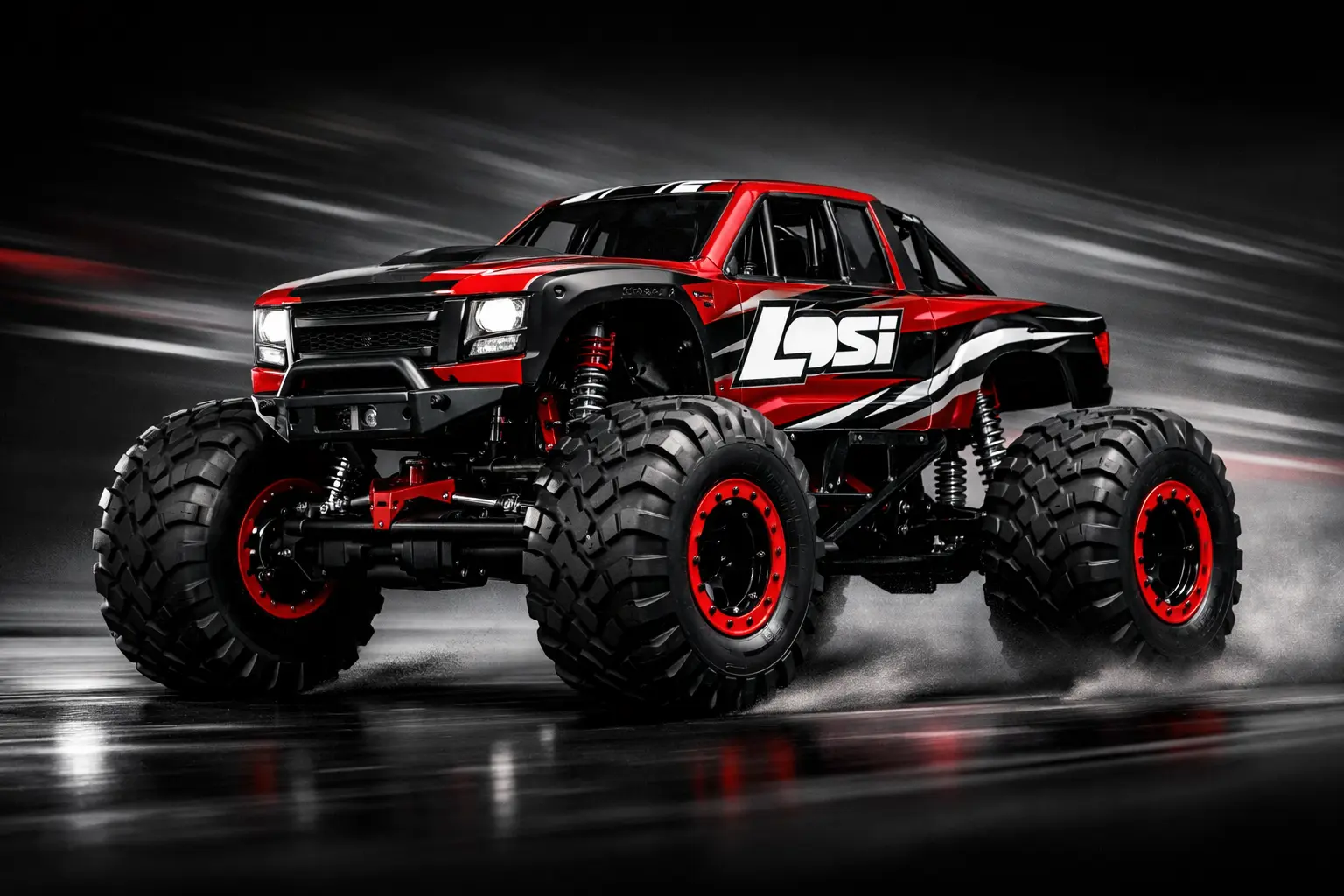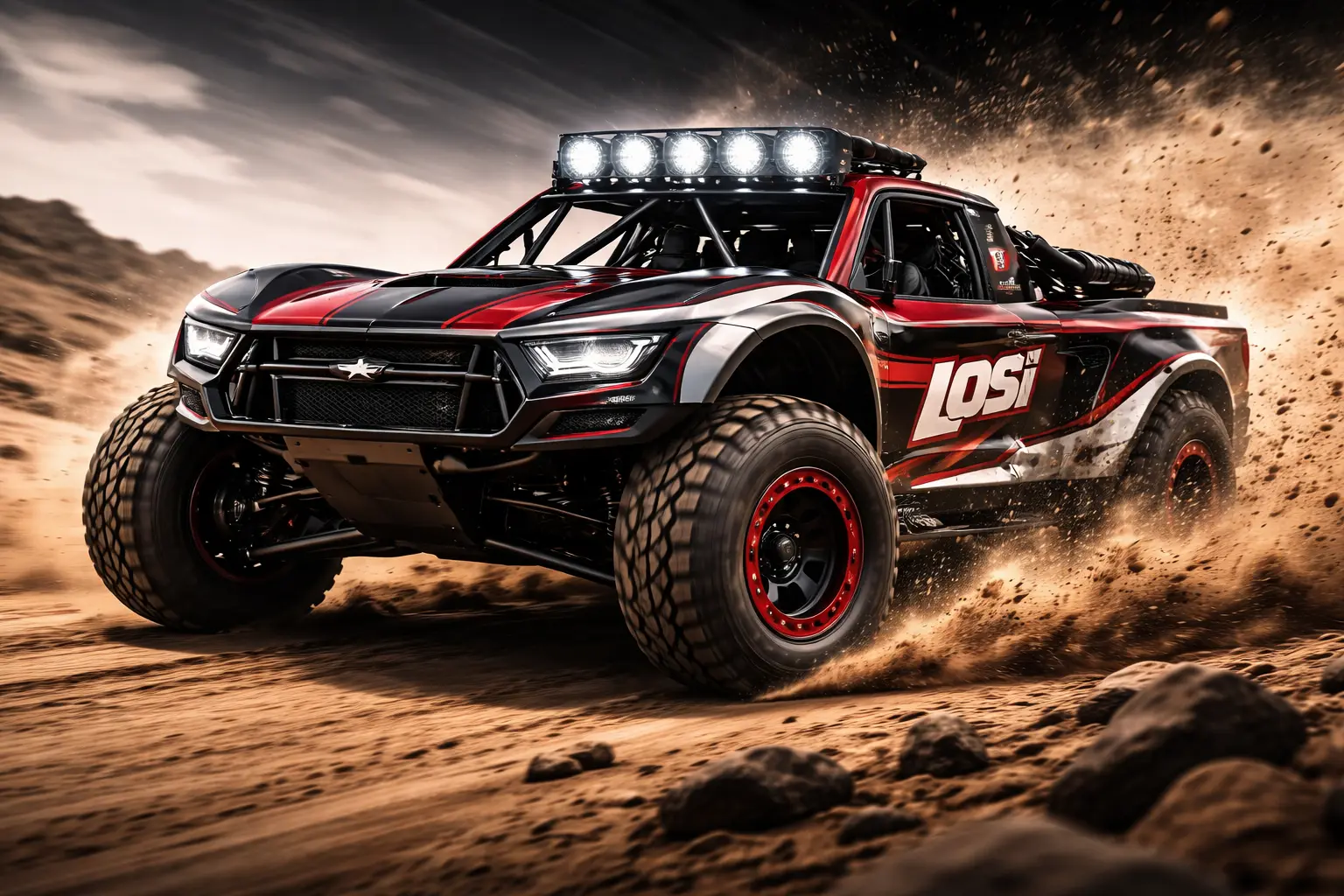
There’s a specific kind of silence that happens when you set a Losi Super Baja Rey 2.0 down in front of people who’ve never seen one up close. They just stare. At 1/6 scale, running on up to 8S LiPo power with licensed King Shocks and BFGoodrich tires, this truck doesn’t look like a toy — it looks like a miniature Baja 1000 build sitting in your garage. Whether it’s worth the premium price tag and the upgrade investment it demands is exactly what this review covers, honestly and in full.
This post contains affiliate links. If you make a purchase through these links, we may earn a commission at no extra cost to you.
Losi Baja Rey 2.0: Specs at a Glance
| Specification | Detail |
|---|---|
| Scale | 1/6 (Super Baja Rey 2.0) / 1/10 (standard Baja Rey 2.0) |
| Length | 35 in (889 mm) — SBR 2.0 |
| Weight | 21.6 lbs without battery — SBR 2.0 |
| Motor | Spektrum Firma 750Kv 4-pole brushless (SBR 2.0) / 3800Kv (1/10) |
| ESC | Spektrum Firma Smart 160A, 8S-rated (SBR 2.0) / 130A sensorless (1/10) |
| Servo | Spektrum S905 HV waterproof (SBR 2.0) / S614S 15kg metal gear (1/10) |
| Suspension | 4-link solid rear axle, independent front |
| Shocks | Licensed King Shocks threaded aluminum (SBR 2.0) |
| Battery | 2× 3S or 4S LiPo IC5 (6S–8S total) — SBR 2.0 / single 3S — 1/10 |
| Radio | Spektrum DX3 with AVC + SR6100AT receiver |
| Top Speed | 50+ mph (8S) |
| Price | ~$869.99 RTR — SBR 2.0 / ~$529.99–$549.99 — 1/10 |
| Where to Buy | Check Price on Amazon |
A quick clarification the internet often glosses over: the “Baja Rey 2.0” line actually covers two distinct products. The flagship is the 1/6-scale Super Baja Rey 2.0 (LOS05021T1 Brenthel / LOS05021T2 King Shocks, ~$870), which is what this review primarily covers. Losi also offers a 1/10-scale Baja Rey 2.0 (LOS03046 Ford Raptor / LOS03049 Ford F-100, ~$530–$550) — a solid truck in its own right, but a different machine entirely. Neither version offers a BND option; both are RTR only.
What’s New in the Baja Rey 2.0
The 2.0 is a genuine platform overhaul, not a sticker refresh. Losi rebuilt the Super Baja Rey on the Super Rock Rey chassis with roughly an inch of added wheelbase courtesy of longer rear trailing arms. That extra length dramatically improves high-speed stability — one of the most consistent complaints about the 1.0 at full throttle.
The battery tray moved from rear-loading to bottom-loading, which sounds minor until you’ve fought to remove a 1.0’s battery pack in the field. The front suspension arms were redesigned with a slider-style geometry for more travel, and the rear diff gained a proper skid plate mounting provision that was conspicuously missing on the original.
Electronics jumped an entire generation. The old Dynamite Fuze motor and ESC are gone, replaced by the Spektrum Firma Smart ecosystem — 160A ESC, 750Kv motor, and a DX3 transmitter with Smart telemetry. Official 8S support (versus the 1.0’s 6S rating) unlocks noticeably more top-end punch. On the 1/10 side, the main improvement is the stronger S614S servo, directly addressing the 1.0’s most frequent failure mode, and redesigned upper front arms with secondary dampening shocks for better front suspension compliance.
Visually, the 2.0 lineup gains full licensed partnerships: Method Racing beadlock wheels, BFGoodrich KM3 mud-terrain tires, and — on the SBR 2.0 — King Shocks licensed coil-overs and the choice between the Brenthel Industries trophy truck body or King Shocks livery. The 1/10 version adds the retro Ford F-100 Isenhouer Brothers Racing body as a second option alongside the Ford Raptor R.
Design & Build Quality
Opening the box on a Super Baja Rey 2.0 for the first time is one of those moments in the RC hobby you don’t forget. I’d been building and running trucks for years before getting my hands on one, and I still did a full double-take at the sheer mass of the thing. This isn’t a truck you casually toss in a backpack — it’s a two-handed carry that draws stares at the park.
Scale Realism
The SBR 2.0’s scale game is legitimately elite. The composite roll cage houses a fully painted driver and co-driver with helmets. Front and rear LED light bars are functional and integrated cleanly — not afterthought zip-tied stick-ons. Dual functional spare tires ride on the rear carrier, and the method beadlock wheels actually have scale-correct hex-lug styling rather than generic dish centers. Standing next to a full-size Baja trophy truck photo, the proportions hold up surprisingly well.
The 1/10 version is notably cleaner in body detail than its 1.0 predecessor — the Ford Raptor R body fits tighter, the graphics are factory-applied, and the licensed Method wheels scale much better than the old generic wheels. It still doesn’t have the presence of the 1/6, but it’s a genuinely handsome truck.
Chassis & Suspension
The 4mm 6061-T6 aluminum main chassis on the SBR 2.0 is stiff and flat — a necessity for a truck that weighs close to 22 lbs loaded. The 4-link solid rear axle with coil-overs is what makes this truck drive differently from every IFS competitor in the segment. It creates real weight transfer, real rear-end rotation under throttle, and real suspension squat on acceleration — the dynamics of an actual trophy truck. Front suspension travel is generous, and the slider-style front axle geometry of the 2.0 revision extends it further than the original.
The 1/10’s chassis is 3mm aluminum with a 2.5mm upper deck, appropriately scaled for the lighter application. The addition of secondary dampening shocks on the front upper arms — borrowed from the SBR 2.0 revision — is a meaningful detail that improves bump compliance on rough surfaces.
One valid complaint on both versions: the body requires approximately 16 screws to remove fully. This is a maintenance tax you’ll pay every time you need to access the ESC or swap a battery. Plan accordingly.
Real-World Performance
On Dirt & Sand
This is where the Baja Rey 2.0 earns its reputation. Running on loose dirt and sand, the solid rear axle creates traction and weight-transfer behavior that no IFS truck can replicate. The King coil-overs absorb whoops and ruts that send smaller trucks airborne. Owners across forum threads consistently describe the SBR 2.0 as a truck that “eats terrain that sends other cars into chaos.” I’ve run it through chunky gravel, packed desert hardpan, and loose sand — and on 6S it’s genuinely fluid in a way that feels closer to driving a real truck than anything else in the segment.
Jumping & Air Control
The honest truth: the Baja Rey 2.0 is a competent jumper, not a spectacular one. The solid rear axle produces a slight nose-down pitch in the air that you have to manage with throttle. It lands well on moderate lips and natural terrain features, but it’s not a truck you want to send off purpose-built tabletops repeatedly. The most common repair story in the community starts with a nose-down landing — the front bumper support is the SBR 2.0’s most breakable part, and it was backordered for months at Horizon Hobby. Think of this as a fast scale truck that happens to be capable over obstacles, not a dedicated air machine.
Speed & Handling
On 6S, the SBR 2.0 delivers strong, controllable power — fast enough to be genuinely exciting, manageable enough to drive precisely. On 8S, it’s properly fast with a measured top speed around 53 mph. The heavy nose keeps it planted through corners, but the rear will step out under aggressive throttle — which actually feels great for long sweeping turns, less great on tight courses. Rollover tendency on high-grip surfaces is real. The single most impactful cheap fix: fill the rear differential with 500K–1M CST silicone diff fluid. It dramatically reduces barrel-rolling and transforms the handling character from “nervous” to “predictable.”
The AVC traction control system, accessible through the DX3, is nearly essential on 8S with the stock hard tires. Most experienced owners run mid-to-high AVC settings until they’ve dialed in the diff fluid and potentially added softer tires.
Durability: What Breaks First?
Community reports from RC forums and AMain reviews are consistent on the failure hierarchy:
- Front bumper/support — the single most-reported part, snapping on nose-down landings. A skid plate is essential before the first run.
- Rear cage flex — the cantilevered spare tires create significant flex behind the cab. A rear chassis brace is near-universal as a day-one mod.
- Rear differential and axle area — hard landings stress the solid rear axle assembly. Aluminum skid plate protection is strongly recommended.
- Plastic spur gear — fails suddenly under high-load situations, particularly on 8S.
- Stock shock fill level — many trucks arrive under-filled from the factory. Re-bleeding and setting oil weight (40wt front, 35wt rear) before the first run prevents early failure.
The honest assessment: the SBR 2.0 leaves the factory roughly 80% finished. The upgrade list below represents the remaining 20% — and it pays for itself in avoided repair bills.
Best Losi Baja Rey 2.0 Upgrades
Servo Upgrade (Priority #1)
The stock Spektrum S905 servo operates well for casual use but is undersized for a 22-lb truck driven hard. On the SBR 2.0, the Savox SV-0235MG (486 oz-in, $85–$93) is the community consensus pick. It requires minor trimming of the servo mount housing but fits cleanly with the Hot Racing LSBR2401 aluminum mount ($40). On the 1/10 version, the Savox SW-1211SG Black Edition ($75–$85, waterproof) or ProTek RC 170SBL ($159, brushless) are the go-to choices. Either way: upgrade the servo before the first serious run, and pair it with an aluminum steering bellcrank to eliminate plastic slop.
Shock Upgrades
Stock King Shocks on the SBR 2.0 work adequately but arrive under-filled — bleed and re-fill them before running. Aftermarket options from GPM (aluminum bodies, ~$50–$65/pair front, ~$55–$75/pair rear) improve consistency and serviceability. For the 1/10, RPM’s front bumper and skid plate (RPM73172, ~$18) is the most recommended first upgrade — cheap, durable, and prevents the single most common break on that model.
Tires & Wheels
Stock BFGoodrich KM3s are visually correct and adequate on moderate terrain, but sidewalls can blow under aggressive bashing. ARRMA Backflip LP tires (~$30–$40/pair) are a popular aftermarket swap with better durability, though they require 17mm hub adapters.
Chassis Protection (Skid Plates)
A front skid plate ($20–$40) is not optional — it’s the single most important protective upgrade on the SBR 2.0. Scorched Parts offers a titanium front skid + rear chassis brace combo ($40–$65) with an “unbreakable” guarantee. Skookum RC’s 3mm stainless version is a solid alternative at ~$30–$40.
Battery Recommendations
The SBR 2.0 needs two 3S or 4S LiPo packs with IC5 connectors. For 6S running (the sweet spot for most drivers), two 3S 5000mAh packs (~$40–$50 each) are ideal. For 8S, two matched 4S 5000mAh packs provide enough capacity for a satisfying run. Whatever you choose, pair them with a quality dual charger — check out our best RC car battery chargers guide to find the right setup. Expect to add $80–$160 in battery costs to your budget before the truck moves.
A full bearing kit (~$20–$30 from Fast Eddy) rounds out the day-one upgrade list — sealed bearings replace the stock metal-shielded units and immediately improve drivetrain smoothness in dirty conditions.
Losi Baja Rey 2.0 vs Traxxas UDR vs Arrma Mojave 6S
| Feature | Losi SBR 2.0 (1/6) | Traxxas UDR (1/7) | Arrma Mojave 6S (1/7) |
|---|---|---|---|
| Price | ~$870 | ~$700–$800 | ~$630–$670 |
| Scale | 1/6 | 1/7 | 1/7 |
| Motor | 750Kv 8S brushless | 2200Kv 6S brushless | 2050Kv 6S brushless |
| Suspension | 4-link solid rear / IFS front | 4-link solid rear / IFS front | Full IRS + IFS |
| Top Speed | 50+ mph (8S) | 50+ mph (6S) | 60+ mph (6S) |
| Weight | 21.6 lbs | 13.4 lbs | 11.9 lbs |
| Scale Realism | ★★★★☆ | ★★★★★ | ★★☆☆☆ |
| Bash Durability | ★★★☆☆ | ★★★☆☆ | ★★★★★ |
| Best For | Scale desert driving, open terrain runs | Ultimate visual realism, Traxxas ecosystem | Pure bashing, jumping, speed |
The Traxxas UDR is the SBR 2.0’s closest philosophical rival — same solid-rear-axle desert truck concept, similar handling DNA, and arguably the best-looking RC truck ever made with its 204-LED light array. It’s lighter, slightly cheaper, and backed by Traxxas’s industry-leading parts network. The SBR 2.0 counters with larger physical scale, significantly more power on 8S, and a more modern electronics package. If you’re already in the Traxxas ecosystem and parts availability is a priority, the UDR is the safer choice — and our Traxxas UDR upgrades guide shows exactly how to get the most from it. If you want maximum physical presence and 8S capability, the SBR 2.0 wins.
The Arrma Mojave 6S is the segment’s best pure performance value. Fully independent suspension, 60+ mph capability, pop-off body clips, and a 2-year warranty make it the obvious choice for drivers who prioritize bashing, jumping, and durability over scale authenticity. It simply looks and drives nothing like a real trophy truck — and for many drivers, that’s a perfectly fine trade. If you’re the type who sends it off every available jump, the Mojave will outlast and outperform the SBR 2.0 in that context every time.
The choice between them comes down to what you want from the hobby: scale experience or raw performance.
Who Should Buy the Losi Baja Rey 2.0?
Buy the SBR 2.0 if you:
- Are specifically passionate about scale desert truck aesthetics and driving dynamics
- Have open terrain — dirt trails, dry lake beds, desert washes — where you can actually use the suspension travel and speed
- Are comfortable with an upgrade investment of ~$150–$200 to get the truck fully dialed
- Already understand the Losi platform and Spektrum Smart ecosystem
Consider the 1/10 Baja Rey 2.0 if you:
- Want the same Baja Rey driving character in a smaller, lighter package at roughly $330 less
- Are constrained on space or transport (the 1/10 fits in a standard backpack)
- Primarily run on 3S power
Look elsewhere if you:
- Are a beginner who wants their first RC truck — the $870 entry price plus required upgrades is a brutal learning curve
- Prioritize jumping and bashing over scale driving
- Need the lowest possible maintenance commitment
If you’re already a Losi fan who’s enjoyed the Losi LMT monster truck or the brand’s larger-scale builds, the SBR 2.0 fits naturally into that philosophy — meticulous scale detail and genuine performance, with the expectation that you’ll know how to wrench on it. Similarly, Losi’s innovation-forward approach carries over from models like the Losi Pro-Moto MX — the brand consistently builds machines that push what’s possible at a given scale.
FAQ
Q: Is the Losi Baja Rey 2.0 good for beginners?
Not really. The Super Baja Rey 2.0 runs on up to 8S LiPo power and weighs nearly 22 lbs — it demands some prior experience to drive safely and maintain properly. The required upgrade investment ($150–$200 before it’s truly dialed) and the need to manage 6S–8S LiPo batteries add additional complexity. The 1/10 Baja Rey 2.0 is more approachable on 3S power, but even that model benefits from experience with brushless systems.
Q: What battery does the Losi Baja Rey 2.0 use?
The 1/6 Super Baja Rey 2.0 uses two LiPo packs with IC5 connectors — either two 3S packs for 6S operation or two 4S packs for the full 8S experience. 5000mAh capacity is the standard recommendation for a satisfying runtime. The 1/10 version runs a single 2S or 3S LiPo with an IC5 connector.
Q: How fast is the Losi Baja Rey 2.0?
The 1/6 Super Baja Rey 2.0 reaches approximately 50–53 mph on 8S power. On 6S — which most experienced owners prefer for the better balance of speed and control — expect speeds in the 35–45 mph range depending on terrain and gearing. The 1/10 version also reaches 50+ mph on 3S with its higher-KV motor.
Q: What’s the difference between the Losi Baja Rey 1.0 and 2.0?
The 2.0 is a substantial upgrade across the board: longer wheelbase via revised rear trailing arms, bottom-loading battery tray for easier access, Spektrum Firma Smart electronics replacing the old Dynamite Fuze system, official 8S support, licensed King Shocks and BFGoodrich/Method partnerships, and a redesigned front suspension geometry with greater travel. The 1.0 is discontinued; the 2.0 fixes its most significant structural and electrical weaknesses.
Q: Losi Baja Rey vs Traxxas UDR: which is better?
It genuinely depends on your priorities. The Traxxas UDR edges ahead on scale visual realism (especially the 204-LED lighting system) and parts availability through Traxxas’s dealer network. The Losi SBR 2.0 counters with larger 1/6 scale presence, more raw power on 8S, and a more modern electronics package. Forum veterans who’ve owned both often give the edge to the SBR 2.0 for driving feel; UDR fans counter with easier maintenance and a locked spool that creates more predictable rear behavior. Both are excellent — your existing brand ecosystem and local parts availability should factor heavily into the decision.
Final Verdict
The Losi Super Baja Rey 2.0 is the best-driving scale desert truck under $900, full stop. The 2.0 revision addressed the original’s real weaknesses — chassis rigidity, electronics quality, battery access, 8S capability — and the result is a machine that delivers a genuinely authentic trophy truck experience in a radio-controlled package. When it’s dialed in with a servo upgrade, chassis protection, bearing kit, and diff fluid tuning, it’s a remarkable thing to drive across open terrain.
The honest buyer calculus: sticker price ($870) plus two LiPo packs ($80–$160) plus essential upgrades ($150–$200) puts your true cost of entry over $1,100. That’s a premium ask, and it requires clear-eyed intent. If you want scale desert truck fidelity and are prepared to invest properly, the SBR 2.0 delivers experiences that the Mojave 6S or UDR simply can’t replicate. If you primarily want a tough, fast basher, the Mojave 6S will make you happier at $250 less.
For the right driver, this truck is one of the most rewarding machines in RC. For the wrong one, it’s an expensive maintenance project.