"Should I get brushed or brushless?" is the first question every new RC hobbyist asks. The short answer: brushless is better in almost every way. The real answer: it depends on what you're doing and how much you want to spend. This guide breaks down how each system works, where each one shines, and exactly what to buy for your situation.
This post contains affiliate links. If you make a purchase through these links, we may earn a commission at no extra cost to you.
Brushed vs Brushless at a Glance
| Feature | Brushed | Brushless |
|---|---|---|
| Speed | Moderate (15–30 mph typical) | Fast to very fast (30–70+ mph) |
| Efficiency | ~75–80% | ~85–95% |
| Maintenance | Brushes wear out, need replacement | Virtually maintenance-free |
| Lifespan | 500–1,000+ hours (with brush replacement) | Thousands of hours |
| Cost | $15–$40 (motor) | $40–$150+ (motor) |
| Heat | Runs hotter | Runs cooler |
| Throttle Control | Good at low speed | Excellent (sensored) to good (sensorless) |
| Weight | Slightly heavier | Lighter |
| Sound | Classic whine | Higher-pitched whir |
| Best For | Beginners, crawlers, budget builds | Performance, racing, bashing |
How Brushed Motors Work
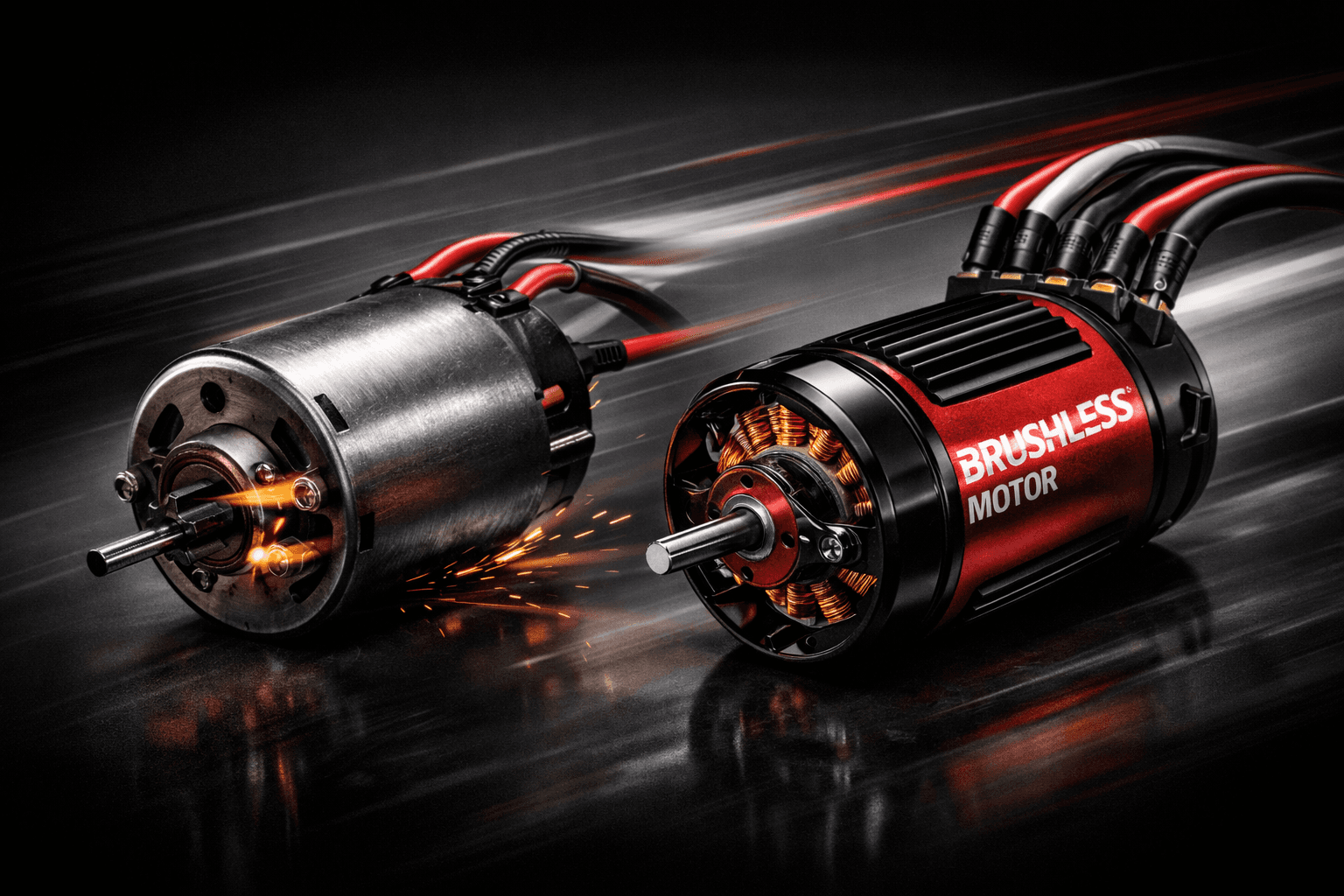
A brushed motor has three main components: a spinning armature (the rotating part wound with copper wire), a pair of fixed permanent magnets inside the can, and two carbon brushes that press against a segmented copper cylinder called the commutator. When current flows through the brushes into the commutator, it energizes the armature windings, which react against the fixed magnets and spin. As the armature rotates, the commutator segments switch the direction of current automatically — that switching is what keeps the motor turning.
The brushes physically touch the spinning commutator the entire time the motor runs. That friction is what limits brushed motors: brushes erode, the commutator surface gets scored and blackened, and performance gradually declines. With a high-turn crawler motor running slow and cool, you might go a whole season without touching it. With an aggressive 12-turn bashing motor, brushes can wear down in a single hard session.
Turns rating is the key spec on a brushed motor. It tells you how many times the copper wire wraps around each armature pole. Fewer turns means thicker wire, lower resistance, more current flow, and higher RPM — but also more heat. More turns means thinner wire, higher resistance, lower RPM, and more torque. In practical terms:
- 12T — stock Traxxas Slash territory, high speed, aggressive heat buildup
- 27T — balanced all-around, traditional stock racing class
- 35T–45T — crawling and trail driving, smooth and torquey
- 55T+ — ultra-slow precision crawling
The Traxxas Titan 12T 550 is the benchmark here — it ships in millions of RTR trucks, produces roughly 22,500 RPM max, and costs around $26. Check Price on Amazon
The 540 size (36mm diameter, ~50mm long) is the standard for 1/10 scale. The 550 uses the same diameter but a longer can, giving it roughly 30% more torque — that's why Traxxas uses it in their trucks. Brushed motors are simple, cheap, proven, and completely rebuildable (open-endbell designs, anyway). They're not inferior by nature — they're just a different tool.
How Brushless Motors Work
A brushless motor flips the traditional layout: the permanent magnets are on the spinning rotor, and the copper windings are stationary on the stator. There are no brushes and no commutator. Instead, the ESC (Electronic Speed Controller) fires the stator windings in sequence electronically, which makes the rotor chase the rotating magnetic field and spin.
Because nothing touches nothing, a brushless motor has essentially zero wear. There's no friction loss from brush contact, no electrical arcing on a commutator, and no carbon dust building up inside. The efficiency gains are real — brushless motors convert roughly 85–95% of electrical energy into mechanical energy versus 75–80% for brushed. That translates to more speed, more run time per charge, and less heat for the same battery.
KV rating is the primary brushless spec. KV means RPM per volt of input — a 3,300KV motor on a fully charged 2S LiPo (8.4V) spins at roughly 27,700 RPM unloaded. Higher KV = faster, lower KV = more torque:
- 1,200–2,500KV — crawlers and high-torque trail builds
- 3,000–4,500KV — bashing, SCT racing, general 1/10 use
- 5,000KV+ — speed runs and lightweight platforms
Brushless motors also use a turns rating in competition contexts — 10.5T is fast, 21.5T is moderate, 30.5T+ is torque-oriented — but this refers to the motor's stator winding count, not armature brushes.
The ESC does far more work in a brushless system than in a brushed one. It's not just a throttle — it's actively controlling the timing and sequence of every power pulse. That's why the motor and ESC need to be matched. If you're upgrading, buy a combo or verify compatibility before purchasing separately. Check out our beginner's guide if you're still deciding between an RTR brushed or brushless model.
Sensored vs Sensorless Brushless Motors
This is where things get nuanced, and it matters more than most beginners realize.
Sensorless brushless motors have no position sensors. The ESC determines where the rotor is by reading back-EMF — the voltage naturally generated in the idle windings as the motor spins. This works very well at mid-to-high RPM. The problem is at slow speeds, where back-EMF is too weak to read reliably. The result is cogging: a stuttery, jerky throttle response when you're barely creeping. For bashing at full throttle, you'll never notice. For crawling over rocks at 1 mph, it's infuriating.
Sensored brushless motors add three Hall-effect sensors mounted 120° apart inside the stator. These report the exact rotor position to the ESC at every moment, including at a complete standstill. From the first fraction of a millimeter of throttle, the ESC knows exactly where the rotor is and fires the correct winding. The result is perfectly smooth, linear throttle at any speed — the same feel crawling over a rock face as blasting down a straight.
I upgraded my Axial SCX10 to a sensored system a few years ago, and the difference at low speed is dramatic. The sensorless motor I had before would hunt and surge trying to maintain position on steep inclines. With a sensored setup, you can hold throttle barely above zero and the motor just holds — no hunting, no cogging. For drift, the difference is equally obvious: sensored brushless lets you initiate slides with precision that a sensorless motor simply can't match (check our drift guide for more on that). At full throttle, you'd never tell the difference between sensored and sensorless. At low speed, they're completely different machines.
When to choose sensorless: bashing, casual driving, budget builds, anything where low-speed finesse doesn't matter.
When to choose sensored: racing (mandatory in most organized classes), crawling, drift, anything requiring precise throttle control at low or variable speeds.
When Brushed Makes More Sense
Don't let anyone tell you brushed is "bad." For some applications, it's genuinely the smarter choice.
Crawling is the biggest one. A quality brushed 35T or 45T motor gives butter-smooth throttle at 1 mph with none of the cogging you get from sensorless brushless. Many competitive crawlers still run high-turn brushed setups specifically for the linear, predictable throttle response. For serious rock crawling setups, check our crawlers guide — but know that a good brushed motor in the right turn count can stay competitive. The Holmes Hobbies Puller Pro V2 ($55–$65) takes this further with a waterproof sensored brushless design purpose-built for crawling — smooth as any brushed motor but without brush wear. Available at AMain Hobbies. For a dedicated deep dive into brushless motor options, KV ratings, and setup tips specifically for rock crawling, our RC crawler brushless motor guide covers the full picture.
Budget builds. If you're spending $100–$200 total on your RC, saving $50–$100 by going brushed is money better spent on a better battery, better tires, or a transmitter upgrade. The driving experience on a brushed 1/10 truck is still a lot of fun. I ran a brushed 540 Titan in my Traxxas Slash for almost a year before upgrading to a brushless system, and I had a blast the entire time. The speed difference when I finally switched was dramatic — but the brushed truck was genuinely enjoyable.
First RC car. Brushless transforms a car into something significantly faster and more powerful. For a total beginner, that power can be overwhelming. Brushed gives you room to learn throttle control, steering technique, and recovery without eating props off every obstacle. You'll crash less and actually learn more.
Simplicity. No ESC programming, no timing adjustments, no sensor cables to route. Plug in and drive. For a kid's truck or a casual driver, that simplicity has real value.
When Brushless Is Worth the Upgrade
For most hobbyists buying a $300+ car, brushless is the right call. Here's why.
Bashing is where brushless earns its reputation. More speed, more torque on demand, more explosive acceleration — everything that makes bashing exciting is amplified. A mid-range brushless system transforms a stock brushed basher. Our bashers guide covers the top picks, and nearly all of them are brushless for good reason.
Racing makes brushless mandatory. Virtually every organized competitive class at club and national levels requires brushless motors. The consistency, efficiency, and response characteristics of brushless simply can't be replicated with brushed. If you ever want to race, buy brushless from the start.
Longevity and total cost. A brushless motor outlasts multiple sets of brushed motors. After the upfront investment, you essentially never pay for drivetrain wear. Better efficiency from the same battery pack also means more run time per charge — check our charger guide to get the most out of whatever pack you're running.
Resale value. Brushless cars hold their value better in the used market. When the time comes to upgrade, you'll recover more of your investment.
How to Upgrade from Brushed to Brushless
What You Need
A brushless motor and a brushless ESC — they're a matched electrical system and must be purchased together or carefully paired. An old brushed ESC cannot run a brushless motor. Most hobbyists buy a combo (motor + ESC packaged together), which guarantees compatibility and usually saves money versus buying separately.
Popular Upgrade Combos
Budget: Hobbywing Quicrun WP 10BL60 G2 Combo (~$79.99)
The best value in name-brand brushless. The ESC is waterproof (IP67), supports 2–3S LiPo, and outputs 60A continuous. The combo includes a 3652 motor in 3,250KV, 4,000KV, or 5,400KV options. Drops directly into any standard 1/10 540-mount chassis. A dramatic upgrade from any brushed setup at a realistic price.
Check Price on Amazon
Mid-Range: Castle Creations Sidewinder 4 Combo (~$130–$170)
USA-designed and assembled, waterproof, deeply programmable via Castle Link. Available with a 1406-4600KV (basher), 1410-3800KV (SCT), or 1415-2400KV (monster truck) motor. Handles aggressive 3S bashing without breaking a sweat. The Castle ecosystem — especially Castle Link Bluetooth programming — is genuinely excellent.
Check Price on Amazon
Premium: Hobbywing XR10 Pro G3 Combo (~$290)
Competition-grade electronics with a 32-bit processor, 160A continuous current, built-in data logging, and triple racing profiles. ROAR, IFMAR, and EFRA approved. Paired with the Xerun V10 G3 motor in 10.5T or 17.5T turns. If you're racing at a serious level, this is the benchmark system.
Check Price and Stock on Amazon
What Else to Check
Before you swap in a brushless combo, look at three things. First, your spur gear: brushless motors produce significantly more torque, and plastic spur gears often can't handle it. A metal spur gear is a $10–$15 investment that saves you from stripping it on the first run. I learned this the hard way — first time I upgraded a car to brushless, I forgot to swap the spur gear. The motor had so much torque it stripped the plastic one in about 30 seconds. Lesson learned: check the spur first.
Second, check your battery connectors: brushless systems often use different connector types (Deans, EC3, XT60) than stock brushed setups. A mismatched connector is an easy fix but annoying if you don't notice before your first run.
Third, consider your pinion gear ratio: a higher-KV brushless motor may need a smaller pinion to avoid overheating. The motor's instructions or the manufacturer's gearing chart will tell you the recommended ratio.
Is It Worth Upgrading or Better to Buy Brushless Outright?
For popular platforms like the Traxxas Slash, the brushless (VXL) version is often only $50–$100 more than the brushed (XL-5) version at retail. Given that the VXL includes a higher-spec chassis, Velineon motor and ESC, and NiMH-to-LiPo-capable electronics, buying the brushless version outright is often cheaper and simpler than upgrading a brushed car. Check if a brushless version of your car exists before budgeting for a mid-car upgrade.
Motor Sizing Explained (540, 550, 380)
Motor sizes are named for their approximate can dimensions and matter when buying replacements or planning upgrades. The 540 (36mm diameter, ~50mm long) is the universal standard for 1/10 scale — touring cars, buggies, most crawlers, and all competitive classes use this size. The 550 shares the same diameter but runs 55–90mm long, giving more torque from the longer armature — it's used in Traxxas trucks, Arrma bashers, and heavier off-road platforms.
The 380 is smaller (~28mm diameter, ~38mm long) and appears in 1/16 and 1/18 scale vehicles. Understanding RC car scale sizes helps here — a 1/18 scale truck with a 380-size motor has completely different upgrade paths than a 1/10 with a 540.
For brushless, sizes are expressed as diameter × length in millimeters: 3650 (36mm × 50mm) is the brushless equivalent of the 540, 3652 is slightly longer, and 4268 covers larger 1/8 scale applications. Always verify the motor size, shaft diameter (3.175mm vs 5mm), and mounting hole pattern before purchasing a replacement or upgrade.
FAQ
Q: Is brushless worth the extra money?
For bashing and racing, yes — the performance difference is substantial, and brushless motors outlast several sets of brushed motors, so the upfront cost pays for itself. For dedicated crawling or a strict budget build under $200, a quality high-turn brushed motor is still a competitive, practical choice. The gap is less about value and more about application.
Q: How long do brushed RC motors last?
With proper maintenance, 500–1,000+ hours of runtime is realistic for most 540-size brushed motors. The brushes themselves typically need replacement every 20–100 hours depending on turn count and driving intensity — a 12T motor bashing on 2S wears them fast, while a 55T crawler motor might last a full season. The motor body rarely fails; it's the brushes that wear down, and they're cheap to replace in any open-endbell motor.
Q: Can I put a brushless motor in any RC car?
Technically yes — if the motor physically fits the mount and shaft size matches your pinion gear, you can install a brushless motor. But you also need a compatible brushless ESC, a metal spur gear to handle the extra torque, and possibly updated battery connectors. Your existing brushed ESC will not work with a brushless motor. Always upgrade motor and ESC together.
Q: What does "turns" mean on an RC motor?
The number of times copper wire wraps around each armature pole. Fewer turns means a faster, higher-revving motor with less torque. More turns means a slower, more torquey motor that runs cooler. A 10.5T brushless motor is aggressive and fast; a 45T brushed motor is slow and powerful enough to pull your RC up nearly vertical terrain. The same logic applies in both brushed and brushless motors, though the KV rating is more commonly used for brushless.
Q: What's the difference between sensored and sensorless brushless?
Sensored motors contain Hall-effect position sensors that tell the ESC exactly where the rotor is at all times — including at standstill. This produces perfectly smooth throttle from zero RPM. Sensorless motors determine position through back-EMF, which only works reliably at mid-to-high RPM, causing a characteristic stuttering (cogging) at very low speeds. For bashing and speed, sensorless is fine and cheaper. For racing, crawling, and drift, sensored is the right choice.
Conclusion
Brushless wins on speed, efficiency, and longevity. Brushed wins on simplicity and upfront cost. Neither is wrong — they're different tools optimized for different priorities. For most people buying a new car at $300 or above, it's worth spending the extra $50–$100 for brushless: the performance is meaningfully better and the motor will outlast the chassis.
If you're starting out and not sure which car to buy, our beginner's guide covers the best options in both brushed and brushless. Ready to go fast? Our bashers guide covers the most powerful trucks money can buy.