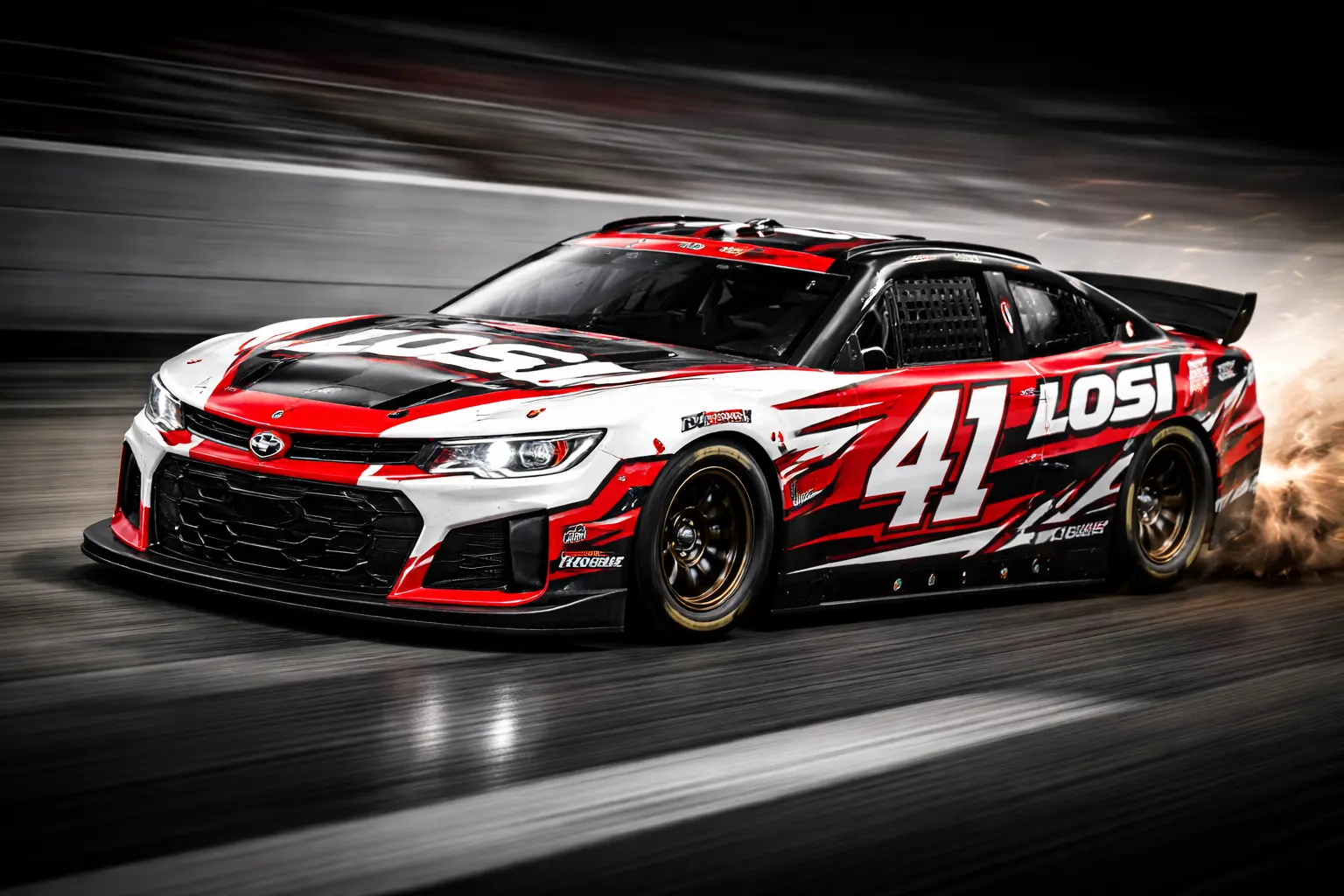
Ten identical stock cars, side by side, three-wide into Turn 1 — that's what RC oval racing looks like with a full field of Losi NASCARs. It sounds ridiculous. It looks even more ridiculous. And it is absolutely the most fun you can have with a radio transmitter in your hand.
This guide covers everything you need to know about the Losi 1/12 NASCAR RC car: the full specs, every body option across Chevrolet, Ford, and Toyota, the upgrades that actually matter, setup tips, and where to find a race.
This post contains affiliate links. If you make a purchase through these links, we may earn a commission at no extra cost to you.
What Is the Losi NASCAR RC Car?
The Losi 1/12 NASCAR AWD RTR is a hobby-grade, officially licensed NASCAR RC car produced by Losi (a Horizon Hobby brand). Despite being commonly searched alongside the Losi 22S,platform, this car actually runs on its own dedicated 1/12-scale AWD architecture shared with the Arrma GROM — a fact worth knowing if you're sourcing aftermarket parts.
It is fully ready to race out of the box — every model ships with battery, charger, transmitter, and a pre-painted officially licensed NASCAR body. At ~$209.99, it's the only serious RTR RC NASCAR option on the market, and it's arguably the best value entry point into organized RC racing. If you're brand new to the hobby, our beginner's guide can help you understand what to look for before buying.
The lineup currently spans nine distinct driver liveries across three manufacturers — Chevrolet, Ford, and Toyota — based on the Next Gen (7th-generation) NASCAR Cup Series car designs. There's also a small but growing heritage/tribute series, including Dale Earnhardt Sr. and Jr. editions.
I bought my first one impulsively after watching a YouTube clip of a 20-car oval race at a hobby shop. Within six weeks I owned two. This car is not a gateway drug — it is the drug.
Losi NASCAR Body Options
One of the best things about this platform is the sheer number of officially licensed body choices. All shells mount to the same chassis, so you can swap between manufacturers in minutes with a body clip change.
Chevrolet Camaro ZL1
The Chevy Camaro ZL1 bodystyle comes on several 2026 lineup cars, including Ross Chastain's #1 Busch Light (bright blue), Kyle Larson's #5 Valvoline (white/red), Chase Elliott's #9 NAPA (blue/white), and William Byron's #24 Raptor livery. The Camaro also anchors the heritage editions: the iconic #3 GM Goodwrench (black) and #8 Budweiser (red) tributes to the Earnhardts.
Check Price and Driver Availability on Amazon
Ford Mustang
The Ford camp includes Ryan Blaney's #12 Advance Auto Parts and Joey Logano's #22 Shell Pennzoil (yellow). Both bodies replicate the Next Gen Mustang faithfully, complete with authentic sponsor decals and the distinctive fastback roofline that makes the Mustang unmistakable even at 1/12 scale.
Check Price on Amazon — Joey Logano #22 Shell
Toyota Camry XSE
Toyota's representation comes via Christopher Bell's #20 DeWalt in the current Cup livery. The Camry XSE shape is arguably the sharpest-looking of the three — an opinion that has started at least a few heated debates at the hobby shop.
My buddy runs the #22 Logano Ford. I run the #9 Elliott Chevy. We have been arguing about which car looks better for six months. (It's the Chevy. Obviously.)
Replacement bodies (pre-painted 2026 liveries) run $53–$72 each through Horizon Hobby. Clear unpainted shells are available for ~$29.99 at AMain Hobbies if you want to paint your own scheme. Pro-Line Racing also produces officially licensed clear body options including Toyota Tundra and Chevy Silverado Truck Series shells — a completely different vibe for the same chassis.
Check Price on Amazon — Pro-Line Toyota Tundra Truck Body
Specs & What's in the Box
| Spec | Detail |
|---|---|
| Scale | 1/12 |
| Drive | AWD (shaft-driven) |
| Motor | 380-size, 28-turn brushed |
| ESC | Spektrum SLT 25A waterproof 2-in-1 ESC/receiver |
| Radio | Spektrum SLT2 2.4GHz, 2-channel |
| Servo | Spektrum SX110 metal-geared |
| Length / Width | 15.2 in / 6.8 in |
| Wheelbase | 8.9 in |
| Weight | 33.0 oz / 935g (with battery) |
| Top speed | 20+ mph (brushed stock) |
| Battery | Spektrum Smart 2S 7.4V LiPo (~1,300mAh) — included |
| Charger | USB/USB-C Smart charger — included |
What's in the box: Fully assembled car, pre-painted body, Spektrum SLT2 transmitter with 4× AA batteries, Smart 2S LiPo battery, USB-C charger, manual and tool kit. Throttle limiter offers 50% "Rookie Mode," 75%, and 100% — genuinely beginner-friendly.
What you might still want: A second battery for back-to-back run times (~20 min per pack), and proper oval tires once you start racing seriously. A dedicated smart charger like the Spektrum S155 (see our full charger guide charges faster and gives you battery health data.
How Does It Drive?
Out of the box, the Losi NASCAR is surprisingly capable. The AWD system delivers predictable, forgiving behavior that beginners can manage immediately — where a rear-wheel-drive oval car punishes throttle mistakes, this one just keeps going straight.
On carpet: Excellent. The stock tires generate consistent grip, the steering response is clean (if slightly sloppy on-center — more on that in upgrades), and the car stays flat through corners. This is where it shines out of the box.
On pavement: Works fine for casual running. Tires wear faster on asphalt, and the car can be a little darty at speed.
On banked dirt: Needs a tire swap to the Pro-Line Goodyear Eagle Dirt compound, but once you do, the AWD system hooks up in a way that's genuinely impressive on a clay oval. The first time I ran mine on a banked dirt track with proper tires, the grip level was insane — railing the high line at full throttle without lifting was something I wasn't expecting from a $210 car.
Throttle response is linear and controllable thanks to the 28T brushed motor. Steering is adequate but has some built-in play that the aluminum upgrade (covered below) fixes significantly. Braking is solid — the active drag braking on the ESC helps keep the car planted when you lift.
Best Losi NASCAR Upgrades
Steering System (~$15–$30) — Do This First
The stock plastic steering has noticeable slop that degrades lap consistency far more than any power or tire limitation. This is upgrade #1, full stop.
The INJORA GROM-14BK Aluminum Steering Set ($15–$18) is the budget pick — CNC aluminum, drops right in, immediate improvement in front-end feel.
The GLOBACT Aluminum Steering Set is another popular option at a similar price point.
Ball Bearings (~$20) — Do This Second
The stock bushings are functional but generate significant friction. The FastEddy Sealed Bearing Kit (TFE9450, $19.99) replaces all 16 bushings with precision sealed bearings. Car rolls noticeably better, feels more responsive, and the bearings protect the drivetrain long-term.
Available at FastEddy Bearings
Brushless Motor/ESC Combo (~$125–$145) — When You're Ready to Go Fast
The Spektrum Firma Smart Brushless Combo (SPMXSEMC25, ~$124.99) is the official plug-and-play upgrade: a 4500Kv brushless motor, 30A Smart ESC, and SR215 DSMR receiver — no soldering, no guesswork. It roughly doubles the car's speed to 35–40+ mph. Important: a gyro is strongly recommended at brushless power levels. Read our brushed vs brushless guide if you're deciding whether to upgrade.
For a more aggressive alternative, the Furitek Scorpion 5600Kv Combo (FUR-2596) is a sensored/sensorless setup popular with competitive racers.
Shocks & Springs (~$10–$25)
The stock oil shocks are serviceable but lack adjustment. The official Losi Tuning Spring Set (LOS-1933, ~$9.99) provides five spring rates from 7–11 lb/in without replacing the shock bodies — the cheapest way to tune your setup for different track conditions.
For full shock replacements, the INJORA 59mm Aluminum Oil Shocks are the value pick with threaded bodies and multiple spring rates included.
Tires — The Right Rubber for the Right Surface
Pro-Line produces officially licensed Goodyear Eagle tires specifically for this chassis, pre-mounted on 8mm hex gunmetal wheels. The Option Tire (Super Soft compound, PRO1030410) is the go-to for competitive carpet and asphalt racing.
The Primary Tire (Soft compound, PRO1030411) is a step firmer — better for grippy carpet or moderate-temperature pavement.
Losi's own Goodyear Eagle Soft Mounted Tires (LOS-1937) are another good option direct from the manufacturer.
Losi NASCAR Setup Tips
Tire Selection by Surface
Carpet oval: Pro-Line Option Tire (Super Soft, PRO1030410) or Losi LOS-1937 Soft. Banked clay/dirt: Pro-Line Goodyear Eagle Dirt Tire (available at Horizon Hobby). Asphalt: Primary Soft (PRO1030411) — harder compound survives the abrasion better. Stock medium tires (LOS-1914) are fine for casual backyard use on any surface.
Ride Height & Camber
For carpet oval racing, run the car as low as possible without dragging the chassis through corners. Start with zero rear camber and a hair of negative front camber (~0.5°). On banked dirt tracks, slightly more ride height prevents high-centering on track features.
Spring Rate
Stiffer springs (higher lb/in from the LOS-1933 set) improve corner stability on high-grip carpet but can make the car feel wooden on low-grip tracks. Start in the middle of the range (9 lb/in) and adjust based on how much roll you're seeing.
Weight Distribution
Most racers running competitive oval classes add a small amount of lead weight to the right-front area to improve rotation on left-turn-only ovals. Experiment with 5–10g increments and pay attention to whether the car pushes (understeer) or rotates too freely mid-corner.
Where to Race Your Losi NASCAR
RC oval racing has grown significantly, and the Losi NASCAR is the car that sparked much of that growth.
Local hobby shops are your first stop — search for tracks in your area and ask specifically about oval nights. Many shops have started dedicated Losi NASCAR classes precisely because the low entry cost drives participation numbers up.
Dedicated RC oval tracks are growing fast, particularly in the Midwest and Southeast. Tracks like 997 RC Raceway and Coastal RC Speedway run formalized Losi NASCAR spec classes with written rules.
Facebook groups searching "RC oval racing [your city or state]" will surface active local communities. These groups also organize informal parking lot and backyard events that require zero track investment.
The spec class appeal is real: when every car costs the same and runs the same spec motor, the racing is incredibly close. Fields of 10–15 cars are common at established tracks, and the drafting and bump-drafting dynamics at 1/12 scale are surprisingly realistic.
For a broader look at the RC racing landscape — oval, off-road, drag, and more — see our full RC racing guide.
Losi NASCAR vs. Losi 22S Sprint Car — Which to Choose?
Both cars are favorites in the oval RC community, but they're aimed at different drivers.
| Losi NASCAR | Losi 22S Sprint Car | |
|---|---|---|
| Scale | 1/12 | 1/10 |
| Drive | AWD | 2WD (rear) |
| Chassis | Composite plastic | 3mm aluminum |
| Motor | 28T brushed | Firma 3650 brushless |
| Primary surface | Carpet / pavement | Banked dirt oval |
| Racing style | Pack racing, drafting | Technical, sliding, winged |
| Price | ~$209.99 | ~$349–$399 |
Check Price on Amazon — Losi 22S Sprint Car
The NASCAR wins on value, approachability, and group racing fun. Ten cars drafting on a carpet oval is a unique experience that's hard to replicate with any other RC class.
The 22S Sprint Car wins on technical depth — the aluminum chassis, brushless power, adjustable suspension geometry, and dirt oval focus make it a proper competition platform. It's also a better choice if your local scene is dirt-heavy.
Recommendation: start with the NASCAR, enjoy the pack racing chaos, and add the Sprint Car when you're ready for something more technical. They're affordable enough to own both.
Frequently Asked Questions
Q: How fast does the Losi NASCAR go?
Stock brushed configuration runs 20+ mph, which is perfectly appropriate for spec-class oval racing on small tracks. Install the Spektrum Firma brushless combo and you're looking at 35–40+ mph. For oval racing, consistency and lap time matter far more than top speed — the best drivers at any track are rarely the fastest in a straight line.
Q: Can you run the Losi NASCAR on dirt?
Yes — swap the stock tires for the Pro-Line Goodyear Eagle Dirt compound and it handles banked clay ovals well. The AWD system actually helps on loose surfaces where rear-wheel-drive oval cars can get unpredictable. It's not a purpose-built dirt car, but it's very capable once you've got the right rubber on it.
Q: What batteries work with the Losi NASCAR?
The car ships with a Spektrum Smart 2S 7.4V LiPo with a proprietary small connector. You can use any compatible 2S LiPo in the same size/connector format. Stick to 2S (7.4V) for the brushed version — pushing 3S on a stock brushed motor shortens its life significantly. The brushless Spektrum combo is rated for 2–3S.
Q: Is the Losi NASCAR good for beginners?
It's one of the best entry points into RC racing that exists right now. Everything needed is in the box, the throttle limiter makes learning forgiving, the AWD system is more stable than typical oval cars, and the active racing community means you'll have people to learn from immediately. See our full beginner's guide for a broader look at starter options.
Q: Can you buy replacement NASCAR bodies separately?
Yes. Clear unpainted shells (Camaro ZL1, Mustang, Camry) sell for ~$29.99 each. Pre-painted current-season liveries run $53–$72 depending on the year. Pro-Line also offers a growing lineup of compatible clear shells including Truck Series and retro 1990s bodies starting around $29.99–$36.99. All fit the same chassis with the same body clips.
Conclusion
The Losi NASCAR is the best dollars-per-fun calculation in RC racing right now. Under $210, ready to race the moment you open the box, with an active spec class community, dozens of body options, and a well-developed upgrade path if you want to go faster — it checks every box for both casual drivers and people who want to get serious about oval racing.
If you're sitting on the fence, here's the honest take: the spec class scene is what makes this car special. Without other Losi NASCARs to race, it's a fun RC car. With ten of them on an oval? It's something else entirely.
Want to explore more racing? Check our complete RC Racing Guide for every discipline. For a full breakdown of every Losi model beyond NASCAR, our Losi RC cars guide covers the entire lineup.