Two 1/10-scale cars lined up 132 feet from a finish line. A Christmas tree counts down — five amber lights, one after another — and then both machines explode off the line in a blur of spinning rubber, screaming brushless motors, and full-throttle chaos. The whole thing is over in about two seconds. Then you do it again.
RC drag racing is the fastest-growing corner of the RC hobby right now, and if you haven’t seen what these cars can do in person, the first time genuinely stops you in your tracks. This guide covers everything you need to understand the sport, pick the right car, set it up correctly, and find people to race against.
This post contains affiliate links. If you make a purchase through these links, we may earn a commission at no extra cost to you.
What Is RC Drag Racing?
RC drag racing is a head-to-head competition between two cars over a straight-line course — typically 132 feet, which represents the 1/10-scale equivalent of a full-size quarter mile. Both cars launch simultaneously when the starting tree drops, and whoever crosses the finish line first wins the round. It’s simple in concept and endlessly deep in execution.
The sport has roots going back decades through IMDRA (International Model Drag Racing Association), which sanctioned both nitro-powered and early electric cars. But the scene that exists today was fundamentally shaped by the no prep movement that exploded in the real-world drag racing scene — specifically Discovery Channel’s Street Outlaws and No Prep Kings. That show brought millions of new fans to grassroots drag racing and directly inspired a wave of RC racers to take their cars to parking lots and industrial roads. RC manufacturers noticed. By 2020, every major brand had launched a purpose-built no prep drag car.
RC drag racing now has professional timing systems, national championships with cash prizes, and events drawing 200+ competitors from across the country. You can also race informally in any clean parking lot on a Saturday morning. Both experiences are legitimate entry points. For context on how drag racing fits into the broader RC racing world, check out our RC Racing Guide: NASCAR, Sprint Cars, Drag & On-Road.
No Prep vs. Prepped Surfaces
This distinction defines the character of the car and the event.
No Prep means the surface is swept clean but receives no traction compound. Cars race on raw asphalt, concrete, or whatever surface is available. Rules mandate rubber tires, realistic street-car bodies, 2WD only, and no electronic steering aids. The racing rewards tuning skill and driver feel over raw horsepower — a properly set-up car on no prep will consistently beat a more powerful car that’s spinning its tires.
Prepped surfaces use traction compound (like PJ1 TrackBite) applied to the launch area, building rubber into the surface over repeated passes. Traditional IMDRA-style events often use prepped surfaces, which allow lower-profile slick tires and generally faster times. The feel is closer to what you’d see at a real drag strip.
No prep dominates the current grassroots scene. The Losi 22S, DR10, and Drag Slash are all designed specifically around it.
Common Race Formats & Classes
Heads-Up racing is the purest form. Both cars leave on a Pro Tree (five amber lights, .400-second intervals), and the first to the finish line wins — no handicaps, no adjustments. This is how Pro Mod, Street Eliminator, and Top Fuel classes work.
Index classes give every racer the same target elapsed time. Run faster than the index and you “break out” — automatic loss. The discipline rewards consistency over speed. The RCDRL runs four index classes: Super Modified (1.70 sec), Super Comp (2.30), Super Street (2.60), and Stock (2.90).
Bracket racing is the great equalizer. Each driver declares a “dial-in” ET before the race. The slower car gets a head start equal to the time difference between the two dial-ins. Break out (run faster than your dial-in) and you lose. Consistency wins brackets, not horsepower — which makes it an ideal format for beginners with stock hardware.
Best RC Drag Cars to Get Started
There are three RTR options that dominate the scene, plus a budget and custom path for racers ready to dig deeper.
| Model | Price | Motor | Drive | Best For |
|---|---|---|---|---|
| Team Associated DR10 | ~$319 | Reedy 3300kV | 2WD | Beginners, best value |
| Losi 22S No Prep Drag Car | $399 | Firma 6500kV | 2WD | Performance, competition |
| Traxxas Drag Slash | ~$399 | Velineon 3500kV | 2WD | Beginners, features |
| Arrma Infraction 6S | ~$699 | Firma 2050kV | 4WD | Street drag / bashing |
Losi 22S No Prep Drag Car
I bought a ‘69 Camaro 22S before I’d ever run at an organized event, partly because of how it looked and partly because the specs were intimidating. That 6500kV Firma motor on 2S is genuinely fast out of the box — faster than any stock Slash or DR10 I’d put next to it in my driveway. First time I ran it on a proper surface with real timing, it pulled a 2.18-second pass with zero tuning. That’s a competitive number at most local events right now.
The Losi 22S No Prep Drag Car ships on a 3mm aluminum chassis derived from the TLR 22 racing platform, with a Firma 100A Smart ESC that reads telemetry through the Spektrum app. The licensed Mickey Thompson drag tires are actual competition-spec rubber, not the compromised rubber that comes with most RTRs. The aftermarket built around the TLR 22 platform is extensive — you can build a genuinely world-class drag car starting from this chassis.
The honest caveat: the SLT3 transmitter is basic, there’s no built-in stability system, and certain ’69 Camaro variants appear to be approaching end of production. If this car interests you, buy sooner rather than later. Check out our detailed Losi 22S Drag Car: Review & Setup Guide for the full breakdown.
Best for: Intermediate racers who want to compete immediately and upgrade over time.
Team Associated DR10
The DR10 RTR is the default recommendation for virtually every new RC drag racer, and for good reason. The stock Reedy 3300kV motor is the least powerful of the three major RTRs, but the DR10 comes equipped with DVC (Dynamic Vehicle Control) — a built-in adjustable gyro that actively counters side-to-side drift on launch. For someone learning to drive straight under full-throttle acceleration, this is a significant advantage.
The DR10’s real competitive advantage is its aftermarket. DragRace Concepts, Exotek, JConcepts, and Pro-Line all produce DR10-specific upgrade parts. The path from stock DR10 to full competition machine is the most documented, most supported journey in RC drag racing — which means when you’re stuck, there’s always a forum post, YouTube video, or Facebook group member who’s already solved the problem.
The composite chassis is functional but not as rigid as aluminum. Plan to upgrade the motor and ESC once you’ve learned the car.
Best for: Beginners. Best overall value and largest aftermarket ecosystem.
Traxxas Drag Slash
The Traxxas Drag Slash HD has features that no other RTR in this segment offers. The built-in Trans Brake lets you hold a button on the TQi transmitter, wind the motor up to your desired throttle level, then release everything simultaneously for a consistent, repeatable launch. TSM (Traxxas Stability Management) in drag racing mode uses a gyro to hold the car straight under power.
These features make the Drag Slash the most forgiving car to learn on. The flip side: TSM must be disabled for sanctioned competition, so you’ll eventually need to learn how to launch and drive without electronic help anyway. The Velineon 3500kV motor is mid-pack on stock power. Traxxas’s unmatched parts network — stocked at virtually every hobby shop in the country — makes repairs fast and cheap.
Best for: Beginners who want maximum assistance from the car while learning.
Budget & Custom Options
If you want to build rather than buy, RJ Speed sells traditional NHRA-style dragster and Pro Mod kits at $130–$165 for the chassis alone. These aluminum and fiberglass kits suit bracket and IMDRA-style racing. Electronics, body, and hardware are separate — budget an additional $200–$400 to complete the build.
For serious competition, DragRace Concepts (DRC) makes the premium chassis options: the Maxim No Prep kit at $600 and the top-tier Maverick at $850, both chassis-only. Exotek produces conversion kits for DR10, Slash, and 22S platforms that upgrade the suspension geometry and chassis stiffness without requiring a full rebuild.
Essential Equipment for RC Drag Racing
Batteries & Chargers
A dedicated drag racing battery is one of the highest-impact upgrades you can make. The goal is maximum burst power over 2–3 seconds, not long runtime, which means two things: shorty packs (shorter dimensions = less rotating mass and lower weight) and high C-rate discharge.
The 2S LiPo shorty pack is the standard class battery for most competition events — maximum 8.44V at tech inspection (the full-charge voltage for a 2S LiHV or standard LiPo). Entry-level racing is fully served by a Zeee or CNHL 5000mAh/100C shorty at $35–$60. Competitive racers run multi-cell parallel configurations like ProTek RC’s 2S5P packs at 8800mAh and 200C burst — rated for the kind of current draw that would destroy a standard pack in seconds.
Use 8mm bullet connectors rather than Deans or XT90 to minimize resistance at high current. Check out our Best RC Car Battery Chargers guide for charger recommendations once you’re managing multiple packs.
Tires & Traction
Drag slicks are the single biggest performance upgrade from stock rubber. RC drag slick tires in 1/10 scale run $15–$40/pair and come in foam (firmer, more consistent) or rubber (softer, more grip, wear faster) compounds. Pro-Line and JConcepts produce the most popular competition options.
For no prep racing, tire prep goes on the tire, not the track. SXT Launch compound is the most popular choice — apply to rear tires, soak 20–30 minutes, wipe before the run. Pimp Juice RC-X and Track Claw are competitive alternatives. Some racers swear by WD-40 as a weekly tire conditioner and Simple Green as a between-run surface cleaner.
Timing System & Starting Tree
For casual events and backyard runs, the Traxxas DTS-1 (~$300–$400) is the most popular semi-professional option. It includes an authentic Christmas tree, staging and finish line beams, Pro and Sportsman tree modes, and Bluetooth data logging to the Traxxas Link app for ET, reaction time, and trap speed.
The RC drag racing timing system search on Amazon covers basic options — for club-level or event-grade timing, Trackmate Racing and Drag-It-Anywhere sell professional wireless systems at $500–$1,500+ with full Christmas tree functionality, 60-foot splits, and bracket racing software. DIY Arduino builds with IR break-beam sensors are also popular in the community and can be assembled for $50–$150.
Tools & Pit Setup
Electric RC drag racing requires no starter box (that’s for nitro cars). What you actually need at the pit: metric hex drivers (1.5, 2.0, 2.5, 3.0mm), 5.5/7.0mm nut drivers, shock pliers, a digital caliper, and a flat setup board. The RC car hex driver tool kit search will cover the basics at $20–$40. Add a balance charger, LiPo safe bag, and an infrared temperature gun for motor/ESC monitoring — the cheapest insurance against blown electronics.
The most underrated diagnostic tool: slow-motion video from the side. Your phone captures everything — wheelie bar contact, tire spin at launch, when the front end comes up and comes back down. You’ll learn more from 10 seconds of slow-mo footage than from 20 discussion-board posts.
How to Set Up Your Car for Drag Racing
Gearing
Drag gearing optimizes for maximum acceleration over 132 feet, not top speed. With a stock 3300–3500kV motor on 2S, start around 90T spur / 20–22T pinion. With an upgraded 3.5T motor running turbo timing, drop to 90T / 17–18T and work upward while monitoring temperature. Motor should stay under 200°F (93°C) after every pass. The rule: gearing, motor timing, and ESC settings are interdependent — change one, and the others need re-evaluation.
Weight Distribution
Target roughly 40% front / 60% rear static distribution. At launch, acceleration forces transfer weight rearward onto the drive tires — you want them loaded, not light. Too much rear bias (35/65 or more rear-heavy) causes the car to ride its wheelie bar instead of driving on the tires. Battery position is the primary adjustment variable: moving the pack forward adds front weight and reduces wheelie tendency.
Wheelie Bar Tuning
Set the bar as low as possible without touching at static height. Ideal launch behavior: the bar makes brief contact 12–18 inches from the line, then lifts. If it drags the entire pass, weight is riding on the bar instead of the tires — slower, not faster. Adjust bar height in small increments, one change at a time, and confirm every adjustment with slow-motion video.
ESC Programming Tips
Three parameters combine for total motor timing: base motor timing (set mechanically on the endbell, typically 20–30°) + boost (ESC adds timing linearly as RPM climbs, typically 10–25°) + turbo (ESC adds timing at full throttle above a threshold RPM, typically 20–40°). Maximum combined timing is 60° — exceed this and you risk cooking both motor and ESC.
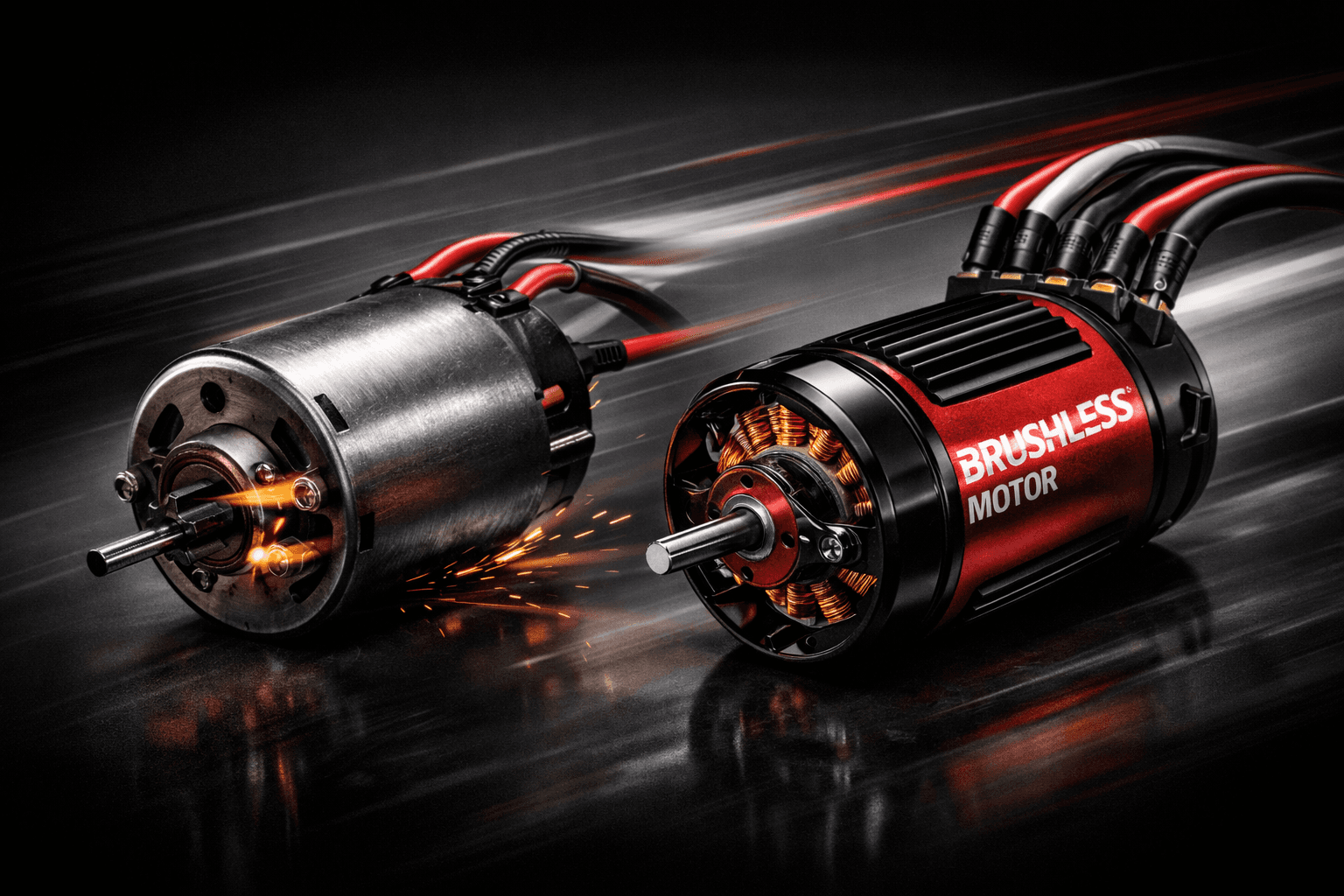
Understanding brushed vs brushless motors is the foundation for knowing why timing matters. The practical starting advice: set drag brake to 0% (any deceleration costs ET), keep punch/start mode conservative, and increase timing in 5° steps while checking motor temperature after every run.
For competitive builds, the Maclan DRK 160’s Launch Power Control algorithm handles the launch curve automatically. The Tekin RX8’s Launch Power and Power Delay settings do the same. These ESC-specific features are what separates a $180 drag ESC from a $50 general-purpose one.
How to Find RC Drag Racing Events Near You
The most effective tool for finding local races is Facebook. Search your city name + “NPRC” or “[Your State] RC Drag Racing” to find active local groups. Nearly every grassroots no prep community runs through Facebook for scheduling, results, and discussion.
RCDragRaces.com serves as a national directory of clubs, tracks, leagues, and events across 20+ US states. The RCDRL (rcdrl.com) lists events in Texas, Florida, and Puerto Rico with a full schedule through the end of 2026. The IMDRA (imdra.com) covers traditional multi-class events with nitro and electric classes, centered in North Carolina but drawing national entries.
Local hobby shops are also a reliable starting point — many organize monthly or biweekly cash days and can connect you with their local group. For the calendar’s marquee event, the RCDRL Summit Racing Equipment US Super Nationals (September, Grand Prairie TX) is the biggest RC drag racing event in the world with 11 classes, three days of racing, and $4,500+ in prize money.
If you can’t find a local group and want to start one, all you need is a clean flat surface, a starting tree, and a Facebook group. The community around RCDragRaces.com has a track-setup guide, and the RCDRL offers affiliate track membership.
RC Drag Racing Rules: What You Need to Know
Rules vary by organization and event, but the core framework is consistent across the no prep community:
Staging: Both cars must be fully staged (both staging lights lit) before the tree activates. Pre-staging is required before staging. A competitor who doesn’t stage within a reasonable timeframe forfeits the round.
False starts: Leaving before the last amber light triggers a red light and an automatic loss, regardless of your ET. No resets, no excuses.
Classes and equipment: Sanctioned no prep classes require 2WD, rubber tires, realistic bodies covering all four tires, a minimum weight of 4.54 lbs (2,060g) ready-to-run, and zero electronic steering aids (DVC, TSM, AVC, and gyros are all banned). Battery voltage is checked before every run — maximum 8.44V for 2S classes.
Tech inspection: Wheelbase and wheelie bar length are measured, motor and ESC are checked for class compliance, and tires are verified for residue compliance (pull-meter test at some events). Post-record runs require the car to remain untouched until officials release it.
Safety: Charged LiPo batteries must be transported in LiPo-safe bags. Cars must have a failsafe set (throttle returns to neutral on signal loss). Spectators and pit crew stay behind the timing lights during active passes.
How Much Does It Cost to Get Into RC Drag Racing?
Entry-level ($380–$460): A DR10 RTR ($320) plus a 2S LiPo shorty ($35–$60), a basic balance charger ($30–$50), and a hex tool kit ($20–$25) gets you to the line. Add drag slick tires ($25–$35) and SXT tire prep ($12) and you’re genuinely competitive at local events for under $460 all in.
Competitive ($700–$1,200+): Upgrading to a Trinity Holeshot 3.5T motor ($85), a Maclan DRK 160 ESC ($200), ProTek RC drag batteries ($120/pair), and an upgraded radio ($150) pushes total spend into the $700–$900 range. Add a DragRace Concepts conversion chassis ($200–$300) and premium tires, and you’re over $1,000 with a genuinely podium-capable setup.
Recurring monthly costs for a regular racer run roughly $50–$100: rear drag tires replaced every 3–8 race days ($25–$40/pair), tire prep ($10–$15/bottle lasting many events), and local event entry fees ($5–$20 for most cash days). This is one of the lower-overhead forms of competitive RC racing.
FAQ
Q: How fast do RC drag cars go?
Stock RTR drag cars running a standard 132-foot no prep pass typically trap at 35–45 mph with 2S power. Competitive builds with 3.5T motors and tuned ESC timing reach 50–65 mph at the finish line. Purpose-built 3S or open-motor builds at sanctioned events can exceed 70 mph. To put the scale in perspective: 60 mph for a 1/10-scale car translates to 600 mph at full scale — faster than a commercial airliner.
Q: What is no prep RC drag racing?
No prep RC drag racing means racing on an unprepared surface — clean asphalt or concrete with no traction compound applied to the track. Tire prep can be applied to the tires themselves, but the track surface receives nothing. This format, borrowed directly from full-scale street racing culture, keeps the emphasis on car setup and driver skill rather than the condition of the racing surface. It’s also what makes organizing races anywhere practical — no surface treatment required.
Q: What’s the best RC drag car for a beginner?
The Team Associated DR10 RTR is the best starting point for most people. The built-in DVC gyro helps beginners drive straight under full-throttle acceleration, the aftermarket is the largest of any drag car, and the price is the most accessible of the major RTRs. If you want maximum out-of-box performance and are willing to spend $80 more, the Losi 22S is worth the upgrade — but note that stock may be limited.
Q: Can I use any RC car for drag racing?
Technically you can race any RC car at an informal event, but for sanctioned competition the rules are specific: 2WD only, realistic body covering all four tires, no electronic steering aids, minimum weight 4.54 lbs, rubber tires. A Traxxas Slash, ARRMA Typhon, or Losi TENACITY 4WD would be either illegal or hopelessly outclassed at a sanctioned event. Purpose-built drag cars (DR10, 22S, Drag Slash) exist for a reason.
Q: How long is an RC drag strip?
The standard RC drag strip is 132 feet — the 1/10-scale equivalent of the full-size quarter mile (1,320 feet). Timing systems also capture the 6-foot mark (equivalent of the 60-foot time used in full-scale racing to measure launch quality) and a 66-foot intermediate for speed trap calculations. Some casual events run 66 feet, but 132 feet is the universal standard for sanctioned competition at RCDRL and IMDRA events.
Ready to Race?
RC drag racing has one of the shortest ramps from “just bought a car” to “competitive at events” of any motorsport — RC or full-scale. The community is welcoming, the equipment is accessible, and a well-set-up $400 entry-level build genuinely runs with cars that cost three times as much.
The Team Associated DR10 on Amazon is the clearest starting point for most racers — grab a 2S LiPo shorty pack, a set of drag slick tires, and search your city on Facebook + “NPRC.” You’ll likely find people already running within 30 miles.
The first time you hear two drag cars leave the line at the same time — that high-pitched scream cutting the air for two seconds and then silence — you’ll understand why this corner of the hobby is growing faster than any other.