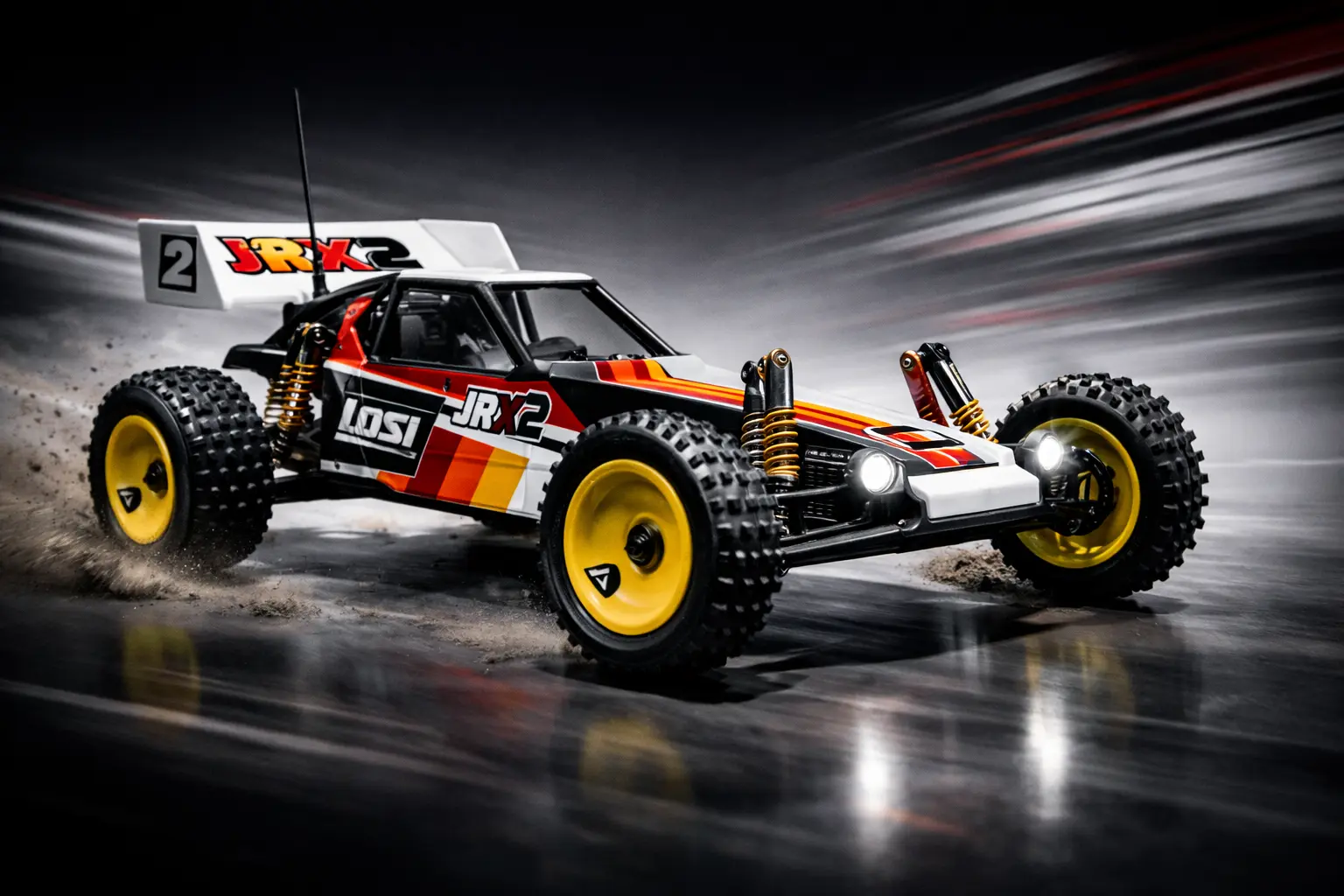
There’s a specific kind of RC nostalgia that hits different. Not the vague “I had one of those as a kid” kind — but the bone-deep kind, where you remember the exact page in RC Car Action magazine, the exact car, the exact race. For a generation of racers, that car was the Team Losi JRX2. Losi bringing it back in 1/16 scale — fully assembled, battery included, ready to run in under five minutes — felt like a message from 1988 landing directly in your inbox.
This review covers everything: the history that makes this car matter, how the modern re-release performs, how it stacks up against competitors, and whether it’s worth picking up at current pricing.
This post contains affiliate links. If you make a purchase through these links, we may earn a commission at no extra cost to you.
A Brief History of the Losi JRX2
The original JRX2 was Team Losi’s first RC car, released in late 1988, and it was born from desperation as much as brilliance. Gil Losi Sr. and his son Gil Jr. had been selling hop-up parts out of a converted skatepark snack bar in Colton, California. Gil Jr. had already won the 1985 IFMAR 4WD World Championship on a Yokomo, but the family business was selling other people’s products. They wanted their own.
Development took over three years. The first prototype components were shaped with a Dremel. When cost overruns threatened the launch, a last-minute $137,000 check from distributor Hobbico — paying upfront for 1,000 kits at $137 each — literally saved the company. Gil Sr. had borrowed against his house to fund production.
What those 1,000 buyers got was a car that challenged everything the Team Associated RC10 had established. The JRX2 introduced a graphite plate chassis in place of the RC10’s stamped aluminum tub, a proper 5-link rear suspension (two lower links, camber link, and two trailing links per hub), and the iconic orange 5-spoke wheels that became the visual signature of the Losi brand. The LRM transmission was engineered for smooth power delivery on the rough, loamy tracks of the era.
The JRX2 didn’t win an IFMAR 2WD World Championship itself, but it launched a platform lineage — JRX Pro, Junior 2, JRX Pro SE, XX — that eventually delivered Losi’s first 2WD World Championship in 1997, when Brian Kinwald won at Pomona driving the Losi XX-CR. The JRX2’s real legacy was breaking Associated’s stranglehold on the class and forcing the entire 2WD buggy to evolve.
I remember flipping through RC Car Action as a kid and seeing JRX2s dominating race results. The orange wheels, that flat plate chassis — there was nothing that looked like it. When Losi announced the 1/16 re-release in 2022, I had it ordered within the hour.
The Mini JRX2 exists within a broader retro RC wave that has transformed the hobby. Tamiya has been re-releasing its classic kits since the mid-2000s — the Grasshopper, the Hornet, the Buggy Champ. Team Associated formalized the trend with a dedicated RC10 Vintage Series, including 30th, 40th, and anniversary editions. Kyosho followed with a full Vintage Series covering the Optima, Scorpion, and Ultima lineages. The demographic reality is simple: the generation that raced these cars in the late 1980s and early 1990s now has careers and disposable income. Losi’s take on the moment was the Mini JRX2 — the only retro re-release that comes RTR, battery included, under $170. See our complete guide to Losi RC cars for the full lineup.
Losi JRX2 Modern Re-Release — Specs & What’s in the Box
The modern Mini JRX2 (LOS01020) is a 1/16-scale interpretation rather than a precise clone of the original, which ran 1/10 scale. At 60% smaller, it preserves the design DNA that matters — the 5-link rear, rear-mounted motor, flat fiberglass plate chassis with kick-up, and era-correct tire patterns — while packaging it into a complete RTR.
| Specification | Detail |
|---|---|
| Model Number | LOS01020 (T1 Red / T2 Blue / T3 Black) |
| Scale | 1/16 |
| Drivetrain | 2WD rear-wheel drive |
| Motor | Firma 42T 280 brushed (SPMXSM5100) |
| ESC/Receiver | Spektrum 25A brushed 2-in-1 (SPMXSE2025RXF) |
| Radio | Spektrum SLT2 2-channel 2.4GHz |
| Servo | Spektrum SX107 micro metal gear |
| Chassis | 2mm fiberglass plate |
| Suspension | 5-link rear; 7mm aluminum oil-filled shocks |
| Differential | Bevel gear with slipper clutch |
| Dimensions | 10” L × 7.2” W × 4.25” H; 181mm wheelbase |
| Weight | 18.6 oz (526g) RTR |
| Battery Included? | ✅ Yes — 7.4V 650mAh 2S LiPo, EC2 connector |
| Charger Included? | ✅ Yes — 0.5A USB LiPo charger |
| Tires | Ribbed front / step-pin rear (dirt & carpet) |
| Bearings | Full ball bearings throughout |
| Est. Top Speed (stock) | ~8–12 mph brushed |
| MSRP | $169.99 (currently discounted — see below) |
Everything is in the box: assembled buggy, battery, USB charger, transmitter with four AA batteries, tools (4-way wrench, 1.5mm hex driver), and manual. Charge time with the stock 0.5A USB charger is roughly 45–60 minutes for about 10–12 minutes of runtime — a legitimate limitation addressed easily by the battery upgrade in the section below.
The 2mm fiberglass chassis deserves a mention. Losi deliberately chose fiberglass over carbon to replicate the flex profile of the original’s graphite plate — and it works. The chassis has that same slight give that lets the car track smoothly over bumpy surfaces rather than deflecting. Six adjustable turnbuckles allow tuning of toe, camber, and ride height, giving this little buggy more setup potential than you’d expect at 1/16 scale.
One important note on pricing: the Mini JRX2 shows signs of being phased out (Losi’s own site recently listed it as discontinued). Major retailers have been running heavy promotions — Tower Hobbies and Horizon Hobby have both offered it at $99.99, and some clearance deals have gone lower. If you’ve been considering one, now is the window.
Driving the JRX2 — Performance Review
The first time I ran mine on a dirt patch in the backyard, it made me smile in a way my Kraton 6S doesn’t. That’s not a knock on the Kraton — that thing is a completely different kind of machine. But there’s something about a light, nimble 1/16 buggy on a smooth dirt path that reconnects you with what RC driving feels like at its most distilled.
Stock, the Mini JRX2 runs at a modest 8–12 mph with the brushed motor. That’s actually appropriate for the size and the intended surfaces — compact driveways, smooth dirt, low-pile carpet, or an indoor track. It doesn’t feel slow in context, because the car is small enough that 10 mph looks and feels zippy. The 5-link rear suspension does genuine work even at this scale: the rear tracks straight under acceleration, holds its line through corners, and absorbs small bumps without the tail snapping loose.
On carpet, the step-pin rear tires grip well and the car steers cleanly with good on-power rotation. On dirt it’s similarly composed — the slipper clutch calibrates wheelspin nicely, and the front ribbed tires provide predictable understeer that keeps things manageable for less experienced drivers.
The SLT2 radio transmitter has a three-position throttle limiter (50%/75%/100%), which is genuinely useful — running at 50% in tighter spaces makes the car much more approachable. Steering response is crisp, and the Spektrum SX107 servo is more than adequate for the scale.
The honest limitations: this isn’t a terrain crusher. Tall grass will swallow it, and rough pavement will rattle it apart faster than you’d like. It’s optimized for smooth, controlled surfaces. Runtime on the stock 650mAh pack is short — budget for the battery upgrade right away if you intend to run it seriously.
Put it next to the Mini-B on the workbench and you can see the design DNA they share at the platform level — same size class, same brand, same RC ecosystem. But the JRX2 has something the Mini-B simply cannot replicate: those classic body lines, that vintage low-slung silhouette, the decals that look like they were lifted directly from a 1989 race flyer. One is a modern performance machine; the other is a time capsule that happens to run. Not sure what 1/16 scale means in practical terms? Our RC car scale sizes guide breaks it all down.
Build Quality & Retro Design
The Mini JRX2 is built to a standard appropriate for its price point — better than most toy-grade RC cars, not as bulletproof as higher-end hobby vehicles. The aluminum-bodied shocks are the headline quality feature: at 1/16 scale, most competitors use plastic-bodied shocks, and the JRX2’s oil-filled aluminum units are a genuine upgrade that improve both performance and longevity.
The fiberglass chassis is nicely finished with countersunk screws and clean edge work. The body is pre-painted polycarbonate with retro liveries that closely echo the original JRX2 color schemes — red with white graphics, blue with white, and the sleeker black variant. The decal work is detailed and the body fits snugly on the chassis.
Community experience has flagged some consistent QC issues worth knowing about upfront: shocks occasionally shipped under-filled with oil, excess transmission grease causing initial binding, and motor plate screws that can strip easily if over-torqued. None of these are deal-breakers — all are addressable in 20–30 minutes at the bench — but first-time buyers should do a quick inspection before the first run.
Disassembly is straightforward. The body pops off on clips, exposing clean access to the motor and electronics. The 2-in-1 ESC/receiver module sits centrally, and the battery tray accepts the stock hardcase pack with a secure fit. For collectors, Losi sells a clear replacement body (LOS310002) specifically for custom painting — a nice touch that acknowledges the display potential of this car.
Losi JRX2 vs Losi Mini-B: Which 1/16 Buggy Should You Get?
This is the question most buyers face. Same brand, same scale class, very similar price range. Here’s how they compare:
| Spec | JRX2 (LOS01020) | Mini-B Brushed (LOS01022) |
|---|---|---|
| Motor | Brushed 42T 280 | Brushed 280 |
| Est. Top Speed | ~10 mph | ~15 mph |
| Drive | 2WD rear, rear motor | 2WD rear, mid motor |
| Chassis | 2mm fiberglass plate | Aluminum plate (TLR 22-based) |
| Suspension | 5-link rear, vintage geometry | Modern A-arm, TLR-derived |
| Design Style | Retro 1988 JRX2 tribute | Modern racing buggy |
| Aftermarket Support | Moderate (growing) | Excellent (10+ years of parts) |
| Price | ~$99–$169 (discounted) | ~$119.99 |
The Mini-B wins on pure performance, aftermarket support, and value at current pricing. Its mid-motor layout provides better weight distribution for racing, and a decade of TLR 22-derived engineering means setup knowledge and performance upgrades are readily available. If you’re into the Losi mini platform and want maximum performance, check out our Losi Mini-B upgrades guide for performance tips.
The JRX2 wins on character, heritage, and emotional connection. It’s the car you buy because you want that specific experience — the look, the lineage, the story. For casual fun, backyard bashing on smooth surfaces, or display alongside your vintage RC collection, it delivers in a way no modern Mini-B ever could.
JRX2 vs Other Retro RC Re-Releases
The Mini JRX2’s most important differentiator in the retro market is that it comes ready to run. Every other major retro re-release currently on sale is a kit.
| Model | Scale | Era | Drive | Price | Status |
|---|---|---|---|---|---|
| Losi Mini JRX2 | 1/16 | 1988 tribute | 2WD | ~$100–$170 RTR | Discounting / discontinuing |
| Tamiya Grasshopper | 1/10 | 1984 | 2WD | ~$100–$130 (kit only) | Available |
| Tamiya Hornet | 1/10 | 1984 | 2WD | ~$155–$170 (kit only) | Available |
| Team Associated RC10 Classic | 1/10 | 1984 | 2WD | ~$299–$380 (kit only) | Limited editions |
| Kyosho Optima Pro | 1/10 | 1985 | 4WD | ~$260–$400 (kit only) | Available |
When you add electronics to a Tamiya Grasshopper kit — motor, ESC, receiver, transmitter, battery, charger — total cost climbs to $250–$300. The RC10 Classic fully built runs $450–$650. The Mini JRX2 at $99 clearance pricing with everything included is an objectively compelling entry into retro RC.
The tradeoff is scale. The 1/10-scale kits deliver a more authentic recreation of the original cars — same geometry, same proportions, substantially more presence on the track. Enthusiasts who want the full retro racing experience tend toward Tamiya’s kits; those who want retro flavor with modern convenience gravitate to the JRX2. Both communities are valid. Check the Tamiya Grasshopper on Amazon if the kit-build experience appeals to you.
Best Upgrades for the Losi JRX2
Performance Upgrades
The single most impactful upgrade is the battery. The stock 650mAh pack delivers about 10–12 minutes of runtime. The ProTek RC 2S 1100mAh 50C LiPo with EC2 connector (~$33 at AMain Hobbies) is a direct plug-and-play swap that nearly doubles runtime with a meaningful boost in punch. Search for compatible 2S LiPo packs on Amazon — look for 1000–1200mAh packs with EC2 connectors specifically compatible with Losi mini vehicles.
For speed, a brushless conversion transforms the car. The Spektrum Firma 6000Kv 2-in-1 combo (~$105 at Horizon Hobby) is the direct drop-in option, pushing speeds to approximately 16 mph. The Furitek VORTEX combo (Paso ESC + 6700Kv Kraken motor, ~$100) is the enthusiast choice, offering app-based tuning and aggressive power delivery. Note that all brushless conversions replace the stock 2-in-1 ESC/receiver, so you’ll need a separate compatible receiver.
Durability Upgrades
A full bearing kit is worthwhile if you bought the car used or plan to run it hard. The stock bushings in some areas wear faster than bearings would. Search for Losi JRX2 bearing kits on Amazon — most full kits run $10–$15.
The 175RC motor plate reinforcement screws (~$4) are close to mandatory — the stock screws strip easily with repeated motor swaps, and this fix costs almost nothing. The Losi HD Slipper Plate (LOS312007, $24 at Horizon Hobby) is shared with the Mini-B and Mini-T 2.0, providing more consistent clutch operation for high-traction surfaces. Carbon fiber shock towers from HackFab ($10 each) replace fragile plastic parts with significantly more durable alternatives.
Cosmetic Upgrades
The clear body (LOS310002, $39 at Horizon Hobby) is made specifically for custom paint jobs — period-correct racing liveries are popular in the community, with some builders replicating the exact graphics from Gil Jr.’s original race car. For display, an RC car display stand sized for 1/16 scale ($10–$20) makes the JRX2 a proper shelf piece alongside any vintage RC collection. Given the discontinuation trajectory, this car may appreciate as a collectible.
FAQ
Q: Is the Losi JRX2 the same as the original from the 1980s?
No — they share a design philosophy and several key engineering elements (5-link rear suspension, rear-motor 2WD layout, flat plate chassis), but the modern Mini JRX2 is a 1/16-scale tribute rather than a replica. The original was 1/10 scale and came as a kit requiring you to supply your own motor, ESC, radio, and battery. The modern version is 1/16 scale, RTR, and costs a fraction of what the original kit sold for in 1988 dollars.
Q: Can you race the Losi JRX2?
Yes, within the right context. It’s not competitive against modern brushless mini buggies in standard classes, but dedicated Mini JRX2 stock class racing has emerged at several tracks — running stock brushed motors on the same 650mAh battery with no electronics changes. In that format, it’s genuinely fun and surprisingly technical. Check your local club for organized retro or mini class events.
Q: What battery does the Losi JRX2 use?
The stock battery is a 7.4V 650mAh 2S 20C LiPo hardcase with an EC2 connector, included in the box. The EC2 connector is specific to Losi/Spektrum vehicles. The most popular upgrade is the ProTek RC 2S 1100mAh 50C with EC2 connector — same plug, double the capacity, noticeably longer runs.
Q: Are Losi Mini-B parts compatible with the JRX2?
Partially. The JRX2 and Mini-B share some consumables — batteries (same EC2 format), bearing sizes, the 60T spur gear, the HD slipper plate, and compatible brushless combos. However, they are not on the same platform. Chassis plates, A-arms, shock towers, and body shells do not cross-swap. The Mini-B’s suspension geometry is fundamentally different (modern A-arm vs. 5-link).
Q: Is the Losi JRX2 good for beginners?
It’s a reasonable beginner option, particularly at current clearance pricing. The three-position throttle limiter on the SLT2 radio lets new drivers start at 50% power until they’re comfortable. The included battery and charger mean zero additional purchases to get running. Its main beginner-friendliness caveat: the short runtime (10–12 minutes) can feel frustrating, so budget $30–$35 for a higher-capacity battery alongside the car. New to RC? The JRX2 is a fun starting point — our RC cars beginner guide covers everything you need to know before your first run.
Conclusion
The Losi Mini JRX2 is exactly what it claims to be: a love letter to one of RC racing’s founding cars, packaged as a modern RTR anyone can drive out of the box. At current clearance pricing — potentially well under $100 — it’s one of the better value propositions in the retro RC space. For nostalgic hobbyists and collectors, it’s a near-automatic buy. For newcomers without the historical connection, it’s still a fun, charming little buggy that competes well within its format.
Its limitations are real — short stock runtime, modest top speed, QC that needs a quick bench check — but none are dealbreakers with minor attention. A battery upgrade and a few minutes with a turnbuckle wrench turns it into a genuinely satisfying machine.
Don’t wait too long. With the product trending toward discontinuation, remaining stock at these prices is finite.