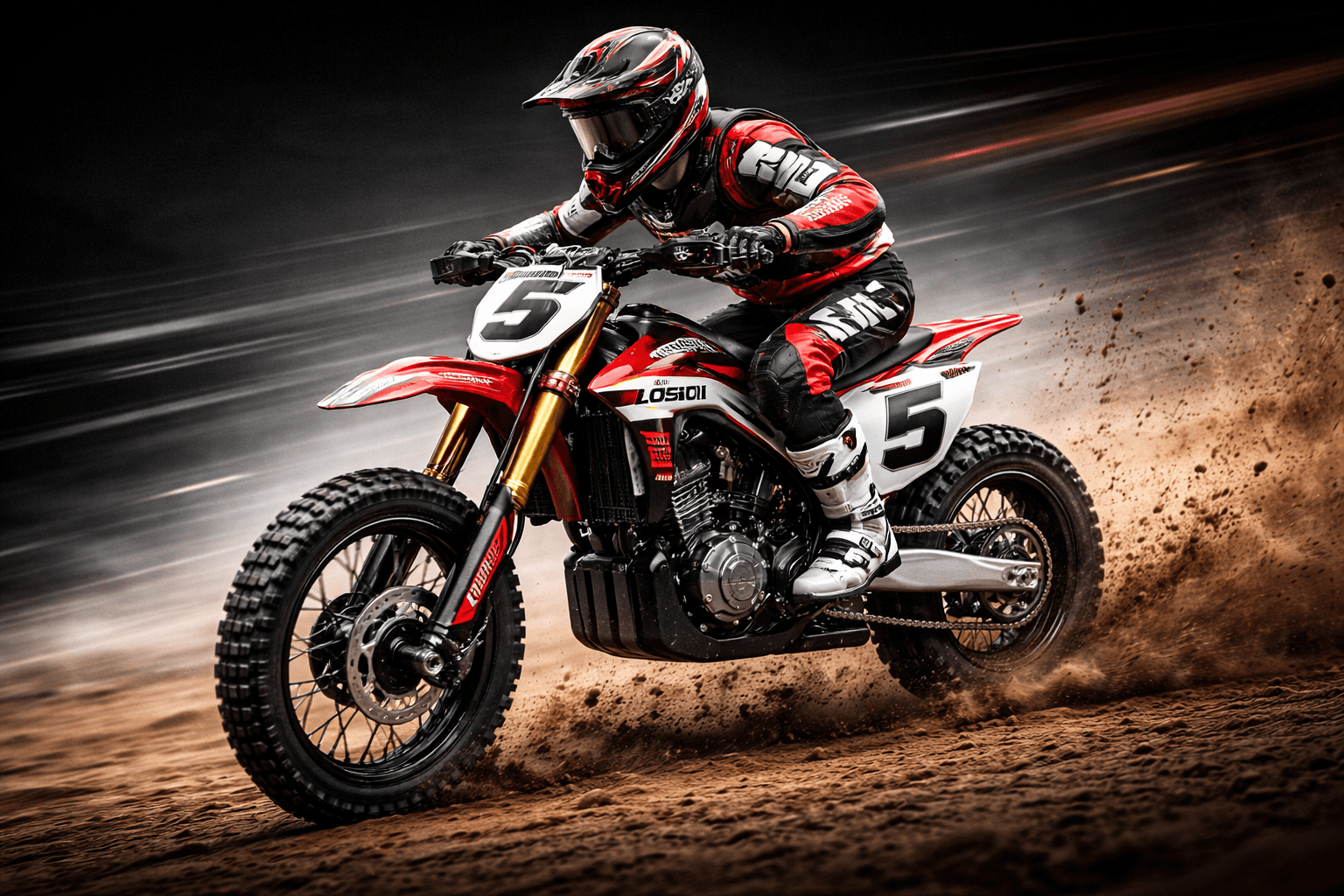
An RC motorcycle that actually balances and rides on two wheels. No training wheels, no gimmick. Just gyroscopic wizardry and some of the most fun you’ll have in 20 years of RC.
When I first unboxed the Losi Promoto-MX, I was genuinely skeptical. An RC motorcycle that balances itself? That sounded like marketing nonsense. Then I set it on the ground, gave it throttle, and watched it ride away on two wheels. My jaw literally dropped. That moment is why I’m writing this review — because this thing has to be seen to be believed, and if you’re on the fence, I want to tell you exactly what you’re getting into.
This post contains affiliate links. If you make a purchase through these links, we may earn a commission at no extra cost to you.
What Is the Losi Promoto-MX?
The Losi Promoto-MX is a 1/4-scale brushless RC dirt bike manufactured by Losi, one of the flagship brands under Horizon Hobby. Unlike every other RC vehicle you’ve ever driven, it rides on two wheels — and stays upright thanks to a patent-pending gyroscopic flywheel system that spins at over 22,000 RPM to create real angular momentum. Think of how a spinning top resists falling over. Same principle, applied to a radio-controlled motocross bike.
Losi is a well-established name in serious RC, known for their 8th-scale buggies and desert trucks. The Promoto-MX is something else entirely — their most ambitious product, and arguably the most technically impressive RC motorcycle ever made available to consumers. It’s sold as an RTR (Ready to Run), meaning the bike arrives fully assembled with the rider figure already seated and everything bound. You charge a battery, bind the controller, and ride.
If you’re new to the hobby and want to understand the power system before diving in, our brushed vs brushless guide covers why brushless motors matter for performance and longevity.
Three versions are currently available in 2026:
- Losi Promoto-MX FXR RTR (Red) — LOS06000T1, ~$549.99, battery not included (Note: Discontinued but still available at some retailers) → Check Availability on Amazon
- Losi Promoto-MX Club MX RTR (Blue) — LOS06000T2, ~$549.99, battery not included → Check Price and Stock on Amazon
- Losi Promoto-MX Pro Circuit RTR (Green) — LOS06002, ~$599.99, battery and charger included → Check Price on Amazon
The Pro Circuit is the best value if you’re starting from scratch — the included battery and charger save you roughly $70–80 versus buying them separately. If you already own Spektrum Smart ecosystem gear, the Club MX or FXR saves you money.
Key Specs
| Spec | Detail |
|---|---|
| Scale | 1/4 |
| Length / Width / Height | 20.2” × 10.8” × 17.3” |
| Wheelbase | 13.9” (353mm) |
| Weight (with battery) | ~7.7 lbs (3,500g) |
| Drive motor | Spektrum Firma 3800Kv 4-pole brushless |
| Gyro motor | Spektrum Firma 2700Kv (flywheel) |
| ESC | Spektrum Firma 85A Smart |
| Balance system | Gyroscopic flywheel + Spektrum MS6X electronics |
| Radio | Spektrum DX3PM transmitter + SR6300PM receiver (2.4GHz) |
| Battery | 2S 7.4V 5000mAh LiPo (IC5 connector) |
| Run time | ~15 minutes |
| Top speed | 40+ mph on 2S |
| Front suspension | Internal spring/dampener fork, tunable fluid, adjustable ride height |
| Rear suspension | Rising-rate 16mm big bore aluminum oil-filled coil-over shock |
| Drivetrain | Rear-wheel chain drive, 32-pitch, 4.8:1 internal ratio |
| Front brake | Cable-driven floating disc |
| Rear brake | Electronic motor braking |
First Impressions & Unboxing
The first thing you notice when you lift the Promoto-MX out of the box is the weight. At nearly 8 pounds with a battery installed, this is a substantial machine — far heavier and larger than photos suggest. That heft is a feature, not a bug. The weight helps the gyro system do its job, and the 20-inch length gives it a realistic presence on any surface.
Build quality out of the box is impressive where it counts. The twin aluminum plate chassis, chain drive, and suspension components feel proper hobby-grade. The plastic bodywork and front fork guards are a step down — they feel like they’re waiting to break — but that’s true of most RC vehicles at this price point. The rider figure is a genuine highlight: a painted PVC helmet and boots, with real stitched fabric clothing in your version’s livery. It looks remarkable at scale, and the detail work matches the $549+ price tag.
Setup is minimal. Charge the battery, install four AA batteries in the transmitter, power everything on, and the receiver binds automatically. The manual includes a useful quick-start guide. I was riding within 45 minutes of opening the box — most of that was waiting for the battery to charge.
How Does It Ride? — Honest Driving Experience
The First 30 Minutes (Learning Curve)
I want to be completely straight with you: the first 30 minutes are humbling. You will lay it down. A lot.
The Promoto-MX does not drive like an RC car. Steering is counter-steer — turning the transmitter wheel right turns the forks left, which shifts weight and initiates a lean to the right, just like a real motorcycle. Every RC reflex you’ve built over years works against you. I spent my first pack trying to catch snap reactions with hard steering corrections, which only made things worse. The gyro was doing its job; I was fighting it.
The throttle relationship is equally counterintuitive at first. Too little throttle at low speed and the bike loses gyroscopic stability and falls. Too much and it wheelies past the recovery point. The DX3PM transmitter includes three drive modes — Dirt Mode, Street Mode, and Wheelie Control — and I’d recommend Dirt Mode exclusively until you’re fully comfortable. It allows jumps while also cutting throttle automatically if the bike tips too far backward, preventing full flip-overs.
By the end of the first battery pack, I was staying upright for longer stretches. By mid-second pack, I was starting to trust the system instead of fighting it. The learning curve is real, but it compresses fast.
Once You Get It (The Magic)
Somewhere around battery number three, something clicks. You stop trying to drive it and start riding it.
Carving a sweeping turn on dirt — front wheel tracking through, the whole bike leaning into the arc — is unlike anything else in RC. It looks exactly like a real motocross bike railing a berm. The sound of the brushless drive motor at full throttle through a straight, combined with the high-pitched whine of the gyro flywheel, is genuinely thrilling. The chain drive delivers that slightly mechanical, jerky power delivery that makes it feel alive in a way that belt or direct-drive RC vehicles don’t.
Wheelies are absolutely possible and completely satisfying. Throttle up from rolling speed, the front end rises, and you modulate throttle to hold the angle. Jumping is where this thing becomes an absolute spectacle. I took it to a local trail on a Saturday with a couple small tabletop features, and within ten minutes there were a dozen people gathered around watching. Two of them looked up the price on their phones before they left. This is the most crowd-drawing RC vehicle I have ever owned, by a significant margin. Something about watching a two-wheeled vehicle catch air and land clean produces a reaction that no 4-wheel RC can match.
The Promoto-MX handles well on dirt, grass, hard pack, and even pavement — though knobby MX tires aren’t optimized for tarmac. Rough terrain and desert sand both handle surprisingly well. The rising-rate rear shock genuinely soaks up bumps, and the long wheelbase keeps the bike stable over rough stuff.
Limitations & Frustrations
Battery life is my biggest complaint, full stop. At roughly 15 minutes per 5000mAh 2S pack, you will want to ride far longer than your batteries allow. Buy at minimum two extra packs before you ever turn the bike on — ideally three. The included S120 USB-C charger in the Pro Circuit kit charges at only 20W, meaning a full charge takes 6–8 hours. That is a genuinely frustrating situation when you want to get back out. Upgrade the charger immediately (more on this in upgrades).
Wind is a real enemy. In anything above a light breeze, the gyro struggles to maintain lean angle compensation, and the bike becomes noticeably harder to control. This isn’t a park windy-day vehicle.
Crash durability varies dramatically by surface. On dirt and grass, the Promoto-MX is remarkably resilient — users report running 40+ packs without significant breakage. On pavement or concrete, hard crashes bend fork tubes and crack plastic. The front crash structure is designed to be sacrificial (it compresses on impact to protect the forks), which is clever engineering, but it means stock crash structures become a consumable part. The rear fender assembly is the most frustrating failure point — it breaks in hard crashes and cannot be purchased as a standalone part, requiring a full assembly replacement at over $60.
This is not a basher. If you’re looking for something to throw off jumps into concrete or absolutely abuse, look at our best bashers guide for that category. The Promoto-MX rewards finesse, not punishment.
Best Losi Promoto-MX Upgrades
Extra Batteries — The #1 Non-Negotiable
This isn’t optional. The 15-minute runtime means one battery is a frustration, two is a session, and three is an afternoon. The correct battery is the Spektrum Smart G2 5000mAh 2S 50C LiPo with IC5 connector (SPMX52S50H5, ~$40–50 each). The battery compartment has tight tolerances — don’t try IC3-to-IC5 adapters or oversized third-party packs with bulky balance leads; they physically won’t fit properly.
Check Price and Availability on Amazon
Upgraded Charger — As Important as the Batteries
The included S120 USB-C charger is practically useless for real sessions. Charging at 20W means a 6–8 hour wait per pack. Upgrade immediately to the Spektrum S155 G2 1×55W AC Smart Charger (SPMXC2050, ~$69.99), which charges a 5000mAh 2S pack in roughly 60–70 minutes. It integrates with Spektrum’s Smart battery ecosystem for automatic cell detection and charge rate optimization — genuinely one of the best bang-for-buck RC upgrades you can make. Our charger guide covers the full Spektrum Smart lineup if you want to compare options.
Check Price and Availability on Amazon
Aluminum Swing Arm & Hub Set — Crash Insurance
The stock plastic swing arm and hubs are the first things to bend in a hard crash with a solid object. Losi’s own aluminum swing arm (LOS364000, ~$69.99) and aluminum hub set (LOS362000, ~$32.99) are direct bolt-on upgrades that dramatically increase crash resistance at the points most likely to fail. If you’re planning to ride on hard surfaces or attempt serious jumps, these are worth installing before the first crash rather than after.
Front Crash Structures — Buy a Stack of Them
The front crash structure is a sacrificial part by design — it absorbs impact force to protect the fork tubes. That’s smart engineering, but it means you’ll go through them. Buy four or five at a time from Horizon Hobby or grab aftermarket 3D-printed versions from the community, which tend to be tougher than stock.
Headset Fluid Upgrade — For Stability at Speed
If you’re experiencing head shake at higher speeds (common on pavement), the fix is upgrading the headset dampening fluid from stock 500,000 cSt to 2,000,000 cSt silicone oil. This dramatically stabilizes high-speed steering oscillation. It’s a $10 fix that makes a noticeable difference. Available from any hobby supplier that stocks silicone differential oil.
Tips for Beginners — How to Ride the Promoto-MX
Tip 1: Start on a large flat grass field, not pavement. Grass slows crashes, forgives mistakes, and gives your tires actual grip. Pavement is unforgiving on both the bike and your confidence when you’re still learning.
Tip 2: Use light throttle to get rolling — the gyro needs speed to stabilize. At a dead stop the bike needs the lean bars to stay upright. Once rolling at even walking pace, the flywheel takes over. Don’t give it full throttle from a standstill.
Tip 3: Steer with tiny inputs — this is not an RC car. A 10% steering input on the Promoto-MX is the equivalent of 50% on a buggy. The counter-steer geometry amplifies your inputs dramatically. Barely breathe on the wheel.
Tip 4: Don’t fight the gyro — let it do its job. Your instinct when the bike starts to lean is to counter-steer immediately. Resist that. The MS6X electronics are faster and smarter than your thumbs at recovery. Smooth, deliberate inputs beat reactive corrections every time.
Tip 5: Plan corners like a real dirt bike — slow in, fast out. Brake before the corner, turn in, then power out. The wider turning radius (compared to an RC car) requires entering corners earlier than you expect.
Tip 6: Practice figure-8s before attempting jumps. Linked figure-8s teach you counter-steer, lean angle management, and throttle control simultaneously. One solid practice session of figure-8s and you’ll be ready for everything else the bike can do.
Who Is the Losi Promoto-MX For?
The Promoto-MX has a clear audience and an equally clear set of people who should look elsewhere.
This is the ideal vehicle for experienced RC hobbyists who want something genuinely different — people who’ve owned buggies, truggies, and crawlers and feel like they’ve seen everything. It’s equally perfect for real motocross or dirt bike riders who want a scale version of the sport they love, especially during off-season. And as a show piece or gift for the person who already has everything in RC, nothing comes close. If you’re brand new to the hobby and want something to build skills on, our beginner’s guide will point you toward more forgiving starting points — though the Promoto-MX is manageable for determined newcomers.
It is explicitly not for pure speed seekers (40+ mph is fast, but straightline speed isn’t the point), hardcore bashers who want to destroy things without consequence, or young children who lack the patience for a learning curve and the fine motor control that counter-steering demands.
FAQ
Is the Losi Promoto-MX worth it?
For most RC enthusiasts, yes — but with caveats. At $549–$599, it’s a premium purchase, and you should budget an extra $70–120 for a proper charger and second battery before your first real session. What you get in return is the most unique riding experience in RC, a legitimate engineering achievement, and the most crowd-drawing vehicle you will ever own. If you want something completely unlike anything else in the hobby, the Promoto-MX absolutely delivers. If budget is tight or you’re primarily after straight-line speed, you’ll find more value elsewhere.
How fast does the Losi Promoto-MX go?
The Promoto-MX reaches 40+ mph on a standard 2S 7.4V LiPo pack. That’s genuinely fast for a 1/4-scale vehicle, though top speed isn’t really the point of this machine — the riding experience at moderate speeds is what makes it special. Unlike RC cars, going faster doesn’t always mean more fun on a two-wheeled platform.
How long does the Losi Promoto-MX battery last?
Approximately 15 minutes per 5000mAh 2S pack under typical mixed riding. Aggressive throttle or continuous high-speed running shortens that window. Buy at least two extra Spektrum Smart G2 5000mAh 2S LiPo packs ($40–50 each) and a fast charger before your first session — the included S120 charger takes 6–8 hours per battery, which is genuinely impractical for a riding day. Our charger guide has everything you need to choose the right Spektrum charger for rapid turnaround.
Is the Losi Promoto-MX good for beginners?
It depends on the beginner. Anyone who has driven RC vehicles before will find the learning curve manageable — most riders get comfortable within two or three battery packs. The key adjustment is unlearning RC car driving instincts and replacing them with motorcycle counter-steering logic. Absolute beginners with no RC experience can learn, but they should expect to spend the first pack mostly picking the bike up off the ground. Start in Dirt Mode on flat grass and be patient with yourself. If you’ve never owned an RC vehicle before, consider starting with something in our beginner’s guide first to build basic throttle and steering feel.
What batteries does the Losi Promoto-MX use?
The Promoto-MX requires a 2S 7.4V LiPo battery with an IC5 connector. The recommended pack is the Spektrum Smart G2 5000mAh 2S 50C LiPo (SPMX52S50H5). The battery compartment has tight physical tolerances — don’t attempt IC3-to-IC5 adapter cables or oversized third-party packs with bulky balance leads, as they often won’t fit properly. Stick to Spektrum Smart G2 packs in the 5000mAh range and you’ll have no fitment issues.
Verdict — Is the Losi Promoto-MX Worth It?
Rating: 8.5 / 10
The Promoto-MX earns its score through genuine innovation, exceptional riding feel, and an experience that simply doesn’t exist anywhere else in RC. The gyroscopic balance system works better than it has any right to, the chassis engineering is legitimately impressive, and the scale realism — from the chain drive to the Dunlop-licensed tires to the stitched-fabric rider figure — sets a standard the hobby hadn’t seen before. The crowd-reaction factor alone is worth something; no other RC vehicle reliably stops strangers in their tracks.
The deductions come from real frustrations. Fifteen minutes of runtime per pack is genuinely short, and the combination of the slow stock charger and tight battery fitment tolerances means your first experience can feel artificially limited. The fragile rear fender assembly (which can’t be purchased separately) and the known gyro motor burnout issue are legitimate quality concerns, even if Horizon Hobby’s warranty service has been responsive. And it is emphatically not a basher — one hard concrete crash can bend fork tubes and end your session.
Who should buy it: experienced RC hobbyists craving something completely different, real dirt bike riders who want a scale version of the sport, and anyone looking for the most impressive RC show piece on the market. Who should skip it: pure speed seekers, bashers, or anyone unwilling to invest in extra batteries and a real charger from day one.
The Losi Promoto-MX is not a perfect product. It is, however, a genuinely extraordinary one — the kind of thing that reminds you why this hobby exists in the first place.
Get the Promoto-MX Pro Circuit on Amazon
Conclusion
The Losi Promoto-MX is the RC vehicle that makes non-RC people interested in RC. That’s a rare thing, and it’s worth a lot. Budget for the full setup — bike, extra batteries, real charger — and you’ll have something you ride for years and show off for as long as you own it.
Curious about other Losi products? Check our Losi NASCAR guide for oval racing fun at a different kind of scale, or browse the full Losi RC cars guide to see where the Promoto-MX fits in the wider lineup. New to the hobby entirely? Start with our beginner’s guide to find the right first vehicle.