Every February, 70,000+ people descend on Johnson Valley, California to watch modified 4x4s tear across open desert at 100 mph before crawling through boulder-choked canyons where progress is measured in inches. That’s King of the Hammers — the toughest single-day off-road race on the planet — and it demands a vehicle that can do two completely opposite things at the same time. The Losi Lasernut U4 is the only 1/10-scale RTR that actually tries to replicate that concept, and understanding why it exists — and who it’s really for — is the only way to know if it belongs in your garage.
This post contains affiliate links. If you make a purchase through these links, we may earn a commission at no extra cost to you.
What Is a Rock Racer? The Ultra4 Connection
Ultra4 Racing was founded in 2007 around one radical idea: what if a single race forced drivers to sprint at full speed across miles of open desert and crawl through gnarly boulder sections — back to back, no stops? The result is King of the Hammers, a 165-mile course through Johnson Valley where competitors have 14 hours to get across alive. The vehicles that thrive there aren’t crawlers and aren’t desert racers — they’re a purpose-built hybrid class called rock racers.
Losi didn’t make up the Lasernut name. Cody Waggoner runs a real Ultra4 team (#48) out of a 40,000 sq-ft laser fabrication shop in Southern California. In 2016, he debuted a controversial all-independent-suspension build at KOH — the first car there to ditch solid axles on both ends — and went on to win the 2018 WE Rock Grand Nationals. That philosophy (speed + articulation through independent suspension, not crawling gearing) is exactly what Losi captured in the 1/10-scale version. The licensed BFGoodrich KM3 tires and Raceline wheels on your RC car are the same ones on the full-size Lasernut.
Losi Lasernut U4: Specs at a Glance
| Spec | Detail |
|---|---|
| Scale | 1/10 |
| Length / Width / Height | 24.3 in / 13.25 in / 8 in |
| Wheelbase | 14.75 in (375mm) |
| Weight (RTR) | ~8.7 lbs |
| Motor | Spektrum Firma 1900Kv 4-pole sensorless 550 brushless |
| ESC | Spektrum Firma Smart 130A — 3S/4S via IC5 |
| Servo | Spektrum S614 digital waterproof (201 oz-in) |
| Suspension | Full independent A-arms — all four corners |
| Shocks | 12mm aluminum-body oil-filled threaded coilovers |
| Differentials | 3 sealed viscous gear diffs (center: aluminum; F/R: plastic) |
| Battery | 3S or 4S LiPo IC5 — max 138.5 × 46.5 × 35mm |
| Radio | Spektrum DX3 2.4GHz DSMR with AVC |
| Tires | Licensed BFGoodrich KM3 2.2”/3.0” on Raceline wheels |
| Top Speed | 50+ mph (4S) |
| Available Colors | Blue (LOS03028T1), Black (LOS03028T2 — discontinued) |
| Price | $479.99 MSRP — Check price on Amazon |
One thing to note: the Lasernut ships with two pinion gears in the box — a 12T for 4S (pre-installed) and a 14T for 3S. Swapping takes five minutes and makes a real difference in how the car feels. The recommended 3S battery dimensions top out at roughly 139 × 47 × 35mm — most standard 5000mAh hardcase sticks fit fine.
Design & Build Quality
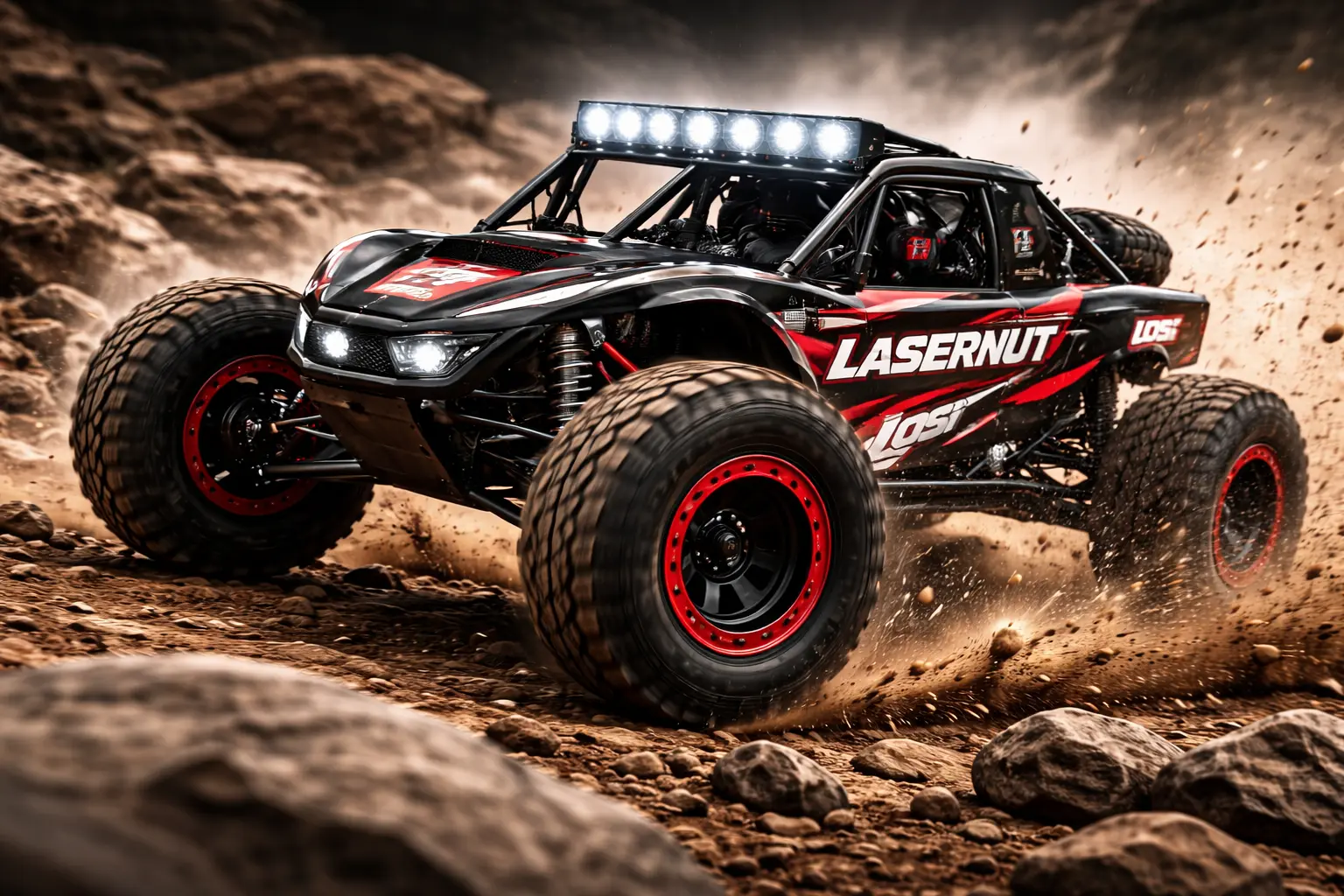
The moment you pull the Lasernut out of the box, it looks unlike anything else in a 1/10 lineup. The roll cage body, spare tire on the rear rack, integrated front LED light bar, and wide-stance proportions make it look like a miniature King of the Hammers competitor — because it is one. The licensed Raceline wheels in their copper/bronze finish match the full-size car exactly.
That visual impact is real, but so are some frustrations with out-of-box quality. I’ve seen multiple Lasernuts come out of the box with loose hardware throughout, incorrect camber settings, differentials that weren’t fully filled from the factory, and the servo saver adjusted so loosely that the steering feels drunk. It’s not every unit, but it’s enough to be a pattern. Budget 30 minutes for an inspection before your first run.
Tube Frame Chassis
The actual chassis is a 3mm anodized 6061-T6 aluminum plate with a 4mm upper deck and 4mm aluminum shock towers front and rear. It’s genuinely solid construction — this isn’t a flex-prone plastic tub. The exposed roll cage body sits above it and gives the car its rock racer visual identity while keeping weight low. The tradeoff is that the chassis itself has zero protection from below — the flat aluminum plate drags on anything you’d call a rock. RPM skid plates fix this immediately.
Suspension Design: Full Independent on All Four Corners
Here’s where the Lasernut separates itself from every other 1/10 trail machine: it runs full independent A-arm suspension on all four corners. Not IFS front with a 4-link rear — completely independent everywhere. This directly mirrors Cody Waggoner’s controversial full-size build that raised eyebrows at KOH before everyone started copying it.
The practical result is a car that handles high-speed desert terrain with precision that solid-axle machines simply can’t match. Each wheel travels independently, meaning the chassis stays flat while tires track the terrain. You lose some maximum low-speed articulation compared to a 4-link rear, but you gain enormously on anything involving speed and technical navigation at pace. It’s a philosophically different machine from a TRX-4 or Capra — and that’s by design.
Real-World Performance
I took my Lasernut out for the first time expecting something between a crawler and a basher — and it turns out neither of those is the right frame of reference. The first time I dropped into a dry creek bed section after a long flat run, something clicked. You can actually carry speed through rough terrain instead of slowing down for it. That’s not a feeling you get from a crawler. It’s also not reckless bashing — it’s precision at pace, and it’s genuinely addictive.
Rock Crawling
The Lasernut will navigate moderate rocky obstacles — trail sections with foot-high boulders, off-camber dirt transitions, loose shale — with a confidence that surprises people who know its platform. The tall BFGoodrich tires, wide stance, and 44mm of ground clearance do a lot of work.
But let’s be direct: this is not a dedicated crawler. It has no locking diffs, no portal axles, no low-range gearing, and no 4-wheel steer. Running your differential fluid slightly thicker improves low-speed rock grip, but the fundamental setup prioritizes speed over maximum crawling articulation. It handles trail obstacles the way the full-size Lasernut handles the boulder sections at KOH — confidently but quickly, not methodically.
I ran it alongside a buddy’s SCX10 III on a rocky trail section once. He was picking every line, winching once. I was finding ways around and through obstacles at a pace that kept things moving. We had completely different experiences of the same trail — both valid, neither the “better” one. If you want to stop and stare at a rock for five minutes before attempting it, the Lasernut isn’t your car. If you want to navigate varied terrain without stopping, it’s excellent.
For a deeper dive into what separates rock racers from pure crawlers, our RC crawlers guide breaks down the full spectrum.
High-Speed Runs & Desert Terrain
This is where the Lasernut comes alive. On packed dirt, gravel, or rocky desert track, the full independent suspension keeps the chassis flat and planted in a way that’s hard to believe until you see it. The car tracks through high-speed corners rather than washing wide, and rough terrain that would send other cars airborne just gets absorbed.
On 4S, 50+ mph is real but not the most fun — the tall soft tires make the car unstable at top speed, and the power can overwhelm traction on anything loose. The actual sweet spot for everyday driving is 3S with the 14T pinion: enough speed to feel exciting (roughly 35+ mph), precision that actually lets you drive intentionally, and enough control to navigate technical terrain without catching a rear wheel and rolling.
Jumping & Bashing
This is the section where I have to be honest with you: the Lasernut is not built to be launched off jump tables. It uses 1/10-scale Tenacity platform drivetrain components in what is essentially a 1/8-scale vehicle with massive, heavy tires. Physics does what physics does. The tall tires create enormous leverage on the front CVDs during hard landings, and those CVDs will snap. If you’re planning to run it through a bashing course with big air, budget for replacement driveshafts and front diff parts before you start.
For occasional natural terrain jumps at speed — the kind you encounter on a desert track — the Lasernut handles itself well. It was designed for those. It was not designed for skateboard ramps or jump-focused bashing parks.
What It Does Best (And What It Doesn’t)
The Lasernut’s sweet spot is mixed terrain at speed: sections where rocky obstacles, loose dirt, elevation changes, and open runs all happen back-to-back. That’s exactly the kind of terrain it was designed around. It does that better than anything else available at this price point.
It doesn’t replace a crawler if you want maximum rock garden capability. It doesn’t replace a desert basher if you want to huck massive jumps. The community learned this the hard way — owners who bought it thinking it was a crawler were disappointed; owners who understood the rock racer concept were thrilled.
Best Losi Lasernut U4 Upgrades
The stock Lasernut is a capable car held back by a few specific weak points. The upgrade path is well-established, relatively affordable, and genuinely transforms the vehicle.
Servo Upgrade
The stock Spektrum S614 at 201 oz-in is the single biggest limiting factor out of the box. Steering feel is sloppy, response is sluggish on the big 2.2” tires, and the steering saver ships absurdly loose. Fix this first.
The Savox SC-1201MG ($40–55) is the community’s top budget pick with 347 oz-in of torque — a 70% improvement over stock. For more demanding use, the Savox SW-1210SG ($70–80) adds full waterproofing and pushes 444 oz-in at 7.4V. Regardless of which servo you choose, also tighten the servo saver spring 5+ half-turns from the factory position. That alone makes a free, immediate improvement before you spend a dollar.
Tires (Crawling-Focused vs Speed-Focused)
The stock BFGoodrich KM3s are genuinely good performance all-terrain tires — well-suited for the car’s desert intent. If you want more rock grip, the Pro-Line Hyrax U4 in G8 compound (~$22–28/pair) was literally designed for U4 rock racers and fits the stock 2.2”/3.0” SC wheels directly. For pure speed, stick with the stock tires or look at Pro-Line Dumont paddle tires on sandy terrain.
Aluminum Links & Steering
The Exotek ETK1930 Heavy Duty Steering Set (~$35–45) replaces the stock plastic bellcrank assembly with 7075 aluminum and swaps brass bushings for proper bearings. Combined with the servo upgrade, this completely eliminates steering slop. GPM Racing makes a similar set (LU4048N) for $25–35. Aluminum steering bellcranks are the second upgrade every Lasernut owner recommends, right after the servo.
Shocks & Springs
Fresh shock oil makes a bigger difference than most people expect. A re-oil with 35wt front / 30wt rear TLR silicone shock oil ($15 total) transforms the suspension feel. For a full replacement, Pro-Line 6038 Pro-Spec shocks ($40–50/pair) or Team Associated V2 12mm Big Bore shocks are the community favorites. RPM skid plates should go on at the same time — the car ships with zero protection below the chassis plate.
Bearings Kit
FastEddy sealed bearing kit TFE6327 (~$25–30) replaces all 26 stock bearings with chromium steel units with rubber seals. In desert and dusty conditions, the stock bearings degrade surprisingly fast. This is a low-cost, high-return upgrade that extends component life across the entire drivetrain.
Battery Picks (3S vs 4S)
The Lasernut does not support 2S — minimum is 3S through the IC5 connector. For everyday use, a 3S 5000mAh LiPo hardcase ($30–45) with the 14T pinion is the sweet spot — plenty of speed, better control, easier on the drivetrain. For peak performance sessions, step up to a 4S 5000mAh pack ($45–65) with the 12T pinion. If you use Spektrum Smart packs, the ESC will display real-time voltage, capacity, and temperature through the DX3 transmitter — zero extra wiring required. Whatever brand you pick, check our best RC car battery chargers guide to make sure your charger can handle LiPo discharge and balance charging properly.
Losi Lasernut vs the Competition
| Losi Lasernut U4 | Axial Capra 1.9 | Element Gatekeeper | Losi Super Rock Rey V2 | |
|---|---|---|---|---|
| Price | $479.99 | $559.99 | ~$399 (discontinued) | ~$899–$949 |
| Scale | 1/10 | 1/10 | 1/10 | 1/6 |
| Suspension | Full independent | Solid axle / 4-link | Solid axle / trailing arm | IFS front, solid rear |
| Motor | Brushless 1900Kv | Brushed 540 | Brushed 550 | Brushless 750Kv |
| Crawling Rating | ★★★☆☆ | ★★★★★ | ★★★★☆ | ★★☆☆☆ |
| Speed Rating | ★★★★☆ | ★☆☆☆☆ | ★☆☆☆☆ | ★★★★★ |
| Best For | Mixed terrain at pace | Competition rock crawling | Trail crawling | High-speed desert |
The Axial Capra is the Lasernut’s philosophical opposite. Portal axles, 4-wheel steering, a 45:1 final drive ratio — it’s a purpose-built crawler that will pick its way over anything but tops out around 7 mph. If crawling is your primary use case, stop reading and buy the Capra.
The Element RC Gatekeeper was a strong value option with smart GKS trailing-arm rear suspension and a lower price point, but it’s now discontinued — secondary market only.
The Losi Super Rock Rey V2 shares the Lasernut’s Ultra4 DNA and IFS heritage, but in a completely different class — 1/6 scale, 8S-capable, 20+ lbs. It’s a rocket ship that happens to look like a rock racer. Our Losi Rock Rey review covers the full 1/6 Super Rock Rey V2 in detail. For the Losi off-road desert lineup more broadly, the Losi Baja Rey 2.0 review also covers where the brand sits in the high-speed segment.
Who Should Buy the Losi Lasernut U4?
Buy it if you are:
- An Ultra4 / King of the Hammers fan who wants a scale replica of the real thing
- A driver who wants to run mixed terrain — rocky sections, open desert, technical dirt — without stopping
- Comfortable with $150–200 of targeted upgrades to reach the car’s full potential
- A Spektrum Smart ecosystem user who wants seamless telemetry integration
Think twice if you are:
- Looking for a dedicated rock crawler — get the Axial Capra
- Planning to bash it off jump ramps regularly — the drivetrain won’t hold up
- Wanting true plug-and-play RTR reliability — the stock servo and build quality issues need attention
- Hunting for the blue colorway — it’s still available; the black is discontinued and stock is dwindling
FAQ
Q: Is the Losi Lasernut U4 a good crawler?
It’s a capable trail runner on moderate rocky terrain, but not a dedicated crawler. It has no locking differentials, portal axles, or low-range gearing. It handles trail obstacles confidently at pace, but a dedicated crawler like the Axial Capra will outperform it on serious rock gardens. Thickening the differential fluid improves low-speed rock grip if trail running is your focus.
Q: What battery does the Losi Lasernut U4 use?
The Lasernut requires a 3S or 4S LiPo through an IC5 connector — it does not support 2S. Maximum battery dimensions are 138.5 × 46.5 × 35mm. Losi includes two pinions: a 12T for 4S (installed) and a 14T for 3S. Most standard 5000mAh hardcase stick packs fit the tray. Spektrum Smart packs enable telemetry through the DX3 transmitter with no extra wiring.
Q: How fast is the Losi Lasernut U4?
Losi claims 50+ mph on 4S, which is plausible but not the most enjoyable speed for most terrain. The practical sweet spot is 3S with the 14T pinion, which puts speed in the 35+ mph range with far better control on loose or technical surfaces. Most experienced owners prefer 3S for everyday driving.
Q: Losi Lasernut vs Axial Capra: which is better?
They’re designed for completely different purposes, so the answer depends entirely on what you want. The Capra is a superior rock crawler with portal axles, 4-wheel steering, and massive articulation for slow technical terrain. The Lasernut is a superior rock racer with brushless power, independent suspension, and high-speed capability. If you want to crawl rocks slowly: Capra. If you want to race through mixed terrain: Lasernut.
Q: Can I use the Losi Lasernut for competitive crawling?
No. The U4RC racing organization did create a Lasernut class for box-stock chassis competition, but that’s a rock racing format — not traditional crawling competition. In a standard RC crawling competition judged on line selection and slow-speed precision, the Lasernut’s lack of locking diffs, portal axles, and low-range gearing puts it at a serious disadvantage against dedicated crawlers.
Final Verdict
The Losi Lasernut U4 is one of the most rewarding RC vehicles in the hobby — once you understand what it is. Out of the box, the sloppy steering and quality inconsistencies are genuinely frustrating. But after a proper servo swap, Exotek steering bellcrank, RPM skid plates, and fresh shock oil, this car does something no other 1/10-scale RTR can: blast through rocky desert terrain at speed with precision and authority, backed by the authentic heritage of a real Ultra4 racing team.
It is not a crawler. It is not a basher. It is a rock racer — the RC equivalent of a King of the Hammers competitor — and there is literally nothing else like it at this scale. If that concept excites you, the Lasernut U4 is absolutely worth the investment.