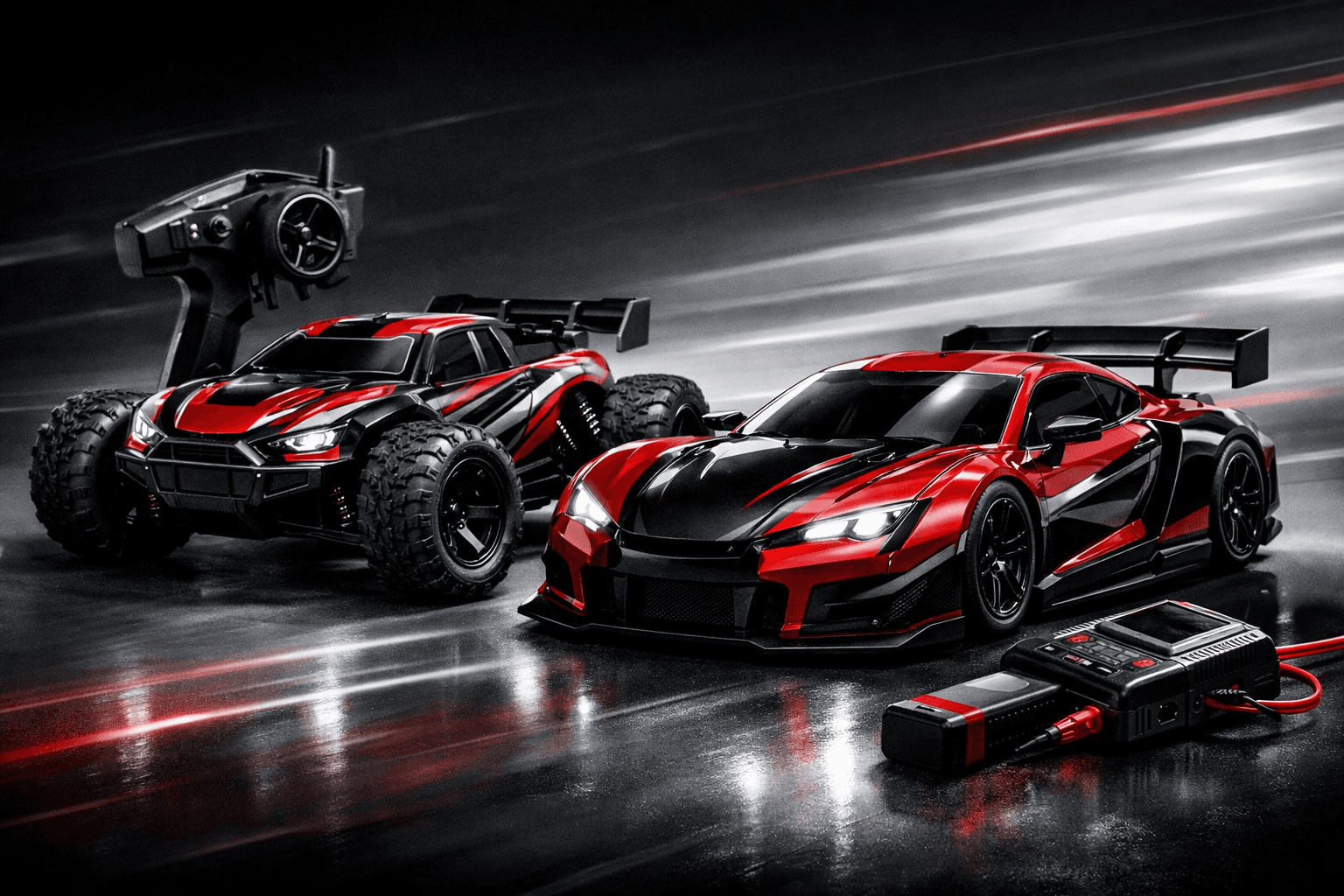
So you want to get into RC cars. Maybe your kid saw one at the park and wouldn't stop talking about it. Maybe you drove one at a friend's house and felt that unmistakable rush when 30 mph worth of truck launches off a curb. Whatever brought you here, you're about to make one of the best hobby decisions of your life — and one of the easiest to get completely wrong if you buy the wrong thing first.
I've been bashing RC cars for over a decade, and I've watched hundreds of beginners make the same expensive mistakes: buying a $40 Amazon special that falls apart in 20 minutes, ordering something rated for expert-level speeds on their first day, or spending $350 on a truck that doesn't come with a battery. This guide exists to cut through all of that confusion.
Here's what we'll cover: the best RC cars for beginners in 2026 across every budget and use case, a plain-English explanation of what all those confusing specs actually mean, the five beginner mistakes that cost people real money, and a full FAQ at the end.
This post contains affiliate links. If you make a purchase through these links, we may earn a commission at no extra cost to you.
Quick Comparison: Best RC Cars for Beginners in 2026
| Model | Price | Scale | Drive | Power | Battery Included | Top Speed | Best For |
|---|---|---|---|---|---|---|---|
| Traxxas TRX-4M | ~$150–$200 | 1/18 | 4WD | Brushed | ✅ Yes | 5–8 mph | True first-timer, indoor/outdoor |
| LaTrax Prerunner | ~$130–$160 | 1/18 | 4WD | Brushed | ✅ Yes | 20–25 mph | Budget first truck |
| ARRMA Granite Voltage | ~$99–$130 | 1/10 | 2WD | Brushed | ✅ Yes | 20–25 mph | Absolute tightest budget |
| Traxxas Slash 2WD XL-5 | ~$200–$230 | 1/10 | 2WD | Brushed | ✅ Yes | 30+ mph | Classic beginner pick |
| ARRMA Granite 4x4 223S BLX | ~$280–$370 | 1/10 | 4WD | Brushless | ❌ No | 50+ mph | Best value brushless basher |
| ARRMA Big Rock 4x4 3S BLX | ~$300–$400 | 1/10 | 4WD | Brushless | ❌ No | 50+ mph | Stability-first bashing |
| ARRMA Senton 4x4 3S BLX | ~$280–$310 | 1/10 | 4WD | Brushless | ❌ No | 50+ mph | Track/smooth terrain |
| ARRMA Vorteks 3S BLX | ~$260–$380 | 1/10 | 4WD | Brushless | ❌ No | 60+ mph | Speed-focused bashing |
| Traxxas Slash 4x4 VXL | ~$410–$450 | 1/10 | 4WD | Brushless | ❌ No | 60+ mph | Experienced beginner |
| Traxxas Stampede 4x4 VXL | ~$450 | 1/10 | 4WD | Brushless | ❌ No | 60+ mph | Monster truck power |
What You Need to Know Before Buying
Brushed vs. Brushless Motors
This is the most important decision you'll make, and it's worth reading our brushed vs brushless motor guide before pulling the trigger.
The short version: brushed motors have physical carbon brushes that make contact with the motor. They wear out, they run hot, and they're slower. Brushless motors have no contact points, are more efficient, and can be frighteningly fast. For most of the hobby's history, brushed was the "beginner" recommendation. That's changing fast in 2026. Brushless motors now come standard on trucks in the $280–$350 range, and many include electronic speed limiters that let you cap power at 50% or 75% until you're ready. If your budget is $250 or more, get brushless.
RTR vs. Kit
RTR (Ready-To-Race or Ready-To-Run) means it arrives assembled and ready to go. A kit is a bag of parts you build yourself — and that kit doesn't include a motor, ESC, receiver, servo, or battery. Kits are fantastic projects, but add $200+ to the true cost. For a first RC car, RTR only. No exceptions.
Scale Sizes
A 1/10 scale truck is roughly 17–18 inches long — the most common size, with the widest ecosystem of parts, bodies, and upgrades. A 1/18 scale truck is considerably more compact and perfect for indoor use, tighter backyards, and low-stress learning. Understanding scale sizes properly before you buy prevents a lot of "oh, this is smaller than I thought" regret. 1/16 is a compelling middle ground that's growing in popularity, offering more punch than 1/18 with more portability than 1/10.
The "True Cost" Problem
Many RTR trucks list a price that doesn't include a battery or charger. A quality 3S LiPo battery runs $30–$60, and a decent charger costs another $30–$50. Some listings will also require a LiPo-safe charging bag (~$10). Always check the box contents before you calculate your budget. The models in this guide note when battery and charger are included.
The Best RC Cars for Beginners in 2026: Full Reviews
1. Traxxas TRX-4M — Best Overall for First-Timers
Price: ~$150–$200 | Scale: 1/18 | Drive: 4WD | Battery: Included ✅
If I had to hand one truck to someone who had never driven an RC car in their life, it would be the TRX-4M. Full stop.
This 1/18 scale crawler arrives with everything in the box — a 7.4V LiPo battery, a USB-C 2-amp charger, and a 2.4GHz radio. Plug it in, charge it up, and you're driving in about 90 minutes. With a runtime of 60+ minutes on that single battery charge, you'll get more seat time in one afternoon than most other trucks give you across multiple packs.
The TRX-4M tops out at just 5–8 mph, which sounds boring until you realize that crawlers drive over rocks, roots, kerbs, and obstacles that would snap a fast truck in half. The 45° steering angle gives it a turning radius that feels almost supernatural in tight spaces. The triangulated 4-link suspension and oil-filled shocks mean it handles terrain with a precision and mechanical satisfaction that fast bashers just can't replicate.
The fully waterproof electronics mean you can drive through puddles, wet grass, and shallow streams without a second thought. The High Trail Edition adds a factory-installed lift kit and larger Mickey Thompson tires for about $30 more — worth it if you want to run outdoors on rocks and gravel regularly.
For a deep dive on what makes crawlers special, check out our crawler guide.
Pros: Everything included, 60+ min runtime, zero intimidation factor, legal in any space including indoors, ultra-durable
Cons: 5–8 mph won't satisfy a speed-seeker, 1/18 scale feels small to some
Check latest price and availability on Amazon
2. Traxxas Slash 2WD XL-5 — The Classic First Truck
Price: ~$200–$230 | Scale: 1/10 | Drive: 2WD | Battery: Included ✅
The Traxxas Slash has been the most recommended beginner RC car for over a decade, and the 2024/2026 refresh makes it better than ever. The updated model now ships with a 3000mAh 8.4V NiMH battery pack and a 45-watt USB-C charger that plugs into any wall outlet or USB-C power bank. The body uses a clipless retention system — no more losing body clips in the grass. Extreme Heavy Duty suspension components are now standard from the factory.
The Slash 2WD puts out speeds north of 30 mph through its XL-5 brushed ESC and Titan 12T motor. Waterproof electronics let you drive through puddles without drama. And crucially, it has Traxxas' patented Training Mode: one button press cuts the power in half but keeps full braking. New drivers can build muscle memory and spatial awareness at manageable speeds before unleashing full throttle.
2WD means it will spin and slide — which beginners often find frustrating on loose terrain, but eventually learn to control instinctively. That rear-wheel-drive character is actually part of the learning process.
Traxxas has unmatched parts availability. Every hobby shop in North America stocks Slash parts. The 7-day-a-week customer support line actually gets answered by people who know RC cars. If you break something — and you will — fixing it is fast, cheap, and educational.
Pros: Complete out-of-box experience, Training Mode, best parts availability on Earth, proper beginner speed
Cons: Brushed motor will eventually need maintenance, 2WD can be twitchy on loose dirt
Check latest price and availability on Amazon
3. ARRMA Granite 4x4 223S BLX — Best Value Brushless Basher
Price: ~$280–$370 | Scale: 1/10 | Drive: 4WD | Battery: Not Included ❌
This is the truck the RC community recommends most often in 2026 when someone has $300–$350 to spend. The Granite 4x4 223S BLX packs brushless power, 4-wheel drive, and an electronics package that would have been considered exotic three years ago — all at a price that undercuts the competition.
On a 2S LiPo, it hits 29–35 mph. On a 3S, it clears 50+. The genius of the 223S platform is that it grows with you: buy a 2S battery first to learn control, then step up to 3S when you're ready. You never need to buy a new truck.
The V4/223S version adds Dynamic Stability Control (DSC) with four modes and a physical throttle limiting switch on the transmitter that caps speed at 50%, 75%, or 100%. These features are genuinely useful for beginners, not marketing gimmicks. DSC makes high-speed cornering corrections automatically — think of it as training wheels that you actually want to use.
The 4WD drivetrain is dramatically more forgiving than 2WD on loose surfaces. The modular chassis design lets you remove the entire power module by unscrewing a single screw, making repairs fast and logical. One known weak point: the stock servo is underpowered for the speed this truck can reach. A $16–$20 servo upgrade is recommended once you start running 3S regularly.
For more on what makes a great basher, see our best bashers guide.
Pros: Best performance-per-dollar in 2026, DSC + throttle limiting, 4WD, modular chassis
Cons: Battery not included (add $35–$60), stock servo is weak
Check latest price and availability on Amazon
4. ARRMA Big Rock 4x4 3S BLX — Best Stability for Bashing
Price: ~$300–$400 | Scale: 1/10 | Drive: 4WD | Battery: Not Included ❌
The Big Rock is built on the same 4x4 BLX platform as the Granite, but with one deliberate difference: the stance is 1.1 inches wider. That sounds like a small change until you're flying a truck at 40 mph over a rutted track and it stays planted instead of looping over. Community consensus says it clearly: "Big Rock for stability, Granite for stunts."
The Crew Cab body adds visual mass and authenticity. The wider dBoots RAGNAROK tires grip aggressively. The same Spektrum Firma brushless system pushes it past 50 mph on 3S. The same modular design makes repairs straightforward. And the 223S version adds DSC and throttle limiting.
Where the Granite is a natural choice if you want a truck that's easy to throw around and pull stunts with, the Big Rock is the better pick if you're bashing rough terrain, driving fast on varied surfaces, or you just want maximum margin for error while you build your skills.
Pros: Wider stance = dramatically more stable at speed, same excellent electronics, tough Crew Cab body
Cons: Slightly less agile than Granite for stunts, same weak servo caveat
Check latest price and availability on Amazon
5. ARRMA Senton 4x4 3S BLX — Best for Smooth Terrain and Track
Price: ~$280–$310 | Scale: 1/10 | Drive: 4WD | Battery: Not Included ❌
The Senton is a short course truck — meaning it has an enclosed body shell with fenders that extend over the tires, mimicking full-size racing trucks. That lower, enclosed profile drops the center of gravity compared to a monster truck and makes it significantly harder to roll over at speed.
On paved surfaces, parking lots, and maintained tracks, the Senton is exceptional. It carves, it launches jumps cleanly, and it looks fantastic doing it. At 50+ mph on 3S, it's among the fastest platforms in this price range.
The catch is that enclosed wheel wells are great for high-speed clean-air performance, but they're a debris trap in rough terrain. Gravel and pebbles can jam into the wheel wells and lock the steering. If you're planning to drive primarily on dirt, grass, and rough ground — pick the Granite or Big Rock instead. If you're headed to a track, a parking lot, or your driveway, the Senton is the superior choice.
Pros: Low center of gravity, nearly impossible to flip, great track performance, 50+ mph
Cons: Enclosed wheel wells jam up on gravel/rough terrain, not ideal for off-road bashing
Check latest price and availability on Amazon
6. ARRMA Vorteks 3S BLX — Fastest in Class
Price: ~$260–$380 | Scale: 1/10 | Drive: 4WD | Battery: Not Included ❌
The Vorteks is the speed machine of the ARRMA 1/10 3S lineup. With an optional pinion gear swap, this stadium truck becomes the first ARRMA 4x4 3S model capable of cracking 60 mph. With AVC (Active Vehicle Control) traction control built into the Spektrum DX3 transmitter, it manages that speed with more electronic assist than most of its competitors.
The new 2WD 223S version at $260 is worth highlighting as a budget entry point into the ARRMA ecosystem. At 2WD and $260, it makes brushless bashing genuinely accessible. The tradeoff is the same as any 2WD: more driver skill required on loose surfaces.
One important caveat for beginners: the Vorteks' #1 reported community issue is motor bearing failure caused by dirt ingress. If you're driving on dusty or sandy terrain, run a motor filter, clean it after sessions, and don't push it in deep gravel. It's a minor maintenance habit, but it's real.
Pros: 60+ mph capability, AVC traction control, fastest ARRMA 3S model, new $260 2WD entry point
Cons: Motor bearing dirt ingress is known issue, requires maintenance discipline, too fast for absolute beginners
Check latest price and availability on Amazon
7. Traxxas Slash 4x4 VXL — When You're Ready to Step Up
Price: ~$410–$450 (true cost: ~$480–$550 with battery) | Scale: 1/10 | Drive: 4WD | Battery: Not Included ❌
The Slash 4x4 VXL is the premium short course truck in the Traxxas lineup, and it's a phenomenal machine — just not one I'd recommend as a first purchase. It's capable of 60+ mph on 3S LiPo and beyond on optional setups, and while Traxxas Stability Management (TSM) makes a meaningful difference, this is a truck that will punish overconfidence.
With the 2024 EHD (Extreme Heavy Duty) version, Traxxas added beefed-up suspension components, a clipless body, and improved drivetrain durability. The VXL-3s speed control and 3500 brushless motor are a matched, optimized system that delivers power in a controlled, predictable way.
This is the right truck if you've already driven RC for a few months, understand throttle management, and you're ready to commit to a higher performance ceiling. Buy it as a first truck and you'll be replacing parts every weekend.
Budget note: the listed price does not include a battery or charger. Add $70–$100 for a quality 2S or 3S LiPo and a proper smart charger — see our charger guide for what to buy.
Pros: Premium build quality, TSM stability management, excellent parts availability, 60+ mph ceiling
Cons: Battery/charger not included (true cost $480+), too fast for total beginners, expensive to repair at speed
Check latest price and availability on Amazon
8. Traxxas Stampede 4x4 VXL — The Monster Truck King
Price: ~$450 MSRP (true cost: ~$520–$570) | Scale: 1/10 | Drive: 4WD | Battery: Not Included ❌
The 2024 Stampede 4x4 VXL is a different beast from the Slash. Where the Slash is a precision racing machine, the Stampede is a monster truck built for spectacle — and the 2024 refresh added features that make it genuinely smarter, not just more powerful.
The headline addition is the 540XL motor — the same unit found in Traxxas' full-size Maxx extreme monster truck, transplanted into a 1/10 chassis. This is the most powerful motor ever offered in a truck this size. The 2024 update also added a self-righting feature: press a button on the transmitter and the truck flips itself back onto its wheels in seconds. No more walking out onto the field to rescue an upside-down Stampede.
A proper wheelie bar is standard to help manage the wheel-standing torque. The 5.3" Sledgehammer tires give it nearly 3 inches of center ground clearance. TSM (Traxxas Stability Management) keeps it pointed straight on slippery surfaces. Waterproof electronics throughout.
Like the Slash 4x4 VXL, budget for a battery and charger on top of the sticker price.
Pros: Self-righting feature, massive 540XL motor, TSM stability, 60+ mph monster truck fun
Cons: Battery not included (true cost $520+), absolutely not a first RC car, expensive repairs
Check latest price and availability on Amazon
9. ARRMA Granite Voltage (Granite 4X2 Boost) — Budget Entry Point
Price: ~$99–$130 | Scale: 1/10 | Drive: 2WD | Battery: Included ✅
The Granite Voltage — now sold as the Granite 4X2 Boost with battery and charger — is the most accessible hobby-grade RC car on this list. At under $130 with battery included, it gets you into the ARRMA ecosystem for the price of a decent meal out for four.
It's a 2WD brushed monster truck that reaches 20–25 mph, has waterproof electronics, a proper composite chassis, and uses the same modular design as the more expensive ARRMA trucks. When it breaks, parts are available. That alone separates it from anything you'll find on Amazon under $100.
The honest caveat: the stock Li-Ion battery that ships with some variants gives only around 6 minutes of run time. Budget for a second battery immediately — a compatible NiMH or LiPo will double or triple your run time. The community forum verdict is blunt: "Everyone who bought the Voltage wished they'd bought the 3S BLX." It's a gateway into the hobby, not a destination. But if your budget is firm at $130, it's genuinely the best option at that price.
Pros: Only hobby-grade option under $130 with battery included, real ARRMA parts availability, upgradeable platform
Cons: 6-minute stock runtime, 2WD, brushed motor will need replacement eventually
Check latest price and availability on Amazon
10. Traxxas LaTrax Prerunner — Budget Crawler Alternative
Price: ~$130–$160 | Scale: 1/18 | Drive: 4WD | Battery: Included ✅
The LaTrax Prerunner is the 1/18 scale speed truck to the TRX-4M's crawler. Where the TRX-4M moves slowly over terrain, the Prerunner hits 20–25 mph in a nimble, go-anywhere 1/18 package. Everything is included: a 7.2V NiMH battery, AC wall charger, and 4 AA batteries for the transmitter.
The Prerunner has all-metal gear differentials front and rear, fully independent suspension, oil-filled shocks, and training mode for new drivers. The LaTrax Lifetime Electronics Warranty means Traxxas will replace the ESC, receiver, or motor if they fail — for the life of the product.
The main limitation is the low ground clearance (0.59" / 15mm) — it gets hung up on high-pile carpet and deep grass. Keep it on hard surfaces, packed dirt, and reasonably smooth outdoor terrain and it performs well above its price point.
Pros: Complete out-of-box, Lifetime Electronics Warranty, 4WD, metal gear diffs, Training Mode
Cons: Low ground clearance limits terrain capability, brushed motor, 1/18 scale feels small to some
Check latest price and availability on Amazon
Brand Deep-Dive: Traxxas vs. ARRMA vs. Losi
Traxxas
Traxxas is the market leader for a reason. Their parts are available in virtually every hobby shop in North America — walk into any store and they'll have Slash parts. Their 7-day-a-week customer support is genuinely responsive. Training Mode is standard across the lineup. The Traxxas iD battery system makes charging nearly foolproof. The downside: Traxxas uses proprietary connector systems, their electronics warranties on many models are only 30 days, and their RTR listings often exclude battery and charger without making it obvious.
ARRMA
ARRMA is the value leader in 2026. Their 223S platform delivers brushless performance and beginner-friendly electronics at prices that genuinely undercut Traxxas VXL models. The 2-year warranty is among the best in the industry. The modular chassis design makes home repairs faster than any competitor. The downsides: less local shop presence than Traxxas, and a weak stock servo is a common complaint across the lineup that you'll want to budget for.
Losi
Losi has serious racing heritage and makes excellent products — notably the Mini-B and Mini-T 2.0 in the 1/16 range (~$150) which offer competition-derived suspension in a compact, beginner-accessible format. Losi products are slightly less ubiquitous in parts availability compared to Traxxas, but enthusiasts who pick Losi rarely regret it. For a complete picture across every major brand — including Axial, Tamiya, and FMS — our RC car brands guide covers the full landscape.
5 Beginner Mistakes That Cost Real Money
1. Buying a Generic Amazon Truck
$20–$60 Amazon RC "trucks" are toys, not hobby-grade vehicles. They're injection-molded out of brittle plastics with sealed electronics and no parts availability. They typically last 15–30 minutes before something breaks that cannot be fixed. The only exceptions worth mentioning are WLToys (144001, 124019) and some BEZGAR models, which offer genuine value in the $80–$120 range. Everything else branded HyperGo, SCY, or appearing on Temu/Banggood should be avoided. A $200 hobby-grade RC car that lasts years with $5 repairs beats a $50 toy that becomes landfill by Tuesday.
2. LiPo Battery Mismanagement
LiPo (Lithium Polymer) batteries are the performance standard in RC, and they require specific care. Discharging below 3.0V per cell causes permanent, irreversible damage. Storing a fully charged LiPo for extended periods degrades it and can create a fire risk. Always store LiPos at storage voltage (approximately 3.8V per cell). Never charge unattended. Always use a fireproof LiPo bag ($10 on Amazon) when charging.
3. Starting with Too Much Speed
60+ mph sounds incredible. It is also the fastest way to turn $400 worth of RC truck into $400 worth of RC truck parts scattered across a parking lot. Every experienced RC driver will tell you the same thing: start with a truck that's fast enough to be exciting (25–35 mph) but slow enough to develop real throttle control and spatial awareness. You can always go faster. You can't un-crash.
4. Skipping Pre-Drive Checks
RC trucks vibrate violently at speed. Screws loosen. Wheel nuts back off. The difference between a fun afternoon and a truck that sheds a wheel at 40 mph is two minutes of checking that everything is tight before each session. Dedicate a hex driver set to your RC bag and make the pre-drive check a habit from day one.
5. Not Budgeting for Repairs
You will break something. This is not a if, it is a when. Budget $30–$50 for a basic spare parts kit when you buy your truck. At minimum: extra suspension arms, wheel nuts, and a body mount. The parts you'll need are predictable based on your truck model — check YouTube and RC forums for "most common broken parts [your model]" before ordering. Having the part on hand means a 10-minute fix instead of a week waiting for shipping.
RC Cars and Drift: A Quick Note
Drift RC cars are a separate discipline that require rear-wheel-drive, polished hard plastic tires (designed to slide, not grip), and a very different driving style. If this sounds interesting, check out our complete drift guide for a full breakdown. For beginners specifically, the MST RMX 2.5 RTR ($300–$330) and HPI RS4 Sport 3 Drift ($200–$250) are the most accessible entry points. Do not buy a drift car as your first RC vehicle — the sliding behavior requires prior throttle and steering control skills to enjoy.
2025–2026 Updates Worth Knowing
The biggest trend reshaping the beginner RC market is the mainstreaming of brushless power with electronic stability assists. What used to cost $400+ now costs $280–$320, and it comes with features like Dynamic Stability Control and throttle limiting that genuinely change what's safe for a beginner to buy first.
Traxxas BL-2s Platform Rollout: The Slash 2WD, Slash 4x4, Stampede 4x4, and Rustler 4x4 have all received brushless power, clipless bodies, Extreme HD components, and USB-C chargers. This is now the standard Traxxas lineup.
Stampede 4x4 VXL: The 540XL motor and self-righting feature are 2024 additions that keep the Stampede relevant against newer competition.
ARRMA 223S DSC Series: The new generation Granite, Big Rock, Senton, Vorteks, and Typhon all feature Dynamic Stability Control with four selectable modes, a physical throttle limiting switch (50%/75%/100%), clipless bodies, all-metal center diffs, and reinforced chassis. This is ARRMA's most beginner-friendly platform to date.
ARRMA Vorteks 223S 2WD at $260: A new brushless entry point that makes the ARRMA ecosystem accessible at a price that previously required going brushed.
Frequently Asked Questions
What is the best RC car brand for beginners?
For most beginners, Traxxas and ARRMA are the two strongest choices. Traxxas offers the best parts availability and customer support, making it ideal for anyone who values being able to walk into a local hobby shop and get help. ARRMA delivers better performance per dollar, especially in the brushless segment, and backs their products with a 2-year warranty. Losi is excellent but slightly less ubiquitous. Any of the three will serve you well. Avoid generic unbranded brands regardless of the price.
Are Traxxas cars good for beginners?
Yes, very much so. Traxxas specifically designed features like Training Mode (which halves power output while maintaining full brakes), Traxxas Stability Management (TSM), and self-righting technology to help beginners develop control skills safely. Their 7-day-a-week customer support and unmatched parts availability mean you're never stranded without a fix. The one caveat is to read the box carefully — many Traxxas VXL models don't include a battery or charger, which can add $70–$100 to the real cost.
How fast do beginner RC cars go?
Entry-level brushed RC cars typically reach 20–30 mph, which is plenty fast for learning. Mid-range brushless models run 35–50 mph. High-performance brushless trucks reach 60+ mph. For most new drivers, anything over 35 mph requires developed reflexes and spatial awareness to control safely. Start in the 25–35 mph range and work up — the hobby is more fun when you're driving on purpose rather than reacting to crashes.
Is it cheaper to build or buy an RC car?
For beginners, buying RTR (Ready-To-Run) is significantly cheaper and less complicated than building from a kit. A comparable kit will cost more than an RTR version of the same model once you add the motor, ESC, receiver, servo, and battery — often $200+ more. Building is a rewarding experience with genuine learning value, but it's a second or third RC project, not a first. RTR always makes sense to start.
Do I need extra batteries and a charger?
If your truck doesn't include a battery and charger (most brushless models over $250 don't), yes — you need both before you can drive. Even if a battery is included, a second battery pack is highly recommended. Most RC batteries provide 20–40 minutes of runtime. A second pack means you drive while one charges, doubling your time on track. See our charger guide for specific recommendations on smart chargers and compatible LiPo packs for each truck.
Final Verdict: Which One Should You Buy?
After all of this, here's the simple version:
You want zero-stress, maximum fun, and a complete kit: Get the TRX-4M (~$150–$200). Everything included, 60+ minute runtime, suitable for literally any space, unkillable patience for beginners.
You want a classic fast truck with complete kit and best support: Get the Traxxas Slash 2WD XL-5 (~$200–$230). The hobbyist's standard for over a decade, and the 2024 refresh made it better than ever.
You want the best performance per dollar in 2026: Get the ARRMA Granite 4x4 223S BLX (~$280–$370 plus battery). The community's most-recommended brushless basher, with a feature set that would have cost $450 three years ago.
You want maximum stability and forgiveness at speed: Get the ARRMA Big Rock 4x4 3S BLX (~$300–$400 plus battery). The wider stance makes it the most controllable fast truck in its price range.
Your budget is firm under $130: Get the ARRMA Granite Voltage / 4X2 Boost (~$99–$130 with battery). For a broader look at everything available at this price range, our best RC cars under $100 guide covers the full field. It's a real hobby-grade truck at a toy price, and it upgrades to brushless when you're ready.
Whatever you choose, remember the golden rule of this hobby: buy from a major brand (Traxxas, ARRMA, Losi), buy RTR, and budget for one spare parts run before you ever leave the driveway. Follow those three rules and you'll be driving for years instead of weeks.
Once you've found your footing and want to explore more advanced options beyond the entry level, our best RC cars for adults guide covers hobby-grade picks across every budget and driving style.
Welcome to the hobby. Try not to crash into the dog.