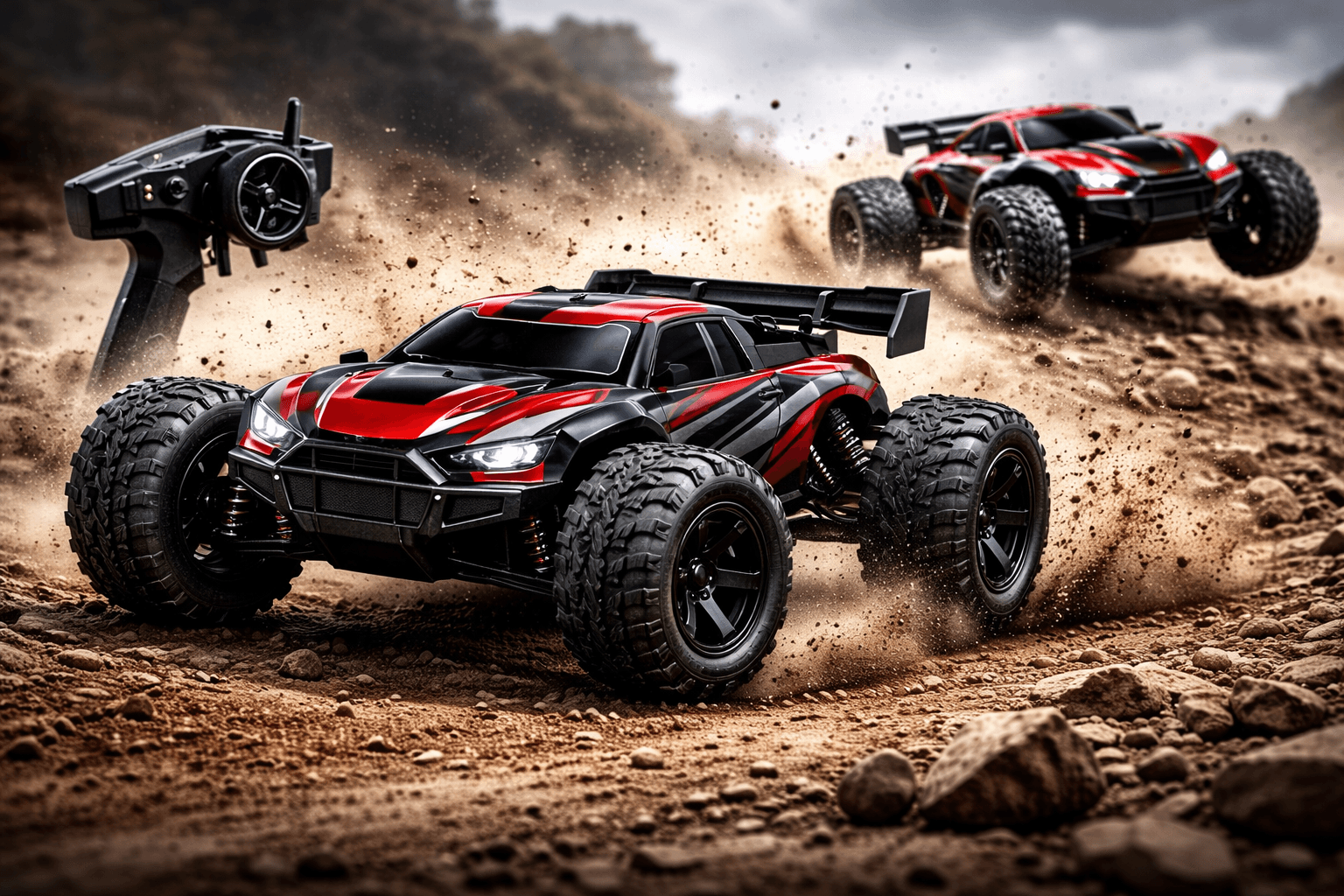
A good basher is a truck you can launch full-speed off a curb, watch it pinwheel through the air, and drive straight home without touching a screwdriver. This guide covers every off-road RC truck category — monster trucks, short course, stadium, desert trucks, and everything in between — with battle-tested picks at every budget, whether you're spending $280 or $900.
This post contains affiliate links. If you make a purchase through these links, we may earn a commission at no extra cost to you.
Quick Picks — Best RC Trucks & Bashers at a Glance
| Truck | Price Range | Category | Power System | Best For | Rating (/10) |
|---|---|---|---|---|---|
| Traxxas X-Maxx 8S | $750–$900 | Monster Truck | Electric 8S | The ultimate backyard king | 9.5 |
| Traxxas Maxx V2 | $450–$530 | Monster Truck | Electric 4S | First serious monster truck | 9.0 |
| Arrma Kraton 6S BLX | $450–$530 | Monster Truck | Electric 6S | Durability-first bashers | 9.2 |
| Losi LMT | $430–$500 | Monster Truck | Electric 4S | Solid axle purists | 8.5 |
| Traxxas Slash 4x4 VXL | $370–$430 | Short Course | Electric 3S | All-around best first truck | 9.4 |
| Arrma Senton 3S BLX | $280–$310 | Short Course | Electric 3S | Best value basher under $310 | 8.8 |
| Losi Tenacity TT Pro | $280–$340 | Short Course | Electric 3S | Underrated gem | 8.3 |
| Traxxas Rustler 4x4 VXL | $370–$420 | Stadium Truck | Electric 3S | Speed + versatility | 8.9 |
| Arrma Typhon 6S BLX | $430–$500 | Buggy | Electric 6S | Pure speed on any surface | 9.0 |
| Arrma Mojave 6S | $480–$550 | Desert Truck | Electric 6S | Best-looking basher on the market | 9.1 |
| Traxxas UDR | $650–$800 | Desert Truck | Electric 6S | Scale desert racing experience | 8.7 |
| Losi Baja Rey 2.0 | $430–$530 | Desert Truck | Electric 3S | Losi scale realism on a budget | 8.4 |
| Arrma Vorteks 3S | $270–$300 | Stadium Truck | Electric 3S | Budget speed demon | 8.0 |
RC Truck Categories Explained
Before you drop $400 on a truck you'll bash in a gravel pit, it's worth knowing what you're actually buying. RC trucks come in distinct flavors, each built around a different driving experience. If you're also interested in learning about scale sizes before diving into categories, that guide will help you understand what 1/10 vs 1/8 vs 1/5 actually means in the real world.
Monster Trucks
Monster trucks are the rock stars of the RC world — oversized tires, high ground clearance, and a suspension system designed to absorb the kind of landings that would destroy anything else. The Traxxas X-Maxx, Arrma Kraton, and Losi LMT all live here. These are the trucks people buy when they want to jump things, crush things, and generally cause a scene at the park. Prices range from around $430 for an entry-level 4S machine up to $900+ for the full 8S X-Maxx experience. Monster trucks are the most popular RC category for a reason — they're the most fun per dollar.
Short Course Trucks
Short course trucks look like miniature versions of the Baja 1000 race trucks you see on TV, complete with wide rear bumpers and a lower, racier profile. They're incredibly versatile — comfortable on dirt tracks, grass, gravel, and pavement. The Traxxas Slash 4x4 is the best-selling RC vehicle of all time, and it earned that title. Short course trucks typically run 1/10 scale and are lighter and more nimble than monster trucks, making them easier to control for newer drivers. Prices generally run $280–$430 for hobby-grade models.
Stadium Trucks
Stadium trucks are the lightweight, high-speed cousins of the short course world. They share similar dimensions but run a narrower body and lighter build, which translates to less rolling resistance and more top-end speed. The Traxxas Rustler 4x4 and Arrma Vorteks are classic examples. These are the trucks you pick when raw speed and technical driving matter more than durability at maximum impact. Great for RC tracks, not ideal for sending off 10-foot jumps onto concrete.
Truggies
A truggy is exactly what it sounds like — a buggy and a truck had a baby. You get the large-diameter tires and ground clearance of a truck combined with the low center of gravity and refined suspension geometry of a competition buggy. The result is a vehicle that handles better than a monster truck but can still absorb serious abuse. The Arrma Talion is the best-known truggy on the market. Truggies tend to attract drivers who want to go fast and jump things without completely sacrificing lap times.
Trophy Trucks / Desert Trucks
Desert trucks and trophy trucks combine scale realism with genuine bashing capability. These are the vehicles that look like they rolled off the Baja 1000 course — long travel suspension, wide stance, and performance coilovers that actually do what they're supposed to. The Traxxas UDR, Losi Baja Rey 2.0, and Arrma Mojave 6S dominate this category. If you care about how your truck looks as much as how it drives, this is where you land.
Best Monster Trucks
Traxxas X-Maxx 8S
The Traxxas X-Maxx 8S ($750–$900) is not a truck. It's a statement. At 1/6 scale and weighing nearly 20 pounds fully loaded, this thing will physically intimidate anyone at the bash spot before you even touch the throttle. Running on dual 4S LiPo packs (8S combined), it pushes past 50 mph stock — but speed is only part of the story. The X-Maxx was designed to be self-righting, meaning it can roll back onto its wheels from any orientation, and its center differential makes it one of the most capable platforms in the monster truck segment. The waterproof electronics, heavy-duty aluminum chassis components, and Traxxas's legendary parts ecosystem mean this truck will outlast most others. If you've got the budget, the X-Maxx is the definitive backyard basher. Still torn between the X-Maxx and the Arrma Kraton 8S? Our X-Maxx vs Kraton 8S comparison covers which one wins for your driving style. Looking to customize yours? Our best Traxxas X-Maxx body shells guide covers the top options.
The downsides are real, though: it's heavy, which means hard landings hit harder, and the price of admission is steep. The X-Maxx isn't the right first truck for someone who's never driven hobby-grade before — the power will catch you off guard. But if you're upgrading from something smaller and you want to go big, there's nothing quite like it.
Check Price on Amazon
Traxxas Maxx V2
If the X-Maxx feels like too much truck (or too much price), the Traxxas Maxx V2 ($450–$530) is where most serious bashers start. This is a 1/10 scale monster truck running on 4S power, capable of 50+ mph with the right battery, and it packs almost everything people love about the X-Maxx into a more manageable package. The V2 revision brought a wider stance, updated suspension geometry, and better stability at speed — the original Maxx had a tendency to get squirrely past 40 mph, and Traxxas fixed that. My Traxxas X-Maxx has been my go-to backyard basher for over a year, and every time I look at the Maxx V2, I think about how it would have saved me a few hundred bucks while still delivering 90% of the experience. That's not a knock — that's a compliment to how good the Maxx is.
The Maxx V2 runs Traxxas's TQi 2.4GHz radio system and comes with telemetry capability out of the box. The main weakness is that it's not as bulletproof as the Arrma Kraton at the same price — the plastic chassis components will crack eventually with aggressive bashing. The aftermarket for the Maxx is excellent, though, and aluminum replacements are everywhere. Prefer a more versatile all-terrain platform? The Traxxas E-Revo 2.0 VXL is worth a look as a 6S alternative with similar Traxxas ecosystem advantages. Check Price on Amazon
Arrma Kraton 6S BLX
The Arrma Kraton 6S BLX ($450–$530) is how Arrma answered the question "what if we built a monster truck that could survive almost anything a driver could throw at it?" I've cartwheeled my Kraton 6S off a 15-foot dirt ramp and the thing drove away like nothing happened. Then I did the same with a cheaper truck and collected the pieces in a bag. Durability matters, and the Kraton has it in spades. The composite chassis is specifically engineered to flex and absorb impacts rather than crack, and the metal-geared drivetrain holds up to 6S abuse better than most of its competitors.
The Kraton runs the Spektrum Firma 6S brushless system with an 2050KV motor, and it hits around 60 mph on a good 6S run. The handling at speed is exceptional for a monster truck — the geometry keeps it planted without sacrificing the big-air capability you're buying a monster truck for. Weaknesses? The Spektrum radio system that Arrma bundles in is just okay — most hardcore bashers upgrade to a Spektrum DX5C or Futaba 4PV eventually. And the stock body doesn't survive as long as the actual truck, but that's true of every basher in this class. Check Price on Amazon
Losi LMT
The Losi LMT ($430–$500) is something different. While every other monster truck on this list uses an independent suspension setup, the LMT runs solid axles front and rear — the same configuration you see on full-scale monster trucks at the arena. That makes it feel completely unlike anything else in your garage. It's heavier and slower to turn in than the Kraton or Maxx, but it has an unshakeable, planted quality that makes big jumps feel confidence-inspiring. The LMT also comes in some incredible licensed liveries (Son-Uva Digger, Grave Digger, Megalodon) which adds a collectibility factor that the Arrma and Traxxas trucks can't match.
The drawbacks are real: solid axles aren't as refined as independent suspension for high-speed bashing, and parts availability is narrower than what you get with Traxxas or Arrma. But as a complementary truck — something you pick up after you already own a Kraton or Maxx — the LMT is one of the most unique driving experiences in the hobby. Check Price on Amazon
Best Short Course Trucks
Traxxas Slash 4x4 VXL
The Traxxas Slash 4x4 VXL ($370–$430) has been the best-selling RC vehicle in the hobby for years, and that's not marketing — it's because the truck actually deserves it. Four-wheel drive, the Velineon 3500KV brushless system, waterproof electronics, and an aftermarket parts ecosystem so large you could build ten different Slashes from scratch without ordering anything from the manufacturer. I ran a Traxxas Slash 4x4 as my only truck for almost two years before upgrading. If I could only own one RC vehicle, that's probably still the one I'd pick.
It's fast (50+ mph on 3S), capable everywhere, and replaceable parts are at every hobby shop in the country. The only complaint is that it's not the cheapest way into the hobby, and the body takes a beating fast if you're bashing hard. Get an extra body shell when you order. Check Price on Amazon
Arrma Senton 3S BLX
The Arrma Senton 3S BLX ($280–$310) is the truck you recommend to the person who wants a proper hobby-grade basher without the Traxxas price tag. Read our full Arrma Senton 3S review for the detailed breakdown. This is a 1/10 scale 4x4 short course truck with the same Arrma build quality you get in the bigger 6S models — composite chassis, metal gears throughout the drivetrain, and electronics sealed against mud and water. On 3S, it runs around 60 mph, which is more speed than most people's brains are ready for the first time. The Senton won't wow you with exotic features, but it will take everything you throw at it and come back for more. At this price point, the value is nearly unmatched. Check Price on Amazon
Losi Tenacity TT Pro
The Losi Tenacity TT Pro ($280–$340) doesn't get talked about enough — our Losi Tenacity DB Pro vs TT Pro comparison breaks down every version in detail. It runs a competition-style buggy chassis under a short course body, which gives it handling characteristics that the Slash and Senton can't quite match at speed. It's nimbler, more responsive, and genuinely fun to drive on a proper dirt track. The Spektrum 3S brushless system delivers solid punch, and the build quality is Losi-standard (which is excellent). The main limitation is that it's the hardest to find parts for at your local hobby shop — if you're far from a major city, you'll be ordering online. But for the driver who wants something a little different with better track performance, it's a genuinely underrated truck. Check Price on Amazon
All three short course trucks cover similar ground, but the Slash 4x4 VXL wins on parts support, the Senton wins on value, and the Tenacity TT Pro wins on handling finesse. If you're brand new to RC, check our beginner's buying guide before committing to any of them.
Best Stadium Trucks & Buggies
Traxxas Rustler 4x4 VXL
The Traxxas Rustler 4x4 VXL ($370–$420) is the stadium truck for people who want to go fast on everything. Same Velineon power as the Slash, same 4WD drivetrain, but in a lighter, lower-profile stadium truck body that clips through the air more cleanly and feels absolutely planted at speed. It's not the most exciting-looking vehicle, but it's one of the most honest — it does exactly what you'd expect, does it brilliantly, and parts are everywhere. For grass, hardpack dirt, and occasional track days, the Rustler 4x4 VXL is hard to beat. Check Price on Amazon
Arrma Typhon 6S BLX
The Arrma Typhon 6S BLX ($430–$500) is technically a buggy, but it belongs in every conversation about fast RC trucks because it is genuinely, embarrassingly fast. On 6S, the Typhon has been recorded at over 80 mph stock with a properly charged pack, and on the right surface it handles like it's on rails. The low center of gravity from the buggy platform keeps it stable at speeds that would flip a monster truck. This isn't a truck for parking lots and casual bashing — the Typhon rewards driving skill. But if you want to go fast in a straight line or get quick on an oval track, nothing at this price point touches it. Check Price on Amazon
Arrma Vorteks 3S
The Arrma Vorteks 3S ($270–$300) is the entry point into the Arrma speed world. At 1/10 scale on 3S power, it'll hit around 60 mph and costs less than any comparable truck in Arrma's lineup. Build quality is consistent with every other Arrma product — the composite chassis and metal drivetrain components are built to survive. If you want an introduction to stadium truck handling without spending Typhon money, the Vorteks is a clean, honest choice. Check Price on Amazon
Best Desert / Trophy Trucks
Traxxas UDR
The Traxxas UDR ($650–$800) — Unlimited Desert Racer — is what happens when Traxxas decides to build a trophy truck and refuses to compromise. Six-wheel independent suspension with Fox-licensed shocks, a six-channel radio, and a scale level of detail that makes it one of the best-looking RC trucks ever made. On 6S it runs comfortably past 50 mph, and the long-travel suspension turns rough terrain into a non-event. It's expensive and requires more setup than a Slash or Maxx, but if you love the Baja race truck aesthetic and want a truck that performs as well as it looks, the UDR is in a class by itself. Check Price on Amazon
Losi Baja Rey 2.0
The Losi Baja Rey 2.0 ($430–$530) brings the desert trophy truck experience down to a price point that doesn't require a second mortgage. Running on 3S power at 1/10 scale, it's not the fastest truck in any category, but the scale detailing is excellent and the driving dynamics are genuinely rewarding — long suspension travel, accurate steering, and a balanced chassis that's forgiving without being boring. For the RC driver who cares about scale realism and wants to actually use the truck as a basher rather than a shelf queen, the Baja Rey 2.0 is a satisfying pick. Check Price on Amazon
Arrma Mojave 6S
The Arrma Mojave 6S ($480–$550) is probably the best-looking basher on the market right now, and it can back it up. The wide desert truck stance, massive ground clearance, and long-travel coilover suspension combine to create a truck that looks fast standing still and actually is fast moving. On 6S it hits 60+ mph, and the Arrma composite chassis handles abuse the way every Arrma does — which is to say, it takes hits that should end a truck and keeps going. This is the truck for the driver who wants to look cool at the bash spot and still out-survive everyone else there. Check Price on Amazon
Electric vs Nitro vs Gas — Which Power System?
Electric (Brushless)
Electric brushless is what 95% of hobby-grade RC trucks run, and for good reason. Modern brushless motors deliver more power than nitro engines at a fraction of the maintenance cost, they're cleaner, quieter (relative to nitro), and the performance ceiling is essentially unlimited — you can run from $300 budget motors to $500 competition-grade systems. LiPo batteries have gotten cheaper, chargers are smarter, and the learning curve is far gentler than anything with a carburetor. If you're buying your first truck or returning to the hobby after years away, go electric brushless. For a deeper look at motor types, our brushed vs brushless guide explains the full picture. This is the recommendation for 99% of buyers, full stop.
Nitro
Nitro trucks run on methanol-based fuel with a small two-stroke glow engine, and they deliver something electric can't: the scream of a real engine at 40,000 RPM and the smell of exhaust. For a certain type of RC enthusiast, that's everything. The trade-off is real — nitro requires needle tuning, glow plug changes, air filter maintenance, and break-in procedures before you even make a full run. Run times are shorter than you'd expect, and the gap between nitro and brushless performance has closed dramatically in the last five years. Nitro is a shrinking market, but it still has a dedicated and passionate following. If you want the engine experience, it's there — just go in with open eyes about the maintenance commitment.
Gas (Large Scale)
Gas-powered RC trucks typically run at 1/5 scale with small displacement two-stroke or four-stroke engines running on regular pump gasoline. These are serious machines — the Losi 5ive-T and HPI Baja 5T are the classic examples, and they're genuinely large vehicles that can weigh 25+ pounds and run at highway speeds. The experience of running a gas-powered RC truck is unlike anything in the hobby — loud, fast, and mechanically engaging in a way that neither electric nor nitro can replicate. The price of entry is high ($700–$1,500+), maintenance is substantial, and they require space that smaller trucks don't. But if you want the 1/5 scale RC cars experience and the sound and smell of a real engine, gas is the only way to go.
What to Look For in a Basher
Durability
The first thing that breaks on most RC trucks isn't what you'd expect — it's the A-arms, body posts, and shock towers, not the motor or ESC. These plastic components absorb energy from impacts, and they're designed to break before the more expensive parts do. When you're evaluating a basher, look at whether the manufacturer uses composite (fiber-reinforced) plastics rather than standard ABS, whether aluminum upper chassis components are available as upgrades, and whether the drivetrain uses metal gears or plastic ones. Arrma's composite chassis has become an industry benchmark for exactly this reason — it's engineered specifically for the kind of abuse bashers deliver.
Parts Availability
This might be the most important factor nobody talks about enough. A $400 truck that you can't find parts for locally is effectively dead the moment it breaks — and every RC truck breaks eventually. Traxxas and Arrma dominate the hobby precisely because their parts are stocked at virtually every hobby shop in North America. You can walk into a store, grab an A-arm or a servo saver, and be back on the road the same day. Other brands may make excellent trucks but require waiting a week for online orders every time something snaps. For bashers especially, proximity to parts is proximity to fun.
Waterproofing
When RC trucks are advertised as "waterproof," what that actually means is that the electronics (ESC, receiver, motor) are sealed against water intrusion — splash-resistant and muddy-puddle-safe. It does not mean submersible. You can run a waterproof RC truck through wet grass, shallow puddles, and mud without the electronics dying. You should not drive it across a creek or submerge it. After any wet run, rinse off mud, dry out the truck with compressed air, and check that bearings haven't seized — water gets past seals over time. Most hobby-grade trucks from Traxxas and Arrma are waterproof from the factory; always confirm before you take a truck out in the rain.
Battery System
The S-rating on a LiPo battery refers to how many cells it contains, each at 3.7V nominal — so 2S = 7.4V, 3S = 11.1V, 4S = 14.8V, 6S = 22.2V, 8S = 29.6V. In practical terms: 2S is enough for casual driving and small-scale trucks. 3S is the sweet spot for most 1/10 scale bashers — fast enough to be exciting, manageable enough to control. 4S starts getting serious, and most adult drivers find it highly satisfying. 6S is for experienced drivers who want to go very fast or do very big jumps. 8S (X-Maxx territory) is a full commitment to maximum everything. Our charger guide will help you pick the right charging setup once you know what voltage you're running.
Upgradeability
The best bashers are platforms, not finished products. An Arrma Kraton or Traxxas Slash can be progressively upgraded over years — aluminum A-arms from RPM or Pro-Line, stronger servo savers, upgraded differentials, higher-KV motors, and better pinion/spur gear combos that raise top speed or increase torque. The aftermarket for top-tier bashers is enormous, and there's genuine satisfaction in building a truck piece by piece that outperforms anything you could buy stock. Before committing to any basher, check whether a real aftermarket exists for it. If the answer is mostly "order from China and wait six weeks," it's probably not your primary basher.
How Fast Do RC Trucks Actually Go?
Here's the honest truth: speed is fun for about five minutes before you realize durability is more fun for the next five years. That said, knowing what to expect is important before you spend $500 on a truck.
| Category | 2S Speed | 3S Speed | 6S Speed |
|---|---|---|---|
| Monster Truck (1/10) | 25–30 mph | 45–50 mph | 60–65 mph |
| Short Course Truck (1/10) | 30–35 mph | 50–55 mph | N/A (most are 3S max) |
| Stadium Truck / Buggy (1/10) | 35–40 mph | 55–60 mph | 75–85 mph |
| Desert Truck (1/10) | 30–35 mph | 50–55 mph | 60–65 mph |
| Monster Truck (1/8, 8S) | N/A | N/A | 50–60 mph (8S = ~65+) |
For the absolute fastest RC trucks available, the Traxxas XRT and Arrma Limitless are built specifically for speed runs and can exceed 100 mph with the right motor/battery combination — these aren't bashers, they're dedicated speed machines. RC cars going 100 mph is a real thing, and it's as insane as it sounds. But for bashing, 50–60 mph is more than enough to produce both enormous jumps and enormous crashes.
FAQ
Q: What is the most durable RC truck?
Both the Arrma Kraton 6S and the Traxxas Maxx V2 have earned reputations as near-indestructible within their respective price brackets. The Kraton's composite chassis and metal-gear drivetrain handle impacts that would total most other trucks. The Maxx's parts ecosystem means that even when something breaks, you're back on the road fast. Either one will outlast cheaper alternatives significantly.
Q: Are Traxxas or Arrma trucks better?
This debate is older than some RC drivers. Traxxas wins on parts availability and customer support — their trucks can be fixed at virtually any hobby shop in North America, and they've been doing this longer. Arrma wins on durability engineering at the same price point — the composite chassis and metal components are genuinely harder to break. For a first truck, Traxxas's ecosystem is a real advantage. For experienced bashers who know what they're doing, Arrma often delivers more truck per dollar.
Q: What's the fastest RC truck you can buy?
For speed runs on a flat surface, the Traxxas XRT (dual motor, 8S) and Arrma Limitless (specifically built for top speed attempts) are the fastest RC trucks available to consumers, with legitimate GPS-verified runs exceeding 100 mph. For off-road bashing, the Arrma Typhon 6S is one of the fastest production trucks you can drive on actual terrain.
Q: Can you run RC trucks in the rain?
If your truck is rated as waterproof — which most modern Traxxas and Arrma hobby-grade trucks are — yes, you can run in light rain and through puddles. "Waterproof" means sealed electronics, not submersible. After a wet run, rinse the truck with fresh water, dry it thoroughly, and lube metal components to prevent rust. Bearings are the most common casualty of regular wet running; plan to replace them periodically.
Q: How much should I spend on my first RC truck?
The $250–$400 range is where the hobby-grade experience starts and where the value-to-fun ratio peaks. Below $250, you're looking at toy-grade vehicles that won't survive serious bashing and don't have replaceable parts. At $280–$310, the Arrma Senton 3S gets you into real hobby-grade performance. At $370–$430, the Traxxas Slash 4x4 VXL adds best-in-class parts support and proven durability. Spending more than $400 on your first truck is possible, but we'd recommend getting comfortable with the hobby first.
Conclusion
Bashing is the most accessible and most immediately gratifying corner of the RC hobby. You don't need to tune a carburetor, build a track, or memorize racing lines — you need a truck, a pack of charged batteries, and somewhere outdoors with dirt or gravel. If this is your first hobby-grade truck, the Arrma Senton 3S BLX at $280–$310 is the recommendation that gets you the most capability for the money, while the Traxxas Slash 4x4 VXL at $370–$430 adds the parts ecosystem that makes long-term ownership easier. Both will handle everything you can throw at them and beg for more.
Want to see what else the hobby has to offer? If you're an adult buyer looking for premium picks across all categories, our best RC cars for adults guide is the right next stop. Or check our beginner's guide for the full starting point, or explore crawli and drifti for a totally different vibe.