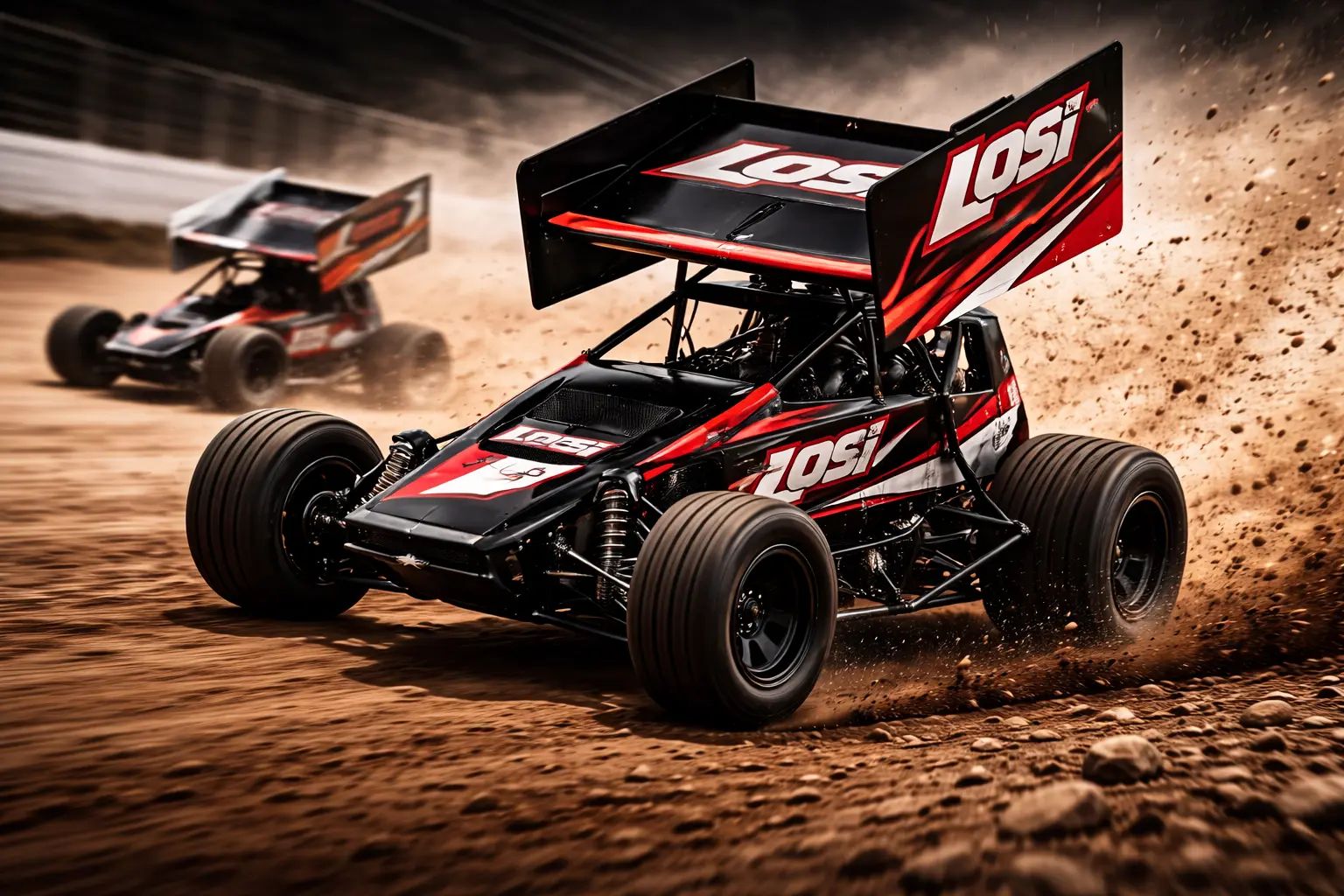
There’s something primal about a sprint car sliding through a dirt oval with the wing flat against the air, tires barely maintaining grip as the driver threads the cushion. Real sprint car racing — World of Outlaws, USAC, Saturday night at the local half-mile — is visceral, loud, and beautiful. For years, RC sprint car racing captured that same feeling but stayed a deeply niche hobby, locked behind expensive competition kits and a steep learning curve. Then Losi dropped the 22S Sprint Car in March 2025, and the whole segment changed overnight.
This guide covers every RC sprint car worth your money in 2026 — from the Losi 22S as the ultimate starting point to the serious competition hardware from Custom Works and beyond — plus everything you need to know about oval setup, tires, wings, and finding a track near you.
This post contains affiliate links. If you make a purchase through these links, we may earn a commission at no extra cost to you.
What Makes RC Sprint Cars Different?
RC sprint cars aren’t just a body kit on a buggy chassis. They’re purpose-built machines designed to replicate the dynamics of dirt oval racing — and that means they behave completely differently from anything else in the RC world.
On an oval, you’re always turning left. That single constraint changes everything about how the car is set up. There’s no differential tuning for right-hand corners. Instead, you’re dialing stagger (different tire sizes on left vs. right), wing angle, and weight placement to maximize corner speed in one direction only. The massive top wing generates real downforce at speed. The offset chassis positions weight toward the left rear — the loaded corner during a left-hand slide. It’s actually closer to real racing engineering than most RC categories.
The connection to full-size racing runs deep. Tony Stewart — NASCAR legend, sprint car team owner, and owner of Eldora Speedway — literally owns Custom Works RC, the heritage competition brand in this space. Hoosier Racing Tire licenses its name to Losi for scale-accurate tread patterns on the 22S Sprint. The RC Chili Bowl runs alongside the real Chili Bowl Nationals in Tulsa every January. This isn’t a toy category pretending to be racing. It’s racing, scaled down.
Racing surfaces break down into three categories: dirt/clay ovals are the most common and most authentic, carpet ovals run indoors year-round with foam tires, and asphalt exists as a smaller niche. The rc racing guide covers the full landscape of RC racing disciplines if you want to see how oval fits into the broader picture.
Best RC Sprint Cars Compared
| Product | Scale | Type | Price | Best For | Rating |
|---|---|---|---|---|---|
| Losi 22S Sprint Car RTR (Red) | 1/10 | RTR | $399.99 | Best overall — beginners to club racers | ⭐⭐⭐⭐⭐ |
| Losi 22S Sprint Car RTR (Blue/Green) | 1/10 | RTR | $349.99 | Own your own battery | ⭐⭐⭐⭐⭐ |
| Custom Works Enforcer 8 (Direct Drive) | 1/10 | Kit | $499.99 | Competition — clay/carpet | ⭐⭐⭐⭐⭐ |
| Custom Works Bullet Sprint (High Bite) | 1/10 | Kit | $549.00 | Competition — high-traction dirt | ⭐⭐⭐⭐⭐ |
| RJ Speed Spec Sprint Car | 1/10 | Kit | $177.99 | Budget — first kit build | ⭐⭐⭐ |
| 1RC Racing Sprint Car 4.0 RTR | 1/18 | RTR | ~$210 | Indoor/entry-level, smaller track | ⭐⭐⭐⭐ |
Losi 22S Sprint Car RTR — Best Overall
Until early 2025, if you wanted a ready-to-run RC sprint car in 1/10 scale, you had basically one option: the 1RC Racing 1/18 scale car. Everything else was a kit you built yourself. Then Losi released the 22S Sprint Car and the whole calculus changed.
I still remember unboxing mine and just staring at it for a minute. The chrome wheels, the scale driver figure with the painted helmet, the electroplated exhaust headers — this thing looks like a proper sprint car at first glance, not a toy. The moment I pulled the body release clip (a single spring-loaded lever, no pins) and saw the aluminum chassis underneath, I knew this wasn’t a casual release.
The 22S platform already had serious credibility — it underlies the Losi 22S Drag Car and other platform variants, and it borrows race geometry from the Team Losi Racing 22 championship buggy. Building a sprint car around that platform was a smart move.
Specs & What’s in the Box
| Spec | Detail |
|---|---|
| Scale | 1/10 |
| Drivetrain | 2WD rear-wheel drive |
| Motor | Spektrum Firma 3650 3300Kv brushless (sensorless) |
| ESC | Spektrum Firma 45A Brushless Smart Lite |
| Servo | Spektrum S684 25T waterproof metal gear |
| Radio | Spektrum SLT2 2-channel 2.4GHz |
| Chassis | 2.5mm 6061-T6 aluminum |
| Top speed | 25+ mph |
| Battery (RTR base) | 2S LiPo, IC5 connector |
| Shocks | Aluminum threaded (30wt front / 35wt rear) |
| Wheelbase | 10.25″ (260mm) |
| Weight (no battery) | 4.95 lb (2.25 kg) |
| Tires | Licensed Hoosier, 2.2″-based, soft compound |
The Red variant (LOS-2359, $399.99) includes a Spektrum Smart 2S 4000mAh 30C LiPo with IC5 connector plus a Spektrum Smart S120 USB-C charger. That bundle saves you roughly $25 versus buying battery and charger separately — and for first-time buyers, having everything in the box removes a lot of friction. The Blue (LOS-1387T1) and Green (LOS-1387T2) variants run $349.99 but require you to source your own 2S LiPo.
Notable box contents beyond the car itself: Two complete decal sheets with custom number options, a non-winged sprint nameplate for wingless class eligibility, a body clip tool, and printed quick-start guide. Losi also offers free downloadable body panel templates on their website for custom livery projects.
Three variants available:
| Color | SKU | Battery Included? | Best For |
|---|---|---|---|
| Red | LOS-2359 | Yes + charger ($399.99) | Best buy — complete package |
| Blue | LOS-1387T1 | No ($349.99) | Have your own 2S IC5 battery |
| Green | LOS-1387T2 | No ($349.99) | Have your own 2S IC5 battery |
Note: Recently, the Blue and Green variants have been showing as back-ordered or unavailable at multiple retailers. The Red version appears to have the most consistent supply — shop accordingly.
How It Drives on Dirt
The first time I got the 22S Sprint sideways through a banked dirt turn — proper four-wheel drift, wing slicing through the dusty air — I genuinely laughed out loud. The rear-wheel-drive layout combined with the sealed gear diff means you manage throttle like a real sprint car driver. Brush it early, you push wide. Squeeze it gradually, the car hooks up and slings out of the corner.
On hard-pack clay, the stock Hoosier tires give solid initial bite. On loose dust, you’ll want softer compound JConcepts tires fairly quickly — the stock rubber starts sliding around in a way that’s less controlled drift and more randomness. The sensorless Spektrum motor delivers power linearly enough for beginners but lacks the low-speed precision of a sensored system. An upgrade to a Hobbywing Justock combo will transform the driving experience, especially for competitive oval racing.
At stock power levels, the 22S Sprint is genuinely beginner-accessible. The chassis geometry is forgiving — the long wheelbase keeps it stable on oval, and the offset weight bias makes left-hand corners feel natural. Cornering on the outside of a banked track, feeling the side-bite load up and hold, is exactly what this car was built for.
Wing adjustment takes about 30 seconds. Loosen two screws, tilt the angle, retighten. You’ll find yourself doing this constantly as you dial in the car for different track conditions — it’s one of those setup variables that makes a genuinely noticeable difference.
Pros & Cons
Pros:
- Complete RTR package — no building required
- Excellent scale detail and authenticity
- Aluminum chassis with TLR 22 racing geometry
- Winged/non-winged configurations included
- Quick-release body/cage system (no pins)
- Strong aftermarket support already emerging (Pro-Line body, AKA tires, custom wraps)
- Compatible with TLR/Losi option parts ecosystem
Cons:
- Stock motor is sensorless — notchy low-speed performance, less competitive at club level
- IC5 connector is Spektrum-proprietary — most racing batteries use XT60/Deans
- Blue and Green variants have been scarce since launch
- Gear differential (not a locked axle) moderates stagger effectiveness
- At $349–$400, it’s the most expensive entry-point in the RTR segment
- Stock servo is adequate but not upgrade-level for competition
Custom Works Sprint Car Kits — Best for Competition
Custom Works RC has a backstory that no other brand in this hobby can match: it’s owned by Tony Stewart. The three-time NASCAR Cup champion, sprint car fanatic, and owner of Eldora Speedway bought the company in 2003 and has been personally racing their cars ever since. When the guy who races full-size sprint cars for fun also builds and races RC sprint cars, that’s about as strong an endorsement as a brand can have.
I’ve built both a Losi 22S Sprint RTR and a Custom Works Enforcer kit. The experience couldn’t be more different. With the Losi, you’re unboxing and driving the same day. With the Enforcer, you’re spending a weekend building — and every hour of that build teaches you something about oval racing setup that makes you a better driver.
Current Custom Works Models
| Model | Price | Best Surface | Drivetrain |
|---|---|---|---|
| Enforcer 8 (Direct Drive) | $499.99 | Clay/carpet/asphalt (foam tires) | Direct Drive |
| Enforcer 8 (Gearbox) | $499.99 | Clay/carpet/asphalt | Gearbox |
| Bullet Sprint (High Bite) | $549.00 | High-traction loose dirt | Buggy tires |
| Outlaw 5 | $499.99 | Loose dirt | Buggy tires |
The Enforcer 8 Direct Drive is the go-to for tracks running spec/stock classes — Direct Drive means no gearbox, just motor-to-diff, which is required for many spec classes. The Gearbox version unlocks modified classes where gear ratios are adjustable. The Bullet is Custom Works’ newest platform, optimized for high-bite outdoor dirt with standard 2.2 buggy tires.
Remember: these are kits only. Budget an additional $300–$400 for a quality radio, servo, ESC/motor combo, battery, and charger. Total investment typically lands between $750–$1,000+ to have a race-ready Custom Works build.
Who Are Custom Works Kits For?
These aren’t beginner products. They’re for racers who have outgrown RTR performance and want to compete seriously at club and national level. The chassis construction — carbon fiber plates, 7075 aluminum CNC components, titanium turnbuckles, ceramic diff balls — is legitimately race-grade hardware.
Custom Works cars have won the RC Chili Bowl and multiple national events. If your goal is podiums at organized oval events, this is where you end up. If you’re still figuring out whether oval racing is for you, start with the Losi and graduate from there.
Other RC Sprint Car Options
RJ Speed — Best Budget Kit
RJ Speed makes the most affordable RC sprint car kits on the market, targeting club racers and hobbyists who want a purpose-built oval car without the Custom Works price tag. The Spec Sprint Car (~$178) is their strongest offering — it includes mounted and trued foam tires and a ball diff, putting it closer to race-ready than the base kits. The Classic Sprint and Speedway Sprinter are more bare-bones.
Reviews are mixed — quality control is inconsistent compared to Custom Works, and instructions can be vague. But for spec Legends-class racing at a local track where everyone’s on similar equipment, RJ Speed holds its own.
1RC Racing Sprint Car 4.0 — Best Small-Scale RTR
The 1RC Racing Sprint Car 4.0 (~$210) is the only other RTR sprint car in the current market. At 1/18 scale with an 8700Kv brushless motor, NiMH battery, and 2.4GHz radio, it’s a complete package at a lower price point than the Losi. It runs well on smaller carpet ovals and indoor tracks where a 1/10 car would be too large. Not a competition tool against 1/10 racers, but a great way to experience oval racing in a garage or basement setup.
McAllister Racing Bodies — For Custom Builds
McAllister Racing produces scale Lexan sprint car bodies designed for serious builders. The Velocity VS-A Sprint and Mercer Sprint are their flagships — thick polycarbonate construction, made in the USA, available in multiple wall thicknesses for different durability needs. The Placerville Sprint is specifically designed for Custom Works chassis. These are for builders who want authentic-looking scale detail without a stock body.
Budget Options & DIY Conversions
A popular budget path is converting a short course truck or stadium truck for oval racing. The Traxxas Slash Modified class ($420 MSRP) is factory-built specifically for this — it includes a proper oval body and sprint car-inspired setup geometry. Not a sprint car in the traditional sense, but it runs in the same oval racing ecosystem and uses similar track strategy.
True DIY conversions (slapping a McAllister body on a custom chassis) exist in the community but require fabrication experience and comfort sourcing individual components. Possible, but the Losi 22S RTR is now competitive enough at $350–$400 that DIY conversions make less sense than they did before its release.
Sprint Car Setup Guide: Getting Dialed for Oval Racing
Oval racing is a different technical world from off-road or on-road RC. The concepts aren’t complicated, but they’re counterintuitive if you’re coming from buggies or touring cars. Here’s what you actually need to know.
Stagger Setup Explained
Stagger is the difference in tire circumference between the right side and left side of the car. A larger tire on the right means the car naturally arcs left — exactly what you want on a left-turn-only oval. Think of rolling a coffee cup with a taper: it curves toward the smaller end.
On a banked track with good grip, you might run 1–2 inches of right-side stagger. On a flat track with low traction, you might run zero stagger or even reverse stagger (left side bigger). Start at zero and adjust based on how the car wants to turn — if it understeers (pushes wide), add right-side stagger. If it oversteers (spins out), reduce it.
On the Losi 22S Sprint specifically, the sealed gear diff moderates the effect of rear stagger. The front is more sensitive: a larger right-front tire promotes more understeer; a larger left-front loosens the car. Front stagger adjustments have a stronger influence than rear on this platform.
Wing Angle & Downforce
The top wing is your primary aerodynamic tuning tool. More angle (25–35°) generates more downforce — better corner grip, slower top speed. Less angle (15–20°) reduces drag for higher straight-line speed with less cornering bite. For dry-slick/low-grip conditions, increase wing angle. For heavy/tacky tracks with abundant mechanical grip, flatten the wing and carry more speed.
Moving the wing forward on its mounting increases front-end grip. Moving it rearward adds rear stability. Small wickerbill tabs at the trailing edge add significant downforce with minimal extra drag — a trick borrowed directly from full-size sprint car setup. At stock 22S Sprint motor speeds, aerodynamic effects are subtle but real. Upgrade to a 13.5T sensored system and the wing becomes a major setup variable.
Tire Choices for Dirt & Clay
The JConcepts system is what most competitive oval racers use as a reference:
| Compound | Color | Best Surface |
|---|---|---|
| Super Soft | Green | Loose/dusty outdoor dirt |
| Soft | Blue | General outdoor/indoor |
| Versatile | Aqua | Dusty-to-medium bite |
| High Bite | Gold | Indoor clay/carpet |
| Ultra High Bite | Silver | Max traction indoor |
The Dirt Webs front + Ellipse rear combo in Green or Aqua compound is the consensus starting point for loose dirt. For clay and indoor carpet, Ellipse front and rear in Gold or Silver compound. Bring multiple compound sets — track conditions change throughout a race day, and what works in morning practice often doesn’t work for the evening main.
→ Shop RC Oval Dirt Tires on Amazon
Weight Placement Tips
The battery is the heaviest single component in a 1/10 sprint car. Moving it around is your primary ballast adjustment. The Losi 22S Sprint’s adjustable battery tray allows fore/aft positioning — take advantage of it.
Move the battery forward for more steering response on entry. Move it rearward for better traction on corner exit. Move it left (inward) to shift cross-weight toward the loaded rear corner in left-hand turns — generally desirable for more traction and stability. Beyond the battery, adjustable spring preload on the shocks lets you set cross-weight percentage, but the battery position is where most beginners should start.
Best Losi 22S Sprint Car Upgrades
Wraps & Bodies
The stock painted body looks sharp out of the box, but the real fun starts with custom wraps. Several vendors have already built out Losi 22S-specific libraries:
- Whipple’s Kustom Wraps (whipplekustomwraps.com) — 50+ designs, replica driver themes (Kyle Larson, Rico Abreu, etc.), custom one-offs available. ~$40–60. Community consensus: “the best wrap available, hands down.”
- Darkside Studio Arts (darksidestudioarts.com) — chrome finishes, metallic flakes, neon patterns, chassis skins
- Truline Graphics (trulinegraphics.com) — custom with your number and name, $49.99, 2–3 day production
For competitive racing, the Pro-Line Losi 22S Sprint Car Body (PRO3674-00) is a lightweight polycarbonate replacement that trims 115 grams off the stock plastic body. In close racing, that matters.
Motor & ESC
This is the most impactful upgrade you can make. The stock Spektrum Firma 3650 (sensorless, 3300Kv) delivers reasonable fun at stock speeds but doesn’t hold up competitively.
The community consensus is clear: the Hobbywing XR10 Justock G3S Combo (~$160) is the sweet spot for club racing. Available in 10.5T, 13.5T, 17.5T, and 21.5T turns. It’s ROAR approved, runs in “blinky” mode (0° timing) for spec class legality, and delivers smooth sensored performance that transforms low-speed oval control.
For modified (open timing) classes, the Hobbywing XR10 Pro G3 ESC + V10 G3 motor (~$200–250) or Tekin RS Gen2 combos are popular choices.
→ Shop Brushless Motor Upgrades on Amazon
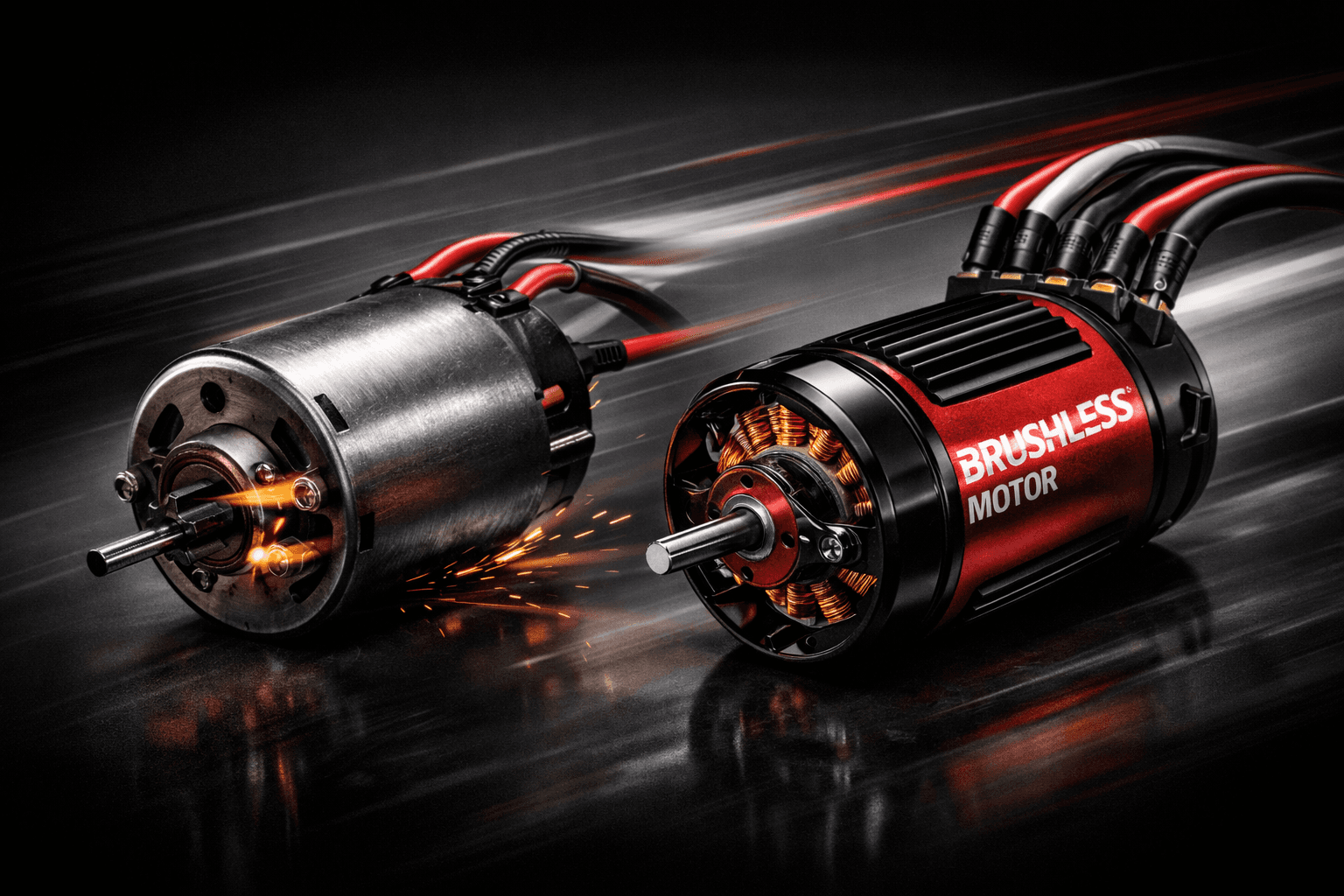
See also: Brushed vs Brushless RC Motors — many entry oval classes actually mandate brushed motors to keep costs down and racing close.
Tires
See the tire section above. For a direct Amazon option that covers the most common choice categories:
→ Shop RC Oval Sprint Tires on Amazon
Servo
The stock Spektrum S684 is waterproof and functional, but for competitive oval racing you want faster transit times and more consistent hold. Target 0.08–0.10 seconds at 6V+, metal gears, and low-profile if your car has clearance constraints.
Mid-tier picks: Savox SC-1258TG ($70) and Savox SC-1251MG ($55) are widely used. Step up to the ProTek RC 575LP (~$130, brushless motor) for serious competition.
→ Shop High Speed Digital Servos on Amazon
Battery
The Losi 22S Sprint runs on 2S LiPo with an IC5 connector. The Red bundle’s included 4000mAh battery is fine for bashing but on the small side for a full race program.
For racing, shorty packs (96mm) keep weight centered and low. The Gens Ace 2S 5000mAh Shorty ($40) or CNHL 2S 4900mAh Shorty (~$25) are solid choices. Note that most racing batteries use XT60 or Deans connectors — you’ll need an IC5 adapter or to resolder.
→ Shop 2S LiPo Shorty Packs on Amazon
Where to Race RC Sprint Cars
The RC oval community is active, welcoming, and growing — but finding your local scene requires a little digging since these tracks don’t always have prominent online presences.
Best resources for finding a local track:
- RCSignup.com (rcsignup.com/events/eventsByState.cfm) — the most comprehensive event list in RC racing, filterable by state and by track surface type (indoor dirt, outdoor dirt, carpet oval). Start here
- DirtOval.com Track Directory — owned by Custom Works, focused specifically on dirt oval. Community-maintained
- OvalRC.net Track Directory — dedicated oval resource with YouTube content
- Facebook Groups — honestly the most reliable method. Search your city or state plus “RC dirt oval” or “RC sprint car racing.” Nearly every active oval club has a Facebook page that’s more current than any website
Major national events worth knowing:
- RC Chili Bowl — Tulsa, OK each January alongside the full-size Chili Bowl Nationals. The premier sprint car RC event
- Motorama — Harrisburg, PA each February. Runs 410 Sprint, 360 Sprint, Late Model, Midget, and MudBoss classes with 50-lap A-mains. Sold-out crowd, real production value
Governing body: ROAR (roarracing.com) sanctions RC oval nationally. Membership is $40/year and opens access to sanctioned events. Their oval racing rulebook sets minimum sprint car weight (50oz) and class specifications — worth reading before building for competition.
FAQ
Q: What scale are RC sprint cars?
The dominant competition scale is 1/10, which is what Custom Works, Losi, RJ Speed, Team GFRP, and most other manufacturers build for. A growing 1/18 segment led by 1RC Racing exists for smaller tracks and entry-level racing. Quarter-scale (1/4) sprint cars are a separate gas-powered niche with their own national organization (QSAC) and a much higher price point (~$2,500+).
Q: Can I race a Losi 22S Sprint Car on carpet?
Yes, but the stock tires are for dirt — the soft Hoosier compound will slide on carpet rather than grip. For carpet oval racing, you’ll want to swap to foam tires appropriate for high-bite surfaces (JConcepts Gold or Silver compound). The chassis itself is perfectly capable on carpet; it’s purely a tire and setup change.
Q: What is stagger on an RC sprint car?
Stagger is the intentional difference in tire circumference between the right and left sides of the car. Because oval racing only turns left, running a larger right-side tire causes the car to naturally arc left — helping it negotiate corners with less driver steering input. It’s one of the most important oval setup variables. Start with zero stagger and add in small increments, adjusting based on whether the car pushes (add stagger) or oversteers (reduce stagger).
Q: How much does it cost to get into RC sprint car racing?
The Losi 22S Sprint RTR is the cheapest complete starting point at $349.99–$399.99. Add a better battery ($25–$40), possibly an aftermarket motor combo later ($160), and some tire sets ($20–$30 each), and a full racing setup in the $500–$600 range is realistic. Competition kit builds (Custom Works, Team GFRP) run $750–$1,000+ with electronics but are optional — many club racers race RTR-based cars for years.
Q: Are there RC sprint car competitions near me?
Almost certainly, if you’re in the US. Start with RCSignup.com filtered to your state and “oval” surface type. Facebook is often more current — search your area plus “RC dirt oval.” Most tracks run weekly or biweekly club races with low entry fees ($5–$15 typically) and welcome beginners. The oval community is notably welcoming compared to some RC disciplines.
Final Verdict: Which RC Sprint Car Should You Get?
Just starting out and want to race oval: Get the Losi 22S Sprint Car RTR in Red ($399.99, battery included). It’s the best entry point this hobby has ever had — a properly engineered sprint car with zero build time and a strong upgrade path once you catch the bug. You’ll be on the track the same weekend it arrives.
Budget-conscious and don’t mind building: The RJ Speed Spec Sprint Kit at ~$178 gets you a legitimate 1/10 oval racer at roughly half the Losi price. Add a basic radio/servo/ESC setup for another $100–150 and you’re racing. Quality is lower than the Losi, but for spec class club racing, it works.
Serious about competition: Step into a Custom Works Enforcer 8 ($499.99 kit) with a Hobbywing Justock motor combo. The build process teaches you oval racing engineering from the inside out, and the carbon fiber/CNC chassis has the race pedigree to back up the investment. Tony Stewart didn’t become part-owner of a hobby brand to sell mediocre hardware.
Want to try oval before committing: The 1RC Racing 1/18 Sprint Car 4.0 (~$210) is an RTR package at a lower buy-in. Run it on a carpet track or in your driveway oval and see if the format clicks before you invest in 1/10 equipment.
The dirt oval RC scene is having a moment. Losi’s entry into the sprint car market brought a manufacturer with real distribution and real credibility to a segment that’s been quietly passionate for decades. Whether you start with a $178 kit or a $400 RTR, you’re getting into something that’ll have you looking for local tracks before you’ve finished your first battery pack. The Losi NASCAR oval racers crowd is already discovering dirt oval — and many of them aren’t looking back.