Your motor, ESC, and tires get all the attention — but the battery is the single biggest performance upgrade most beginners overlook. Swap a tired NiMH pack for a quality LiPo and your RC car will feel like an entirely different machine. This guide covers everything you need to know about LiPo specs, safety, connectors, and the best batteries for every budget and vehicle in 2026.
This post contains affiliate links. If you make a purchase through these links, we may earn a commission at no extra cost to you.
LiPo vs NiMH: which battery type should you use?
If your RC car came with a NiMH pack, you’ve probably already noticed the power fading halfway through a run. That slow voltage drop is baked into NiMH chemistry. LiPo batteries deliver a flat, consistent voltage from start to finish, which means stronger acceleration and more predictable handling the entire session.
Here’s a side-by-side comparison:
| Feature | NiMH | LiPo |
|---|---|---|
| Voltage per cell | 1.2V | 3.7V |
| Weight (5000mAh) | 350–400g | 200–280g |
| Punch / acceleration | Moderate, fades over run | Strong and consistent |
| Runtime (same mAh) | Shorter effective runtime | Longer effective runtime |
| Price (5000mAh pack) | $30–50 | $20–60 |
| Maintenance | Minimal | Balance charging, storage voltage |
| Safety | Very low risk | Low risk with proper care |
The verdict: NiMH packs are fine for absolute beginners or kids who want zero battery management. For everyone else, LiPo is the move. They’re lighter, more powerful, deliver flat power curves, and are often cheaper per pack than NiMH equivalents. The tradeoff is that LiPo batteries require a balance charger and a few safety habits — all of which become second nature within a week.
The first time I dropped a 3S into my Slash after running 2S for months, it felt like a completely different truck. The acceleration nearly ripped the body off the clips.
If you’re brand new to the hobby, check out our complete RC cars beginner guide for a full overview before diving into battery specs.
Understanding LiPo battery specs
Four numbers define every LiPo pack: cell count, capacity, discharge rate, and connector type. Understand these and you’ll never order the wrong battery again.
Cell count (2S, 3S, 4S, 6S) — what the “S” means
The “S” stands for “series” — the number of 3.7V cells wired together inside the pack. More cells means higher voltage, and higher voltage means more motor RPM and speed.
| Cell Count | Nominal Voltage | Fully Charged | Typical Use |
|---|---|---|---|
| 2S | 7.4V | 8.4V | 1/10 scale beginners, crawlers, touring cars |
| 3S | 11.1V | 12.6V | Arrma 3S line, Traxxas VXL trucks, mid-range bashers |
| 4S | 14.8V | 16.8V | Traxxas Maxx, performance 1/8 scale |
| 6S | 22.2V | 25.2V | Arrma 6S line, Traxxas E-Revo 2.0, speed demons |
Critical rule: never exceed your ESC’s voltage rating. A 3S pack in a 2S-only ESC will fry your electronics instantly. Always check the specs before upgrading cell count. If you’re curious about the performance difference, read our Traxxas 3S vs 2S comparison for real-world testing data.
Capacity (mAh) — how long you can run
Capacity is measured in milliamp-hours (mAh) and directly determines runtime. A 5000mAh pack is the sweet spot for most 1/10 scale vehicles — expect roughly 20–30 minutes of mixed bashing. Stepping up to 6500mAh stretches that to 30–40 minutes but adds noticeable weight. Packs at 8000mAh+ are popular for 1/8 scale trucks where the larger chassis handles the extra grams without a handling penalty.
The tradeoff is straightforward: more capacity means longer runs but a heavier vehicle. For racing, lighter is better. For weekend bashing, go bigger and enjoy the extra time.
Discharge rate (C-rating) — how much power it can deliver
The C-rating tells you the maximum continuous current a battery can supply. The formula is simple: capacity (in Ah) × C-rating = max amps. A 5000mAh pack rated at 50C can theoretically deliver 250 amps continuously.
Here’s the honest truth: C-ratings are wildly inflated across the industry. There’s no standardized testing method, and most batteries perform at roughly 35–50% of their advertised rating. A pack labeled “100C” from a budget brand likely performs similarly to a “50C” pack from a reputable one. Independent testing has confirmed this repeatedly.
Don’t obsess over C-ratings. For most bashers, a 25C–50C rating from a trusted brand (Gens Ace, Zeee, Ovonic, CNHL) is more than enough. A 5000mAh 25C pack already delivers 125 amps continuous — well above what a Traxxas Velineon VXL-3s system pulls at full throttle. Spend your money on capacity and brand reputation, not chasing inflated C-rating numbers.
Connector types — the compatibility maze
This is where beginners get tripped up most often. Different brands use different connectors, and ordering the wrong one means your battery won’t plug in.
| Connector | Current Rating | Used By | Notes |
|---|---|---|---|
| Traxxas iD | ~75A | All Traxxas vehicles | Proprietary; integrates balance plug |
| IC5 | 120A | Current Arrma, Losi (Spektrum ecosystem) | Backwards-compatible with EC5 |
| IC3 | 60A | Older Arrma/Spektrum models | Backwards-compatible with EC3 |
| EC5 | 120A | Aftermarket batteries, older Arrma | Plugs directly into IC5 |
| XT60 | 60A | Most aftermarket batteries | Growing standard for 1/10 scale |
| XT90 | 90A | High-power 6S+ setups | Common on 1/8 scale aftermarket |
| Deans/T-plug | ~60A | Budget batteries, older vehicles | Universal but lower current handling |
Key compatibility tip: IC5 and EC5 connectors are physically cross-compatible — an EC5 battery plugs directly into an IC5 ESC with no adapter. Same goes for IC3 and EC3. The “IC” version simply adds a data pin for Spektrum Smart telemetry. If you don’t need Smart features, any EC5 battery works perfectly in current Arrma vehicles.
I spent way too long trying to figure out why my Gens Ace wouldn’t fit my Arrma Granite before realizing I’d ordered EC3 instead of IC3. Save yourself the headache — always double-check connector type before ordering.
For Traxxas owners, adapters exist (TRX-to-EC5, TRX-to-XT60), but they add resistance at high current draws. They work fine for casual bashing — just don’t rely on them for 6S power systems. Soldering the correct connector is the better long-term solution, though it does void your Traxxas warranty.
LiPo battery sizes and fitment
Before you click “Add to Cart,” measure your battery tray. LiPo packs come in three general form factors:
Hard case packs have a rigid plastic shell that protects cells from crash impacts and debris. They’re required for sanctioned racing (ROAR rules) and recommended for any bashing or off-road driving. The downside: slightly heavier and harder to spot internal swelling.
Soft case packs use heat-shrink wrap with no rigid shell. They’re lighter and make puffing immediately visible, but they’re vulnerable to punctures from rocks and crashes. Best reserved for on-road use or vehicles with well-protected battery compartments.
| Scale | Typical Battery Size | Dimensions | Common Vehicles |
|---|---|---|---|
| 1/10 Racing | Shorty pack | ~96 × 47 × 25mm | Touring cars, racing buggies, stadium trucks |
| 1/10 Bashing | Standard stick | ~138 × 47 × 25mm | Traxxas Slash, Arrma 3S line, most 1/10 trucks |
| 1/8 Scale | Large pack | ~155 × 48 × 40mm+ | Arrma 6S line, Traxxas Maxx, 1/8 buggies |
Always check your specific vehicle’s battery tray dimensions before ordering. Even within the same scale, tray sizes vary between manufacturers. A pack that fits a Slash perfectly may not clear the battery strap on a Typhon.
LiPo safety — the rules you can’t skip
LiPo batteries store a lot of energy in a small package. Treat them with basic respect and they’re perfectly safe — the same lithium-ion chemistry powers your phone and laptop. Nearly every LiPo fire traces back to user error: wrong charger settings, charging damaged packs, or leaving them unattended. Follow these rules and you’ll be fine.
Charging safety
Always use a balance charger set to LiPo mode with the correct cell count. A NiMH charger will destroy a LiPo pack and can cause a fire. Pair it with a quality charger — see our best RC car charger picks for tested recommendations.
Charge at 1C rate as your standard — that’s 5 amps for a 5000mAh pack, which takes about an hour. Some batteries support 2C fast charging, but sticking to 1C maximizes lifespan.
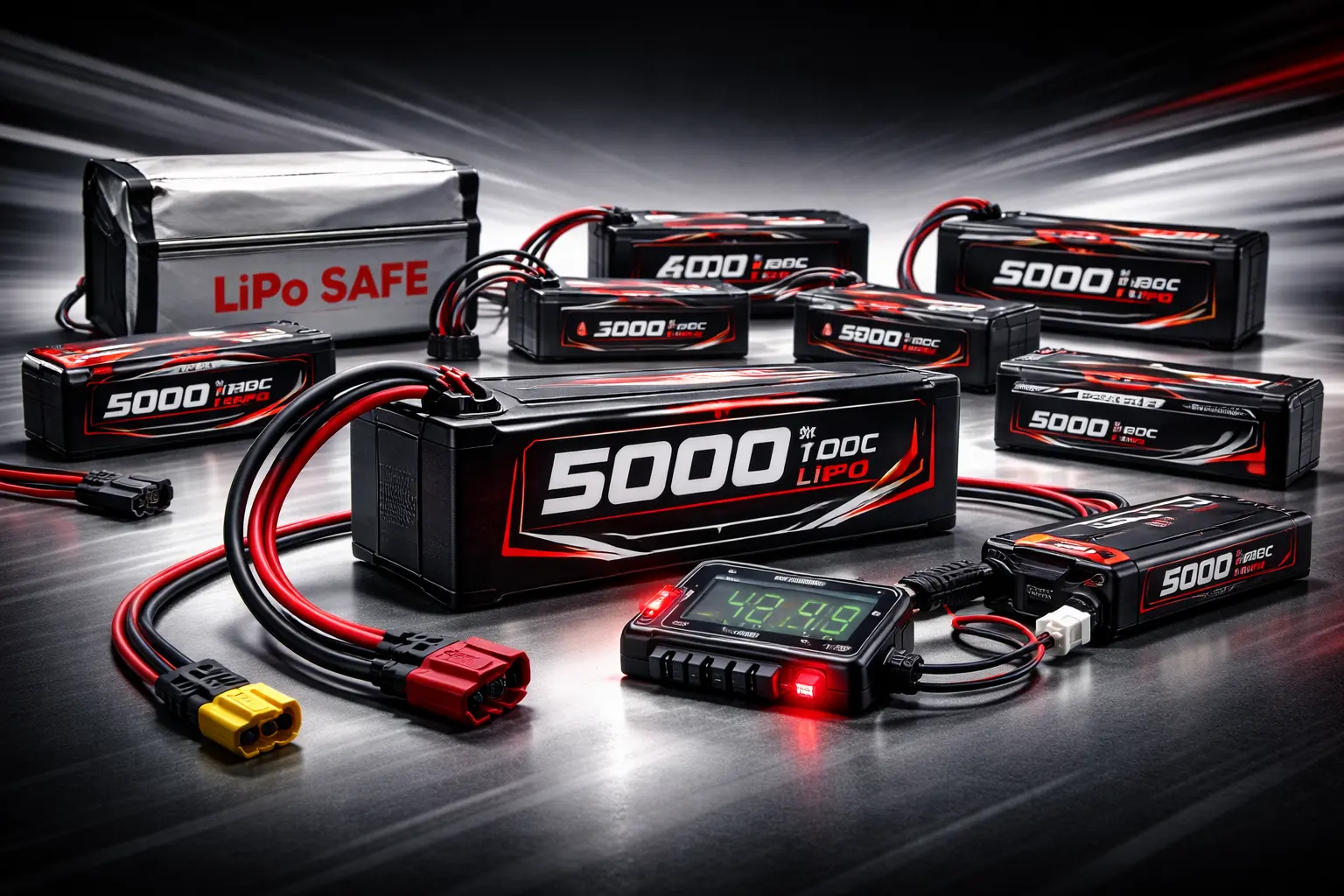
Never charge unattended. This is the one non-negotiable rule. Be in the room. Charge on a fireproof surface or inside a LiPo safe bag — they’re under $10 and cheap insurance. Let batteries cool to room temperature after a run before plugging them in; 15–30 minutes is enough.
Storage and maintenance
The golden number is 3.8V per cell — that’s your storage voltage. Never leave a LiPo sitting at full charge (4.2V/cell) or fully depleted (below 3.0V/cell) for more than a day. Both extremes accelerate degradation and puffing. Most quality chargers have a dedicated “Storage” mode that automatically charges or discharges to the correct voltage.
Store batteries in a cool, dry place between 40–80°F (4–27°C). A climate-controlled room is ideal. The trunk of your car on a summer day? That’s how you kill a pack fast. Pick up a LiPo voltage checker to quickly verify cell voltages before and after every session.
When to retire a LiPo
Puffing or swelling is the clearest warning sign. If your pack feels bloated or the case is bulging, stop using it immediately. Don’t charge it, don’t try to “fix” it — the internal cell structure is compromised and continued use risks thermal runaway.
Other retirement signals include noticeable runtime drops (losing 20%+ of original capacity), cells that won’t balance during charging, or any visible physical damage like dents, torn wrapping, or exposed wiring.
I’ll admit it — my first LiPo puffed because I forgot it in my car after a session at full discharge. $40 lesson learned. Now I always storage-charge the same night.
To dispose of a dead LiPo: discharge it to 0V using a light bulb or your charger’s discharge function, then take it to a battery recycling center. Call2Recycle has over 30,000 drop-off locations across the US — Best Buy, Lowe’s, Home Depot, and most hobby shops accept them. The old salt water method works but is slow and outdated. Never throw a LiPo in the regular trash.
Best RC LiPo batteries by category
Here’s our overview of the top picks across categories:
| Battery | Cells | Capacity | Connector | Price Range | Best For | Rating |
|---|---|---|---|---|---|---|
| Zeee 2S 5200mAh | 2S | 5200mAh | Deans/EC5 | $22–30 (2-pack) | Budget bashing, crawlers | ★★★★☆ |
| Gens Ace 3S 5000mAh | 3S | 5000mAh | XT60/EC5 | $32–45 | Arrma 3S, Traxxas VXL | ★★★★★ |
| Zeee 3S 5200mAh | 3S | 5200mAh | EC5/Deans | $25–35 | Budget 3S bashing | ★★★★☆ |
| Gens Ace 6S 5000mAh | 6S | 5000mAh | EC5 | $65–80 | Arrma 6S, high-performance | ★★★★★ |
| Traxxas Power Cell 3S | 3S | 5000mAh | Traxxas iD | $50–65 | Traxxas ecosystem | ★★★★☆ |
Best budget 2S LiPo
The Zeee 2S 5200mAh 50C is the best-selling RC LiPo on Amazon for good reason. At roughly $11–15 per pack in a two-pack bundle, it’s nearly impossible to beat on value. Hard case construction, JST-XH balance connector, and available in Deans, EC3, EC5, or XT60 variants. Thousands of users report years of reliable service for casual bashing and crawling. The 50C rating is definitely inflated — expect real-world performance closer to 25–30C — but that’s plenty for any 2S application.
Best 3S LiPo for Arrma and Traxxas
The Gens Ace 3S 5000mAh 50C is our top pick for the 3S category. Gens Ace consistently ranks as the benchmark brand for cell quality, pack consistency, and longevity. At $32–45, it’s a mid-range price for genuinely premium performance — backed by an 18-month warranty and 60-day money-back guarantee. Available with XT60 or Deans connectors. For Arrma vehicles, grab the EC5 variant for direct plug-in compatibility.
For a budget alternative, the Zeee 3S 5200mAh at $25–35 delivers solid performance for weekend bashers who don’t want to spend Gens Ace money. It won’t match the consistency or punch under heavy load, but it’s a great practice and backup pack.
Best 6S LiPo for high-performance
The Gens Ace 6S 5000mAh 45C G-Tech is a proven performer for the Arrma 6S lineup and other high-voltage rigs. At $65–80 on Amazon, it delivers reliable power delivery with EC5 connectors that plug directly into IC5 Arrma ESCs. For even more headroom, the 5100mAh 80C G-Tech variant runs about $75–90. Budget-conscious bashers should look at HRB’s 6S 5000mAh at $50–65 — solid performance at a lower price point.
Best Traxxas-compatible battery
The Traxxas Power Cell 3S 5000mAh 25C is the plug-and-play choice for Traxxas owners at $50–65 from authorized dealers. The iD connector auto-detects on EZ-Peak chargers — zero configuration needed. Traxxas’s Lifetime Battery Exchange Program is a genuine perk: free replacement in the first year, and 50% off a new pack any time after that regardless of condition. The 25C rating is lower than aftermarket options, but Traxxas rates honestly where others inflate.
For aftermarket alternatives, a Gens Ace or Zeee 3S with an XT60-to-Traxxas adapter cable gives you better specs at a similar price — just note you’ll need a non-iD balance charger.
Best shorty pack for 1/10 buggies
The Gens Ace 2S 5000mAh 60C Shorty fits the compact battery trays found in racing buggies, stadium trucks, and touring cars. At roughly $30–40, it’s the go-to for competitive 1/10 drivers running XRAY, Team Associated, Serpent, or Losi platforms. Dimensions of ~95 × 47 × 25mm keep weight low at just 211g, and it’s ROAR approved for sanctioned events.
Which battery for your RC car?
Not sure what to order? Find your vehicle below:
| Vehicle | Cell Count | Connector | Our Pick |
|---|---|---|---|
| Traxxas Slash 4x4 | 2S or 3S | Traxxas iD | Traxxas Power Cell 3S 5000mAh |
| Traxxas Maxx | 4S | Traxxas iD | Traxxas Power Cell 4S 6700mAh |
| Traxxas X-Maxx | 8S (2× 4S) | Traxxas iD | Traxxas Power Cell 4S 6700mAh (×2) |
| Arrma Granite 3S | 3S | IC5 (EC5 compatible) | Gens Ace 3S 5000mAh |
| Arrma Kraton 6S | 6S | IC5 (EC5 compatible) | Gens Ace 6S 5000mAh |
| Arrma Typhon 3S | 3S | IC5 (EC5 compatible) | Gens Ace 3S 5000mAh |
| Losi Mini-B / Mini-T | 2S | EC2 | Powerhobby 2S 1100mAh |
| Generic 1/10 buggy | 2S shorty or standard | Deans/XT60 | Zeee 2S 5200mAh |
For Arrma owners: any battery with an EC5 connector plugs directly into the IC5 port on current Firma ESCs — no adapter needed. Brands like Gens Ace, Zeee, Ovonic, and CNHL all sell EC5-equipped packs specifically marketed for Arrma compatibility.
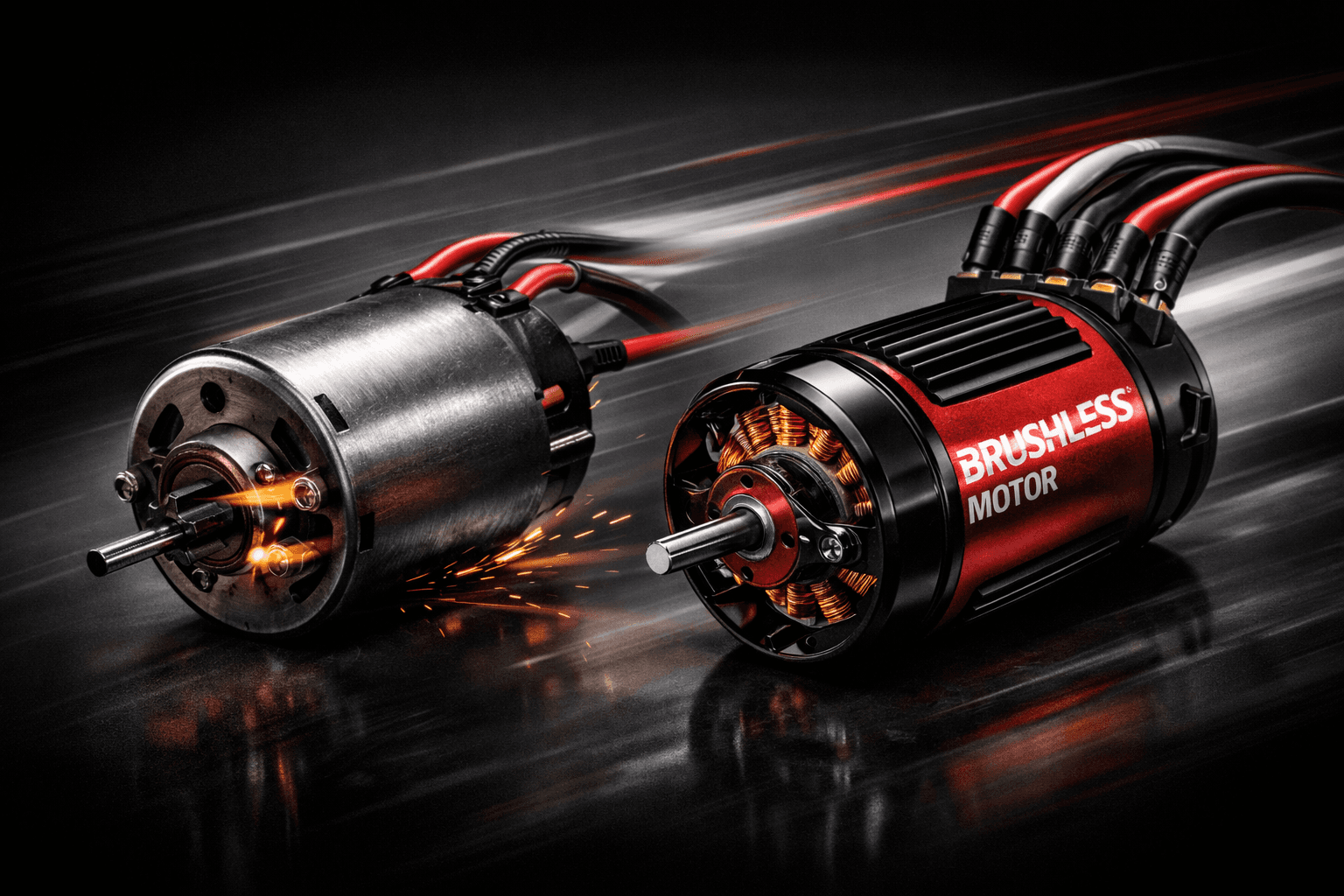
Traxxas owners have a choice: stick with Traxxas Power Cell for seamless iD integration, or save money with aftermarket packs and adapter cables. Both approaches work — it comes down to whether you value convenience or flexibility. If you’re exploring what upgrading from stock power feels like, read our brushed vs brushless guide for the full picture.
FAQ
Can I use a 3S LiPo in a 2S RC car?
Only if your ESC is rated for 3S. A 3S pack delivers 11.1V — that’s 50% more voltage than a 2S at 7.4V. If your ESC only supports 2S, the extra voltage will destroy it instantly. Many RTR vehicles like the Traxxas Slash VXL and Rustler VXL come with ESCs that handle both 2S and 3S, so check your manual or ESC specs first. When supported, the jump to 3S delivers dramatically more speed and acceleration — just expect more stress on drivetrain parts too.
How long does a LiPo battery last?
Expect 200–500 charge cycles with proper care, which translates to roughly 2–3 years of regular use. The biggest longevity factors are storage habits (always store at 3.8V/cell), charging practices (balance charge at 1C), and avoiding deep discharges below 3.3V per cell under load. Some hobbyists report 5+ years from well-maintained packs, while abused batteries can puff in under a dozen cycles.
Do I need a special charger for LiPo batteries?
Yes — a LiPo-compatible balance charger is mandatory. Never use a NiMH-only charger on a LiPo pack. LiPo cells require precise voltage limiting at 4.2V per cell and individual cell balancing that NiMH chargers don’t provide. A quality multi-chemistry charger like the SkyRC B6AC V2 ($50) or Traxxas EZ-Peak Plus ($60) handles LiPo safely and takes the guesswork out of charging. Check our best RC car charger picks for our tested recommendations.
Are LiPo batteries dangerous?
With proper handling, no. LiPo fires are real but uncommon, and nearly every incident traces back to user error — wrong charger settings, charging a damaged pack, or leaving batteries unattended during charging. Follow the basic rules (balance charge, never charge unattended, use a LiPo bag, inspect for puffing, store at 3.8V/cell) and the risk is minimal. Context matters: your smartphone runs on the same lithium-ion chemistry. RC packs just store more energy and have less built-in protection circuitry, so they need a bit more respect.
What’s the best LiPo battery brand for RC cars?
Gens Ace is the overall best brand for quality, consistency, and warranty support across all cell counts. For budget builds, Zeee offers unbeatable value — their 2S two-packs regularly cost less than a single premium pack. Traxxas Power Cell is the best option if you’re all-in on the Traxxas ecosystem and want zero-hassle iD integration. Spektrum Smart batteries (sold through Horizon Hobby) offer the most advanced smart features but at premium pricing. Brands like Ovonic, HRB, and CNHL occupy a strong mid-range position with growing reputations for reliability.
Conclusion
The battery isn’t an accessory — it’s the heart of your RC car’s performance. A well-chosen LiPo transforms the driving experience in ways that no other single upgrade can match. If you’re picking just one versatile pack, the Gens Ace 3S 5000mAh hits the sweet spot of performance, compatibility, and value for the majority of 1/10 scale vehicles.
Pair your new pack with a proper balance charger from our best RC car charger picks, practice the safety basics covered above, and you’ll get years of reliable power from every battery you own. Ready to find the right truck for that fresh pack? Head over to our best RC trucks & bashers guide for our latest picks.