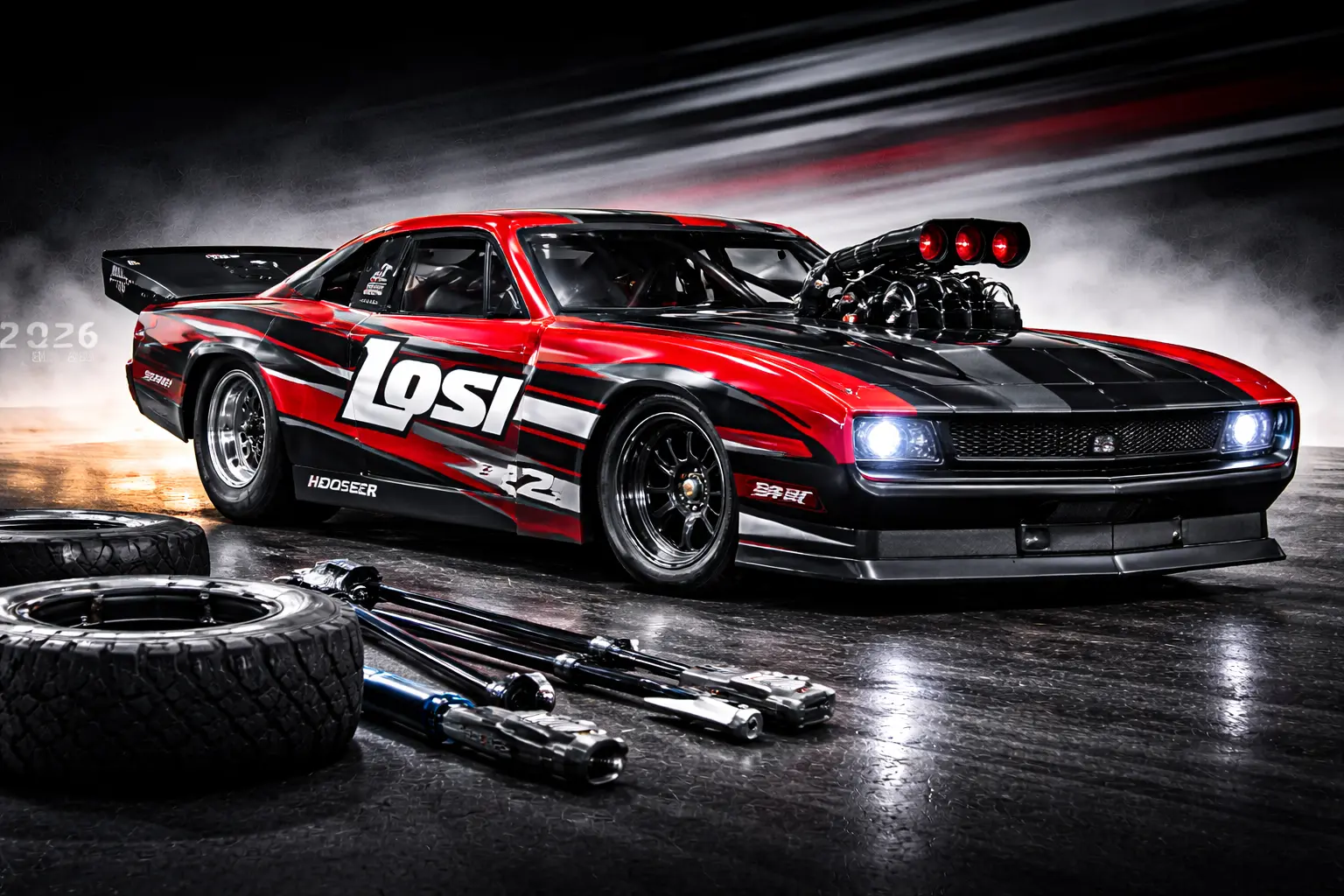
RC drag racing has exploded over the last few years — from casual parking lot runs to $25,000 winner-take-all events with 500 entrants. And right at the center of that growth sits the Losi 22S No Prep Drag Car: a 1/10-scale, brushless, rear-wheel-drive machine built on a legitimate race platform and wrapped in an officially licensed ‘69 Camaro body. It’s one of the most capable RTR drag cars ever produced — and right now, you can find it on clearance for less than its competitors cost new.
This post contains affiliate links. If you make a purchase through these links, we may earn a commission at no extra cost to you.
Losi 22S Drag Car: Specs Overview
| Specification | Detail |
|---|---|
| Scale | 1/10 |
| Drive | 2WD (rear-wheel drive) |
| Chassis | 3mm aluminum |
| Wheelbase | 13.1” (333mm) |
| Motor | Spektrum Firma 3652, 6500kv brushless |
| ESC | Spektrum Firma 100A Smart ESC |
| Radio | Spektrum SLT3 3-channel transmitter |
| Recommended Battery | 2S LiPo shorty or standard, IC5 connector |
| Tires (rear) | Mickey Thompson ET Drag licensed slicks (2.2”/3.0”) |
| Tires (front) | Mickey Thompson Ultra Light Front Runner (2.2”/2.7”) |
| Wheelie Bar | Fully adjustable height and length (stock plastic) |
| Top Speed | 50+ mph on 2S |
| Available Versions | ’69 Camaro (Summit Red / Blue), ’68 Ford F100 (Magnaflow / Losi Garage), Roller |
| Price | Check current price on Amazon |
What Makes the 22S a Legit Drag Car
Most RTR drag cars fall into one of two camps: either they’re a bashing platform crammed into a drag body, or they’re purpose-built but compromised to hit a price point. The Losi 22S is neither. It’s built on the Team Losi Racing 22 platform — the same DNA as TLR’s championship-winning 1/10 buggies — adapted specifically for the drag strip. That means a 3mm aluminum chassis, competition-grade differentials with 500,000cSt diff oil (essentially locked for straight-line traction), and an elevated all-metal transmission that actually handles power.
What Losi chose to put in the electronics bay is what really separates it from the pack. The Spektrum Firma 6500kv brushless motor is the fastest stock motor of any RTR drag car. The Firma 100A Smart ESC handles it properly, with drag-specific programming and waterproofing. From the factory, this car is doing 50+ mph on a 2S LiPo — faster out of the box than either the Team Associated DR10 or the Traxxas Drag Slash.
The Roller version (LOS03041) is also worth mentioning if you’re a hobbyist who already has electronics — it comes with the same premium chassis, tires, and hardware, with no motor, ESC, or radio, letting you drop in your preferred brushless system from day one.
The No Prep Heritage
No prep drag racing — where the track surface gets no traction compound treatment, just like a real street — has been exploding in full-scale motorsport. Street Outlaws, No Prep Kings, Cash Days… the culture is massive. And the RC version mirrors it almost exactly: 132-foot strips (a 1/10-scale quarter-mile), stock-looking bodies, single elimination brackets, and a surprisingly serious competitive scene. The RC Drag Racing Guide has a full breakdown of the format, the rules, and how to find events near you.
Losi clearly designed the 22S with this culture in mind. The officially licensed Mickey Thompson tires, the multi-piece chrome bumper and grille assembly on the Camaro, the pre-installed LED headlights — it all screams no-prep authenticity. The ’69 Camaro body in particular draws constant compliments at the track. The ‘68 Ford F100 Drag Truck variant pulls an equally strong reaction from anyone who’s ever watched a full-scale no-prep event.
Out-of-the-Box Experience
I remember the first time I pulled the 22S out of the box — the aluminum chassis caught the light and I thought “this is a serious piece of kit.” Then I made the mistake every new drag racer makes: I hit the throttle on a cold run before doing a single burnout, and the rear end kicked sideways before the car had moved five feet. Lesson one of drag racing: warm those tires.
Once I got into a proper routine — a quick burnout to heat the Mickey Thompson slicks, stage up, full throttle — the car was genuinely impressive. The first timed pass was 2.7 seconds over the 132-foot strip. A few alignment tweaks and some practice later, I was regularly hitting the 2.5-second range on stock hardware. That’s competitive for a 2S stock class.
The points that need immediate attention out of the box are real, though. Apply threadlock to the pinion gear set screw immediately — multiple owners report it backing off within the first few minutes of running. The multi-piece body (front grille, bumper sections, rear clips all held by screws) is the car’s biggest design compromise; after a few hard launches and one sideways moment, those body sections start gapping. It’s the trade-off Losi made for scale accuracy. Also worth doing from day one: disable reverse on the ESC to prevent accidentally dumping the car into a tailspin.
Drag Setup Guide: Getting the 22S Dialed In
This section is where the 22S really earns its reputation. Because it’s built on a real race platform, it responds to real race-car tuning techniques. Get these right and you’ll shave half a second off your ETs without spending a dollar.
Gearing & Motor Setup
Stock gearing is a 22T pinion / 76T spur at 48 pitch — a 2.43:1 ratio that balances top speed and launch torque well for the 6500kv motor on 2S. The community consensus is that torque rules in drag racing: “Go with the lowest gear that doesn’t just spin tires.”
For the stock Firma 6500kv setup, stay in the 21T–25T pinion range with the 76T spur. Push past 25T and the motor starts running hot, and the ESC’s aggressive thermal cutoff will shut you down mid-pass. If you upgrade to a Castle Mamba X with a 5700kv motor (more on that below), the 22/76 stock gearing lands you around 55 mph — ideal for the 2.5-second bracket. Step up to a 6400kv and a 25T pinion with the 76T spur, and you’re chasing sub-2.0 times at around 70 mph.
Competition builds with 4.5-turn motors use much lower pinions (19–20T) with 90T spurs, but at that point motor timing and ESC settings have to be tuned as a complete system, not individually.
Tire Selection
If there’s one upgrade that changes everything, it’s rear tires. The stock Mickey Thompson ET Drags are a fine starting point, but they grow at speed and lack the consistency needed for repeatable ETs. The drag racing community has pretty clearly converged on a hierarchy:
The community default is the Pro-Line Hoosier Drag Slick in MC (Clay) compound — excellent all-around traction, available in multiple compounds, and the tire you’ll see on the most competitive cars at a club event. For higher-speed builds above 60 mph, the Pro-Line Reaction HP Belted (S3 compound) is critical — the belted carcass won’t balloon at 7,000 RPM where non-belted tires start to deform.
JConcepts Mambos are the other go-to choice, with temperature-specific compounds (Green below 80°F, Gold above). They have a wider footprint and thicker inner carcass that handles bigger power without issues. For serious competition, Team Ottsix Voodoo Absolute Zero and DragRace Concepts Kinetic tires represent the top tier.
Always heat your tires with a proper burnout before staging — no VHT traction compound is permitted in no-prep events, so warm rubber is your only traction aid.
Wheelie Bar Adjustment
The stock wheelie bar is adjustable for both height and length, and getting it right matters a lot. For lower-power 2S builds in the 2.5–3.0 second bracket: lower the bar slightly so the wheels ride close to the surface, which limits weight transfer and keeps the car planted without lifting. For more powerful setups chasing sub-2.0 times: raise the bar to allow more weight to transfer to the rear at launch, then let the bar control the lift.
The key insight from experienced drivers: riding the wheelie bar sacrifices steering on anything faster than a 2.0-second 132-foot ET. At that speed, the car needs to stay level, not balance on the bar. The Exotek Racing carbon fiber adjustable wheelie bar (adjustable from 9.5” to 12”) is worth the upgrade if you’re running serious power — its flat carbon design adds controlled upward flex that acts as a shock absorber, and the titanium turnbuckle adjustment is far more precise than the stock hardware.
Weight Distribution Tips
Target roughly 40% front / 60% rear static weight balance. The 22S’s rear-motor, rear-ESC layout means the back is already heavy, which can cause front-end lift at launch. The factory front bumper has an adjustable weight channel — use it to slide ballast as far forward as possible. Also slide your battery pack as far forward as your tray allows. Under NPRC competition rules, the minimum ready-to-run weight is 4.54 lbs, so strategic weight placement matters more than chasing the lightest possible setup.
Best Losi 22S Drag Car Upgrades
Motor & ESC Upgrade
This is the single biggest performance lever on the 22S. The stock Firma combo is genuinely good for a stock class, but the aftermarket electronics step changes are dramatic.
Entry level (~$270): Castle Mamba X paired with a 1406-5700kv motor. Sensored, consistent, reliable. Pushes the car to ~55 mph on 2S — the sweet spot for the 2.5-second bracket. Browse brushless motor options on Amazon.
Mid-level (~$355 total): Castle Mamba Monster X + 1412-6400kv. Sub-2.0-second capable, around 70 mph on 2S. This is where the car starts to feel genuinely fast.
Competition: Hobbywing XeRun XR10 PRO DR with the XeRun 3652 DRX motor (8500kv or 9500kv). 32-bit processor, three-stage launch control, data logging via app. The go-to combo for serious NPRC competition. Maclan’s DRK 160 RS Edition ESC with their DRK 4-Pole 6600kv motor is another top-shelf option with Android app tuning.
One critical note: do not use a motor larger than 3650 size in the 22S. The drivetrain cannot handle 3660-size motors — it will destroy outdrives, slipper pads, and the differential. Stick to 36mm-diameter motors.
Drag Tires (Priority Upgrade)
As mentioned in the setup section, this is actually the first upgrade to make before touching electronics. A good set of Pro-Line Hoosier Drag Slicks or JConcepts Mambos costs $15–$30 and will take more time off your ET than almost anything else at the same price.
Body Options
The 22S body mounts are compatible with a huge range of aftermarket shells. Pro-Line’s 1967 Mustang, 1969 Nova, and 1978 Malibu all fit, as do PROTOform’s Nissan GT-R R35 and a growing catalog of Bittydesign options. The Roller’s bare platform also accommodates custom fabricated bodies popular in the outlaw classes.
Bearings & Drivetrain
The stock bearings are adequate but not exceptional. The FastEddy sealed bearing kit ($27 on Amazon) is the most affordable upgrade that reduces rolling resistance and extends drivetrain life. For competition, the Whitz Racing Hyperglide Full Ceramic bearing kit ($67) is the premium option.
Drivetrain-wise, the TLR Heavy Duty Slipper System handles more power more reliably than the stock unit, and the Exotek Vader Drag Chassis Kit (full carbon fiber conversion) is the holy grail structural upgrade for serious racers.
Battery Recommendations
Stick to a 2S LiPo in either standard or shorty hardcase format with IC5 connector. Shorty packs are preferred for weight balance. Look for at least 4500–5000mAh capacity and 80C+ discharge rating for consistent power delivery across a full session. Browse 2S LiPo shorty packs on Amazon — options in the $25–$50 range from Zeee, CNHL, and HOOVO all get strong reviews from the drag racing community. A quality charger is equally important — see our best RC car battery chargers guide for recommendations.
Running 3S is technically possible with the Firma combo but genuinely exceeds the stock motor’s RPM limits and voids the Castle warranty if you’ve already upgraded. Most competitive racers get far better results from better gearing and tires on 2S than from chasing voltage.
Losi 22S vs Team Associated DR10 vs Traxxas Drag Slash
| Feature | Losi 22S | Team Associated DR10 | Traxxas Drag Slash |
|---|---|---|---|
| Price | ~$150–$200 clearance | ~$270–$320 | ~$300–$360 |
| Motor | Firma 6500kv ⭐ | Reedy 3300kv | Velineon 3500kv |
| ESC | Firma 100A Smart ⭐ | Reedy SC600-BL ~60A | VXL-3s ~80A |
| Chassis | 3mm aluminum ⭐ | Molded composite | Low CG composite |
| Stability Aid | Spektrum AVC | DVC digital gyro | TSM + Trans Brake ⭐ |
| Wheelbase | 13.1” | ~12.5” | 12.9” |
| Aftermarket | Good (TLR parts) | Deepest of the three ⭐ | Good (Slash ecosystem) |
| Production Status | Discontinued | Active ⭐ | Active ⭐ |
| Best For | Intermediate racers | Competitive racers ⭐ | Complete beginners ⭐ |
I spent a weekend at a club event running a 22S against a DR10 and a Drag Slash side by side. The 22S was noticeably faster out of the box — the 6500kv motor pulls harder off the line than the DR10’s 3300kv, full stop. But when the DR10 owner dropped in a mid-level Castle combo (same upgrade I’d recommend for the 22S), the gap evaporated almost completely, and he still had a bigger catalog of drag-specific hop-up parts to choose from.
The Drag Slash surprised me at the beginner end. The Trans Brake function — hold the throttle, release the button for a consistent launch — genuinely removes one of the hardest skills to learn in drag racing: the staged launch. It’s a gimmick that actually works.
If I’m being straight about the comparison: the DR10 is the best long-term investment for anyone planning to race seriously. Deepest aftermarket, most competitive at the club level, active production means parts on shelves forever. The Drag Slash is the easiest for a newcomer — you’ll figure out bracket racing before you outgrow it. And the 22S is the best stock car, especially at clearance pricing, for someone who wants the premium chassis and strong electronics from day one and isn’t worried about the discontinued status.
Who Is the Losi 22S Drag Car For?
The drag racing newcomer who wants to be competitive immediately — the stock 6500kv motor and 100A ESC are the best RTR electronics of the three main platforms. You’re not spending your first $150 upgrading stock brushed gear; you’re learning to drive.
The basher who wants to try the drag strip — if you’ve been hooning a Traxxas Slash or Arrma Typhon and want to see what a serious drag car feels like, the 22S’s aluminum chassis and licensed Camaro body are far more satisfying than adapting a generic platform. Check out our RC drag racing beginner guide to understand the format before your first event.
The intermediate racer who found a clearance deal — at $150–$200, this is a premium aluminum chassis car at entry-level pricing. The TLR platform means competition parts bolt on directly, and there’s a clear upgrade path to sub-2.0-second capability without a full chassis swap.
The customizer and scale builder — the officially licensed body, chrome hardware, and LED headlights make the 22S the most scale-realistic platform in the segment. The Pro-Line, PROTOform, and JConcepts body ecosystems mean endless personalization options. The Losi 22S platform also spans Sprint Car and SCT variants, so your tuning knowledge transfers across multiple builds.
What it’s not ideal for: anyone who prioritizes the deepest competitive ecosystem above all else (that’s the DR10), or a true beginner who wants maximum crash forgiveness and hand-holding features (that’s the Drag Slash).
FAQ
Q: Is the Losi 22S Drag Car fast out of the box?
Yes — it’s the fastest RTR drag car of the three main competitors straight from the box. The Spektrum Firma 6500kv motor and 100A ESC deliver 50+ mph on a 2S LiPo, with stock elapsed times around 2.5–3.0 seconds over a 132-foot no-prep strip. Expect 2.5 seconds with a proper tire warm-up and some basic alignment work.
Q: What battery should I use in the Losi 22S Drag Car?
Use a 2S LiPo (7.4V) in either standard or shorty hardcase format with an IC5 connector. Target at least 4500mAh capacity with an 80C+ discharge rating. Shorty packs help with weight balance by allowing the battery to sit further forward. See current 2S shorty options on Amazon. Running 3S is technically possible but exceeds the stock motor’s design limits and isn’t recommended without a full electronics upgrade.
Q: Can I bash with the Losi 22S or is it drag-only?
Technically you can, but it’s not ideal for bashing. The drag-tuned rear differential is essentially locked (500,000cSt fluid), which makes cornering awkward. The multi-piece scale body is fragile by bashing standards, and the long wheelie bar catches everything. It’s purpose-built for straight-line runs — if you want an all-rounder from the 22S family, look at the SCT platform instead.
Q: What’s the best tire upgrade for the Losi 22S Drag Car?
The Pro-Line Hoosier Drag Slick in MC (Clay) compound is the community consensus for most conditions. For builds running above 60 mph where tire ballooning becomes an issue, switch to the Pro-Line Reaction HP Belted in S3 compound — the belted carcass holds its shape at high RPM. Temperature-sensitive racers often prefer JConcepts Mambos with the Green compound below 80°F or Gold compound above it. Browse RC drag slick tire options on Amazon.
Q: Losi 22S vs DR10: which is better for beginners?
For a true beginner, the Team Associated DR10 is the safer long-term choice — it’s actively produced, has the deepest aftermarket ecosystem, and its weaker stock motor (3300kv) is actually easier to manage while learning launch technique. The 22S’s 6500kv motor is more powerful than many beginners can use productively at first. That said, if you find the 22S on clearance at $150–$200, its aluminum chassis and better stock electronics make it a compelling value play for someone willing to manage the steeper initial learning curve.
Final Verdict
The Losi 22S No Prep Drag Car is the most capable RTR drag car ever produced by a major manufacturer — better stock electronics, a better chassis, and more racing DNA than either the DR10 or the Drag Slash. Its discontinued status doesn’t change any of that; it just changes the price. At clearance pricing of $150–$200, it’s an absolute steal for any RC enthusiast who wants to enter the no-prep drag scene with a legitimate platform.
Apply threadlock to the pinion on day one, get a fresh set of Pro-Line Hoosier drag slicks, and spend time dialing in your wheelie bar and battery position before touching the electronics. You’ll be hitting 2.3–2.5 second passes before you ever open the upgrade catalog.
Check current availability and pricing on Amazon — and make sure to check out our full RC drag racing guide before you head to your first event.