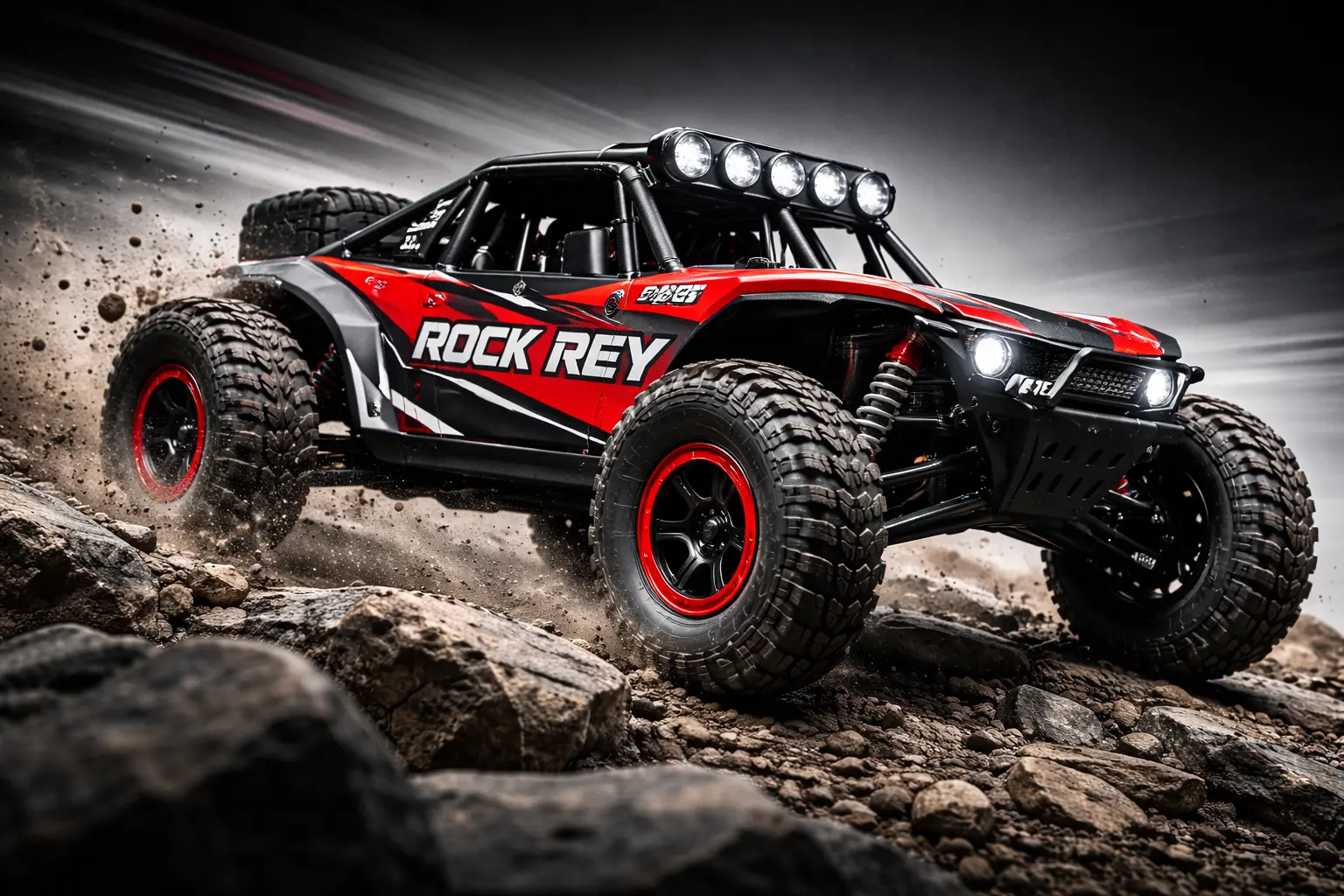
The Losi Rock Rey is one of those RC trucks that makes you rethink what a trail rig can be. It’s not a crawler. It’s not a basher. It’s a 1/10-scale replica of the most brutal motorsport format on the planet — King of the Hammers Ultra4 racing — and nothing else on the market does what it does.
If you’ve been eyeing one and wondering whether it’s worth tracking down, this review will give you the complete picture: what it does brilliantly, where it falls short, how it stacks up against the competition, and exactly which upgrades transform it from good to exceptional.
Important note before we begin: The Losi Rock Rey 1/10 (LOS03009) was discontinued in late 2023. All RTR, BND, and Kit variants now show as discontinued on Horizon Hobby and all major retailers. New-in-box units still surface from third-party sellers at clearance prices ($350–450 range). Parts support remains solid — AMain Hobbies and Horizon Hobby both stock Rock Rey spares. If you can’t find a new unit, the closest current alternative from Losi is the Losi Lasernut U4 or Losi Hammer Rey, which share much of the same DNA. Check out our complete guide to Losi RC cars for the full current lineup.
This post contains affiliate links. If you make a purchase through these links, we may earn a commission at no extra cost to you.
Losi Rock Rey — Specs at a Glance
| Spec | Detail |
|---|---|
| Scale | 1/10 |
| Motor | Dynamite Fuze 550 2800Kv sensorless brushless |
| ESC | Dynamite Fuze 130A waterproof |
| Radio / Receiver | Spektrum DX2E 2.4GHz DSMR + SR6200A with AVC |
| Smart Technology | No |
| Drive | 4WD shaft-driven, single-speed |
| Front Diff | Open gear |
| Center Diff | Gear (lockable with Vaterra insert) |
| Rear Diff | Locked spool |
| Front Suspension | Independent long-arm A-arm |
| Rear Suspension | 4-link live solid axle |
| Wheelbase | 15.0 in (381 mm) |
| Length / Width | 20.75 × 12.75 in (527 × 324 mm) |
| Weight (no battery) | 6.55 lb (3.0 kg) |
| Ground Clearance | 2.2 in (56 mm) at rear diff |
| Tires | Maxxis Creepy Crawler LT 2.2” |
| LED Lights | 12-LED roof light bar included |
| Top Speed | 40+ mph on 3S LiPo |
| Battery Included | No — requires 2S or 3S LiPo, EC3 connector |
| Last Retail Price | $399–$519.99 RTR |
The Rock Rey is a 3.5mm hard-anodized 6061-T6 aluminum chassis platform with a 4-piece bolt-on polycarbonate body and integrated nylon composite roll cage. It runs on a 2S or 3S LiPo hardcase battery — the community’s consensus is a quality 3S 5000mAh for the best balance of runtime and power. A 3S 5000mAh hardcase LiPo runs $35–50 and is the single best accessory to buy alongside the truck.
What Is a Rock Racer? (And Why It’s Different from a Crawler)
Before diving into performance, it’s worth understanding the category — because buying a Rock Rey expecting a crawler experience is a recipe for disappointment, and vice versa.
Rock crawler (TRX-4, SCX10 III, Redcat Gen9): Purpose-built for technical, slow-speed obstacle navigation. Locked diffs, low gearing, portal axles, often under 5 mph. These trucks thrive on near-vertical obstacles where momentum is the enemy.
Trail truck (Element Enduro, Axial SCX10 III Base Camp): A slightly more energetic crawler — capable of moderate trails at 5–10 mph, good ground clearance, but no real speed.
Rock racer / Rock Rey: Inspired directly by Ultra4 and King of the Hammers — arguably the most demanding motorsport on the planet, where competitors sprint across 50+ miles of open California desert at 100 mph, then attack canyons with boulder sections that would destroy any vehicle not built specifically for it. Founded in 2007, King of the Hammers now draws 35,000+ spectators annually. The RC version captures this formula with independent front suspension for high-speed stability combined with a solid rear 4-link axle for crawling traction, running licensed Maxxis tires and Raceline wheels straight from the real race cars.
Rock bouncer (Axial RBX10 Ryft): Designed for momentum-based rock climbing — low and wide, no real speed, thrives on aggressive terrain using weight transfer rather than grip.
The Rock Rey sits at roughly 70% racer / 30% crawler. It cannot compete with a dedicated crawler on vertical obstacles, but it can hit 40+ mph on open ground and still pick its way through moderate boulder sections — no other production 1/10 RC in its price range can claim both.
Trail Performance — How the Rock Rey Actually Drives
What I love about the Rock Rey is that one minute you’re blasting across a dry riverbed at full throttle, and the next you’re picking your way up a boulder section — no other truck in my fleet does both that well. That’s the pitch, and on most terrain, it genuinely delivers.
Open ground and speed: On 3S with a fresh pack, the acceleration is genuinely surprising. The 2800Kv sensorless brushless motor pulls hard through the midrange and will hit 40+ mph on flat terrain. AVC (Active Vehicle Control) earns its keep here — it fights the truck’s natural tendency to swap ends on loose surfaces, acting like a light gyro to keep it tracking straight. The IFS front absorbs imperfections smoothly at speed, and the long-travel coil-overs soak up jumps without bottoming hard. As a “bash and rip” vehicle on trails, desert flats, and park terrain, it’s fantastic fun.
Trail crawling (under 45 degrees): This is where the Rock Rey surprises people who dismiss it as just a fast truck. The locked rear spool means constant drive to both rear wheels — on rocky terrain where one wheel lifts, the other keeps pushing. Combined with the soft, sticky Maxxis Creepy Crawler compound, the truck walks through chunky rock gardens, roots, and loose shale with more confidence than its 40+ mph top speed would suggest. Crawling at minimum throttle is where the sensorless motor becomes an issue — it cogs (lurches) at very low speed rather than delivering smooth, creep-style power. For casual trail work, manageable. For technical competition crawling, a sensored motor swap is necessary.
Steep crawling (over 60 degrees): I learned this limitation the hard way trying to climb a near-vertical rock face that my buddy’s TRX-4 walked up without breaking a sweat. The Rock Rey’s IFS front simply doesn’t have the axle articulation or gearing reduction that a dedicated crawler provides. On anything under 60 degrees it holds its own and does it faster than any crawler. On true vertical terrain, it needs a running start or a different truck.
The bolt-on body panels, while spectacular for scale looks, mean you’ll spend real time disassembling the truck every time you need to reach the electronics or diffs. Budget that time accordingly.
Build Quality & Scale Details
The aluminum chassis is genuinely impressive — 3.5mm hard-anodized 6061-T6 is a proper platform, not a cost-cut substitute. The threaded coil-over shocks adjust easily for preload, and the four-piece polycarbonate body panels clip into the integrated roll cage in a way that looks nothing like a typical RC and exactly like a 1/10-scale race vehicle.
The first time I took it to a trail spot, two guys with SCX10s came over just to look at it. The cage, the licensed Maxxis tires on Raceline wheels, the scale interior with driver figure, the functional 12-LED roof light bar — the Rock Rey has trail presence that very few RC trucks can match. People assume it’s a highly modified custom build, not a stock RTR.
Build quality from the factory is solid where it counts: the aluminum chassis and gearbox are genuinely overbuilt. Where it falls short is in small plastic components under load — the stock servo horn is the single worst component on the truck and strips under hard steering use on 3S. Replace it with the aluminum TLR1555 horn before your first pack. Later production runs included a metal insert, but it’s still not adequate. The steering system as a whole (servo saver, bellcrank, tie rods) needs upgrading for serious use — stock steering feels vague at speed and has too much flex off-road.
The stock Maxxis Creepy Crawler tires are a good compound but balloon at high speed on 3S, reducing grip. Tire tape around the circumference is a free fix; a proper foam and tire upgrade is the real solution.
Durability after upgrades, though? Owners regularly describe it as remarkably tough. Multiple reviews mention the truck surviving punishment comparable to Traxxas bashers once the steering and bearings are addressed.
Rock Rey vs. the Competition
| Model | Type | Scale | Crawling | Speed | Price Range | Best For |
|---|---|---|---|---|---|---|
| Losi Rock Rey | Rock racer | 1/10 | ★★★☆☆ | ★★★★★ | ~$350–520* | Trail speed + light crawl |
| Traxxas TRX-4 | Crawler | 1/10 | ★★★★★ | ★★☆☆☆ | ~$530–550 | Technical crawling |
| Traxxas TRX-4 Sport | Budget crawler | 1/10 | ★★★★☆ | ★★☆☆☆ | ~$370 | Entry crawling |
| Axial SCX10 III | Crawler | 1/10 | ★★★★★ | ★★☆☆☆ | ~$350–490 | Competition crawling |
| Losi Lasernut U4 | Rock racer | 1/10 | ★★★☆☆ | ★★★★★ | ~$450 | Speed, Smart electronics |
| Element Enduro | Trail truck | 1/10 | ★★★★☆ | ★★★☆☆ | ~$280–430 | Budget trail running |
*Discontinued — secondary market pricing
vs. Traxxas TRX-4: The TRX-4 is the better crawler, full stop. Dual-speed, Traxxas Stability Management, metal portal axles, and dedicated slow-speed gearing make it a technical crawling machine. But it caps out around 10–12 mph and weighs considerably more. Choose the TRX-4 if you want to crawl. Choose the Rock Rey if you want to do both. Check Price on Amazon
vs. Traxxas TRX-4 Sport: The Sport version at ~$370 is a legitimate budget crawler with portal axles, but brushed motor only and no locking diffs. The Rock Rey is faster, more exciting, and better looking. The TRX-4 Sport wins for pure value crawling. Check Price on Amazon
vs. Axial SCX10 III: Widely considered the best platform for competitive crawling at its price point. Portal axles, excellent aftermarket, dedicated comp class support. Not in the same conversation for speed. Choose the SCX10 III if crawling is the primary goal. Check Price on Amazon
vs. Losi Lasernut U4: The closest current production alternative to the Rock Rey. Same rock racer concept, similar price, but full independent suspension front and rear (no solid rear axle), Spektrum Smart electronics with telemetry, and 4S compatibility. Better for pure speed and electronics integration, worse for crawling. The Rock Rey’s solid rear axle gives it a genuine crawling edge. Check Price on Amazon
vs. Element Enduro: The Enduro lineup at $280–430 is the go-to for budget trail running with genuine off-road manners. Brushed motor limits speed but the platform is forgiving and easy to maintain. Choose the Enduro if you want relaxed trail driving without the upgrade budget. If you want speed alongside the trail work, the Rock Rey wins on every dimension except price and simplicity. If pure crawling is your priority, our RC crawler guide covers the best dedicated options.
Bottom line: The Rock Rey is for the driver who wants a single truck that can run trails at genuine speed, conquer moderate obstacles, and look incredible doing both. If one of those two dimensions doesn’t matter to you, there’s a more purpose-built option that does the remaining one better.
Best Upgrades for the Losi Rock Rey
The Rock Rey has a deep aftermarket supported by Losi, Hot Racing, SSD RC, Pro-Line, GPM, RPM, and Xtreme Racing. The upgrade path follows a clear priority order.
Trail & Crawling Upgrades
The most impactful crawling upgrade is locking all three differentials using inexpensive Vaterra diff inserts (~$6 each for center and front) — a full locked setup transforms rock section performance with minimal steering penalty on trail terrain. Pair this with a servo upgrade to a Savox SC-1258TG or Holmes Hobbies TrailMaster Pro 550 (~$70–100) with an aluminum servo mount to eliminate the vague, flexy stock steering feel. For tires, Pro-Line Hyrax 2.2” in G8 compound (~$30/pair) on SSD wheels with dual-stage closed-cell foam inserts are the community’s top choice — they grip, don’t balloon, and look scale-appropriate. Browse 1.9” RC trail tires on Amazon. For tire choice breakdowns by terrain type, our RC crawler tires guide covers 1.9, 2.2, and 2.4 options in detail. Run 50–60 weight shock oil to tighten up the suspension for the truck’s 6.55 lb weight.
Speed & Bashing Upgrades
The stock sensorless motor cogging is the biggest limiting factor for both crawling precision and full-speed bashing enjoyment. The top upgrade is a Castle Creations Mamba X ESC with a sensored 550 motor (~$170+), which delivers silky smooth throttle control from creep to full speed and handles 3S without thermal issues. On the stock electronics, run a quality 3S 5000mAh hardcase LiPo (find one on Amazon) — it’s the cheapest way to maximize the stock power system. A pinion swap from 10T to 11T or 12T adds top speed at the expense of crawling torque, useful if bashing dominates your use case.
Scale Upgrades
The Xtreme Racing carbon fiber body kit (#10345, ~$99) replaces all four polycarbonate panels with 1.2mm carbon fiber — instantly more durable and visually stunning. Pro-Line 6” LED light bars (~$25) add working lights for evening runs beyond the stock roof bar. Scale accessories including a roof rack, spare tire, jerry cans, and tool bag complete the Ultra4 trail look. Browse 1/10 RC scale accessories on Amazon.
Durability Upgrades
Day One, non-negotiable: Aluminum servo horn (TLR1555, ~$10) before the first battery. FastEddy sealed bearing kit (TFE4436, ~$25–34) replaces all stock bearings — the rear pinion bearing in particular wears quickly under load. Browse Losi Rock Rey bearing kits on Amazon. Follow up with aluminum front steering spindles and C-hubs (Losi LOS334008/LOS334009, ~$50–60) from Horizon Hobby, an SSD HD front bulkhead (~$20), and RPM front A-arms and bumper/skid (~$30). One free and effective mod: wrap the stock tires with electrical tape around the circumference to prevent ballooning at speed until proper tire foam upgrades are fitted.
What You Need to Know Before Buying
What’s included: Fully assembled truck, pre-painted and pre-installed body, 12-LED roof light bar, Spektrum DX2E transmitter, and a 4xAA battery holder for the transmitter. What’s not included: Battery, charger, and AA batteries.
Real total cost of entry: The RTR last retailed at $399–520 new. Add a 3S 5000mAh LiPo ($40), a basic balance charger ($30), and the mandatory aluminum servo horn ($10) and you’re at $480–600 before any other upgrades. A realistic “properly upgraded” Rock Rey runs $650–750. That’s still competitive with what a new Traxxas TRX-4 plus a 3S battery package costs — and delivers a fundamentally different experience.
Parts availability: Excellent, and likely to remain so for several years. Losi maintains parts support for discontinued models, and both AMain Hobbies and Horizon Hobby stock Rock Rey-specific parts extensively. The shared platform with the Baja Rey and Hammer Rey means many components are interchangeable, extending the parts catalog further.
Space requirements: The Rock Rey is not a driveway or small backyard truck. Its 40+ mph speed needs open desert terrain, dry riverbeds, trails, or large parks to stretch its legs properly. On trail, you need genuine rocks and elevation change to justify the crawling capability. This is not a casual Sunday driveway basher — it rewards access to real outdoor terrain. Want something faster and more off-road focused without the crawling dimension? The Losi Tenacity lineup might be a better fit for open-field bashing.
FAQ
Q: Is the Losi Rock Rey a good crawler?
It’s a capable moderate-terrain crawler but not a dedicated crawler. The locked rear spool and Maxxis Creepy Crawler tires handle chunky trail sections, roots, and rocks under 45–50 degrees well. On near-vertical technical obstacles where a TRX-4 or SCX10 III shines, the Rock Rey’s independent front suspension limits articulation and the sensorless motor produces cogging at low throttle. Upgrading to a sensored motor and locking all three diffs significantly improves the crawling experience. Think of it as “very capable trail truck with bonus crawling ability” rather than “real crawler with bonus speed.”
Q: How fast is the Losi Rock Rey?
Losi claims 40+ mph on 3S LiPo, and real-world GPS testing by community members consistently returns 38–45 mph depending on battery condition, terrain, and pinion setup. With an 11T or 12T pinion swap it can push past 45 mph. On 2S it runs more conservatively in the 25–30 mph range, which is actually better suited for technical trail work.
Q: Can the Losi Rock Rey handle rocks and boulders?
Yes, on moderate terrain. The 2.2” Maxxis Creepy Crawler tires provide excellent traction on natural rock surfaces, and the locked rear spool maintains drive through uneven terrain. The truck handles chunky boulder fields and natural rock gardens confidently. The limiting factor is obstacle height and angle — anything approaching vertical challenges the IFS front geometry and the sensorless motor’s ability to creep smoothly. For gnarly comp-style crawling, a dedicated crawler will outperform it.
Q: What battery does the Losi Rock Rey take?
A 2S or 3S LiPo with an EC3 connector and a hardcase format recommended. Most owners run a 3S 5000mAh hardcase. The truck accepts packs up to approximately 145mm × 48mm × 42mm in the main battery tray. No battery is included with the RTR. Check current 3S LiPo pricing on Amazon.
Q: Losi Rock Rey vs Traxxas TRX-4 — which is better?
Depends entirely on your use case. The TRX-4 is a better dedicated crawler: dual-speed transmission, Traxxas Stability Management, metal portal axles, and a huge aftermarket designed specifically for technical climbing. It crawls things the Rock Rey cannot. The Rock Rey is faster, more visually exciting, and far more versatile for trail running and mixed terrain where you want speed and crawling in the same session. If technical obstacle crawling is 80%+ of your intended use, buy the TRX-4. If you want a trail companion that can both rip and climb, the Rock Rey has no direct competitor.
Conclusion
The Losi Rock Rey isn’t perfect out of the box — the steering system needs work, the servo horn will strip, and the sensorless motor limits crawling precision. But once the essential upgrades are in place, it delivers an experience genuinely unlike anything else in the 1/10 category: Ultra4-inspired looks, 40+ mph speed, and enough crawling capability to handle real trail terrain in a single platform. It’s perfect for the trail runner who gets bored moving at 5 mph and wants a truck that rewards both full-throttle moments and technical sections. It’s not the right choice for dedicated comp crawlers or pure bashers looking for a park truck.
Finding a new-in-box Rock Rey at clearance prices below $400 is an excellent deal — but budget another $150–200 for the upgrades that bring out the platform’s true potential. If you can’t find one, the Losi Hammer Rey on the same platform with Smart electronics is the current closest production alternative. For the full Losi lineup, see our Losi RC cars guide.