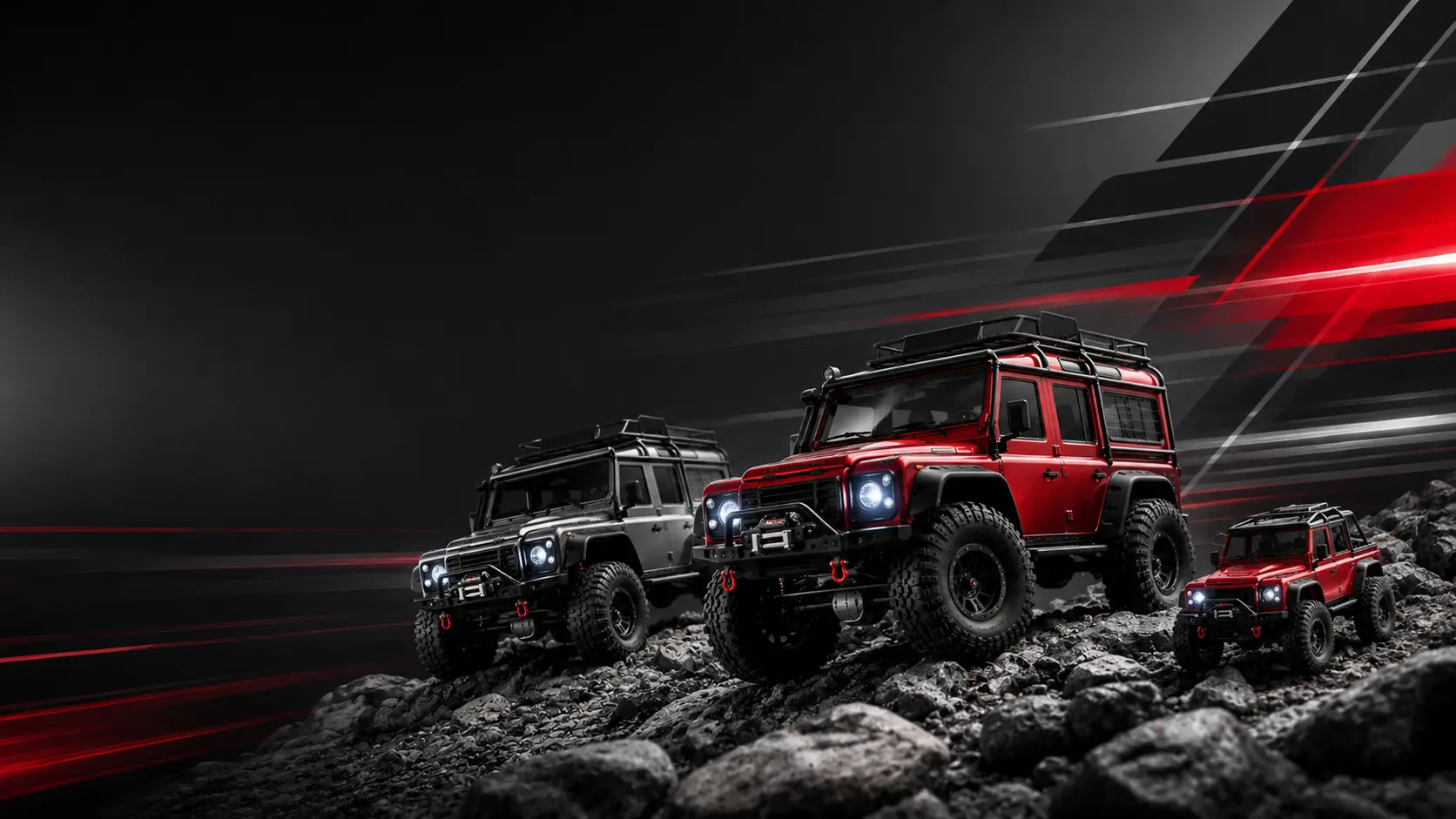
The Traxxas TRX-4 didn't just enter the scale crawling market — it crashed the party, tossed portal axles on the table, and made everyone else rethink their price points. Whether you're eyeing the full-featured flagship, the budget-friendly TRX-4 Sport, or the surprisingly capable 1/18 TRX-4M, there's a version of this platform for almost every kind of RC driver. But "almost" is doing a lot of work in that sentence, and picking the wrong one for your use case is an expensive mistake.
I've run the stock TRX-4 Sport for over a year on everything from groomed trail paths to rocky backyards, and I've watched the TRX-4M ecosystem explode from two body options at launch to a full lineup of licensed trucks. This guide covers the entire TRX-4 family — specs, pricing, body options, the honest Axial comparison, what you actually need to buy alongside the truck, and a straightforward recommendation by rider profile. No hedging, no winner-crowning.
This post contains affiliate links. If you make a purchase through these links, we may earn a commission at no extra cost to you.
The TRX-4 Story — Why Traxxas Got Serious About Scale Crawling
Traxxas spent most of its first three decades earning a reputation in the bashing and racing world. The Rustler, the Slash, the E-Revo — fast, durable, beginner-friendly trucks built to run hard and survive crashes. Scale crawling wasn't really in the vocabulary. That segment belonged to Axial, Redcat, and the custom-build crowd at RCCrawler.com, and honestly, Traxxas seemed fine with it.
Then in 2017, everything changed. Traxxas dropped the original TRX-4 with a fully licensed Land Rover Defender body, and the RC world did a double-take. Portal axles — something Axial had been selling as a premium upgrade — came stock. A remote-shifting two-speed transmission. Electronically locking front and rear differentials. Traxxas TQi radio with Bluetooth Traxxas Link app support. All in a trail-ready RTR package. The SCX10 II was the king of the segment at the time, and the TRX-4 didn't knock it off the throne immediately — but it absolutely made everyone aware there was a new contender.
The TRX-4 Sport followed in 2018 as a lower-cost entry: same portal axle architecture, stripped of the two-speed and remote diff locks to hit a more accessible price. Then in late 2022, Traxxas went smaller with the 1/18 TRX-4M — a micro crawler that surprised the whole community by being genuinely capable out of the box and not just a novelty. The TRX-4M has since expanded to four body options and generated one of the most active upgrade ecosystems in small-scale crawling.
The TRX-4 platform's core pitch is the same across all three tiers: Traxxas-level build quality, fully waterproof electronics, and enough licensed body options to satisfy every enthusiast's garage fantasy. Whether that's worth the price premium over Axial depends entirely on who you are and how you crawl. More on that later. For a full look at everything Traxxas builds, check our complete Traxxas brand guide.
The Three TRX-4 Families — TRX-4, TRX-4 Sport & TRX-4M
Before diving into each platform, here's where everything sits side by side:
| Feature | TRX-4 (Flagship) | TRX-4 Sport | TRX-4M |
|---|---|---|---|
| Scale | 1/10 | 1/10 | 1/18 |
| MSRP (approx.) | ~$549.95 | ~$329.95–$349.95 | ~$179.95 |
| Axles | Portal (TRX-4 exclusive) | Portal (same as flagship) | Straight, locked spools |
| Transmission | 2-speed (High/Low, remote) | Single-speed | Single-speed |
| Differentials | Electronic T-Lock (F+R) | Permanently locked spools | Permanently locked spools |
| Radio | TQi 4-channel + Traxxas Link | TQ 2-channel | TQ 2-channel (ECM-2.5) |
| Cruise Control | Yes | No | Drive profiles (3) |
| Fully Waterproof | Yes | Yes | Yes (ECM-2.5 module) |
| Motor | Titan 550 (21T brushed) | Titan 550 (21T brushed) | Titan 180 (87T brushed) |
| Battery | 2S–3S LiPo or 6–7 cell NiMH | 2S–3S LiPo or 6–7 cell NiMH | 2S 750 mAh (included) |
| Best Use Case | Scale trail, overlanding, collecting | Budget trail, beginner scale | Indoor/desk, light trail, travel |
One important thing the marketing doesn't make obvious: the TRX-4 Sport is not a stripped-down straight-axle version of the flagship. It runs the same portal axles. What it loses is the two-speed, the remote T-Lock diffs, and the TQi radio system. That's still a meaningful step down from the flagship — but it's not as dramatic a gap as some online guides imply. If you're choosing between the Sport and the flagship, you're really deciding how much the two-speed and electronic diff locks matter to you.
If you're newer to scale RC in general, our guide to RC car scale sizes is a solid starting point before committing to any platform.
TRX-4 Flagship — The Scale Crawler Workhorse
The standard TRX-4 is the one that started the conversation in 2017, and Traxxas has iterated on it steadily since. The current production model — the Defender in clipless form (82256-4) at $549.95 — represents the most polished version of the platform to date.
Here's what makes it different from everything else in the TRX-4 family:
Portal axles with internal gear reduction. These aren't just cosmetic. Portal axles raise the differential above the axle centerline, which increases ground clearance without needing enormous tires. Combined with the TRX-4's C-channel steel ladder frame and 90 mm GTS oil-filled shocks, the truck sits noticeably higher over obstacles than trucks running conventional axles.
Two-speed transmission. High range is usable for trail driving and flat-ish crawling. Low range drops the gear ratio dramatically and is where you want to be on steep rock faces or serious technical terrain. The shift happens from the transmitter — no stopping, no fumbling with body panels.
Electronic T-Lock differentials. Front and rear locking diffs, engaged remotely. On flat ground, unlocked diffs let the truck navigate naturally. Lock them up on a ledge or obstacle, and all four tires pull in unison. Compared to the Sport's permanently locked spools, the T-Locks give you more versatility but also more to think about.
TQi 4-channel radio with Traxxas Link. The TQi is genuinely good — comfortable, precise, and Bluetooth-capable via the optional Link module ($6511). With Traxxas Link and the app, you can tune up to 30 radio channels, adjust throttle curves, and manage settings for multiple vehicles. The cruise control function (really a set-and-hold throttle position, adjustable from the multi-function knob) is surprisingly useful on long flat sections where you don't want hand fatigue setting in.
Body options on the 1/10 flagship platform include the Land Rover Defender (the original, still the most popular), the 1979 Ford Bronco, the 2021 Ford Bronco, the Mercedes-Benz G 500 4x4², the F-150 High Trail Edition, and the Chevrolet K10 High Trail Edition. The K10 and F-150 High Trail variants include a long-arm lift kit, 110 mm shocks, and a 336 mm extended wheelbase — a meaningfully different truck from the standard Defender platform.
Where does the flagship fall short? The stock servo (the 2075 metal-gear waterproof unit) is fine for trail driving but shows its limits on aggressive rock ledges where precise, high-torque inputs matter. Upgrading to a higher-torque aftermarket servo is one of the first mods serious crawlers make. The heavy licensed body shells — especially the Defender and G 500 — also make the truck top-heavy compared to more minimalist builds. Brass portal covers and brass rear hub carriers are the common fix, lowering the center of gravity while adding weight where you want it.
For upgrade paths on the 1/10 platform, our guides on crawler servos, crawler shocks, and brushless motors for crawlers cover the most popular mods. And if you want to explore scale accessories for your rig, this guide has everything from mini gas cans to working winches.
→ Check the current TRX-4 Defender price on Amazon
TRX-4 Sport — Scale Looks, Smaller Budget
The TRX-4 Sport gets unfairly dismissed in a lot of online discussions. People hear "Sport" and assume it's a budget toy with compromised hardware. It's not.
The Sport runs the same portal axle architecture as the flagship. Same waterproof Titan 550 brushed motor. Same XL-5 HV ESC. Same 2075X metal-gear digital servo with a 45° steering angle. Same fully waterproof electronics. For rock crawling at a beginner to intermediate level — trail paths, backyard obstacles, light technical terrain — the Sport is genuinely capable.
What you're giving up is real, though:
- No two-speed transmission. The Sport is single-speed, geared for crawling torque. That's fine for crawling. It becomes a limitation if you want to actually trail drive — move between obstacles at a reasonable pace — where High range on the flagship is a significant quality-of-life improvement.
- Permanently locked diffs (spools), not T-Locks. The Sport's diffs don't open and close — they're locked all the time. This actually works fine for most crawling situations. The problem is tight turns on flat ground: with both axles locked, the truck scrubs tires and can hunt on smooth surfaces. If your crawling is mostly technical terrain, you'll barely notice. If you're doing mixed use — trail, street, backyard — it becomes more annoying.
- TQ 2-channel radio, no Traxxas Link. No app tuning, no cruise control, no multi-function knob. The TQ is a clean, usable transmitter; it's just not the TQi.
Current pricing puts the TRX-4 Sport (82224-4 clipless) at roughly $329.95 to $349.95 depending on retailer — around $200 less than the flagship Defender. That's a meaningful difference. For a first crawler, a gift for a younger driver, or someone who wants to get into scale crawling without committing to the full flagship experience, the Sport is the right call.
If you're thinking about buying a kit version to build up instead of going RTR, our guide to the best RC crawler kits is worth reading before you commit.
TRX-4M — The 1/18 Revolution
I'll be honest: when Traxxas announced the TRX-4M in September 2022, my first reaction was "neat, a novelty." A $149.95 1/18 crawler from the brand that built the Slash? I figured it would be a shelf piece.
I was wrong. The TRX-4M — which hit retail in November 2022 with Bronco and Land Rover Defender bodies — turned out to be one of the most genuinely fun RC vehicles in the sub-$200 bracket, and the upgrade community around it exploded almost immediately. By the time Traxxas added the F-150 High Trail Edition (97044-1) and the Chevrolet K10 High Trail Edition (97064-1) in October 2023, the TRX-4M had firmly established itself as a platform, not just a product.
Here's what makes the TRX-4M work:
The ECM-2.5 module is brilliant engineering. Rather than separate ESC, receiver, and lighting controller components, Traxxas packaged everything into a single waterproof module. Three drive profiles — Sport, Trail, and Crawl — adjust throttle sensitivity and drag brake on the fly. Crawl mode gives you that essential slow, creep-like control that makes micro crawling actually usable indoors. The module also handles 2S LiPo with low-voltage cutoff, so you don't fry the included battery.
Scale at 1/18 is more impressive than you'd think. At 155 mm wheelbase (162 mm for the High Trail variants), the TRX-4M is about the size of a large hardback book. It fits on a coffee table obstacle course. It navigates the gap between furniture legs. It's the crawler you run when you can't get outside, or when you're in an apartment and don't have a backyard. It also travels — throw it in a hiking pack and actually use it on trails.
The current TRX-4M body lineup (verified at traxxas.com as of April 2026):
| Body | Part # | Wheelbase | MSRP |
|---|---|---|---|
| Land Rover Defender | 97054-1 | 155 mm | ~$179.95 |
| Ford Bronco | 97074-1 | 155 mm | ~$179.95 |
| Ford F-150 High Trail Edition | 97044-1 | 162 mm | ~$179.95 |
| Chevrolet K10 High Trail Edition | 97064-1 | 162 mm | ~$179.95 |
The weak points you need to know about. The stock 2065T servo is the most common failure point — it strips the main gear faster than you'd like, especially if the truck takes a tumble from desk height. This isn't a maybe; it's a when. Plan for a metal-gear servo upgrade (Injora, MEUS, Treal all make direct-fit options) within the first few months of ownership. The Titan 180 87T brushed motor is also a candidate for replacement under heavy crawling load; an Injora 48T drop-in is a popular fix. The ball-bearing conversion kit (Traxxas #9745X) is another early upgrade worth doing — stock bushings work, but bearings make the whole driveline smoother and quieter.
The upgrade ecosystem is genuinely huge. Brass portal covers, axle housings, extended wheelbase kits, crawler tires, rock lights — the TRX-4M can become a surprisingly capable mini rig for not a lot of money. Our dedicated TRX-4M upgrades guide covers all of it in depth.
→ Check current TRX-4M prices on Amazon
Body Options & Scale Variants Across the Family
One of the TRX-4 platform's biggest selling points is the sheer variety of licensed bodies. Here's a rundown of what's available where, with some context on what actually differentiates the variants beyond aesthetics:
Land Rover Defender — The OG. Available on both the 1/10 flagship and the 1/18 TRX-4M. The Defender body is tall, boxy, and detailed — mirrors, door handles, antenna, the works. That tall body does raise the center of gravity on the 1/10, so brass counterweights are a near-universal early mod. Still the most recognizable and most popular body in the lineup for good reason.
Ford Bronco (2021) — Available on both 1/10 and TRX-4M. Captures the revival-era Bronco aesthetic well. Slightly lower roofline than the Defender helps with stability. Very popular on the TRX-4M in particular. Our dedicated TRX-4 Bronco review covers it in more detail.
1979 Ford Bronco / Ranger XLT — 1/10 only. The retro Bronco appeals hard to the nostalgia crowd. Distinct from the 2021 Bronco in proportions and character.
Mercedes-Benz G 500 4x4² — 1/10 only (82096-4). This is the 1/10 flagship exclusive. The G-Wagen body is absurdly detailed and extremely heavy — even more top-heavy than the Defender. Not for beginners, but for collectors and scale realism enthusiasts, it's a showpiece. Note: a 1/18 G 500 TRX-4M does not currently exist in the Traxxas lineup despite some online speculation.
Ford F-150 High Trail Edition — Both 1/10 and TRX-4M (97044-1). The High Trail variants share a long-arm lift kit that extends the wheelbase, adds more suspension travel, and improves obstacle clearance. The F-150 body reads as more "off-road truck" and less "adventure 4x4" — different appeal for a different collector.
Chevrolet K10 High Trail Edition — Both 1/10 and TRX-4M (97064-1). The K10 is the vintage truck option, all wide fenders and classic American pickup proportion. The High Trail setup gives it more ground clearance than you'd expect for something wearing old-school Chevy sheetmetal. Comes in both red and black special edition versions.
For sourcing aftermarket shells or painting your own, our body shells guide covers the broader crawler body market and what's worth considering if you want something beyond the Traxxas catalog. And if you're building up a crawler from scratch, the RC crawler tires guide is the first accessories purchase you should plan for.
TRX-4 vs. Axial SCX10 III — The Crawler Debate
If you're shopping 1/10 scale crawlers, you're going to land on this comparison eventually. Let's do it properly.
The current Axial SCX10 III Base Camp RTR runs portal axles (AR45 units), a single-speed metal-gear transmission, a Spektrum SLT3 transmitter with SR515 5-channel receiver, an Axial Slickrock 35T brushed motor, and a 40A waterproof Spektrum ESC. Street price is in the $349–$389 range. See our dedicated Axial brand guide for more context on the full Axial lineup.
Here's the honest head-to-head:
| Category | TRX-4 Flagship | SCX10 III Base Camp |
|---|---|---|
| Price | ~$549.95 | ~$349–$389 |
| Axles | TRX-4 portal (stock) | AR45 portal (current Base Camp) |
| Transmission | 2-speed (remote shift) | Single-speed |
| Differential control | Remote T-Lock (F+R) | Locked (fixed) |
| Radio | TQi + Traxxas Link | Spektrum SLT3 |
| Scale realism (body) | Very good (licensed) | Excellent (minimalist scale detail) |
| Electronics ecosystem | Traxxas (excellent support) | Spektrum/Horizon (excellent support) |
| Aftermarket | Very large | Massive (SCX10 platform) |
| Weight / stability | Heavier / more top-heavy | Lighter, better side-hill |
| Waterproofing | Full | Full |
Where the TRX-4 wins: Out-of-the-box trail capability, particularly the two-speed transmission and remote diff locks. You can park the truck in High range, shift to Low for a technical obstacle, lock the diffs, climb it, unlock and shift back up — all from the transmitter without stopping. On a long mixed-use trail, that versatility matters. The TQi radio and Traxxas Link app are also a genuinely better radio experience than the SLT3 for tuning purposes.
Where the SCX10 III wins: Price — meaningfully so. The Base Camp at $349 competes directly with the TRX-4 Sport (not the flagship), which makes the comparison more complicated. The SCX10 III platform also has the deeper aftermarket ecosystem for scale crawling specifically — the Injora, Axial, and scale-part community is enormous. Body selection on the SCX10 side leans more scale-correct in proportion. And for pure crawling competence per dollar, many experienced crawlers still rate the SCX10 III highly.
My honest take: If you're buying one truck and you want to trail drive — not just crawl obstacles in your backyard — the TRX-4 flagship's two-speed and T-Locks are worth the premium. If you're primarily setting up a crawler for technical crawling, competition-style courses, or you're budget-conscious, the TRX-4 Sport or SCX10 III Base Camp is the smarter pick at similar money. The Axial doesn't make the TRX-4 irrelevant; it just means the TRX-4 flagship's price needs to be justified by use case. Our full crawler comparison guide goes deeper on the segment beyond just these two.
If crawler competition is on your radar, check out our competition crawler guide and crawler course ideas before you commit to a platform.
Batteries, Chargers & What You Need Besides the TRX-4
None of the 1/10 TRX-4 or TRX-4 Sport models come with a battery or charger — budget for those separately. The TRX-4M is the exception: it includes a 2S 750 mAh LiPo and a basic USB charger, which is enough to get running on day one.
For the 1/10 TRX-4 and TRX-4 Sport:
The XL-5 HV ESC is compatible with 2S or 3S LiPo, or 6–7 cell NiMH. In practice, 3S LiPo is the go-to for most drivers — more punch, better runtime, lighter than an equivalent NiMH pack. The Traxxas 2872X 3S 5000 mAh iD LiPo is the most popular pairing; it's on Amazon, it physically fits the TRX-4 battery compartment, and the iD plug auto-configures cell count on compatible chargers. Runtime on a 5000 mAh 3S is typically 45–60 minutes of trail driving depending on terrain aggressiveness.
If you don't already have a LiPo charger, the Traxxas EZ-Peak Plus (model 2970) handles both NiMH and LiPo, supports the iD connector auto-detection feature, and is widely available on Amazon. It's a 4A charger — not the fastest out there, but reliable and Traxxas-ecosystem compatible.
iD versus non-iD: if you're buying Traxxas batteries specifically, get the iD versions. The auto-detection feature is convenient and eliminates one step of setup. If you have a collection of non-Traxxas batteries, an EC3-to-iD adapter solves the connector issue without forcing you to rebuy your whole battery stock.
For a full deep-dive on LiPo selection, safety, and storage, our RC LiPo battery guide covers everything. And our RC battery charger roundup includes options beyond the Traxxas ecosystem if you're already shopping for a dual-chemistry charger.
For the TRX-4M:
The included 2S 750 mAh pack is fine for initial runs but too small for serious sessions. The community standard is a 2S LiPo in the 350–800 mAh range with a JST connector. Runtime jumps noticeably with a 800 mAh upgrade pack. The ECM-2.5 includes low-voltage cutoff, so you don't need to babysit the battery.
On the radio side: The TQi that ships with the flagship TRX-4 is competent and doesn't need replacement for most drivers. If you're running multiple TRX vehicles and want a premium aftermarket option, our transmitter guide covers the broader market. The TQ that ships with the Sport and TRX-4M is serviceable — upgrade if you feel range or precision becoming a limitation.
On motor choices: both the 1/10 TRX-4 models run brushed motors stock. If you're considering a brushless upgrade for more crawling torque, our brushed vs. brushless comparison explains the tradeoffs, and our crawler brushless motors guide covers the specific considerations for crawlers (low-RPM torque matters more than top speed).
Which TRX-4 Should You Buy?
Let me break this down by who you actually are:
"This is my first crawler ever."
Go TRX-4M or TRX-4 Sport. The TRX-4M at $179.95 is the lowest-risk entry — if crawling isn't for you, you haven't lost $500. If it hooks you (and it probably will), you'll naturally progress to the 1/10 platform. If you want a 1/10 right away, the Sport gives you portal axle capability without the flagship's price. Don't start with the flagship; you'll be learning and likely crashing before you appreciate what the T-Locks and two-speed actually add. Our beginner RC car guide has broader context for new drivers.
"I want a crawler but I'm working with a strict budget."
TRX-4 Sport (~$329.95). Portal axles, waterproof electronics, great servo — you're getting most of the TRX-4 experience for $200 less. Or compare it against the Axial SCX10 III Base Camp in the same price band. Both are genuinely capable; it comes down to whether the Traxxas ecosystem or Axial's aftermarket community matters more to you.
"I live in an apartment / want to crawl indoors."
TRX-4M, no question. The 1/18 footprint, desk-friendly scale, and three drive profiles make it the right tool for indoor crawling. It's not a toy — it's a proper scale crawler that happens to fit on a kitchen counter obstacle course.
"I want to do serious scale trail driving — mixing flat sections and technical terrain."
TRX-4 flagship. The two-speed is the feature that sells the premium. High range for trail transit, Low range for technical, T-Locks when you need them. Pick your body based on aesthetic preference: Defender if you want the classic, Bronco if you want something slightly lower and more stable, K10 or F-150 High Trail if you want the lifted truck look with a longer wheelbase.
"I'm building a scale overland rig with full accessories."
TRX-4 flagship, and budget for scale add-ons alongside the truck itself. The platform supports roof racks, scale lighting, working winches, and a deep pool of scale accessory brands. The Defender body is the go-to for scale builds. See our scale accessories guide before you start shopping parts.
"I want to run competition-style courses."
TRX-4 Sport or SCX10 III Base Camp. Competition crawling rewards lightweight, agile trucks — the heavy licensed bodies on the flagship work against you. The Sport's permanently locked spools are actually an advantage in comp settings where you want consistent traction at all times. If you're serious about competition, also look at dedicated crawler kits that give you more chassis tuning flexibility.
"I want to collect multiple bodies on the same platform."
TRX-4 flagship. The full lineup of licensed 1/10 bodies — Defender, Bronco variants, G 500, K10, F-150 High Trail — all swap onto the same chassis. Budget one body at a time and enjoy the variety.
Frequently Asked Questions
Q: What's the actual difference between TRX-4, TRX-4 Sport, and TRX-4M?
All three share the TRX-4 DNA — portal axles on the 1/10 models, scale detailing, and Traxxas-grade waterproofing — but they're meaningfully different trucks. The flagship TRX-4 ($549.95) adds a remote two-speed transmission, electronically locking T-Lock differentials, and the TQi radio with Traxxas Link app support. The TRX-4 Sport ($329.95–$349.95) keeps the portal axles but drops to a single-speed, permanently locked diff spools, and a simpler TQ 2-channel radio. The TRX-4M ($179.95) is a completely different scale — 1/18 instead of 1/10 — with straight axles, locked spools, a tiny Titan 180 motor, and the ECM-2.5 all-in-one electronics module. They're different tools, not versions of the same truck.
Q: Is the TRX-4 Sport worth it over the flagship TRX-4?
Depends entirely on how you crawl. The Sport has the same portal axles as the flagship, so the physical obstacle capability is close. What you're missing is the two-speed (makes mixed-terrain trail driving much more enjoyable), the remote T-Lock diffs (useful but not essential), and the TQi radio with Traxxas Link. If your crawling is mostly technical terrain — obstacles, backyard rock piles, trail crawling at slow speed — the Sport covers 80% of the flagship's performance for 60% of the price. If you want to actually drive trails that mix flat sections and technical bits, the flagship's two-speed earns its premium.
Q: Is the TRX-4M better than the Axial SCX24?
Different in more ways than "better." The TRX-4M is 1/18 scale, bigger, and better suited for outdoor use; the SCX24 is 1/24 scale, more nimble indoors, and has a vastly larger aftermarket ecosystem. The TRX-4M is fully waterproof out of the box and has a wider steering angle (45°); the SCX24 generally is not waterproof. For pure desk/indoor crawling and parts variety, the SCX24 still wins. For outdoor trail use and weather durability, the TRX-4M edges it. Price is nearly the same ($149.99 for the SCX24 vs. $179.95 for the TRX-4M).
Q: Can you run the TRX-4 outdoors in rough terrain on the stock setup?
Yes — and it handles it better than most competitors out of the box. The portal axles give genuine ground clearance, the fully waterproof electronics mean puddles and creek crossings aren't a concern, and the 90 mm GTS shocks soak up reasonable trail impacts. Where the stock setup hits its limits is in very aggressive technical terrain, where a higher-torque aftermarket servo and upgraded steering components make a real difference. The most commonly reported stock limitation is the steering servo struggling with large rocks that push back hard on the wheels.
Q: Are TRX-4 upgrades backward-compatible across versions?
Partially, and you need to check before buying. The 1/10 flagship and TRX-4 Sport share many chassis components — suspension links, shocks, axle housings — so a lot of brass upgrade parts work across both. However, diff carriers, transmissions, and electronics are platform-specific; a T-Lock diff from the flagship won't drop into the Sport's axle housings. The TRX-4M is a completely separate scale and uses none of the 1/10 hardware. Always verify fitment against the specific item number you're running.
Conclusion
The TRX-4 family is genuinely one of the most complete RC crawler lineups available — not because every model is perfect, but because there's a real answer for almost every use case and budget. The TRX-4M at $179.95 is one of the best micro crawlers ever made at that price point, the TRX-4 Sport offers real portal-axle capability at a genuine budget price, and the flagship TRX-4 justifies its premium for drivers who actually use the two-speed and T-Locks on trail.
The honest caveats: Traxxas prices everything at a premium compared to Axial and Redcat, spare parts from authorized dealers are more expensive than the Chinese-brand alternatives, and the heavy licensed bodies on the flagship work against you in pure crawling competitions. If scale realism and brand-ecosystem reliability matter to you — and for a lot of drivers, they do — the TRX-4 platform delivers. If you want to maximize crawling competence per dollar and don't mind a deeper learning curve on the electronics, Axial's SCX10 III is a serious alternative worth considering.
Pick the right tier, plan your battery purchase before you check out, and don't sleep on the TRX-4M if you think you only want the big truck — a lot of serious 1/10 TRX-4 owners also have the micro version sitting on their desk and running during lunch.
→ Check the latest TRX-4 lineup on Amazon — and see our complete guide to RC crawlers or our full Traxxas brand guide to compare the TRX-4 against the full field before you commit.