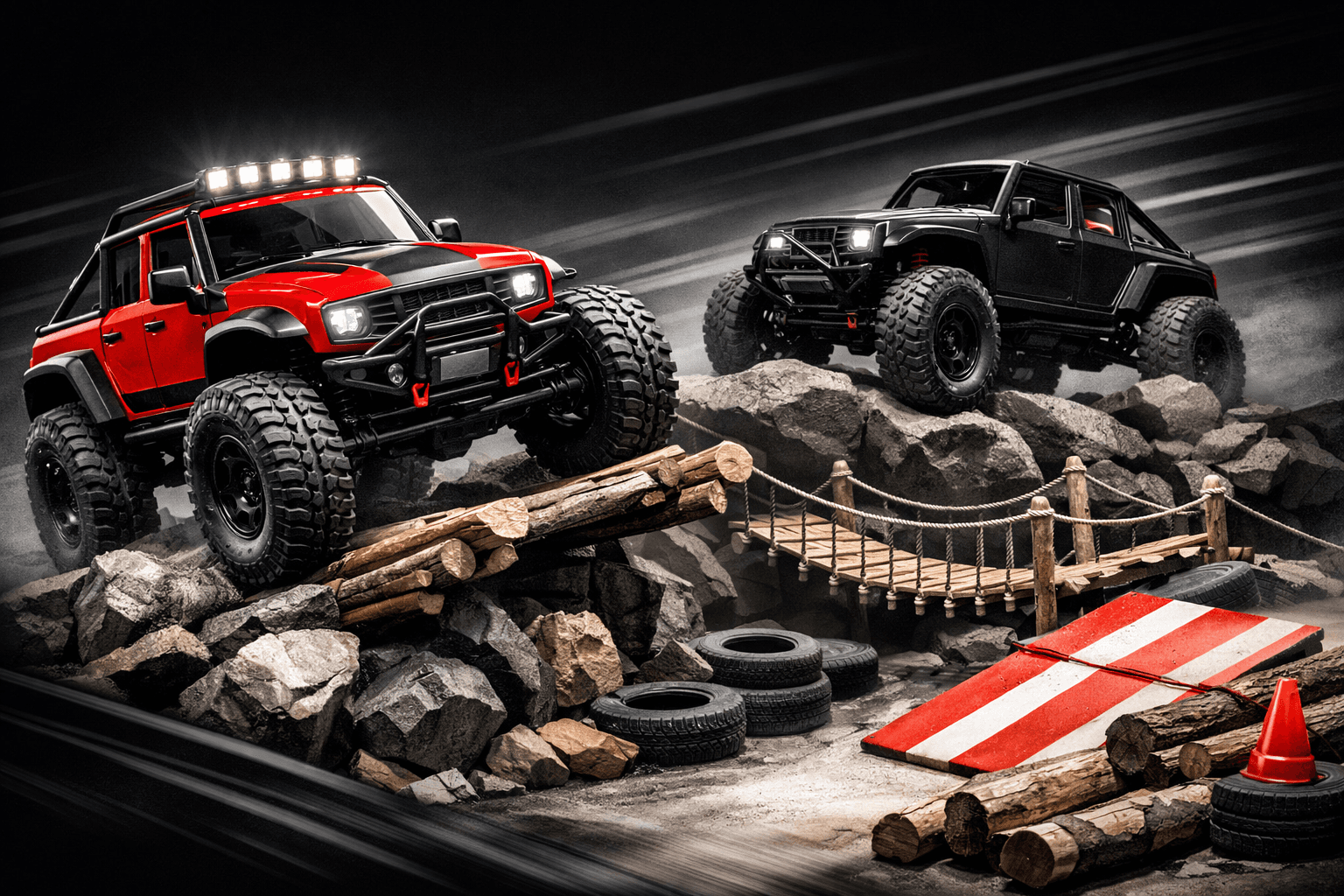
Building a crawler course is half the hobby. The moment you set the last rock in place, step back, and send your rig into that first gate section — that feeling never gets old. A great RC crawler course turns your backyard into a miniature Moab, your garage into a year-round trail system, and even your dining table into something your crawler friends will drive across town to session. And you can build one for less than you'd spend on a set of tires.
Whether you're working with a 20x30-foot backyard, a 10-foot patch of garage floor, or literally just a folding table for your SCX24, this guide covers course ideas for every space and budget. You'll find layout inspiration, a full breakdown of the best materials, obstacle designs with build tips, and the fastest ways to find existing RC crawler parks near you. Dig into our full crawlers guide if you need help picking the right rig first.
This post contains affiliate links. If you make a purchase through these links, we may earn a commission at no extra cost to you.
Planning Your Crawler Course
How Much Space Do You Need?
The honest answer: less than you think. A 4x4-foot table is enough for a serious mini crawler course if you're running an Axial SCX24 ($130–$160 — Check Price on Amazon or a Traxxas TRX-4M ($160–$175 — Check Price on Amazon. These 1/24 and 1/18 scale crawlers navigate surprisingly complex terrain in a tiny footprint. For a 1/10 scale rig like the Axial SCX10 III ($350–$430 — Check Price on Amazon, you'll want at least 10x10 feet for a basic RC crawler track — 10x20 feet gives you room to design a proper loop with multiple obstacles. If you're building a competition or club course with gate sections and full trails, plan for 20x30 feet or more.
Indoor vs. Outdoor
Indoor courses are weatherproof, always available, and easy to control. The terrain is limited to what you bring in, but foam, wood, and rocks can create incredible variety. The tradeoff is space — most indoor setups live in garages, basements, or spare rooms, which caps your scale. Outdoor courses have natural advantages: real dirt, natural contours, trees, and rocks that would cost a fortune to replicate inside. The downside is exposure to rain, freeze-thaw cycles, and the occasional rig going missing in tall grass.
My buddy and I built a rc crawler course in his backyard with $60 worth of landscaping rocks from Home Depot and some scrap lumber. That was two years ago and we still run it every weekend. It's rained on it, snowed on it, and had a dog dig through one section. Still runs great. Best investment in the hobby.
Scale Considerations
For reference, the scale sizes guide goes deep on this, but the short version: 1/24 crawlers (SCX24) run on obstacles made from aquarium pebbles and small sticks. A 1/10 crawler needs rocks 2–6 inches across to create a real challenge. Build for your scale or everything will feel wrong — a boulder that stops a 1/10 rig cold is just a stepping stone for a TRX-4 monster truck.
Budget
You can build a great rc crawler course diy on almost any budget. A tabletop mini crawler course for an SCX24 costs $15–$40 in materials. A proper backyard trail for a 1/10 scale rig runs $40–$100. A permanent, competition-style course with concrete features and custom woodwork can run $200–$500 or more. The good news: rocks don't depreciate, and most of the materials are one-time purchases.
Best Materials for a Crawler Course
Rocks & Boulders
Landscaping fieldstone and river rocks from Home Depot, Lowe's, or any garden center are the backbone of any RC crawler course. For 1/10 scale rigs, you want rocks in the 2–6 inch range — big enough to force real tire placement, small enough to create gaps and channels. For 1/24 scale SCX24 courses, small aquarium gravel and pea-sized rocks work perfectly. Buy a 5 lb bag of natural aquarium rocks ($8–$15) for micro courses — they're pre-cleaned, come in natural colors, and the variety of shapes is perfect for creating realistic terrain at small scale.
Cost: $10–$60 depending on scale and quantity. Source: Home Depot, Lowe's, garden centers, Amazon.
Wood
Scrap 2x4s and 1x6 boards are the builder's best friend. Use them for bridges, log crossings, ramps, and elevated approach sections. For outdoor courses, grab pressure-treated lumber — regular wood will rot within a season or two in wet climates. A bundle of cedar or pine stakes from the garden section works perfectly for log obstacles and gate markers. You can usually find scrap lumber at construction sites, sawmills, or on Facebook Marketplace for free.
Cost: $0–$30. Source: Hardware stores, scrap piles, Marketplace.
Dirt & Sand
Natural terrain is free, shapeable, and looks fantastic. If you're building an outdoor course, use the existing ground contours as your base and bring in topsoil or play sand to fill gaps and create mounds. Mix coarse sand with dirt for a firmer base that holds shape better than pure soil. The best outdoor rc crawler terrain starts with a dirt base — everything else sits on top of it.
Cost: $0–$20 for a bag of play sand. Source: Hardware stores, your own backyard.
Foam Board / Insulation Foam
XPS foam (the pink Owens Corning FOAMULAR board, sold at Home Depot) is the go-to for indoor rc crawler indoor courses. A 2"×4'×8' sheet runs about $25–$60 and can be carved with a hot wire cutter or box knife into hills, rock faces, and terrain features that would be impossible to replicate with real materials. Lightweight, easy to paint, and easy to rearrange. Stack multiple sheets for elevation gain. Seal with exterior latex paint to add some durability.
Cost: $25–$60 per sheet. Source: Home Depot, Lowe's (look for Owens Corning FOAMULAR NGX).
Concrete & Mortar
For permanent outdoor builds, concrete opens up a whole new tier of course building. Use mortar mix to create realistic rock walls, cliff faces, and ledges that hold up to weather and heavy rigs. Pour a concrete base section and press real rocks into it while wet for a textured climbing surface that looks incredible. This is weekend-project territory, but the results are permanent and impressive.
Cost: $15–$40 for a bag of mortar mix. Source: Hardware stores.
3D Printed Accessories
The 3D printing community has produced hundreds of free STL files for RC crawler scale accessories — bridges, barriers, trail signs, outhouse stops, logs, road signs, fire towers. Check Thingiverse and Printables for "RC crawler scale accessories" — you'll find enough free downloads to outfit an entire trail system. If you don't own a printer, local makerspaces or 3D printing services can produce parts cheaply. Check out our 3D printing guide for more on using printed parts in the hobby.
Cost: $0 for files, $5–$20 per part at a print service. Source: Thingiverse, Printables, local makerspaces.
Natural Elements
Free from your backyard or nearest trail: sticks, bark chunks, pine cones, moss, and lichen. These are the secret ingredient that separates a realistic-looking course from a pile of rocks on a board. A thick piece of bark propped against a rock creates a natural ramp. Pine cones become boulders at micro scale. Dried moss applied to foam with tacky glue turns a pink foam hill into a convincing green slope. A handful of sticks becomes a log crossing.
Cost: $0. Source: Outside.
Essential Crawler Course Obstacles
Rock Garden
The rock garden is the most fundamental obstacle in the entire sport — a section of varied-size rocks that forces the driver to pick a line carefully and execute tire placement with precision. The key design insight that most beginners miss: mix your rock sizes, and don't make them too big. Smaller rocks with tighter gaps are harder to crawl than a single large rock, because there's less consistent grip surface. Pile three or four layers deep so the rig has to climb, not just roll over. Build the entry at an angle so there's no straight-line solution.
Difficulty: Beginner–Intermediate | Materials: Landscaping rocks, fieldstone | Build tip: Set the largest rocks first as anchors, then fill gaps with smaller ones. Wedge them together so they don't shift under the rig's weight.
Side Hill / Off-Camber Trail
A trail cut along a slope where the crawler tilts sideways — the definition of an off-camber section. This is the most realistic of all rc crawler scale trail features and one of the hardest to drive well. It tests weight transfer, suspension articulation, and driver patience in equal measure. The best off-camber I ever built was cut into a dirt mound with about a 45-degree tilt. It looks casual until you watch 90% of drivers roll their rigs on it. Everyone keeps asking to run it again.
Difficulty: Intermediate–Advanced | Materials: Dirt mound, embedded rocks for traction variation | Build tip: The transition in and out of the off-camber is where most rigs fail — make those approach and exit angles gradual.
Bridges & Log Crossings
A plank bridge over a gap or a log crossing between two elevated sections is one of the most visually satisfying obstacles to film and one of the most practical to build. Two pieces of 2x4 with a 1x6 deck make a basic bridge in 20 minutes. Leave the railings off for extra challenge — a rig that slips sideways will go off the edge. Add staggered height legs so the bridge tilts slightly for extra difficulty.
Difficulty: Beginner | Materials: Scrap lumber, exterior screws | Build tip: Make the deck boards slightly narrower than your rig's track width on one side, so the driver has to choose a precise line.
Hill Climb / Descent
The rc crawler hill climb is pure torque and traction drama — a steep incline with varied surfaces that tests motor output, brake control, and tire choice. Embed rocks randomly into the slope to break up the surface and prevent tire spin. Mix loose dirt with gravel sections. The descent is often harder than the climb: slow, controlled braking while keeping weight balanced over the front tires is what separates good drivers from great ones.
Difficulty: Beginner–Intermediate | Materials: Dirt, embedded rocks, gravel | Build tip: Don't make the hill too smooth — every rock embedded in the face creates a new challenge and prevents the rig from just launching straight up on momentum.
Gate Sections (Competition Style)
Gates are the defining feature of a rc crawler competition course — two poles or flags that the crawler must pass between in a specific direction, with scoring penalties for missed gates. This adds a precision and strategy element that pure terrain crawling lacks. Set gates using wooden dowels or bamboo skewers pushed into foam or dirt, with a brightly colored foam block or flag at the top. Place them at transitions between obstacles so the driver has to hit the gate and manage the terrain simultaneously.
Difficulty: Intermediate | Materials: Wooden dowels, foam blocks, string or ribbon flags | Build tip: Reference SORRCA rules for competitive gate dimensions and scoring — it makes casual sessions more exciting when everyone's running real comp rules.
Water Crossings (Outdoor)
A shallow water crossing is the most dramatic-looking obstacle in outdoor crawling — even an inch of water makes the video footage look incredible. Use a shallow plastic storage bin sunk into the ground, a natural puddle, or just a low-lying section of the course after rain. Only run waterproof rigs through water. The Traxxas TRX-4M is fully waterproof out of the box — built for exactly this. Standard rigs need electronics sealed before you send them into water.
Difficulty: Easy (if waterproof) | Materials: Shallow tray, natural water | Build tip: Add rocks at the entry and exit to make the approach more interesting — a flat water crossing is boring, but one flanked by boulders with a technical entry line is a crowd-pleaser.
Tunnel / Overhang
A low-clearance section that forces the crawler to duck under a rock shelf or bridge tests body height, approach angle, and driver judgment. Build it by propping a flat rock or plywood panel on two vertical supports, leaving just enough clearance for the rig to pass through — barely. Stack foam or rocks on top for visual weight. This obstacle catches drivers who don't know their rig's roof height, and it rewards those who approach at the right angle.
Difficulty: Beginner | Materials: Flat rocks, plywood, foam supports | Build tip: Make the clearance adjustable so you can tighten it up for experienced drivers and open it slightly for beginners.
Switchback Trail
Tight S-curves on an incline that force the crawler to reverse direction multiple times while maintaining uphill progress. This is the most satisfying rc crawler course layout element to drive when it's well-built, because it rewards steering precision and rewards rigs with excellent articulation. Wheelbase matters enormously — a longer rig like the Axial SCX10 III will fight the tight switchbacks in ways a shorter rig won't.
Difficulty: Intermediate | Materials: Dirt or foam base, rock borders to define the trail | Build tip: The switchback banks should tilt slightly inward to help the rig stay on the trail. Flat or outward-banked turns will flip rigs on tighter courses.
Course Layout Ideas
Backyard Trail Course (10x20 feet, 1/10 Scale)
This is the classic setup — a loop course built around the natural contours of a standard backyard, using landscaping rocks as the primary obstacle material with dirt fill between sections. Start by laying out five to seven obstacle zones with spray paint: a rock garden entry, an off-camber mid-section, a hill climb, a log bridge, a switchback, and a finishing gate. The loop format means two drivers can run at the same time from opposite ends. Use a garden hose to define the trail boundaries and add a thin layer of sand to improve tire grip on smooth sections. This course rewards upgrading to better tires — a set of Pro-Line Flat Iron 1.9" XL G8 tires ($25–$32 — Check Price on Amazon will transform how your Axial SCX10 III handles the rock sections.
Dimensions: 10x20 feet | Materials: Landscaping rocks, scrap lumber, topsoil | Approximate cost: $40–$100
Garage / Basement Indoor Course (8x12 feet, 1/10 Scale)
A modular indoor course built on a plywood or concrete base lets you crawl year-round regardless of weather. Start with a 4x8 foot sheet of 3/4" plywood as your base section, build a foam terrain layer using 2" XPS FOAMULAR board stacked and carved to shape, then add rocks and wood obstacles on top. The modular advantage: rearrange every few sessions for fresh challenges without rebuilding from scratch. This is especially valuable in cold climates where an outdoor course is frozen solid from November through March. Use Woodland Scenics rock molds ($10–$15 — Check Price on Amazon to cast custom plaster rock sections that look far more realistic than bare foam.
Dimensions: 8x12 feet | Materials: Plywood, XPS foam, rocks, lumber | Approximate cost: $50–$150
Tabletop Micro Course (3x4 feet, 1/24 Scale — SCX24)
I built a tabletop SCX24 course in my apartment using foam board, aquarium rocks, and some sticks from the park. Total cost was maybe $15. My girlfriend was not thrilled about the rock collection on the dining table, but the course was incredible — three distinct obstacle zones, a tunnel, a log crossing, and a switchback trail, all on a surface smaller than a card table. The Axial SCX24 ($130–$160 — Check Price on Amazon was built for exactly this kind of indoor micro environment. A 5 lb bag of aquarium rocks ($8–$15) provides enough "boulders" for two complete micro courses at this scale.
Dimensions: 3x4 feet | Materials: XPS foam board, aquarium rocks, sticks, pine cones | Approximate cost: $15–$40
Competition / Club Course (20x30+ feet)
Designing a proper rc crawler competition course is a serious project — it requires planning gate placement, managing elevation changes, providing spectator sightlines, and balancing difficulty across skill levels. Reference SORRCA rules for standard gate dimensions and scoring methodology before you start placing obstacles. A solid club course includes at least six to eight numbered gates, a required hill climb section, one water or mud obstacle (if you have waterproof rigs in the group), and a clear start/finish line. Budget for flagging, gate poles, and permanent rock features — this is where concrete obstacle walls earn their investment. Add scale accessories like trail signs, a winch gate, and some LED light bars for night runs ($10–$30) to take the atmosphere to another level.
Dimensions: 20x30+ feet | Materials: Landscaping rocks, pressure-treated lumber, concrete, gate poles | Approximate cost: $200–$500+
Finding RC Crawler Parks & Trails Near You
The best place to start is RC Spotters (rcspotters.com) — a community-run trail directory where users submit and rate RC rock crawling trails by location. The site has a geolocation search feature and covers dozens of states, plus some international spots. Axial's Course & Club Directory at axialadventure.com lists hobby shops with dedicated crawler courses and local RC clubs organized by state. The RC Zone (therczone.com) provides a broader national track locator that includes crawler courses alongside racing tracks.
For local intelligence, join a Facebook group by searching "RC crawler [your state]" or "RC trail [your city]" — these regional groups are the fastest way to find unofficial spots, invite-only sessions, and upcoming club events that never appear on formal directories. Your local hobby shop is also an underrated resource: the staff usually know every unofficial rock garden and trail in a 30-mile radius, especially if the shop stocks crawler parts.
Public parks with rocky terrain are legitimate crawling spots in many areas — just be respectful of trail users, clean up after yourself, and avoid sensitive vegetation. Some dedicated RC crawler parks now operate with membership models, providing maintained courses open year-round. Mountain Adventure RC Park in North Georgia is one example of this growing trend.
FAQ
Q: How much does it cost to build an RC crawler course?
A tabletop micro course for an SCX24 or TRX-4M costs $15–$40 in materials — mostly aquarium rocks and foam board. A basic backyard trail for a 1/10 scale rig runs $40–$100 with landscaping rocks and scrap lumber. A full competition-style club course with concrete features and gate systems can run $200–$500 or more, depending on permanent installations.
Q: What rocks are best for an RC crawler course?
Landscaping fieldstone and river rocks from Home Depot or Lowe's are the best value for 1/10 scale courses — look for 2–6 inch pieces with varied shapes and rough surfaces. For 1/24 scale micro courses, buy a bag of natural aquarium rocks ($8–$15) — they're pre-cleaned, varied in shape, and perfectly sized for SCX24-scale terrain. Mix rock sizes in every obstacle section for maximum difficulty.
Q: Can I build a crawler course indoors?
Absolutely — indoor courses are some of the best in the hobby. Use XPS foam insulation board (Owens Corning FOAMULAR from Home Depot) as your terrain base, carve it to shape, and add rocks and wood obstacles on top. Garage and basement indoor courses are completely weather-independent and can be built in a modular format that rearranges for variety between sessions.
Q: How big does an RC crawler course need to be?
Minimum 4x4 feet for a micro crawler course running an SCX24 or TRX-4M. At least 10x10 feet for a basic 1/10 scale course, and 10x20 feet or more if you want a proper loop with multiple obstacle sections. Competition and club courses start at 20x30 feet to allow gate placement, elevation changes, and spectator access.
Q: Where can I find RC crawler parks near me?
Start with RC Spotters (rcspotters.com) for a geolocation trail directory, and check Axial's Course & Club Directory at axialadventure.com for hobby shops with dedicated crawler courses. Facebook groups are the fastest source for local unofficial spots — search "RC crawler [your state]" to find active regional communities. Your local hobby shop is also an excellent source for insider knowledge on nearby crawling spots.
Conclusion
Building a course is half the hobby — it's creative, it's affordable, and it makes every drive more meaningful than lapping the same flat pavement. Start small. A rock garden and a bridge is enough for a first session. Add an off-camber section next weekend. Invite two friends, run some gates, and discover that the best part of RC crawling has nothing to do with the price of your rig.
Don't have a crawler yet? Check our RC Crawlers Complete Guide to find the right rig for your course, or browse our best crawler kits if you'd rather build one from scratch.