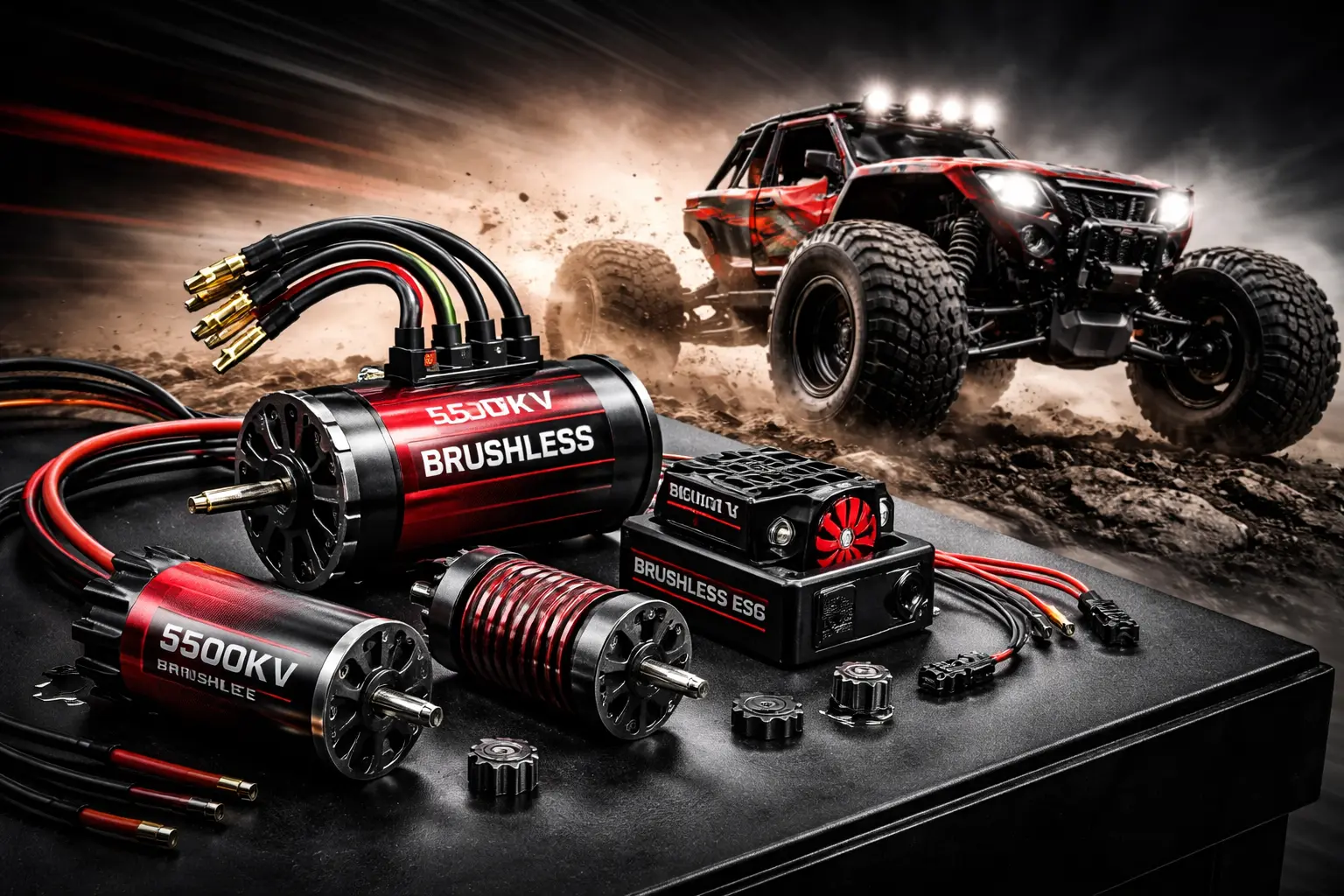
Sensored brushless motors have changed crawling forever — you can now inch forward with millimeter-level precision that brushed setups simply can’t match. If you’re ready to upgrade your crawler’s powertrain, or you’re trying to make sense of KV ratings, sensored vs sensorless, and the maze of combos out there, this guide covers everything: what specs matter, which products are worth your money in 2026, and exactly how to convert your specific rig.
New to crawling? Start with our complete RC crawler guide before diving in here.
This post contains affiliate links. If you make a purchase through these links, we may earn a commission at no extra cost to you.
Brushless vs Brushed for Crawling — Do You Need to Upgrade?
Brushed motors aren’t bad for crawling. That needs to be said upfront. A Holmes Hobbies CrawlMaster 15T paired with a Hobbywing 1080 ESC is a ~$65 setup that delivers excellent low-speed control and zero headaches. The physical brush-to-commutator contact is inherently smooth — the motor naturally produces linear torque from standstill. Plenty of top competition crawlers run brushed for serious events because that final increment of ultra-slow precision is hard to replicate artificially.
So when does brushless actually make a difference?
Brushless wins on every metric except price and that last sliver of ultra-low-speed precision. It runs cooler, lasts dramatically longer (tens of thousands of hours versus 1,000–3,000 for brushed), and converts energy at 85–90% efficiency versus 60–75% for brushed — which translates to roughly 20–30% more runtime per charge. For trail driving, scale builds, and anything that involves carrying a rig through water or mud, brushless is simply better. FOC (Field-Oriented Control) technology has effectively closed the control gap at the hardware level, and sensored systems eliminate the cogging that plagued early brushless crawlers.
The cogging myth — solved by sensored
Cogging — that awful stuttering at near-zero RPM — used to be the dealbreaker for brushless crawlers. It came from sensorless ESCs using trial pulses to guess rotor position at startup, since there’s no back-EMF signal at standstill. Sensored motors contain Hall-effect sensors that report exact rotor position at all times, so the ESC always knows where the motor is. Smooth power from 0 RPM, no guessing, no stuttering.
My first brushless attempt in a crawler was a sensorless motor off Amazon — nice specs on paper, but at crawling speeds it cogged so badly the truck was essentially undrivable on rocks. Sent it back and went sensored the same week. The difference was night and day. Don’t skip sensored for crawling.
When I finally swapped the stock Titan 21T in my TRX-4 for a proper sensored brushless setup, the low-speed control was genuinely shocking. I could inch forward a millimeter at a time on a rock ledge — something the brushed motor could never do without jerking. The upgrade paid for itself the first time I cleared an obstacle I’d been stuck on for months.
For a general overview of the two motor types, check out our brushed vs brushless explainer.
| Feature | Brushed | Brushless Sensored |
|---|---|---|
| Cost | Low ($25–60 motor) | Medium–High ($60–250 combo) |
| Low-speed control | Very good | Excellent (with FOC) |
| Efficiency | 60–75% | 85–90% |
| Maintenance | Brushes wear out | None |
| Noise | Quiet | Motor whine at speed |
| Longevity | 1,000–3,000 hours | 10,000+ hours |
| Waterproofing | Variable | IP67 on premium units |
Crawler Brushless Motor Specs Decoded
KV Rating & Turns — Lower Is Better for Crawling
KV is the unloaded RPM the motor produces per volt. A 2100KV motor on a 2S LiPo (7.4V) spins at ~15,500 RPM with nothing attached. Lower KV means more torque and less speed at any given voltage — which is exactly what a crawler needs.
In brushed motors, “turns” and KV have a direct relationship: more turns of wire = more torque, less speed. In brushless, turns aren’t standardized across manufacturers, but the general approximation for 2-pole 540 motors is: 10.5T ≈ 3,300KV, 13.5T ≈ 2,700KV, 17.5T ≈ 2,200KV, 21.5T ≈ 1,800KV. Note that 4-pole motors (Tekin ROC412, Hobbywing AXE) have more commutation events per revolution and produce smoother rotation with more torque at low RPM than equivalent-KV 2-pole designs.
| KV Range | Turns Equivalent | Best For |
|---|---|---|
| Under 1,500KV | 25T+ | Competition crawling, ultra-slow precision |
| 1,500–2,100KV | 17.5T–21.5T | Trail crawling, scale builds, most users |
| 2,100–2,800KV | 13.5T–17.5T | Trail running, fast trail/hybrid use |
| 2,800–3,500KV | 10.5T–13.5T | Rock racing, dual-purpose rigs |
For the majority of trail crawlers, 1,800KV on 2S is the sweet spot. Low enough for real control on rocks, fast enough to move at trail speed without feeling painfully slow.
Sensored vs Sensorless — The Make-or-Break Decision
Sensored brushless uses Hall-effect sensors to report exact rotor position to the ESC at all times — including zero RPM. The ESC knows exactly where the motor is and delivers perfectly timed current every single commutation event. Result: butter-smooth startup, zero hesitation, full torque from standstill.
Sensorless ESCs estimate rotor position using back-EMF — voltage generated by the spinning motor. At zero or very low RPM, there is no back-EMF. The ESC sends exploratory pulses to figure out where the rotor is, which causes the motor to twitch, stutter, and lurch. That’s cogging. It’s fine for bashing, where you’re rarely crawling at near-zero throttle under load. For crawling, it’s a disaster.
If you take one thing from this article: never buy a sensorless motor for crawling.
You need both a sensored motor AND a sensored-capable ESC. A sensored motor plugged into a sensorless ESC just behaves as sensorless — the sensor wire isn’t connected to anything. Check both components before buying.
Motor Size — 540 vs 550
Both 540 and 550 motors share the same ~36mm diameter. The difference is length: 540 motors are approximately 50mm long, 550 motors run 55–65mm. Most 1/10 crawlers — SCX10 III, TRX-4, Element Enduro, Capra — use 540-size motors. The 550 size fits in larger/heavier rigs and generally produces more torque due to a longer rotor.
In brushless nomenclature, a “3650” motor is 36mm diameter × 50mm long — effectively a 540. A “3660” is 36mm × 60mm — a 550. Most shaft diameters in 1/10 crawling are 3.175mm (1/8 inch). Some 550-class brushless motors use a 5mm shaft, which is stronger but requires a different pinion.
Best Brushless Crawler Motors & ESC Combos (2026)
After extensive research across RCCrawler forums, community threads, and retailer listings, here’s where the market stands in 2026:
| Motor/Combo | Type | KV Options | Sensored | Est. Price | Best For | Rating |
|---|---|---|---|---|---|---|
| Hobbywing Fusion SE | 2-in-1 combo | 1200, 1800KV | Yes (FOC) | ~$80–100 | Best value, most users | ⭐⭐⭐⭐⭐ |
| Hobbywing AXE R2/R3 | ESC + motor | 1200–3300KV | Yes (FOC) | ~$110–200 | Premium trail/comp | ⭐⭐⭐⭐⭐ |
| Tekin ROC412 + RX4 | Separate | 500–5700KV | Yes | ~$220–250 | Competition crawling | ⭐⭐⭐⭐⭐ |
| Castle Copperhead 10 + 1406 | Combo | 1900–3800KV | Yes | ~$130–150 | Mid-range performance | ⭐⭐⭐⭐ |
| Hobbywing Fusion Pro | 2-in-1 combo | 1800, 2300KV | Yes (FOC) | ~$125–155 | Heavy rigs, more power | ⭐⭐⭐⭐ |
| Holmes CrawlMaster 2n1 | 2-in-1 combo | 1800, 2300KV | Yes | ~$75 | Holmes faithful | ⭐⭐⭐⭐ |
| Surpass Hobby + QuicRun 10BL120 | Separate | ~2500–3100KV | Yes | ~$65–75 | Budget brushless entry | ⭐⭐⭐ |
| Furitek Stinger/Torpedo | Micro combo | Varies | Yes (FOC) | ~$65–150 | SCX24 / TRX-4M | ⭐⭐⭐⭐⭐ |
Best Combo — Plug and Play
The Hobbywing QuicRun Fusion SE is the community’s near-unanimous best-value crawling upgrade in 2026, and for good reason. It integrates a 40A FOC ESC directly into a sealed 540-size sensored motor — eliminating the three phase wires and sensor cable that normally run between components. IP67 waterproof, intelligent closed-loop torque control, and a drag brake rated at 200% of standard brushless systems.
The 2-in-1 design makes installation genuinely simple. When I dropped the Fusion SE into my SCX10 III, the whole swap took about 15 minutes. I plugged in battery and receiver leads, set the drag brake via the LED program card, and it was already dialed for crawling out of the box. No phase wire routing, no sensor cable management, no compatibility concerns. If you don’t want to mess with settings, it works brilliantly on defaults.
Available in 1200KV (for heavier rigs or geared-up setups) and 1800KV (ideal for most 1/10 trail crawlers on 2S). The 1800KV variant is the one to get for 90% of builds.
Best Crawling-Specific Motor
For builders who want a dedicated sensored motor paired with their ESC of choice, Holmes Hobbies remains the most respected name in crawling-specific brushless motors. Their Puller Pro V2 is a 4-pole, 12-slot sensored inrunner with a waterproof sensor board, available in Stubby (compact 540), Standard 540, and R 540-L (550 length) configurations.
The 4-pole design produces noticeably smoother low-RPM output than 2-pole racing motors at the same KV. The Stubby variant (1800KV or 2700KV) is the go-to for tight motor bays like the Axial Capra. Holmes also offers the newer CrawlMaster 2n1, which is their integrated combo alternative to the Fusion at ~$75 — featuring a custom 10-pole, 12-slot inrunner in a fully sealed housing.
Holmes Hobbies products are best sourced through AMain Hobbies where stock is most reliable. Note that Holmes products sometimes show back-order status — availability can be limited.
Best Mid-Range Option
The Castle Creations Copperhead 10 + 1406 Slate Combo hits a strong mid-range sweet spot at ~$130–150. Castle’s SmartSense technology provides sensored startup smoothness then transitions to efficient sensorless operation once spinning — the best of both modes. The CRYO-DRIVE feature reduces heat during partial throttle (where crawlers spend most of their time), and the system is fully waterproof.
The 1406 Slate motor is a 4-pole, 12-slot design — the same architecture that makes the Tekin ROC412 so smooth. Available in 1900KV, 2280KV (the most popular crawling KV), 2850KV, and 3800KV. Programmed via Castle Link USB (often included free) or B-Link Bluetooth adapter.
Best Budget Brushless for Crawling
For under $75 total, the Surpass Hobby Rocket sensored 540 motor ($16–35) paired with the Hobbywing QuicRun 10BL120 Sensored G2 ESC ($50) gives you a fully functional sensored brushless crawling system. The Surpass motors are 2-pole racing-style designs — not purpose-built for crawling — but they work well at 13.5T (~3100KV) or 21.5T (~2500KV) on 2S with a properly tuned ESC.
The 10BL120 G2 is a solid standalone sensored ESC that handles the drag brake and programming you need. The limitation is the Surpass motor’s single-pole design produces slightly less smooth low-RPM behavior than a 4-pole crawler motor, and build quality can be inconsistent. Great for trying brushless without a big investment, but expect to upgrade the motor eventually.
Check Surpass Hobby motors on Amazon | Check QuicRun 10BL120 on Amazon
Best Micro Brushless (1/18 & 1/24)
Furitek owns the micro brushless market. For the Axial SCX24, the Furitek Stinger combo (Lizard Pro 30A ESC + Micro Komodo 1212 3450KV motor + Bluetooth module + CNC mount + pinion) is the benchmark at ~$65–75. The step-up Torpedo combo (Python Pro waterproof ESC + Cedar inrunner) runs ~$130–150. Both use FOC control and program via the free FURICAR Bluetooth app.
For the TRX-4M, Furitek makes a Stinger 118 variant purpose-built for the 1/18 scale platform. The Traxxas OEM brushless kit (#6250, ~$120) is the zero-hassle plug-and-play alternative that retains stock radio and lighting.
Check Furitek combos on Amazon
Which ESC Pairs Best with Each Motor?
If you’re buying a standalone motor rather than a combo, motor-ESC compatibility matters — especially for sensored operation.
| Motor | Recommended ESC | Combined Price | Notes |
|---|---|---|---|
| Holmes Puller Pro V2 | Castle Copperhead 10 | ~$195–230 | Excellent combo, Castle’s SmartSense handles sensored/sensorless |
| Holmes Puller Pro V2 | Hobbywing QuicRun 10BL120 | ~$115–145 | More budget-friendly, very capable |
| Tekin ROC412 | Tekin RX4 | ~$220–250 | Native pairing, HotWire Bluetooth telemetry |
| Surpass Hobby 540 sensored | Hobbywing QuicRun 10BL120 | ~$65–85 | Best budget combination |
| Hobbywing AXE motors | Hobbywing AXE ESC only | ~$110–200 | Closed ecosystem — must use matched AXE ESC |
Critical: Make sure both your motor and ESC specifically list sensored support. “Brushless ESC” alone does not mean sensored-capable. The sensor cable (usually 6-pin JST) must be connected to both components.
Drag brake deserves special mention here. Crawling requires drag brake set to 80–100% — this prevents the vehicle rolling backward when you release the throttle on an incline. Most standard brushed ESCs lack adjustable drag brake; it’s one of the biggest practical differences when switching to a crawling-tuned brushless system.
Brushless Conversion by Vehicle
Every stock RTR crawler ships with a brushed ESC. Every brushless conversion requires replacing both the motor and ESC — there are no exceptions among current popular platforms.
| Vehicle | Stock Motor | Recommended Combo | ESC Swap Required | Difficulty | Notes |
|---|---|---|---|---|---|
| Axial SCX10 III | 35T 540 brushed | Hobbywing Fusion SE 1800KV | ✅ Yes | Easy | Standard 540 mount, no mods needed |
| Traxxas TRX-4 | Titan 550 21T | Hobbywing Fusion Pro 1800KV | ✅ Yes | Easy | Stay ≤2200KV — high gear ratio |
| Axial Capra 1.9 | 35T 540 brushed | Holmes Puller Pro Stubby + Copperhead 10 | ✅ Yes | Medium | Tight space — use Stubby variant only |
| Element Enduro | 14–16T 540/550 brushed | Hobbywing Fusion SE 1800KV | ✅ Yes | Easy | Universal community recommendation |
| Redcat Gen9 | Generic 550 brushed | Fusion SE or Copperhead 10 + 1406 | ✅ Yes | Easy | 2-speed gearbox pairs well with ~2280KV |
| Traxxas TRX-4M (1/18) | 180-size brushed | Traxxas #6250 BL kit (plug-and-play) | ✅ Yes | Easy | Retains stock radio + lighting; Furitek Stinger 118 = better crawl performance but needs new radio |
| Axial SCX24 (1/24) | ~90T 180-size brushed | Furitek Stinger or Spektrum Firma 8A | ✅ Yes | Medium | Board version affects install complexity; Firma = simplest drop-in |
Universal installation tips: Check your pinion gear size before ordering — brushless motors often need a smaller pinion (10–12T) to compensate for higher no-load RPM. Use blue threadlocker on motor mount screws. If your chassis has a heat-treated motor plate, a 30-second heat gun pass makes motor screw access much easier. Never run a brushless motor without confirming sensor cable seating — a partially connected sensor wire causes intermittent cogging that’s maddeningly hard to diagnose.
Upgrading the motor? Don’t forget the servo — our crawler servo guide covers the best options for completing the powertrain upgrade.
ESC Programming Tips for Crawling
Spend 20 minutes programming your ESC. It makes more difference than the motor itself. A perfectly spec’d motor on factory ESC defaults will underperform a cheaper motor on a dialed-in program. Here are the three settings that matter most:
1. Drag Brake — Set it high
Drag brake determines how hard the motor resists turning when throttle is at neutral. For crawling, set it between 80–100%. Without it, your rig rolls freely backward the moment you back off the throttle on any incline — a disaster on technical terrain. Use a “slow” or “medium” drag brake ramp (not instant) to avoid jarring brake engagement that can break traction. The Hobbywing Fusion features an “Active Brake on Throttle” mode that maintains drag brake even while throttle is applied, preventing runaway speed on descents — turn this on.
2. Punch / Throttle Curve — Soften the hit
Punch controls how aggressively the motor accelerates from a stop. Set it low (1 or 2 out of 10 on most ESCs). The goal is to eliminate the initial power spike that breaks traction before you can react. A soft exponential throttle curve gives you far more resolution at the low end — where 90% of crawling actually happens. Many experienced crawlers map the first 60% of trigger travel to just 30–40% of motor output, then let it ramp up for trail speed.
3. Low Voltage Cutoff — Protect your LiPo
Set LiPo cutoff to 3.2–3.4V per cell with a “gradual” or “soft” warning mode. Abrupt power cutoff on a steep incline can send a rig tumbling — gradual reduction gives you time to pick a safe spot to stop. Also check your BEC voltage: many high-torque crawling servos run at 7.4V HV, and running them on a 6V BEC causes brownouts under load.
Brushless motors are more efficient but still need the right battery — see our LiPo battery guide to make sure your pack supports the discharge rate your brushless system demands.
Programming tools by brand
The Hobbywing LED Program Card ($10) is the essential companion for any Fusion or QuicRun ESC — a credit-card device that accesses all settings without a PC or phone. For smartphone programming, the Hobbywing OTA Bluetooth Module ($35–45) connects to the free HW Link app with real-time data logging. Castle ESCs use the Castle Link V3 USB ($20, often bundled free) with full PC software, or the B-Link Bluetooth adapter ($50) for mobile access. Tekin’s HotWire 3.0 adds Bluetooth telemetry to RX4 ESCs. Furitek ESCs have built-in Bluetooth and use the free FURICAR app.
Check Hobbywing program card on Amazon
FAQ
Q: Is brushless better than brushed for RC crawling?
For most crawling, yes — modern sensored FOC brushless motors deliver smooth low-speed control, longer motor life, and better efficiency than brushed. The main exception is extreme competition crawling at ultra-slow speeds under maximum load, where some advanced drivers still prefer brushed for the last increment of precision. For trail driving and scale builds, brushless wins.
Q: Do I need a sensored brushless motor for crawling?
Absolutely. Sensorless brushless motors use back-EMF to detect rotor position, which only works when the motor is already spinning. At the near-zero RPM speeds that define crawling, a sensorless system produces cogging and stuttering that makes the truck undrivable on rocks. Sensored motors use Hall-effect sensors to report exact rotor position at all times, enabling smooth torque delivery from standstill.
Q: What KV motor is best for a crawler?
For most 1/10 crawlers on 2S LiPo, 1,800KV is the sweet spot. It’s low enough for real precision on technical terrain but fast enough for trail driving. Competition-oriented builds going for maximum low-speed control should look at 1,200KV or lower. Faster trail builds that need more top speed can go up to 2,300–2,800KV.
Q: Can I just swap the motor or do I need a new ESC too?
You always need a new ESC when converting from brushed to brushless. Brushed ESCs control motor speed by varying voltage to two wires. Brushless ESCs control three-phase timing in a completely different way. There is no such thing as a brushed ESC that runs a brushless motor. Budget for the full conversion: motor + ESC (or a 2-in-1 combo like the Hobbywing Fusion to keep it simple).
Q: What’s the best budget brushless setup for a TRX-4?
The best value entry into sensored brushless for a TRX-4 is a Surpass Hobby 13.5T sensored motor ($25) + Hobbywing QuicRun 10BL120 Sensored G2 ESC ($50) for around $75 total. A step up — and a big one for plug-and-play simplicity — is the Hobbywing Fusion Pro 1800KV (~$130–155), which handles the TRX-4’s high gear ratio well and requires zero compatibility checking.
Conclusion
Sensored brushless is the single best upgrade you can make to a crawler’s powertrain. The technology that used to make brushless impractical for slow-speed work — cogging, jerky startup, poor low-RPM control — is solved by any modern sensored FOC system. The Hobbywing QuicRun Fusion SE 1800KV is the top pick for most builders: FOC control, IP67 waterproofing, 2-in-1 simplicity, and a price around $80 that competes directly with brushed upgrades. Whatever route you choose, pair it with a proper drag brake setup and soft throttle curve — and you’ll have a rig that performs like something twice the price.
Check the Hobbywing Fusion SE on Amazon
Looking for the full picture on rock crawlers? Head back to our complete RC crawler guide to explore builds, tires, servos, and more.