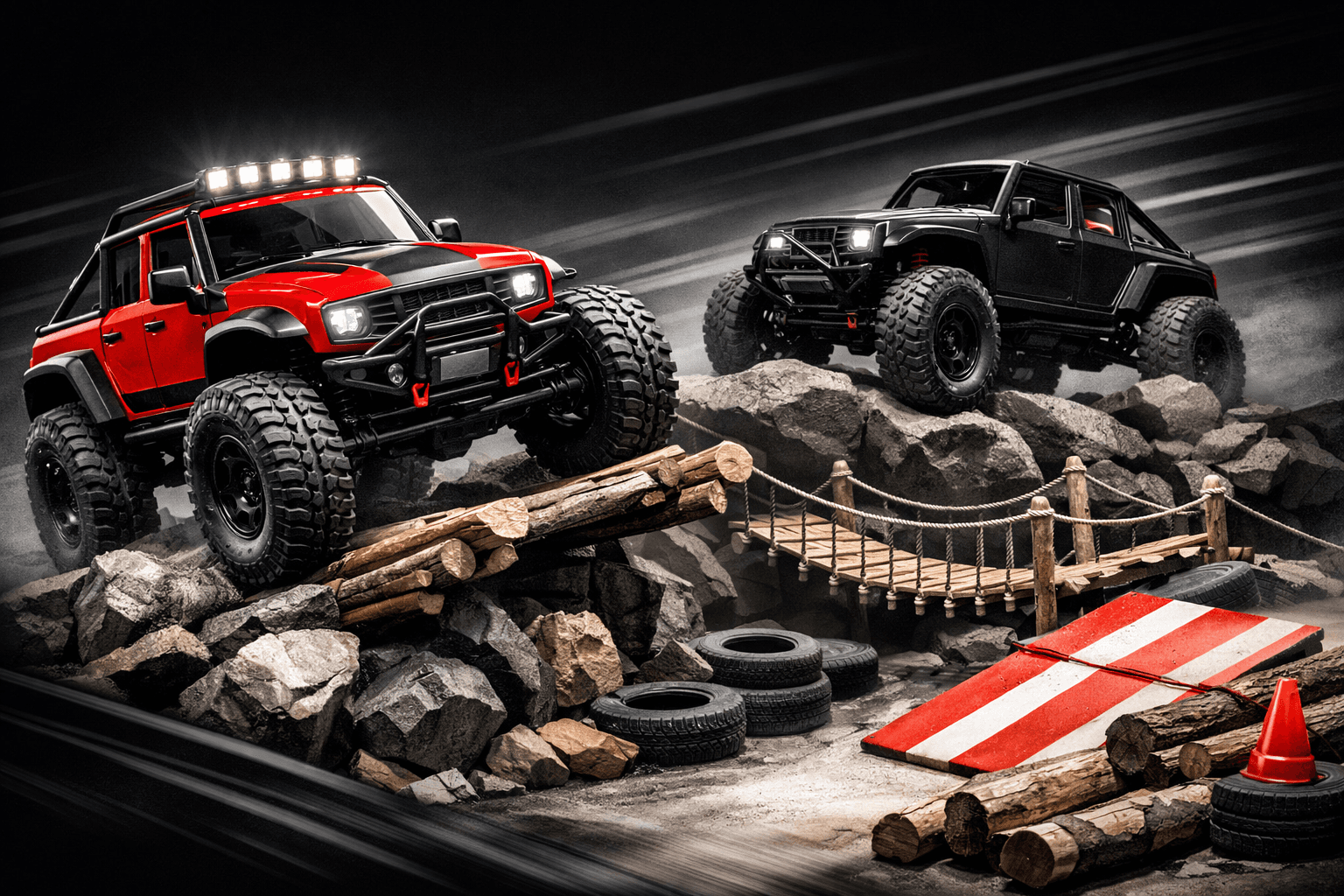
Scale numbers confused me when I first got into RC. I thought "1/10 scale" meant something tiny — like a model car sitting on a shelf. Then my first Traxxas Slash arrived, and I was floored: the thing was nearly two feet long. That's when I realized RC scale math works differently than I'd assumed, and that picking the wrong scale for your situation can cost you real money and real frustration.
This guide breaks down every common RC scale from 1/28 all the way up to 1/5, with real-world size comparisons, specific model examples, and a clear recommendation for each type of driver.
This post contains affiliate links. If you make a purchase through these links, we may earn a commission at no extra cost to you.
How RC Scale Sizes Work
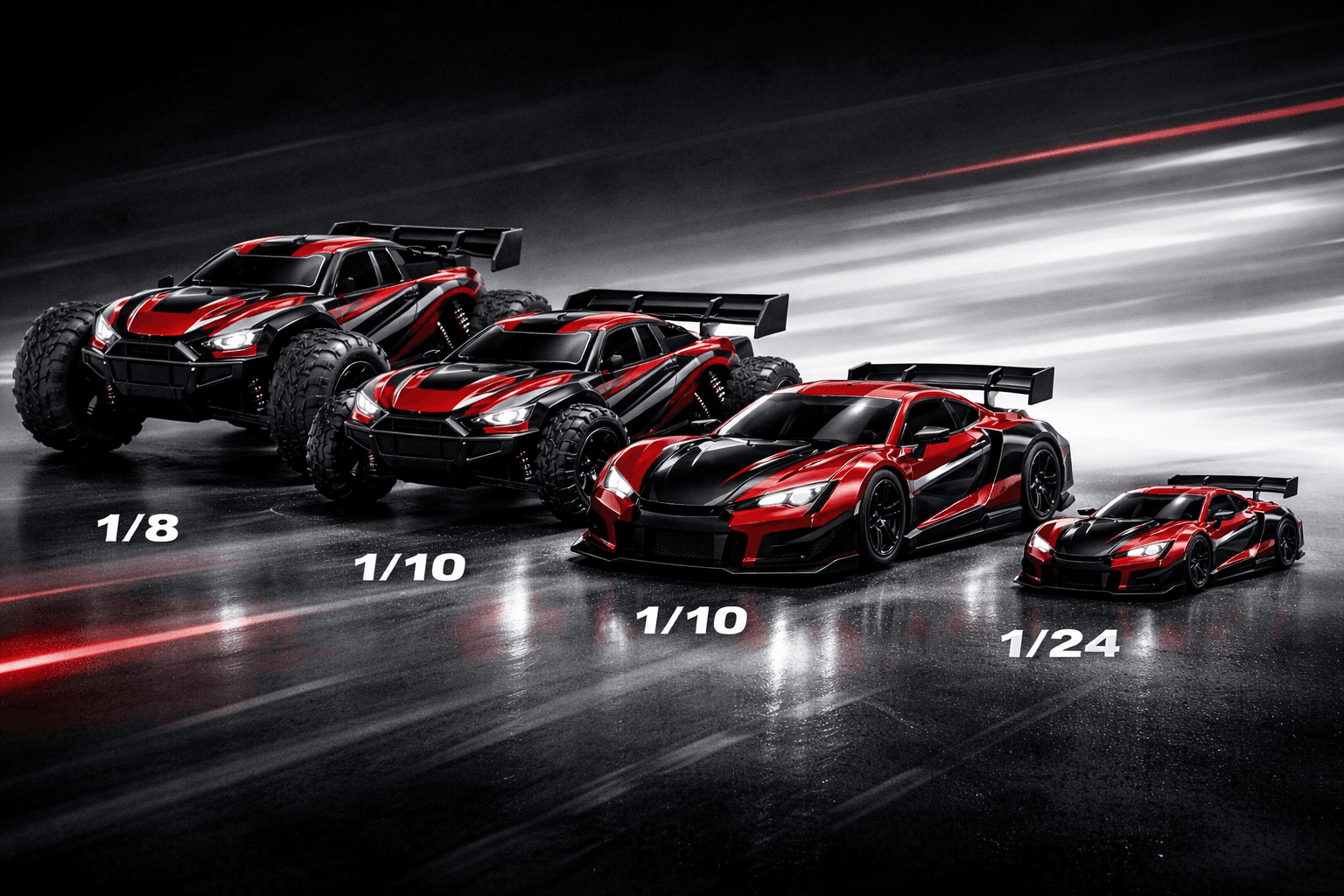
When a car is labeled "1/10 scale," it means the model is theoretically 1/10th the size of the full-size vehicle it represents. A full-size truck that's 200 inches long would produce a 20-inch RC model at 1/10 scale. Simple enough.
The catch? Unlike model trains — where HO scale is a precisely standardized 1:87 ratio enforced by the NMRA — RC scale is a marketing category, not a dimensional standard. No governing body enforces exact measurements. Two 1/10 cars from different brands can differ by three or more inches because they're modeling different real vehicles. A Jeep Wrangler and a NASCAR stock car are wildly different sizes in real life, and so are their RC counterparts at the same nominal scale.
What actually matters when comparing RC cars is the wheelbase (distance between axle centers), the chassis width, and the overall body dimensions — not the scale number printed on the box. Use scale as a rough guide, not a precise specification.
RC Car Scale Size Chart
| Scale | Approx. Length | Approx. Width | Real-World Comparison | Example Model | Price Range |
|---|---|---|---|---|---|
| 1/28 | 5–6 in | 2.5–3 in | Deck of cards | Kyosho Mini-Z RWD | $150–$220 |
| 1/24 | 7–9 in | 3.5–4.5 in | Large smartphone | Axial SCX24 | $130–$160 |
| 1/18 | 9–11 in | 7–8 in | Hardcover book | Arrma Granite Grom | $100–$160 |
| 1/16 | 12–14 in | 8–10 in | Large tablet | Traxxas E-Revo VXL | $250–$350 |
| 1/10 | 17–23 in | 9–12 in | Carry-on luggage | Traxxas Slash 4X4 | $200–$600 |
| 1/8 | 20–25 in | 12–19 in | Small dog | Arrma Kraton 6S | $450–$800 |
| 1/7 | 27–29 in | 12–15 in | Medium golden retriever | Arrma Mojave 6S | $550–$850 |
| 1/6 | 30–34 in | 13–16 in | Large dog, carry-on side | Axial SCX6 | $800–$1,100 |
| 1/5 | 35–42 in | 18–22 in | Medium suitcase | Losi 5IVE-T 2.0 | $1,200–$1,500 |
1/28 Scale — The Micro Racer
At roughly 5 to 6 inches long, a 1/28 scale RC fits comfortably in the palm of your hand. These are precision miniatures built for indoor carpet and tile racing, not backyard bashing.
The standard-bearer of this scale is the Kyosho Mini-Z RWD lineup. The latest iteration uses the fourth-generation MR-04 chassis, which delivers a noticeably lower center of gravity and reworked steering geometry compared to its predecessor. Prices hover around $150–$220 for a ready-to-run set. Check Price on Amazon
Pros: Runs anywhere indoors; remarkably precise handling; community of dedicated clubs and tracks; low operating cost.
Cons: Proprietary parts ecosystem; not compatible with standard hobby-grade electronics; fragile on rough surfaces; steep learning curve for maintenance.
This scale is genuinely niche. If you're looking for your first RC car, skip 1/28. If you're a veteran driver looking for a technical indoor challenge or want to run lap sessions at a Mini-Z club, it's absolutely brilliant.
1/24 Scale — The Micro Crawler
The 1/24 scale occupies a sweet spot for anyone who wants genuine hobby-grade performance in a package small enough to run across a kitchen floor or desk. Think of it as a large smartphone in length — manageable, pocketable, and surprisingly capable.
The platform that defined this scale is the Axial SCX24 series. The current lineup has evolved well beyond the original Deadbolt; the SCX24 Ford Bronco 4X4 RTR is a strong starting point with its oil-filled shocks, Spektrum electronics, and officially licensed body. Check Price on Amazon
I'll be honest: I bought a SCX24 on a whim to crawl around a coffee shop obstacle course built from books and mugs. What surprised me was how well it actually handled real outdoor terrain — loose gravel, bark chips, low curb drops. It's not a toy. It's a fully rebuildable platform with a genuine aftermarket.
Pros: Runs absolutely anywhere; massive aftermarket parts community; inexpensive to upgrade; great for indoor competitions.
Cons: Tiny size means more delicate electronics; limited speed for open-area bashing; batteries need frequent swaps.
This is a fantastic second RC for someone who already owns a 1/10. For beginners, it can be fragile until you learn the hobby. Check out our complete RC crawlers guide for more 1/24 options.
1/18 Scale — The Junior Basher
At 9 to 11 inches long and roughly as wide as a hardcover novel, the 1/18 scale is the sweet spot for young drivers and people who want a real RC car without dedicating an entire shed to it.
The standout model here is the Arrma Granite Grom, a 4WD monster truck that refuses to act its size. With a genuine ARRMA pedigree — waterproof electronics, oil-filled shocks, a metal-geared servo — it delivers the kind of durability you'd expect from a full-size ARRMA basher. At around $130, it competes against nothing in its class. Check Price on Amazon
The Granite Grom was my go-to recommendation for a nephew who kept destroying budget toys. It has now survived two years of genuine abuse including a driveway gap jump that I would describe as inadvisable. It's on its second set of tires and otherwise unchanged.
For more Arrma small-scale options, our Arrma Grom series compared guide covers the full lineup including the Typhon Grom buggy and Mojave Grom desert truck.
Pros: Manageable speed for younger drivers; genuinely durable for the size; easy to transport; affordable entry point into the ARRMA ecosystem.
Cons: Not compatible with standard 1/10 parts; can feel underpowered on thick grass; limited racing scene compared to 1/10.
1/16 Scale — The Compact Powerhouse
At 12 to 14 inches, the 1/16 scale sits awkwardly between junior and full-size. Think of it like a large tablet — legitimately capable, but not the first choice for most drivers. This scale has fewer dedicated models than 1/10 or 1/18 and can feel like a gap-filler in most manufacturers' lineups.
The most notable example is the Traxxas E-Revo VXL 1/16, a 4WD brushless truck that packs serious performance into a compact frame. The VXL Velineon brushless system pushes this little truck past 30 mph, and the rocker-actuated suspension (adapted directly from the full-size E-Revo) delivers real handling capability. Check Price on Amazon
Pros: Faster and more capable than 1/18; Traxxas parts availability; compact enough for most vehicles' trunks.
Cons: Fewer model options than adjacent scales; parts ecosystem smaller than 1/10; can outgrow the scale quickly.
1/10 Scale — The Sweet Spot
If I had to recommend one scale to anyone just getting into RC, it would be 1/10 without a moment's hesitation. This is the scale where everything converges: the widest selection of vehicles, the deepest parts ecosystem, the most active racing clubs, and the best balance of performance and portability.
A 1/10 car is roughly the size of carry-on luggage — substantial enough to feel real, manageable enough to fit in your car without a second thought.
1/10 Bashing & Street: Traxxas Slash 4X4 VXL
The Traxxas Slash 4X4 VXL HD is the benchmark short-course truck. At 22.36 inches long with 4WD, a VXL brushless system capable of 60+ mph, and Traxxas Stability Management, it handles everything from backyard bashing to competitive club racing. At around $400, it's an investment — but one with a decade-long track record. Check Price on Amazon
1/10 Crawling: Axial SCX10 III Jeep JLU Wrangler
For trail crawling, the Axial SCX10 III Jeep JLU Wrangler with portal axles is the gold standard. The replica V8 engine housing, portal axle drivetrain, and Spektrum Smart electronics combine to create the most realistic and capable 1/10 crawler on the market. At around $500, it's premium pricing for a premium product. Check Price on Amazon
See our RC crawlers complete guide and our RC drift cars guide for more 1/10 options across different disciplines.
Pros of 1/10: Overwhelming parts availability; active club racing scene; wide price range ($200–$600+); works for bashing, crawling, racing, drifting, and more.
Cons: Not the cheapest entry point; can be physically large for very young kids; crashes at full speed can be expensive.
1/8 Scale — The Serious Basher's Scale
Step up to 1/8 and you enter a different category entirely. These are physically imposing machines — roughly the size of a small dog — built to absorb 6S LiPo punishment and deliver performance that obliterates anything in the 1/10 class.
The community consensus is clear: if bashing is your primary goal, 1/8 is your scale. One Arrma forum veteran put it plainly — there's no 1/10 that can hang with a 1/8 basher.
Arrma Kraton 6S V6
The Arrma Kraton 6S V6 is the definitive 1/8 speed monster truck. At 23.39 inches long, 18.15 inches wide, and powered by a Spektrum Firma 2050Kv brushless motor with a 150A Smart V2 ESC, it's rated for 65+ mph with the right pinion. The EXB-hardened 7075 T6 aluminum chassis and 29mm differentials mean it takes punishment that would destroy lesser trucks. Check Price on Amazon
For 1/8 buggy racing, the Losi 8IGHT-XE and Tekno EB48 are both competitive at the club and national level. See our RC racing complete guide for a deep dive into 1/8 racing setup.
Pros: Dominant bashing performance; wide variety of options across brands; well-supported parts ecosystem.
Cons: Heavy (10+ lbs); expensive batteries (2×3S or 6S); harder to transport; not for beginners.
See our best RC trucks for bashing guide for a full 1/8 scale comparison.
1/7 Scale — The Oversized Bashers
The 1/7 scale is Arrma's territory, and they've owned it with the Mojave and Infraction platforms. These are enormous trucks — nearly 28 to 29 inches long, wider than most 1/8 bashers, built specifically for high-speed desert running and street bashing.
The Arrma Mojave 6S V2 measures 28.15 inches long and 13.98 inches wide. At around $600–$650, it's a legitimate step up from 1/8 in both size and presence. The 6S brushless system delivers 60+ mph speeds on dirt with a brutality that genuinely requires open space to appreciate. Check Price on Amazon
Pros: Unmatched desert truck performance; imposing size is genuinely exciting; excellent out-of-box electronics.
Cons: Needs serious space to run; transportation is a challenge; very expensive repair costs after crashes.
1/6 Scale — The Giant Crawler
The 1/6 scale is essentially the maximum practical size for an RC crawler, and the Axial SCX6 Jeep JLU Wrangler defines the category. At 33.55 inches long and weighing 25 pounds, it's closer to a large dog than a toy. The SCX6 runs on the proven SCX10 III platform, scaled up to accommodate a brushless Firma Crawler ESC, portal-axle-inspired AR90 axles, and two-speed transmission. Battery not included; plan for a serious LiPo setup.
Available at Check Price on Amazon at around $1,000.
Pros: Jaw-dropping scale realism; genuine crawler capability on any terrain; impressive at trail events and club meetups.
Cons: Massive; expensive; requires significant battery investment; not for beginners.
1/5 Scale — The Nuclear Option
The 1/5 scale is where RC stops being a hobby and starts becoming a lifestyle. At 35 to 42 inches long and weighing 35+ pounds, a 1/5 car is the size of a medium carry-on suitcase. It requires a dedicated vehicle to transport, open terrain to run, and a serious commitment to maintenance.
The Losi 5IVE-T 2.0 is the benchmark. Powered by a Zenoah G320 32cc gasoline engine — yes, real gasoline — it delivers the kind of visceral performance that turns heads at any park or trail. The 32cc engine produces enough torque to power this 4WD behemoth across virtually any terrain. At $1,300–$1,400, it demands serious investment.
Pros: Unmatched presence and performance; gasoline means long run times; incredible community of dedicated enthusiasts.
Cons: Extremely expensive to run and repair; requires open spaces and responsible operation; not suitable for most beginners; gas-powered requires engine break-in and carb tuning.
Which Scale Should You Choose?
Your first RC car: Start with 1/10. The parts availability, community support, and performance range make it the most forgiving scale to learn in. A Traxxas Slash 4X4 or Arrma Senton will give you years of running before you outgrow it. Our best RC cars for beginners guide has specific recommendations for every budget.
Limited space (apartment, small yard): Go 1/24 (Axial SCX24) for crawling, or 1/28 (Kyosho Mini-Z) for indoor racing. Both are genuinely capable and run comfortably indoors.
You want to race at a club: 1/10 is the standard for most local club racing. Step up to 1/8 buggy (Losi 8IGHT-XE, Tekno EB48) when you're ready for regional and national-level competition.
You want to bash hard: 1/8 is the answer. The Arrma Kraton 6S or Typhon 6S will outlast and outperform anything at 1/10 scale. See our best RC trucks for bashing guide.
You want to crawl technical trails: 1/10 (Axial SCX10 III, Traxxas TRX-4) is the gold standard. For micro indoor crawling, the 1/24 SCX24 has a passionate following.
Kids under 10: The 1/18 Arrma Granite Grom is a strong choice — durable, manageable speed, and a genuine hobby-grade platform they won't outgrow quickly.
Budget is tight: 1/18 or entry-level 1/10 brushed. Avoid the temptation to go cheaper with toy-grade RC cars — they're disposable and won't survive a season of regular use.
You want the ultimate experience: 1/5 gas (Losi 5IVE-T 2.0) — but read the entire guide above before you commit.
Frequently Asked Questions
How big is a 1/10 RC car in inches?
A 1/10 scale RC car typically measures between 17 and 23 inches long, depending on the full-size vehicle it represents. A 1/10 short-course truck like the Traxxas Slash measures 22.36 inches long, while a 1/10 crawler like the Axial SCX10 III comes in at about 19 inches. Width ranges from 9 to 12 inches. In practical terms, it's roughly the footprint of a large carry-on bag.
What is the most popular RC car scale?
The 1/10 scale is overwhelmingly the most popular scale in the RC hobby. It dominates club racing (both on-road and off-road), has the widest selection of ready-to-run vehicles across every discipline, and offers the deepest parts and upgrade ecosystem of any scale. Whether you're buying a Traxxas, Arrma, Axial, or Losi, the 1/10 lineup is always the largest.
What's the difference between 1/8 and 1/10 scale RC cars?
The physical size difference is noticeable but not dramatic — a 1/8 car is roughly 2 to 4 inches longer and significantly wider than a comparable 1/10. The real difference is in performance and durability. 1/8 cars typically run 6S LiPo power versus the 3S common in 1/10 bashing, which means dramatically more torque, higher speeds, and heavier-duty drivetrain components. 1/8 scale is the dominant class at national-level off-road racing, and the preferred choice for serious bashers who want maximum durability at speed.
What RC scale is best for beginners?
The 1/10 scale is the best choice for most beginners. It has the widest selection of entry-level to mid-range vehicles, the best parts availability if something breaks, and the most community support across forums, YouTube, and local clubs. If budget is a concern, a brushed 1/10 starter truck from Traxxas, Arrma, or Axial can be found for $200–$300 and will handle typical beginner use reliably.
Are RC car parts interchangeable between scales?
Generally, no. Parts are scale-specific and often brand-specific. A shock absorber from a 1/10 Arrma will not fit a 1/8 Arrma, and Traxxas parts are not cross-compatible with Axial parts at any scale. Within a single brand's platform family — such as the Axial SCX10 series or the Traxxas 1/10 lineup — there is often meaningful parts sharing, but cross-scale and cross-brand compatibility is rare. This is one more reason the 1/10 scale excels for beginners: more aftermarket options mean more upgrade paths and easier sourcing of replacement parts.
Ready to Choose Your Scale?
Start with our beginner's RC car buying guide if you're still deciding — it breaks down the best specific models at every budget within the 1/10 ecosystem. If crawling is your thing, the RC crawlers complete guide covers everything from 1/24 micro rigs to 1/6 scale monsters. For speed and bashing, don't miss our best RC trucks and bashers guide and RC drift cars guide.
Whatever scale you choose, the best one is the one that matches how and where you actually drive — not the biggest number on the box.