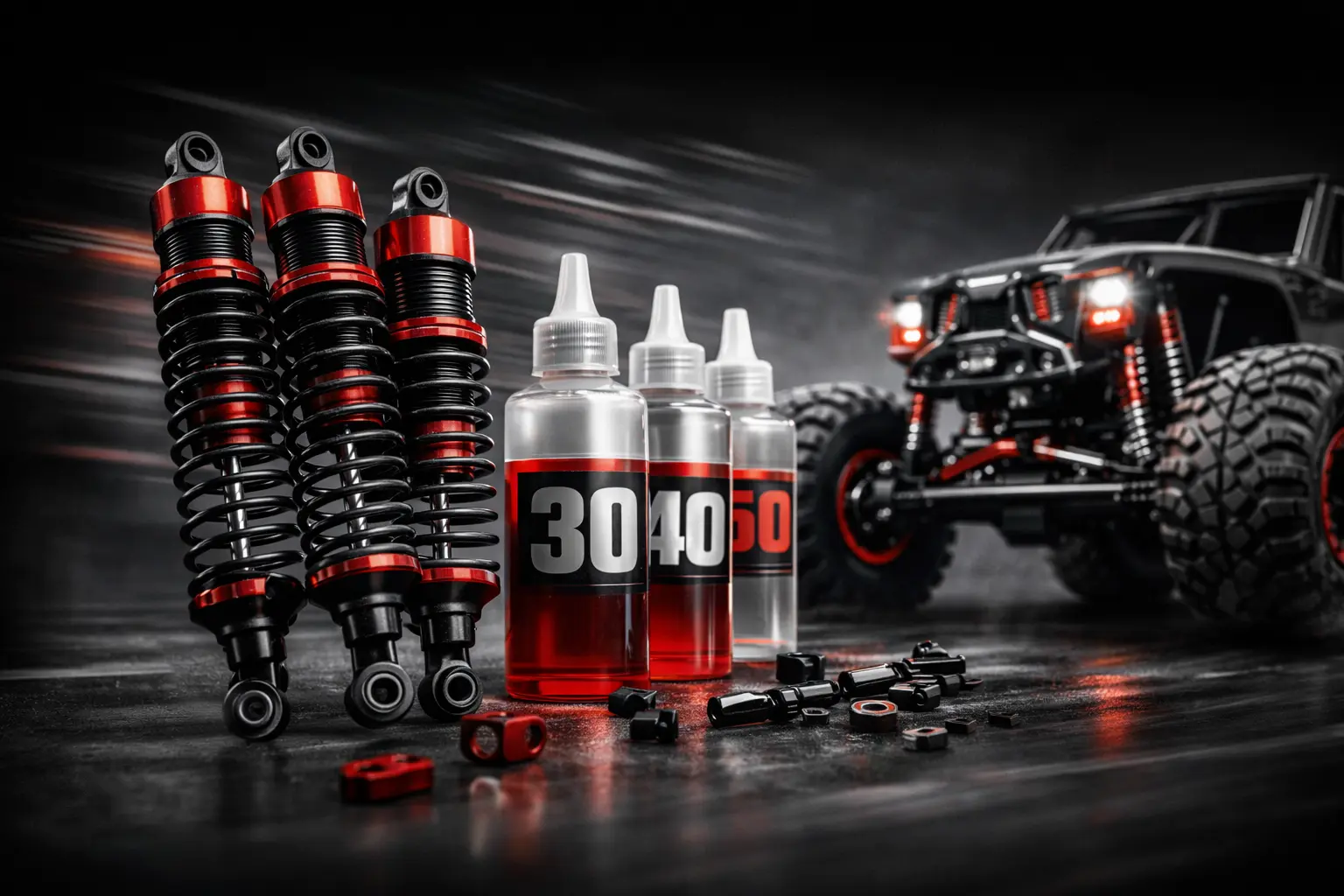
Your crawler’s shocks are the single upgrade that transforms a bouncy, unpredictable rig into a planted, confident trail machine — and most RTR crawlers ship with oil weights and spring rates that are frankly an afterthought. Nail the shock setup, and suddenly your truck hooks up on off-camber sections it used to slide off. This guide covers every lever you can pull: shock types, oil weight, tuning, and the best aftermarket picks for 2026.
For a full overview of the hobby, check out our complete RC crawler guide.
This post contains affiliate links. If you make a purchase through these links, we may earn a commission at no extra cost to you.
Why Shocks Matter More on a Crawler Than Any Other RC
On a basher or short-course truck, shocks exist to absorb big hits. On a crawler, their job is fundamentally different: they control articulation. When one wheel drops into a gap, the shock on that corner needs to extend freely — allowing the tire to stay in contact with terrain — while the opposite corner compresses without lifting the truck off the rocks.
That extension travel is called droop, and it’s the most critical suspension parameter in crawling. A truck with generous droop keeps all four wheels grounded across wildly uneven surfaces, which translates directly into traction and stability. Limit that droop — with stiff springs, heavy preload, or poor shock geometry — and wheels start lifting. Lifted wheels don’t steer. They don’t drive. They’re dead weight that pushes your crawler sideways off the line you wanted.
The problem with stock RTR shocks is that they’re designed to look functional and survive a drop test, not to maximize articulation. Plastic-bodied units flex under load, seals leak after a few runs, and the oil that comes from the factory is typically 30–32wt — fast enough for a basher, but too bouncy for the low-speed, precision demands of rock crawling.
I learned this the hard way running 30wt in my SCX10 and wondering why it bounced around on every rock face. Switched to 50wt and it was like a completely different truck — planted, smooth, and way more predictable on off-camber sections. That one $12 bottle of silicone oil was more impactful than the $80 aluminum links I installed the same week.
RC Crawler Shock Types Explained
Standard Coil-Over Oil Shocks
The overwhelming majority of crawler shocks — stock and aftermarket — use this design. A piston attached to a shaft moves through an aluminum or plastic cylinder filled with silicone oil. The oil is forced through small holes in the piston head, creating resistance (damping). A coil spring wrapped around the outside provides the return force.
Simple, rebuildable, and infinitely tunable through oil weight, piston design, and spring rate. This is what 95% of crawlers run, and it’s what this guide focuses on. The difference between a $15 plastic unit and a $45 aluminum-bodied shock isn’t the concept — it’s precision, sealing quality, and rebuild potential.
Internal Bypass Shocks (IBS)
Full-scale bypass shocks use ports machined into the shock body at specific positions along the stroke. Oil bypasses the piston early and late in the travel (soft damping for comfort), then is forced through the piston at mid-stroke (stiffer damping to resist hard bottom-out). This position-sensitive damping is phenomenally effective on real trucks at highway speeds.
At RC scale, true IBS designs don’t function as intended. The physics don’t translate well below 1/5 scale — the ports are too small relative to oil viscosity to create meaningful bypass effect, and at crawler speeds (inches per second, not feet per second), there simply isn’t the force needed to activate the bypass zones. Forum veterans are blunt: at 1/10 scale, the shocks are just too small to work like their full-scale counterparts. Functional RC bypass shocks exist only at 1/5 scale (MCD Racing). The Incision S8E shocks are sometimes marketed with IBS language but are standard emulsion shocks — very good ones, but not true bypass.
If someone is trying to sell you IBS performance at 1/10 scale, it’s a marketing term, not an engineering reality. The practical takeaway: don’t chase IBS, chase good standard shocks properly tuned.
Scale Replica Shocks
This is where aesthetics meet function, and for many scale crawler builders, that’s a perfectly valid place to be. RC4WD produces officially licensed replicas of King Off-Road, Bilstein, and Old Man Emu shocks with authentic branding, accurate proportions, and aluminum construction. They function adequately for trail driving — smooth articulation, decent sealing — while making your crawler look like it rolled out of a 1:1 build sheet.
The RC4WD King Piggyback Shocks on my crawler are 90% cosmetic overkill and 10% functional improvement over stock. But man, do they look incredible parked on a scale trail. Sometimes the hobby is about the looks too, and there’s nothing wrong with that.
Scale shocks pair perfectly with a scale body — see our best crawler body shells guide for the full look.
Shock Types Quick Reference
| Type | Best For | Price Range | Complexity | Performance |
|---|---|---|---|---|
| Standard coil-over (aluminum) | Trail, comp, all-around | $20–$80/pair | Low | Excellent |
| Standard coil-over (plastic) | Budget RTR | $0–$15/pair | Low | Mediocre |
| Scale replicas (RC4WD King, Bilstein) | Scale trail building | $35–$50/pair | Low | Good |
| “IBS” at 1/10 scale | Marketing copy only | N/A | N/A | N/A |
| True IBS (1/5 scale only) | Large-scale comp | $150+/pair | High | Excellent |
| Piggyback (RC) | Cosmetic appearance | $40–$55/pair | Low | Same as standard |
Shock Oil Weight — The Complete Guide
What Oil Weight Means (And How It’s Measured)
Shock oil viscosity is measured in centistokes (cSt) — a scientifically standardized unit. The “weight” number (20wt, 40wt, 60wt) is an industry shorthand that is not standardized across brands. This is the single most misunderstood fact in RC shock tuning.
Team Associated 30wt measures approximately 373 cSt. Team Losi Racing 30wt measures approximately 338 cSt. The divergence grows at higher viscosities. The practical rule: pick one brand of oil and run it across all four shocks. Never mix brands even at matching weight numbers, as you’ll get inconsistent corner-to-corner damping.
The simple relationship: higher number = thicker oil = slower shock movement = more planted, controlled behavior.
Oil Weight Conversion Reference
| Weight (wt) | Approx. cSt | Crawler behavior |
|---|---|---|
| 20wt | 200 | Very fast rebound, bouncy — too light for crawling |
| 25wt | 275 | Light, quick articulation |
| 30wt | 350 | Light-medium — typical RTR stock oil |
| 35wt | 425 | Medium, good trail starting point |
| 40wt | 500 | Community sweet spot for trail crawling |
| 45wt | 575 | Medium-heavy, stable on technical terrain |
| 50wt | 650 | Heavy — excellent planted feel |
| 60wt | 800 | Very heavy, scale-realistic slow movement |
| 70wt | 900 | Extremely planted — competition/weighted rigs |
Oil Weight Recommendations by Crawling Style
| Style | Front Oil | Rear Oil | Why |
|---|---|---|---|
| Comp crawling (light rig) | 30–35wt | 35–40wt | Quick articulation, low-CG belly dragger |
| Comp crawling (weighted rig) | 50–60wt | 60–75wt | Controls chassis roll on steep terrain |
| Trail running | 40wt | 45wt | Balanced control + articulation |
| Scale cruising | 50–60wt | 55–65wt | Slow, realistic scale suspension movement |
| Fast trail / bashcrawler hybrid | 25–35wt | 30–35wt | Responsive, quick rebound for speed |
The front/rear split is intentional: slightly heavier oil in the rear helps control pitch (nose-diving on descents), while lighter front oil keeps the steering end responsive and easy to place over rocks.
How to Change Shock Oil (Quick Guide)
This is a 10-minute job once you know the process. My first shock rebuild was a disaster — oil everywhere, air bubbles I couldn’t get out, and one shock that leaked from day one. Turns out I wasn’t bleeding them properly. Once I learned the right technique, it became routine.
What you need: Your chosen silicone shock oil, a rebuild kit with fresh O-rings, silicone grease (Associated Green Slime or equivalent), and a clean surface.
- Disassemble — Remove the shock from the truck. Unscrew the cap, pull out the shaft assembly, and drain old oil completely.
- Inspect and clean — Check O-rings for swelling or cracking. Replace them every rebuild — they degrade even when they look okay. Lube new O-rings with silicone grease before installation.
- Fill — With shaft fully extended (piston at the bottom of the body), fill the body 3/4 full with new oil.
- Bleed — Slowly cycle the shaft up and down 4–6 times. Watch bubbles rise to the surface. With thick oil (50wt+), wait 10–15 minutes for bubbles to fully clear. This step is non-negotiable.
- Top off and seal — Fill oil to the rim. Slowly compress the shaft to your desired rebound position (minimal or zero for crawling), then thread on the cap while excess oil flows out over the threads. The goal is zero air trapped above the piston.
- Reinstall — Let sealed shocks sit vertically for 5 minutes before remounting. This confirms no leaks and lets any remaining micro-bubbles settle.
The single most common mistake: sealing the cap while the shaft is extended. This pulls air in above the piston as you thread the cap. Always cap with shaft compressed.
Front vs. Rear Oil Weight — Should They Be Different?
Yes, almost always. The rear of a crawler carries more static weight (battery, motor, transmission) and needs more damping resistance to control chassis pitch under throttle and on steep descents. A common starting split is +5–10wt in the rear compared to front. For example: 40wt front / 45–50wt rear for trail use, or 55wt front / 65wt rear for a weighted competition build.
The only time to run identical front/rear oil is on a very balanced rig where you’ve specifically measured and equalized weight distribution.
Shock Setup & Tuning Tips
Spring Preload
Preload is adjusted by threading the spring collar up (more preload) or down (less preload) on threaded shock bodies, or by swapping spacer clips. Preload does not change spring rate — it only changes the position on the spring’s travel range. More preload raises ride height and reduces available droop. Less preload lowers the truck and increases droop, but can cause the chassis to sag excessively under its own weight.
The crawler tuning goal: run the minimum preload needed to keep the chassis at your target ride height. This maximizes available droop for articulation.
Droop & Rebound Settings
Droop is the downward suspension travel available when a wheel hangs freely. For crawling, target a 60/40 droop-to-compression ratio — 60% of total shock travel should be in extension (droop) and 40% in compression. Aggressive competition setups push to 70/30.
Rebound is the speed at which a shock returns to its extended position after being compressed. Crawlers want minimal rebound — slow, controlled return keeps the chassis from bouncing back and upsetting the chassis balance on rocks. Heavier oil naturally reduces rebound speed. Many experienced builders use a small internal spring below the piston to create a slight negative preload, keeping the shock from extending fully and eliminating rebound bounce entirely.
To maximize droop: use the lightest viable springs, minimize preload, and consider using droop spacers — sections of plastic rod placed on the shock shaft inside the body that physically limit compression travel, which proportionally increases the droop-to-compression ratio without changing total travel.
Shock Mounting Positions
Most crawlers offer multiple upper and lower shock mount positions. Moving the upper mount outward (further from chassis centerline) stiffens the effective spring rate through mechanical advantage and reduces suspension travel. Moving it inward softens the effective rate and increases articulation range. For crawling, inner mount positions are almost universally preferred.
Shock angle matters too. A more vertical shock provides maximum damping efficiency per inch of wheel travel. A more laid-down angle feels softer and provides greater effective wheel travel from the same shock stroke. Most quality crawler setups run shocks at a moderate angle rather than fully vertical, balancing efficiency with articulation freedom.
The golden rule of shock tuning: change one variable at a time. Adjust oil weight, test on your home trail, assess, then move to spring rate, test again. Changing oil, springs, preload, and mount positions simultaneously makes it impossible to know what worked.
Best RC Crawler Shocks (2026)
Complete Comparison Table
| Shock | Type | Best Fits | Best For | Price Range | Rating |
|---|---|---|---|---|---|
| Traxxas Big Bore (2660/2661/2662) | Aluminum coil-over | Universal 90–110mm | Best overall value | ~$25–30 / 8pcs | ⭐⭐⭐⭐⭐ |
| Traxxas GTS (TRA8260) | Aluminum bladder | TRX-4, universal 90mm | Trail + scale builds | ~$40 / 2pcs | ⭐⭐⭐⭐⭐ |
| INJORA aluminum threaded (4pcs) | Aluminum coil-over | Universal 70–120mm | Budget first upgrade | ~$15–22 / 4pcs | ⭐⭐⭐⭐ |
| Yeah Racing Desert Lizard | Aluminum internal spring | Universal 100mm | Mid-range scale look | ~$22–28 / 2pcs | ⭐⭐⭐⭐ |
| Hot Racing aluminum threaded | Aluminum coil-over | Universal 90–100mm | Mid-range build quality | ~$24–30 / 2pcs | ⭐⭐⭐⭐ |
| RC4WD King Piggyback (100mm) | Aluminum scale replica | Universal 1/10 | Scale appearance | ~$42–48 / 2pcs | ⭐⭐⭐⭐ |
| Incision S8E (90mm) | 8mm bore aluminum | SCX10 III, Capra, Enduro | Competition, upgradeable | ~$40 / 2pcs | ⭐⭐⭐⭐ |
| Pro-Line Pro-Spec Scaler | US-made aluminum | Universal 90mm | Premium performance | ~$75–80 / 2pcs | ⭐⭐⭐⭐⭐ |
Best Budget Crawler Shocks
INJORA Aluminum Threaded Shocks — Check Price on Amazon
For under $22 shipped with Prime, INJORA’s four-pack aluminum threaded shocks are the default first upgrade for any budget crawler build. Threaded bodies allow easy ride height adjustment, the aluminum construction eliminates the flexing and leaking that plagues stock plastic units, and they’re available in 70mm through 120mm to fit virtually every 1/10 and 1/18 platform. Don’t expect competition-grade sealing — O-rings benefit from a quick lube job out of the box — but for the price, the performance improvement over stock is enormous.
Yeah Racing Desert Lizard — Check Price on Amazon
The Desert Lizard offers a step up in fit and finish with triple O-ring seals, internal spring design, and a clean scale look that doesn’t embarrass itself on a trail truck. Available in 90mm and 100mm. They’re not as serviceable as true coil-over designs, but for trail running they hold up well and look the part.
Best Mid-Range Crawler Shocks
Traxxas GTS Aluminum Shocks (TRA8260) — Check Price on Amazon
These are the factory shocks on the TRX-4, and they’re genuinely excellent — smooth, well-sealed, and available in six spring rate options directly from Traxxas. The community’s verdict is unambiguous: stock TRX-4 shocks are so good that many builders run them on their other crawlers too. Titanium-nitride coated shafts, aluminum bodies, bladder-style internals. At ~$40/pair they’re the best performance-per-dollar shock in this price tier. Take-off sets from TRX-4 builds regularly appear on eBay and Facebook groups for $40–50 per set of four.
GMade XD Aeration Shocks — Check Price on Amazon
GMade’s XD series features aluminum bodies with an aeration (emulsion) design that provides a plush, compliant feel — great for slower scale driving. Available in 80mm, 90mm, and 100mm. Not as widely available as Traxxas units, but the emulsion design delivers a noticeably smoother ride feel, especially on smaller terrain features.
Best Scale Crawler Shocks
RC4WD King Off-Road Scale Shocks — Check Price on Amazon
Available in 80mm, 90mm, 100mm, and 110mm with multiple body styles (smooth, corrugated, piggyback), the RC4WD King shocks are the definitive scale shock. Officially licensed from King Off-Road Racing Shocks, they feature authentic stamping, realistic proportions, and adequate functional performance for trail use. The piggyback reservoir is non-functional (scale appearance only), but the shock body itself is a proper oil-filled unit. Build and run quality is sufficient for trail driving when O-rings are properly greased out of the box.
Hot Racing Aluminum Shocks — Check Price on Amazon
Hot Racing’s oil-filled aluminum shocks (the TD90X04 and TD100X04 threaded models, not the air-damped versions) provide solid mid-range value with CNC-machined bodies and reliable sealing. The anodized aluminum looks sharp on a trail truck without the premium price of licensed scale replicas.
Best Competition Crawler Shocks
Traxxas Big Bore Shocks (T-Maxx 4962 8-pack)
This is the community’s open secret. The Traxxas Big Bore platform — available in 90mm, 100mm, and 110mm — is the foundation that many competition shocks are built around. The T-Maxx 4962 eight-pack provides 8 complete shocks for roughly $25–30, making it the absolute best bang-for-buck option in all of RC crawling. Pair them with aftermarket springs from Dlux Fab or Dravtech and custom mounts, and you have a competition-grade setup. Multiple 2024–2025 competition build threads on RCCrawler.com reference this exact combination.
Incision S8E 90mm Scale Shock Set — Check Price on Amazon
The factory choice on Vanquish VRD, Stance, and H10 Optic crawlers. The S8E features an 8mm bore (larger than most competitors for improved fluid volume and consistency), dual X-ring seal cartridges, and a deep ecosystem of upgrade parts: TiN-coated shafts ($12.99), hard-anodized bodies ($14.99), and machined pistons ($6.99). They’re field-serviceable in minutes. Note: community feedback consistently reports that the stock seal cartridges benefit from early replacement, and leaking is the top complaint. If you’re prepared to maintain them, the S8E ecosystem is one of the best platforms available for competition-level work.
Building from scratch? Our RC crawler kit guide includes recommendations where you can choose your own shocks from the start.
Which Shocks Fit Your Crawler?
The 90mm eye-to-eye length is the universal standard for 1/10-scale crawlers. Always measure your stock shocks from the center of one mount hole to the center of the other before ordering.
| Vehicle | Stock Shock Size | Recommended Upgrade | Notes |
|---|---|---|---|
| Axial SCX10 III | ~90–94mm | Traxxas GTS, Incision S8E 90mm, RC4WD 90mm | Any quality 90mm coil-over works directly |
| Traxxas TRX-4 (Gen 1 & 2) | 90mm (GTS) | Already excellent stock — upgrade springs before shocks | Long Arm Kit requires 112mm shocks |
| Traxxas TRX-4M | 51mm | INJORA 59mm aluminum, Pro-Line 52mm Big Bore | Plastic stock units are friction-only, upgrade immediately |
| Axial Capra 1.9 | ~90mm | Pro-Line 90mm, Traxxas GTS, Incision S8E | Excellent out-of-box suspension geometry |
| Element Enduro | 90mm | Element FT aluminum (ASC42078), any 90mm coil-over | Plastic stock units benefit greatly from aluminum upgrade |
| Redcat Gen8/Gen9 | ~95–97mm | RC4WD 90mm + spacers, INJORA 90–100mm | Uses proprietary extended pivot balls — check clearance |
Always measure your stock shocks (eye-to-eye length) before ordering replacements. Going significantly longer than stock raises CG, stresses driveshafts, and often causes driveshaft binding or ejection at full droop. The practical maximum for most 1/10 crawlers without mount modifications is 100–110mm.
Shocks and tires work together — our RC crawler tires guide covers 1.0, 1.9, and 2.2 options and how compound choice interacts with your suspension setup.
FAQ
Q: What oil weight should I use in my RC crawler shocks?
For most trail and general crawling, 40–50wt is the community consensus starting point. Stock RTR crawlers typically ship with 30–32.5wt, which most users find too bouncy and upgrade immediately. Run slightly heavier oil in the rear (+5–10wt) compared to front to control chassis pitch. For scale cruising, 55–65wt creates realistic, slow suspension movement. For competition crawling with a light build, you may drop to 30–35wt for maximum articulation speed; heavier weighted rigs often run 60–100wt to control roll.
Q: Are internal bypass shocks worth it for crawling?
True internal bypass (IBS) shocks do not exist in functional form at 1/10 scale. The physics require scale speeds and forces that RC crawlers never approach. Any product marketed as IBS at 1/10 scale is either using the term loosely (meaning dual-stage springs) or is a marketing claim with no engineering basis. Don’t pay a premium for IBS performance in a 1/10 crawler — focus that budget on better oil, quality springs, and proper shock geometry instead.
Q: How often should I rebuild my crawler shocks?
For trail crawlers, rebuild (fresh O-rings + new oil) every 10–20 sessions, or immediately after any wet, muddy, or sandy conditions where contamination is likely. Signs that a rebuild is overdue: oil leaking past the shaft, a noticeably different damping feel between left and right shocks, dry or sticky shaft movement, or visible oil residue on the shock body. Replace O-rings at every rebuild — they swell from silicone oil contact over time even when they look undamaged.
Q: Do I need different shocks for front and rear?
Not different models, but often different oil weights and spring rates. The rear of most crawlers carries more static weight (battery, electronics) and benefits from slightly heavier oil (+5–10wt) and a stiffer spring to control pitch and prevent excessive squat under throttle. Front shocks with lighter oil stay responsive for steering precision and keep the front end articulating freely over small terrain features. Some builders also run softer rear springs with more preload to fine-tune weight transfer, but this is advanced tuning territory.
Q: Can I use basher shocks on a crawler?
Technically yes, but the results are usually poor. Basher shocks are designed for high-speed impacts — they have stiffer spring rates, faster piston valving, and shorter total travel optimized for jumps and landings, not slow articulation. The spring rates that absorb a 10-foot jump will barely compress when a crawler wheel drops into a 2-inch crack. You can certainly experiment, but expect to re-valve with much heavier oil and swap to softer crawler-specific springs. You’ll spend more time and money adapting basher shocks than you would buying crawler-specific units.
Conclusion
Shocks are the upgrade that delivers the biggest real-world impact for the least money in RC crawling. A $30 set of Traxxas Big Bores with the right oil and proper bleeding will outperform $80 premium shocks that are poorly set up. Start with 40–50wt oil for trail use, maximize droop through minimal preload and correct mount positioning, and bleed every air bubble out before you seal the caps. For the single most versatile recommendation in 2026: the Traxxas GTS shocks are hard to beat for trail crawling — exceptional quality, widely available, and proven across dozens of different platforms. Check current pricing on Amazon and pick up a silicone shock oil set while you’re at it to dial in your weight.