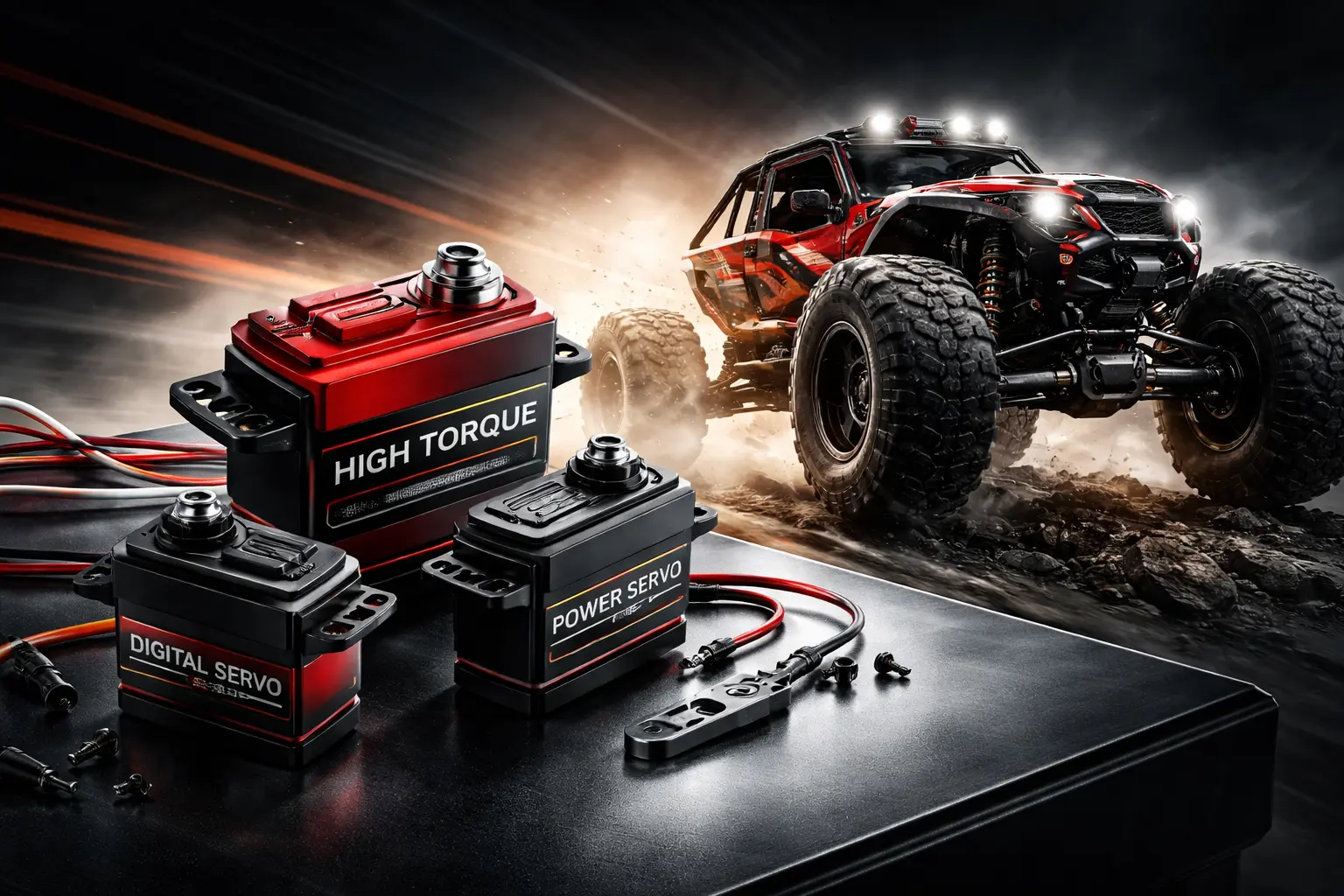
The steering servo is the single most overlooked upgrade on any RTR crawler — and the one that makes the biggest difference on the trail. Stock servos are an easy place for manufacturers to cut costs, and most of them are woefully underpowered for real rock crawling. Swap in the right servo and your truck will hold a line on a steep off-camber that had it washing out before. This guide breaks down every spec that matters, names the best servos at every price point, and tells you exactly what fits your specific rig.
For a full overview of the hobby, start with our complete RC crawler guide.
This post contains affiliate links. If you make a purchase through these links, we may earn a commission at no extra cost to you.
Why the Servo Matters So Much on a Crawler
On a basher, the steering servo’s job is simple: turn left, turn right, repeat. On a crawler, it’s doing something completely different. It’s fighting the weight of the truck pressing down on the front tires, resisting the terrain trying to kick the wheels straight, and holding a precise angle while you crab sideways across a loose ledge. That’s not steering — that’s a sustained load-bearing task.
The stock servo in my SCX10 III was fine on dirt paths, but the moment I hit a steep off-camber section, it couldn’t hold the wheels in position under load. The truck would drift toward the fall line no matter what I did with the trigger. Swapped in a Savox SW-1210SG, and it was like a different vehicle — precise hold, no buzzing, no wandering on side hills. That single upgrade transformed how the truck handled the gnarly stuff.
When a servo is undersized for crawling, the symptoms are hard to miss: a constant buzzing noise as the motor fights to hold position, heat buildup in the servo case, and eventually stripped gears or a burned motor. The buzzing in particular is your servo screaming that it’s being overwhelmed. A properly sized servo is quiet and confident — you feel the firmness through the linkage the moment you pick the truck up.
Crawler Servo Specs Explained (What Actually Matters)
Torque — How Much Do You Need?
Torque is everything in crawling. It determines whether your servo holds the wheels where you put them or surrenders to gravity and terrain pressure. The general rule: more is almost always better, up to a reasonable point for your scale.
| Scale | Minimum Torque | Recommended | Overkill |
|---|---|---|---|
| 1/24 (SCX24) | 2 kg-cm / 28 oz-in | 4–8 kg-cm | 12+ kg-cm |
| 1/18 (TRX-4M) | 5 kg-cm / 70 oz-in | 7–12 kg-cm | 15+ kg-cm |
| 1/10 (SCX10, TRX-4) | 25 kg-cm / 347 oz-in | 30–50 kg-cm | 70+ kg-cm |
| 1/6 (SCX6) | 50 kg-cm / 694 oz-in | 60–100 kg-cm | 150+ kg-cm |
One important nuance: running a High Voltage (HV) servo at 7.4V instead of 6V can increase torque output by 30–60%. The Savox SW-1210SG delivers 20 kg-cm at 6V but 32 kg-cm at 7.4V. If your ESC’s BEC is adjustable or you’re running a standalone BEC, HV servos represent serious bang for the buck.
Speed — Does It Matter for Crawling?
Short answer: not really. A speed of 0.15–0.20 sec/60° is perfectly adequate for trail crawling. You’re not snapping between lock-to-lock at high speed — you’re making deliberate, precise inputs at walking pace.
A slow, powerful servo beats a fast, weak one every time on the rocks. The only exception is competition crawling, where faster servos (0.08–0.12 sec/60°) allow for “tire wiggling” — a technique where rapid left-right inputs walk the front axle down ledges. For trail use, ignore the speed spec and focus on torque.
Waterproof Rating — IP65 vs IP67
IP65 handles water jets and splashes — adequate for wet grass and light rain. IP67 means the servo can be submerged up to 1 meter for 30 minutes, which is what you actually need for creek crossings and mud.
Learned the hard way that “water-resistant” and “waterproof” aren’t the same thing. My first servo upgrade died after a creek crossing that was maybe two inches deep. The case looked sealed, but water found its way in through the output shaft. Now I only run IP67-rated servos on any trail truck that goes near water.
The budget servo market is full of “waterproof” claims without certified IP testing. Basic O-rings degrade over time and many budget servos are splash-resistant at best. For dedicated trail and creek crawling, treat any servo without a certified IP67 rating as non-waterproof.
When you can skip waterproofing: indoor crawling, dry competition courses, and sealed bench-race rigs. In those cases, save the money and put it toward torque.
Brushed vs Brushless Servo Motors
Three motor types exist in RC servos. Brushed motors are the cheapest, typically found in sub-$25 servos. Coreless motors (also called “brushed coreless”) eliminate the iron armature core for faster response and better efficiency — most quality mid-range servos use them. Brushless motors are the premium option: longer lifespan, superior return-to-center precision, lower noise, and better efficiency at higher voltages.
For most trail crawlers, a quality brushed or coreless servo is all you need. The difference between a good coreless servo and a brushless unit is noticeable but not transformative on a casual trail rig. Brushless earns its premium on competition crawlers where sustained load and thousands of hours of runtime matter. If you’re running the same servo hard every weekend, brushless is worth the premium. If you’re a weekend warrior on moderate trails, a good coreless at half the price is the smarter buy.
Metal Gears & Spline Count
Metal gears are non-negotiable for crawling. Full stop. The constant back-and-forth pressure under sustained load destroys plastic gears in short order. Most quality servos use steel gears. Some market titanium gears as premium, but the practical difference versus hardened steel is minimal — surface treatment matters more than base material.
The 25T spline is the universal standard across essentially the entire crawling market — Savox, Traxxas (1/10), Power HD, INJORA, AGFRC, Reefs RC, Holmes Hobbies, ProTek, and virtually all Chinese-manufactured servos. Futaba uses 23T, and some older Hitec models use 24T. This matters because mismatched servo horns will slip under load. When buying aftermarket aluminum horns, always confirm 25T compatibility.
Best RC Crawler Servos (2026)
Here’s the full lineup before we break down each tier:
| Servo | Torque (7.4V) | Speed (7.4V) | Waterproof | Motor | Price | Best For |
|---|---|---|---|---|---|---|
| ANNIMOS DS3225 PRO | 35 kg-cm | 0.075 sec | IP66 | Coreless | ~$18–25 | Budget trail |
| INJORA INJS025 | 25 kg-cm | 0.16 sec | IP65 | Brushed | ~$12–18 | Entry trail/mini |
| JX CLS5830HV | 30 kg-cm | 0.10 sec | Yes | Coreless | ~$22–30 | Budget HV |
| Yeah Racing YE-0034 | 33 kg-cm | 0.083 sec | IP67 | Coreless | ~$55–70 | Mid-range all-rounder |
| AGFRC A73BHLW V2 | 40 kg-cm | 0.09 sec | IP67 | Brushless | ~$45–60 | Best value BL |
| Savox SW-1210SG | 32 kg-cm | 0.13 sec | Yes | Coreless | ~$85–100 | Trusted mid/high |
| Reefs RC 422HD V2 | 400 oz-in | 0.10 sec | IP67 | Brushless | ~$105–110 | Premium trail/comp |
| ProTek RC 370TBL | 650 oz-in | N/A | Yes | Brushless | ~$159 | Buy-once premium |
| Holmes Hobbies SHV500 V3 | 680 oz-in | N/A | Yes | Brushless | ~$110 | Direct power |
Best Budget Crawler Servo (Under $30)
ANNIMOS / ZOSKAY DS3225 PRO — ~$18–25 — Check Price on Amazon
This is the one the RCCrawler forum consistently recommends for trail rigs on a budget. The PRO variant (also sold under ZOSKAY and various unbranded names — look for “DS3235PRO”) uses a coreless motor and stainless steel gears, delivers 35 kg-cm at 7.4V, and is rated IP66. At under $25, it checks every practical box for a trail crawler. Community verdict: for receiver-powered setups, the DS3235PRO is widely considered the most reliable budget option. One important caveat: buy the red 25 kg or the PRO coreless variants, not the blue 35 kg brushed version, which has inconsistent quality control.
INJORA INJS025 — ~$12–18 — Check Price on Amazon
Injora’s in-house servo is a solid entry-level option — 25 kg-cm at 6V, rubber-seal waterproofing, metal gears, 25T. It’s not HV-capable and the waterproofing is basic, but for a first upgrade on a beginner’s trail rig or as a backup servo to keep in the parts box, it punches above its price. Available on Amazon with Prime shipping, which matters when your servo strips on a Friday evening before the weekend run.
Best Mid-Range Crawler Servo ($30–$70)
AGFRC A73BHLW V2 — ~$45–60 — Check Price on Amazon
Here’s the mid-range sweet spot that the informed segment of the community keeps quietly recommending. The AGFRC A73BHLW V2 is a brushless, fully programmable, IP67-rated servo delivering 40 kg-cm at 8.4V. Multiple forum members have pointed out that it’s the same OEM factory that manufactures the Reefs RC 422HD — sold for 30–50% less with essentially identical guts. If you want brushless performance without paying boutique brand markup, this is the move.
Yeah Racing YE-0034 IP67 Coreless — ~$55–70 — Check Price on Amazon
Yeah Racing’s crawler-specific servo hits every checkbox: IP67 waterproofing (certified, not just claimed), stainless steel gears, full CNC aluminum case, coreless motor, and 33 kg-cm at 8.4V. The 0.083 sec speed is faster than most servos in this price range, giving it a competition edge. Available in black, blue, and red. This is the servo I’d recommend to anyone doing serious trail work who doesn’t want to think about waterproofing issues.
Savox SW-1210SG — ~$85–100 — Check Price on Amazon
The old reliable. The SW-1210SG has been a community staple for years — 32 kg-cm at 7.4V, fully waterproof, coreless motor, steel gears, aluminum case. It’s technically above the mid-range price band, but its proven track record earns it a spot here. The main caveats: the stall current reaches 7,400 mA at 7.4V, meaning a standalone 5A+ BEC is mandatory, and a small percentage of units arrive DOA or develop glitching issues. Pair a servo upgrade with proper shock tuning and your crawler will feel like a completely different truck.
Best Premium Crawler Servo ($70+)
Reefs RC 422HD V2 — ~$105–110
The 422HD V2 is purpose-built for crawling: brushless motor, 400–434 oz-in across its voltage range (4.8–8.4V), IP67 waterproofing with 7-point seals, magnetic position sensor for better return-to-center, fully programmable via Reefs Link, and a CNC aluminum case with triple ball bearings. It’s genuinely excellent hardware. The caveat is Reefs RC’s warranty reputation — community reports of failure rates and slow support are worth researching before committing. Available at Horizon Hobby and AMain Hobbies.
Holmes Hobbies SHV500 V3 / BLS SHV500v2 — ~$80–110
Holmes Hobbies built their reputation on one key innovation: direct LiPo power. Their “Direct Power” servos accept 2S–4S voltage directly from the battery pack, bypassing the BEC entirely. This eliminates brownout risk, simplifies wiring, and delivers maximum torque from your pack voltage. The SHV500 V3 delivers 680 oz-in at 14V. The BLS SHV500v2 is the BEC-powered variant at ~500 oz-in at 8.4V — a strong option if your ESC has a solid HV BEC. Long-term reliability is excellent for most users, though stock availability can be a recurring frustration. Available at AMain Hobbies.
ProTek RC 370TBL “Black Label” — ~$159.99 — Check Price on Amazon
The buy-it-once option. The 370TBL is brushless, waterproof to 1 meter, delivers 650 oz-in at 7.4V, runs standard dimensions (40 × 20 × 37.8mm), and uses full steel gears in an aluminum case. It gets the most consistently positive community reviews of any servo in the premium tier — builders describe it as the last steering servo they ever needed to buy for their crawler. If you want one servo that handles everything from casual trails to competition lines without ever thinking about it again, this is the answer. Building from a kit? Our RC crawler kit guide includes tips on choosing the right servo from the start.
Best Micro Servo for 1/24 & 1/18 Crawlers
Emax ES08MA II (SCX24) — ~$8–14 — Check Price on Amazon
The community standard SCX24 upgrade. Metal gears, 2 kg-cm at 6V, only $8–10, and nearly the same dimensions as stock. Requires an aftermarket servo tray (Hot Racing HRASXTF24M01 or INJORA CNC aluminum mount). I threw a $12 micro servo into my TRX-4M as a test, fully expecting to replace it within a month. Eight months later, it’s still running fine. For mini crawlers, you really don’t need to spend big — the scale is small enough that budget micros handle the loads without stress.
Savox SW-0250MG (TRX-4M) — ~$35–45 — Check Price on Amazon
The consensus TRX-4M recommendation: direct drop-in for the stock mount, waterproof, metal gears, 25T, 5 kg-cm at 6V — a massive step up from the stock Traxxas 2065’s 32 oz-in. The SW-0250MGP Plus version adds soft-start capability. For anyone running a TRX-4M seriously, this is the upgrade.
Reefs RC 99 Micro (SCX24 premium) — ~$59.99
For SCX24 builds that warrant the investment, the Reefs 99 is the top of the market: 99–115 oz-in, CNC aluminum case, IP67 waterproofing, 25T micro spline, and a brass edition for added weight. The Holmes Hobbies BLS HV150 (~$59.99) is the brushless alternative at 174 oz-in at 8.4V — though it requires a solid 5A BEC and can brown out smaller ESCs. Both available at AMain Hobbies.
Which Servo Fits Your Crawler?
Always check your servo mount dimensions before buying — most 1/10 crawlers take a standard-size servo (40 × 20mm), but a few use mini or low-profile formats that require adapters or different mounting strategies.
| Vehicle | Stock Servo | Servo Size | Recommended Upgrade | Notes |
|---|---|---|---|---|
| Axial SCX10 III | Spektrum SPMS683 (173 oz-in) | Standard | AGFRC A73BHLW V2 / SW-1210SG | Standard mount, no adapter needed |
| Traxxas TRX-4 | Traxxas 2075X (125 oz-in) | Standard | Traxxas 2270 (drop-in) or SW-1210SG | No adapter needed; BowHouse mount recommended for heavy servos |
| Traxxas TRX-4M | Traxxas 2065T (~32 oz-in) | Sub-micro | Savox SW-0250MG | Stock mount compatible; MEUS brass mount for bigger upgrades |
| Axial Capra | Spektrum unit (underpowered) | Standard | DS3235PRO budget or Holmes SHV500 | Treal/INJORA aluminum mounts for SOA conversion |
| Element Enduro | Reedy 1320MG (173 oz-in) | Standard | EcoPower WP120T / SW-1210SG | Standard mount; GPM aluminum upgrade available |
| Redcat Gen9 | Hexfly Torque-Spec (25–42 kg-cm) | Standard | No upgrade needed for trail use | One of the best stock servos of any RTR crawler |
| Axial SCX6 | Spektrum S905 (538 oz-in) | 1/5 large + adapter | NSDRC RS2500 / Powerhobby 1512MG | Uses 15T spline — aftermarket horns must match |
| Axial SCX24 | Axial micro (15 oz-in, plastic gears) | Micro | Emax ES08MA II + aftermarket mount | Requires servo tray swap; Hot Racing HRASXTF24M01 most popular |
TRX-4 note: Traxxas’s own servo upgrade, the 2270 (236 oz-in), is the cleanest plug-and-play option — same connector, same spline, no BEC concerns. For higher torque, any standard 25T servo works, though heavy high-current servos benefit from a BowHouse or aftermarket mount for stability.
SCX6 warning: The stock Spektrum S905 uses a non-standard 15T spline, not the universal 25T. Any aftermarket servo horn must match. Most upgrade servos for the SCX6 use the standard 25T and include a compatible horn.
Installation Tips
Go aluminum on the servo horn. Plastic horns flex and crack under sustained load at crawling torques. A clamping-style 25T aluminum horn — which grips the output shaft via a split bolt rather than press-fitting — is the correct choice for any servo above 200 oz-in. Look for aluminum servo horns on Amazon. Verify your spline count before ordering.
Center the servo before mounting. With the horn removed, power on the transmitter with steering trim and sub-trim zeroed and EPA at 100%, then power on the receiver. The servo moves to electronic center automatically. Install the horn at 90° to the case. With 25T splines, perfect 90° is unlikely — try both orientations, use whichever is closer, and trim from there. Adjust linkage lengths mechanically before touching the radio trims.
Remove the servo saver. The crawling community has largely reached consensus here: servo savers introduce slop, and that slop absorbs exactly the force you’re trying to apply to the wheels. Crawlers move slowly enough that impact protection is unnecessary. Replace it with a rigid aluminum horn and let the servo do its job. The only exception is shift/DIG servos where binding against drive dogs can occur.
Set your endpoints — this is critical. Start EPA at 50%, turn wheels to full lock, slowly increase until you reach maximum deflection, then back off slightly. The servo should never stall against the mechanical stops. Sustained stalling destroys servos, and it’s almost always the reason budget servos die quickly. Set left and right endpoints independently.
High-torque servos need a real BEC. Stock ESC BECs typically output 1–3 amps. Servos above 300 oz-in can draw 5–8+ amps at peak. Underpowered BECs cause brownouts (complete loss of vehicle control mid-crawl), stuttering, and ESC damage. For any servo above 300 oz-in, run a standalone 10A+ continuous BEC. Direct-power servos from Holmes Hobbies and NSDRC bypass this entirely. Once your steering is sorted, check out our scale accessories guide to complete the build.
Don’t overtighten the servo horn screw — snug is enough. Overtightening can crack aluminum horns or damage the output shaft on some servo designs.
FAQ
Q: How much torque do I need for a 1/10 RC crawler?
For basic trail use, 25 kg-cm (347 oz-in) is the practical minimum. For serious trail crawling, 30–50 kg-cm puts you in comfortable territory where the servo handles steep side-hills and rock gardens without hunting or buzzing. Competition builds running chassis-mounted servo setups with long drag links often run 70+ kg-cm because the mechanical disadvantage requires more torque to achieve the same wheel force.
Q: Is a brushless servo worth it for crawling?
For casual trail crawlers, the honest answer is: not necessarily. A quality coreless servo at half the price delivers very good performance on the trail. Brushless becomes worthwhile if you crawl frequently, want the best possible return-to-center precision, or run competition. The AGFRC A73BHLW V2 at ~$50 makes the brushless upgrade more accessible than it used to be, and at that price the argument shifts — you’re not paying a huge premium anymore.
Q: Can I use a cheap servo in my TRX-4?
Yes, with realistic expectations. A DS3225PRO coreless (~$20) will handle moderate trail use reliably if you set your EPA correctly and keep the servo away from sustained stalling. The trail crawling community runs them regularly without issue. For harder terrain, creek crossings, or competition, step up to something with a certified IP67 rating and proper brushless motor.
Q: Do I need a waterproof servo for trail crawling?
If you’re crawling near water, yes. “Near water” includes wet grass, puddles, stream crossings, and mud — which describes most trail sessions. IP67-rated servos are the reliable standard. Budget “waterproof” claims without certified IP ratings should be treated as splash-resistant at best. For indoor or dry competition crawling, waterproofing is optional.
Q: What’s the best servo for the Axial SCX10 III?
For trail use under $60, the AGFRC A73BHLW V2 is the best pick — brushless, IP67, 40 kg-cm at 8.4V, standard dimensions, direct drop-in. For a proven mid-range waterproof option, the Savox SW-1210SG ($90) is the long-standing community recommendation. For premium no-compromise performance, the ProTek RC 370TBL ($159) is the buy-once choice with the strongest community reviews in the high-torque bracket.
Conclusion
If you’re going to do one upgrade to an RTR crawler, make it the servo. Nothing else transforms trail capability as directly. For most trail rigs, the DS3235PRO (~$20) is genuinely good enough and costs less than a set of tires. The real sweet spot for the majority of crawlers is the AGFRC A73BHLW V2 (~$50) — brushless, IP67, programmable, and made by the same factory as boutique brands charging twice the price. For a buy-once premium option, the ProTek RC 370TBL has the most consistently positive community track record in the high-torque tier — check price on Amazon and pair it with a proper standalone BEC for the best results.