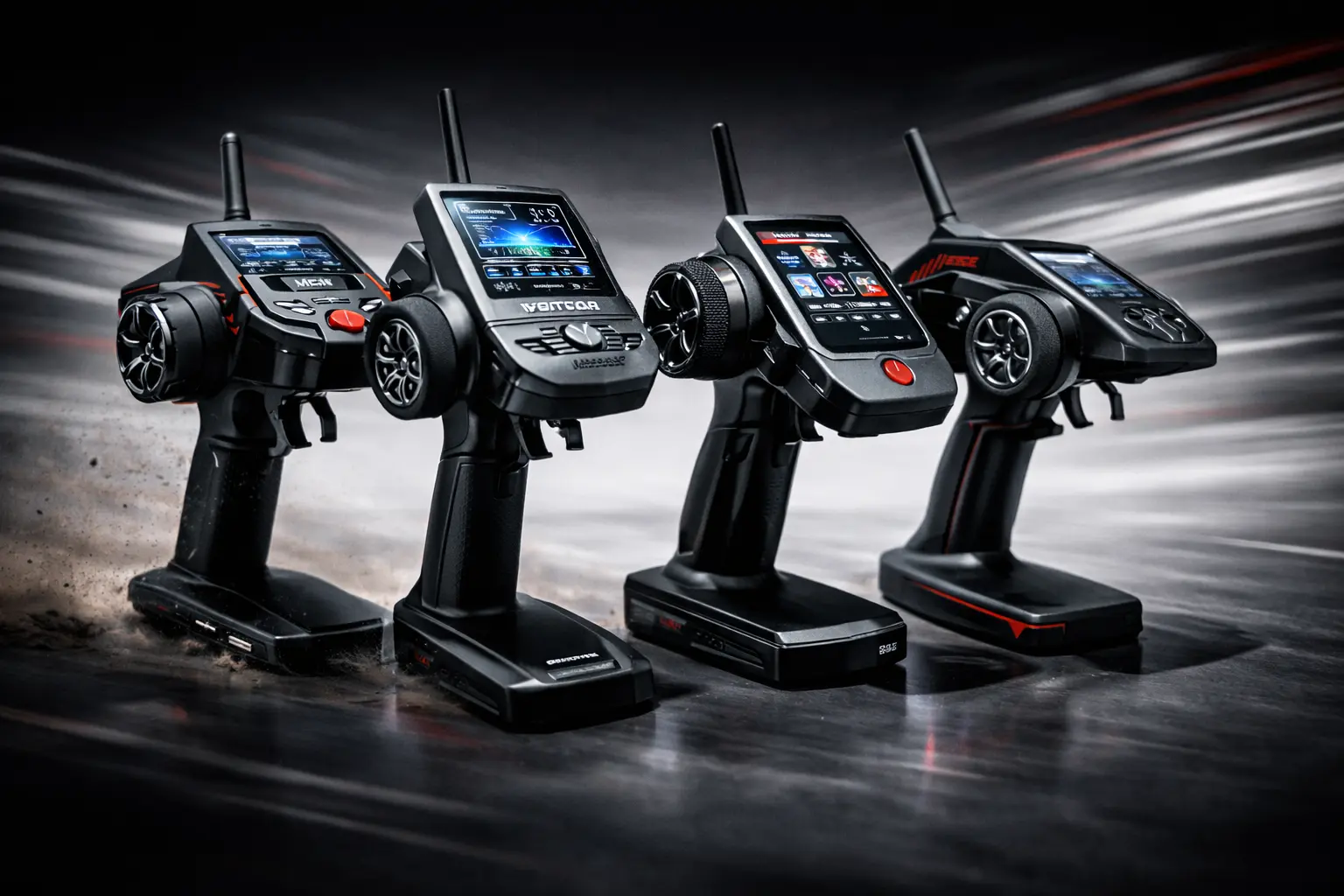
Your transmitter is the only thing between you and your car. Every throttle input, every steering correction — it all flows through that pistol grip. And yet most hobbyists spend hundreds on motors, ESCs, and batteries while ignoring the radio that controls all of it.
This guide covers every budget from $30 to $600+, with real pricing, protocol compatibility, and honest takes on which radios are actually worth your money in 2026.
This post contains affiliate links. If you make a purchase through these links, we may earn a commission at no extra cost to you.
Do You Actually Need to Upgrade Your Radio?
Short answer: it depends. Long answer: probably yes, but not always right now.
I ran the stock Spektrum STX2 that came with my Arrma Outcast for about six months before finally pulling the trigger on a DX5 Rugged. Honestly, I’d been putting it off thinking the difference wouldn’t be worth it. I was wrong. The throttle control improvement alone was worth the price — it’s like going from a light switch to a dimmer dial. Suddenly I could feather the power through corners instead of just being full-on or full-off.
When upgrading makes sense:
- You’re running multiple vehicles and want one radio to control all of them
- You’ve moved from casual bashing to track racing or competition drifting
- Your current radio lacks channels for accessories (diff locks, winch, lights)
- You want telemetry — battery voltage, temperature, and speed data at a glance
- You simply want a better feel in your hands during long sessions
When it doesn’t:
- You have a single basher you run occasionally
- You’re brand new to the hobby and still learning the basics
- Your RTR radio is working fine and you have no plans to expand your fleet
The real value of investing in a proper transmitter is simple: one radio + multiple cheap receivers = your entire fleet under control. A $130 Flysky Noble NB4+ with five $25 receivers costs less than buying individual RTR radios for each car. If you’re just starting out, our RC cars beginner guide covers all the basics before you start spending on upgrades.
RC Radio Basics — What You Need to Know
Before you spend a dollar, you need to understand four things: channels, protocols, telemetry, and ergonomics. Skip this section and you risk buying a radio that can’t bind to your car, or upgrading to something that maxes out at two functions.
Channels — What Do They Do?
Every function on your RC car requires a channel. Channel 1 is typically steering, Channel 2 is throttle/brake. That’s your minimum — 2-channel.
A 3-channel radio adds an AUX switch, useful for lights or a basic ESC mode change. Start adding diff locks, a 2-speed transmission, a winch, LED controls, and gyro sensitivity adjustment, and you’re burning through channels fast. Crawlers regularly need 5–6 channels. Drift setups with gyro tuning, front/rear brake bias, and aux functions can use 8 or more.
The practical rule: buy more channels than you think you need. Upgrading your radio because you ran out of channels is annoying and expensive.
Protocols & Compatibility — The Big Catch
This is where new hobbyists get burned. Every brand uses a proprietary radio protocol, and they don’t cross-talk. A Spektrum transmitter cannot bind a Futaba receiver. A Flysky AFHDS 2A transmitter cannot bind an AFHDS 3 receiver — even though both say “Flysky” on the box.
| Brand | Protocol | Compatible Receivers | Backward Compatible? |
|---|---|---|---|
| Spektrum | DSMR / DSMR+ | SR-series surface receivers | DSMR works with DSM2 receivers (slower) |
| Futaba | S-FHSS / T-FHSS / T-FHSS SR | R-series surface receivers | Multi-protocol radios support all three |
| Flysky | AFHDS / AFHDS 2A / AFHDS 3 | FS/FGr-series receivers | No — each generation is incompatible |
| Sanwa | FH4 / FH5 / FH5U | RX-series receivers | M17 supports FH4+FH5; M17S drops FH4 |
| Traxxas | Proprietary TQi | Traxxas TQi receivers only | No cross-compatibility |
| RadioLink | Proprietary FHSS | R-series receivers | Limited |
I once bought a Futaba receiver thinking it would bind to my Spektrum radio. Thirty minutes of Googling later, I learned the hard way that RC radio protocols don’t mix. Save yourself the trouble — pick an ecosystem and stick with it. The only workaround is a multi-protocol radio like the RadioMaster MT12, which supports dozens of older protocols (Spektrum DSM2, Futaba S-FHSS, Flysky AFHDS 2A) but still can’t handle newer proprietary ones like AFHDS 3 or Sanwa FH5.
Telemetry — Worth It?
Telemetry means your car sends data back to your transmitter in real time. Depending on the sensors installed, you can monitor:
- Battery voltage — prevents over-discharge damage to expensive packs
- Motor/ESC temperature — alerts you before a thermal cutoff ruins a run
- Vehicle speed — GPS-based top speed readouts
- RPM — gearing optimization for racing
For everyday bashers and crawlers, battery voltage is the only truly useful metric. The other data is more relevant for racers optimizing setups. It’s a nice feature if your budget supports it — but don’t let telemetry be the deciding factor that pushes you into a more expensive tier.
Pairing a quality radio with a brushless motor setup gives you the best throttle response, and having telemetry to monitor that motor’s temperature is genuinely useful in hard-running applications.
Ergonomics & Feel
All surface RC radios use a pistol/wheel grip format — a steering wheel operated by one hand, a trigger for throttle/brake controlled by the other. This is standard across the entire category, unlike the twin-stick gamepads used for drones and aerial RC.
What varies enormously is build quality: the resistance of the trigger spring, the smoothness of the steering wheel bearing, the weight balance in your hand, and the grip texture. High-end radios from Sanwa and Futaba feel like precision instruments. Entry-level Flysky radios feel like decent toys. Neither assessment is wrong — it just depends on what you’re comparing to.
Feel matters more than specs on paper. A radio with 3ms latency that feels imprecise in your hands will perform worse than one with 5ms latency that fits perfectly.
Best RC Car Transmitters by Budget
Here’s the full comparison at a glance, then detailed picks in each tier below.
| Radio | Channels | Protocol | Telemetry | Receiver Incl. | Price Range | Best For |
|---|---|---|---|---|---|---|
| DumboRC X6 | 6 | FHSS | ❌ | ✅ (gyro) | $25–35 | Single-car beginners |
| Flysky FS-GT5 | 6 | AFHDS 2A | ❌ | ✅ (gyro) | $50–65 | First upgrade, crawlers |
| RadioLink RC6GS V3 | 7 | FHSS | ✅ (basic) | ✅ (2× gyro) | $70–85 | Best budget range + telemetry |
| Flysky Noble NB4+ | 8 | AFHDS 3 | ✅ | ✅ | $120–150 | Best overall value |
| Spektrum DX3 Smart | 3 | DSMR | Optional* | ✅ | $89–100 | Spektrum ecosystem users |
| Futaba 3PV | 3 | S-FHSS / T-FHSS | Optional* | ✅ | $99–119 | Entry-level racing |
| Futaba 4PM Plus | 4 | T-FHSS SR | ✅* | ✅ | $220–280 | Multi-function builds, racing |
| Spektrum DX5 Rugged | 5 | DSMR | ✅* | ✅ | $200–250 | Bashers and crawlers |
| Sanwa M17 | 4 | FH4 / FH5 | ✅ | ✅ | $550–600 | Competition racing and drift |
| Futaba 7PXR | 7 | T-FHSS SR | ✅* | ✅ | $700–800 | Pro racing and complex builds |
Telemetry requires compatible receiver; T-FHSS SR mode disables telemetry on Futaba radios
Best Budget RC Radio (Under $65)
Flysky FS-GT5 — Top Pick Under $65
The GT5 is the radio the RC community has been recommending as a first upgrade for years, and for good reason. For $50–65 on Amazon, you get 6 channels on the reliable AFHDS 2A protocol, 20 model memory slots, an LCD screen with adjustable settings, and — the killer feature — an FS-BS6 receiver with a built-in gyro. That gyro-equipped receiver alone justifies the price for drift and crawler builds.
Running on 4×AA batteries (an optional LiPo tray is available), it’s lightweight and comfortable. The steering wheel feels decent, the trigger has adequate resistance, and the LCD menus cover all the adjustment basics: steering/throttle EPA, dual rate, exponential, sub-trim, and gyro sensitivity. Range sits around 200 meters — fine for track and backyard use.
For crawlers needing diff locks, lights, and a winch on separate channels, the GT5’s 6 channels handle it. For bashers who just want something better than stock, it delivers a noticeable improvement in feel.
Also consider: The DumboRC X6 ($25–35) if you’re on an absolute budget and only run one car. It packs 6 channels and a gyro receiver for the price of a decent lunch, but has zero model memory — you’ll reprogram it every time you switch vehicles. If you have a growing fleet, this limitation will drive you crazy quickly.
Best Mid-Range RC Radio ($50–$150)
Flysky Noble NB4+ — The Value King
The NB4+ genuinely shocked me when I first picked one up. At around $130 with an FGr4S receiver, it punches so far above its weight that it’s embarrassing for the competition. I keep one as my backup radio, and honestly it handles 90% of what my more expensive setups do. The color IPS touchscreen alone makes every other radio in this price range feel dated.
What you get: 8 channels, AFHDS 3 protocol with under 3ms latency in Sports mode, a 3.5-inch IPS touchscreen, USB-C charging, dual-battery system (removable 18650 in the handle + detachable power bank base), force-feedback vibration, programmable mixes including 4WS and brake mixing, and full bidirectional telemetry.
The steering wheel rotates 180° for different riding preferences. The programming interface is intuitive enough to navigate without reading a manual. And the receivers are absurdly cheap — AFHDS 3 FGr4 units run $20–30 each. If you have five cars, that’s $100–150 in receivers. Compare that to $250+ in Sanwa hardware or $300+ in Spektrum.
The original NB4’s outdoor screen visibility was a legitimate criticism. The NB4+ addresses this with a significantly brighter panel, though bright direct sunlight is still a challenge. Battery life can be tight for long sessions — carry a spare 18650 cell.
Drift drivers especially benefit from a good radio — fine throttle control is everything. See our RC drift guide for more on building a complete drift setup around a quality transmitter.
Spektrum DX3 Smart — Only If You’re Already in the Ecosystem
Horizon Hobby dropped the DX3’s price to $89–100 (from $128), which makes it more reasonable, but it remains limited compared to the NB4+ at a similar price. Only 3 channels, no model memory, no programmable mixes, and no screen worth talking about. Its one trick is Spektrum Smart Technology — with a BT2000 Bluetooth module (~$30 extra), it connects to the Spektrum Dashboard app for live telemetry from compatible Smart electronics.
If your Arrma or Losi RTR came with a stock Spektrum receiver and you’re happy staying in the Spektrum world, the DX3 is a reasonable step up from whatever came in the box. For everyone else, the NB4+ is the better buy at any price point.
Running Arrma trucks? Spektrum radios are the natural ecosystem match — learn more in our complete Arrma guide.
Futaba 3PV (~$99–119): Futaba’s entry into this tier builds quality radios with exceptional reliability. The 3PV covers 3 channels, 10 model memory slots, and supports both S-FHSS and T-FHSS protocols for broad receiver compatibility. Build quality is noticeably better than Chinese competitors. For a first racing radio where reliability matters above channel count, it’s a solid, if unspectacular, choice.
Check Price on Amazon — Futaba 3PV
Best Enthusiast RC Radio ($150–$300)
This bracket is where you start paying for genuine precision, durability, and programming depth.
Spektrum DX5 Rugged — For Bashers and Crawlers
Spektrum built the DX5 Rugged specifically for hobbyists who destroy equipment. The TPU rubber bumper chassis, splash-resistant construction, built-in tool storage compartment, and off-road treaded steering wheel make it unlike anything else in this price range. The thumb-steering lever enables one-handed control — genuinely useful when you’re navigating technical crawler terrain and need a free hand.
Five channels handle most crawler and basher configurations. AVC (Active Vehicle Control) stability management integrates directly with AVC-equipped ESCs without extra hardware. The 20-model memory covers a reasonable fleet. Packaging with the SR515 receiver runs $200–250; the SR6200A bundle adds Advanced Vehicle Control.
One honest caveat: the capacitive touch panel interface frustrated early adopters with input lag and false presses. Spektrum improved this in production revisions, but it’s worth reading recent reviews before buying. The newer DX Rugged+ expands to 12 channels with DSMR+ and dual-protocol support — strongly worth considering if it fits your budget.
While you’re upgrading your radio, make sure your charger is up to par — here are our best RC charger picks.
Check Price on Amazon — Spektrum DX5 Rugged
Futaba 4PM Plus — For Multi-Function Builds and Racing
The 4PM Plus is the most flexible radio in this bracket. 40 model memory slots, T-FHSS SR Super Response, and an extensive mixing suite covering 4WS, dual ESC, brake, gyro sensitivity, steering mixing, and LED control (CPS-1) make it genuinely useful for complex builds that would overwhelm a simpler radio.
The quirk you need to know: T-FHSS SR mode disables telemetry. Racers typically run SR during competition and switch to standard T-FHSS during practice sessions where monitoring battery and temperature data informs tuning decisions.
What surprises most people is the weight — or lack of it. Running on just 3×AA batteries, the 4PM Plus is exceptionally light. Long sessions that would leave your hand fatigued with a heavier radio feel noticeably easier. Build quality is characteristically Futaba: solid, reliable, and built to last years.
Check Price on Amazon — Futaba 4PM Plus
Best Pro/Racing RC Radio ($300+)
Unless you’re racing competitively, you probably don’t need this tier — but if you do, nothing else feels the same.
Sanwa M17 — The Racing Standard
Every serious RC racer knows the Sanwa M17. At the European Touring Series A-Main Modified final, virtually every driver on the podium runs one. The reason is simple: under 2 milliseconds of latency at a nearly 400Hz frame rate. No other production radio in any price bracket matches this.
What does 2ms latency actually feel like? The car responds to your inputs with an immediacy that, once experienced, makes everything else feel like driving through mud. Precise throttle transitions through technical sections — feathering on and off the trigger — become genuinely controllable in a way that a 5ms or 10ms radio simply can’t replicate.
Beyond latency: 200 model memory (expandable via microSD), FH4+FH5 dual-protocol support (backward compatible with older Sanwa receivers), detachable throttle unit with interchangeable springs, color display, USB-C charging, and a 510-gram weight that feels perfectly balanced.
The weaknesses are real: receivers are expensive ($95–110 each for genuine Sanwa units), battery life requires monitoring during long race days, and the menu UI takes time to learn. Third-party FH5-compatible receivers from DasMikro ($22) and 1up Racing ($35) dramatically reduce the per-car ecosystem cost.
For drift builds, the Sanwa M17 paired with an SGS-02 gyro is the standard the community measures everything else against.
Check Price on Amazon — Sanwa M17
Futaba 7PXR — For Maximum Versatility
Where the Sanwa M17 wins on raw latency, the Futaba 7PXR wins on everything else. Seven channels, the most comprehensive mixing suite in any pistol-grip radio, a 4.3-inch color touchscreen, and four-protocol support (T-FHSS SR, T-FHSS, S-FHSS, FASST) give it unmatched flexibility across use cases.
Top competition drivers including Adam Drake and Spencer Rivkin have run the 7PX platform competitively. For complex crawler builds that need winch control, dual diff locks, 2-speed, front/rear brake bias, and lighting on separate channels — all programmable with intuitive mixes — nothing approaches the 7PXR’s capabilities.
Receivers are significantly cheaper than Sanwa’s: R304SB runs $45–55, even the premium R334SBS is $89–100.
Check Price on Amazon — Futaba 7PXR
What About the Traxxas TQi?
The TQi comes bundled with most Traxxas RTR vehicles and is worth understanding properly, since “Traxxas TQi” gets nearly 600 monthly searches from hobbyists wondering if they should upgrade or stick with what they have.
The TQi is a 2-channel pistol-grip transmitter using Traxxas’s proprietary 2.4GHz protocol at approximately 13ms frame rate — functional for casual driving but noticeably slower than any aftermarket radio. Purchased separately, the 4-channel version (Part #6530) costs roughly $90.
What the TQi does well: Traxxas Link app integration (via an optional ~$40 Bluetooth module) provides a clean smartphone interface for adjusting endpoints, exponential, dual rates, and TSM (Traxxas Stability Management) sensitivity — settings unavailable directly on the transmitter itself. The app also unlocks telemetry with compatible Traxxas sensors: speed, RPM, temperature, and battery voltage. TSM stability management is genuinely useful for beginners learning throttle control.
What limits it: The proprietary protocol means Traxxas receivers run $30–40 each — more expensive than Flysky but cheaper than Sanwa. More significantly, you’re locked into Traxxas receivers for any TSM features, and there’s no model memory to save multiple vehicle profiles.
The ecosystem is not truly locked. Despite what you might read, Traxxas ESCs use standard 3-pin servo connectors. Any aftermarket receiver can replace the factory unit — just plug the ESC signal wire and steering servo into the new receiver’s standard channels. You’ll lose TSM stability management, which can be replaced with an aftermarket gyro unit, but everything else functions normally.
Verdict: The TQi is adequate for a single Traxxas vehicle and casual use. If you plan to add more vehicles from any other brand, invest in a proper aftermarket radio from the start. The Flysky Noble NB4+ at ~$130 delivers radically better value, more channels, better feel, and cheaper receivers for a multi-vehicle fleet.
How to Choose the Right RC Radio
Four questions narrow down the right pick:
1. How many vehicles do you have or plan to have?
One vehicle = budget radio is fine. Two or more = invest in a mid-range or better radio with good model memory, and calculate receiver costs across your fleet.
2. Are you racing or bashing?
Casual bashing: GT5 or Noble NB4+. Track racing: Noble NB4+ minimum, Futaba 4PM Plus or Sanwa M17 at serious levels.
3. What’s your real budget — transmitter plus receivers for all your cars?
Don’t just price the transmitter. A $90 Spektrum DX3 with five $52 receivers costs more than a $130 Noble NB4+ with five $25 receivers.
4. What vehicles do you already own?
Arrma and Losi RTRs ship with Spektrum receivers — staying in the Spektrum ecosystem avoids replacing those. Traxxas owners can stay with TQi or go aftermarket. Everyone else: Flysky offers the cheapest ecosystem entry.
| Situation | Recommended Radio |
|---|---|
| First-ever aftermarket radio, single car | Flysky FS-GT5 (~$55) |
| Multi-car hobbyist, best value | Flysky Noble NB4+ (~$130) |
| Arrma/Losi owner, Spektrum ecosystem | Spektrum DX5 Rugged (~$220) |
| Crawler with complex channel needs | Futaba 4PM Plus or Noble NB4+ |
| Drift enthusiast | Flysky Noble NB4+ or Sanwa MT-R |
| Competitive track racer | Sanwa M17 or Futaba 7PXR |
FAQ
Q: Can I use one RC transmitter for multiple cars?
Yes — that’s actually one of the main reasons to upgrade. Any quality aftermarket transmitter stores multiple “model profiles” in memory (20–250 slots depending on the radio), each with its own settings for a specific vehicle. You buy one receiver per car ($20–100 depending on the brand), bind each to your transmitter, save the profile, and switch between vehicles by selecting the appropriate model number. One Flysky Noble NB4+ with five $25 receivers controls five completely different cars with their own tuned settings.
Q: Can I use a Spektrum transmitter with a Traxxas car?
Yes, with a caveat. You’ll need to replace the Traxxas receiver with a Spektrum DSMR receiver (SR315, SR515, etc.). The ESC and servo connections are standard 3-pin plugs compatible with any receiver. You’ll lose Traxxas TSM stability management, but all core functions — throttle, steering, and any additional channels — work normally. This is the path most hobbyists take when upgrading a Traxxas vehicle to an aftermarket radio.
Q: What’s the best RC radio under $100?
The Flysky FS-GT5 ($50–65) is the community consensus answer. Six channels, 20 model memory, a gyro-capable receiver, and AFHDS 2A protocol with a large receiver ecosystem. If you can stretch to $130, the Flysky Noble NB4+ is meaningfully better in every dimension and will last you for years. Anything under $50 (DumboRC X6, FS-GT2B) is functional for a single-car beginner but limiting for anyone planning to grow their fleet.
Q: Do I need telemetry on my RC radio?
For most hobbyists, no. Battery voltage monitoring is the one genuinely useful telemetry feature — it prevents over-discharging expensive LiPo packs and triggering the annoying low-voltage cutoff mid-run. Motor temperature monitoring matters if you’re pushing a brushless system hard and want early warning before a thermal shutdown. Speed data is better served by a dedicated GPS unit like the SkyRC GNSS at a track. If your budget supports a radio with telemetry, it’s a nice bonus — but don’t pay a significant premium specifically for it.
Q: What’s the difference between 2.4GHz and older RC radios?
Older RC systems ran at 27MHz or 40MHz — fixed single frequencies prone to interference from other hobbyists at the same track, requiring “frequency cards” to prevent two radios from transmitting on the same channel simultaneously. Modern 2.4GHz radios use frequency hopping spread spectrum (FHSS) or direct sequence spread spectrum (DSSS), jumping rapidly across dozens of frequencies. This makes modern radios interference-immune — you can run 50 cars simultaneously on the same track with no signal conflicts. Every radio in this guide operates at 2.4GHz. The only reason to mention older systems is if you’re considering buying used equipment from the early 2000s — avoid those for anything beyond a garage restoration project.
Conclusion
If there’s one upgrade that meaningfully improves how every RC car feels, it’s the transmitter. The Flysky Noble NB4+ at around $130 remains the single best value in the market — a color touchscreen, 8 channels, sub-3ms latency, and the cheapest receiver ecosystem of any quality brand. It handles everything from crawling to casual racing without compromise.
Check the current price and pick one up here.
If you’re just starting out and want to understand the full hobby before committing to a specific radio, our RC cars beginner guide breaks down everything from car categories to electronics basics.