The Traxxas Rustler is one of the best-selling RC stadium trucks of all time — and it doesn’t come in one version. It comes in six. Brushed or brushless, rear-wheel drive or 4WD, $210 or $600. Pick the wrong one and you’ll either be frustrated by its limitations or way out of your budget. This guide breaks down every current model so you know exactly what you’re buying.
This post contains affiliate links. If you make a purchase through these links, we may earn a commission at no extra cost to you.
Every Traxxas Rustler Version Explained
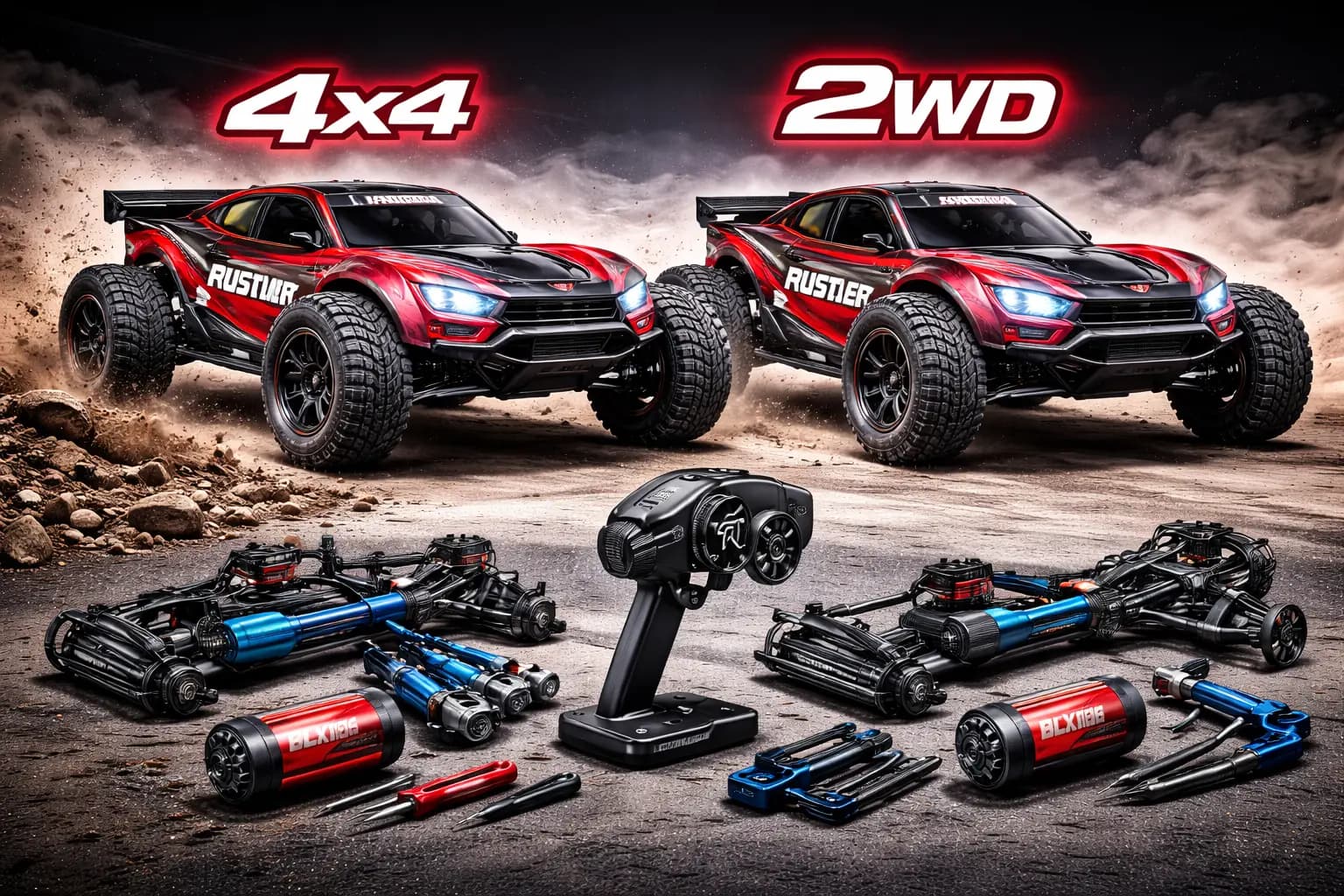
The Rustler isn’t one truck — it’s a family of trucks at different price points. As of 2026, Traxxas sells six distinct electric Rustler variants across two completely different chassis platforms. Here’s the full picture:
| Version | Drive | Motor | ESC | TSM | Top Speed | Price | Best For |
|---|---|---|---|---|---|---|---|
| 2WD XL-5 | 2WD | Titan 12T 550 (brushed) | XL-5 | ❌ No | 35+ mph | $209.95 | Beginners, tight budget |
| 2WD BL-2s | 2WD | BL-2s 3300kV (brushless) | BL-2s | ❌ No | 40+ mph | $249.95 | Budget brushless, 2S only |
| 2WD VXL | 2WD | Velineon 3500kV (brushless) | VXL-3s | ✅ Yes | 70+ mph (3S) | ~$330–350 | Enthusiasts, fun factor |
| 4x4 BL-2s | 4WD | BL-2s 3300kV (brushless) | BL-2s | ❌ No | 40+ mph | $329.95 | 4WD traction, 2S budget |
| 4x4 VXL | 4WD | Velineon 3500kV (brushless) | VXL-3s | ✅ Yes | 65+ mph (3S) | $399.95 | Do-everything truck |
| 4x4 VXL Ultimate | 4WD | Velineon 3500kV (brushless) | VXL-3s | ✅ Yes | 65+ mph (3S) | ~$599.95 | Upgraded out-of-box |
A few things worth flagging immediately. Only models with the TQi radio include TSM — that’s the 2WD VXL, 4x4 VXL, and 4x4 VXL Ultimate. The BL-2s variants and the XL-5 all ship with the basic TQ transmitter. Battery and charger are only included with the XL-5. And the 4x4 VXL was updated in April 2024 (replacing model 67076-4 with 67376-4) with a factory-installed Extreme Heavy Duty Upgrade Kit — stronger driveshafts, HD suspension arms, and better steering components. If you’re shopping used or clearance, double-check the model number.
2WD vs 4WD — What Actually Changes
This is the question that drives most buying decisions, and the honest answer is: it depends entirely on what you want out of the truck.
Handling & Driving Feel
The 2WD Rustler is a rear-wheel-drive machine with a rear-biased weight distribution. That means oversteer, fishtails, and — the moment every 2WD Rustler owner lives for — wheelies. On smooth surfaces, you can drift it, slide it, and make it do things that look spectacular on video. It rewards skill. It also punishes ham-fisted driving. Hit full throttle on 3S without a wheelie bar and the truck will literally backflip off the top of its own inertia.
The 4x4 is a different animal. Power goes to all four wheels, weight is distributed more evenly, and the lower center of gravity (the 4x4 sits 0.65 inches shorter than the 2WD) keeps everything planted. It tracks straight, corners predictably, and is far more forgiving for drivers still developing their throttle control. On loose terrain — grass, sand, gravel, dirt — the 4x4 simply hooks up where the 2WD digs and spins.
On pavement, the 2WD’s lighter weight (3.73 lbs vs 5.12 lbs) gives it a slight top-speed edge. On anything else, the 4x4 is faster where it counts.
Speed & Traction
Both the 2WD VXL and 4x4 VXL run the same Velineon 3500kV motor and VXL-3s ESC. In straight-line testing on pavement, the 2WD occasionally nudges ahead because the drivetrain has less mechanical friction — there’s no front differential or center driveshaft to spin. But in real-world bashing, the 4x4 accelerates harder out of corners and from a dig because all four tires are pulling.
TSM (Traxxas Stability Management) changes the experience significantly on the 4x4. It uses a gyro sensor in the TQi receiver to apply corrective steering when the truck starts to yaw or fishtail — essentially electronic stability control for RC. On snow and wet grass, this is genuinely impressive. On pavement, most experienced drivers dial it down to 25–50% or disable it entirely; at 100% it over-corrects and creates a visible wobble.
Durability & Maintenance
The 2WD platform has been around for decades. It’s mechanically simple — one differential, no front driveline, minimal moving parts. That simplicity translates to lower repair costs and fewer parts to replace when something breaks. The XL-5’s brushed motor and mechanical simplicity make it particularly easy to maintain, which is why it’s been the go-to for parents buying their kid’s first RC.
The 4x4 is more complex. It has a front differential, a center drive shaft, front CVD/driveshafts, and additional steering components. More parts means more potential failure points. Historically, the original 4x4’s plastic driveshafts were a known weak link on 3S power. Traxxas addressed this in the 67376-4 with MAXX-duty 6mm steel driveshafts. The current truck is meaningfully tougher than its predecessor — but if you crash hard and often, expect slightly higher maintenance costs than the 2WD.
The most commonly reported failure on both platforms: the stock servo strips under repeated impact. This is not a design flaw unique to the 4x4 — it affects every Rustler. More on that in the upgrades section.
Weight & Size
| Spec | 2WD VXL | 4x4 VXL |
|---|---|---|
| Weight (no battery) | 3.73 lbs (1,693g) | 5.12 lbs (2,323g) |
| Length | 17.5” (445mm) | 18.78” (477mm) |
| Width | 12.25” (311mm) | 12.94” (329mm) |
| Height | 7.0” (178mm) | 6.35” (161mm) |
| Wheelbase | 11.38” (289mm) | 11.62” (295mm) |
The 4x4 is 1.39 lbs heavier — a 37% penalty for the drivetrain complexity. That weight lives lower in the chassis, which helps stability, but it’s still a real difference you feel when carrying the truck and in the way it responds to jumps.
I ran my 2WD and 4x4 side by side on a dirt path one afternoon. The 4x4 pulled away in a straight line because it hooks up better — no wheelspin, no drama. But the 2WD was more entertaining. Every bump sent it sideways, every throttle blip threatened a wheelie, every corner needed a driver behind the wheel rather than a passenger. The 4x4 is the better truck. The 2WD is the more fun truck. You have to decide which matters more.
Brushed vs Brushless — XL-5 vs VXL
This is the question most beginners ask, and it’s worth answering clearly. Not sure which makes more sense for you? Our brushed vs brushless guide explains the key differences in detail — but here’s the short version.
The XL-5 brushed motor is simpler, cheaper to replace, and forgiving of abuse. It caps at 35+ mph and runs fine on NiMH or 2S LiPo. The motor will eventually wear out — brushed motors have a finite lifespan — but replacements cost $15–20 and take ten minutes to swap. For kids, casual bashers, and anyone who just wants a tough truck that’s ready to run without babysitting, the XL-5 is still excellent.
The Velineon 3500kV brushless motor in the VXL doesn’t wear out in the same way (no brushes to replace), runs significantly cooler, and delivers far more torque and speed. The throttle response is instant and linear in a way that brushed motors can’t match. On 3S, the jump in performance from XL-5 to VXL is not incremental — it’s a completely different experience.
The current lineup adds the BL-2s tier as a middle ground. The BL-2s sensorless 3300kV motor is brushless but capped at 2S LiPo maximum. You get brushless efficiency and the durability of the platform, without the full 3S capability. At $249.95 for the 2WD BL-2s, it’s a compelling upgrade from the XL-5 without requiring 3S battery investment.
If budget allows, go VXL. The performance gap justifies the price. If it doesn’t, the XL-5 is still a blast — and it includes a battery and charger, which makes the true total cost difference smaller than the sticker prices suggest.
Traxxas Rustler 4x4 VXL — In-Depth Review
The Rustler 4x4 VXL is what I hand to friends who want to try RC for the first time. TSM keeps it manageable, 4WD keeps it planted, and it handles everything from grass to gravel to pavement without complaining. It’s not the most exciting truck — it’s the most competent one.
The current model (67376-4) ships with the factory HD upgrade already installed, which eliminates the driveshaft-breakage complaints that plagued earlier versions. Out of the box, it’s genuinely a lot of truck: Velineon 3500kV motor, VXL-3s ESC supporting up to 3S LiPo, GTR Ultra Shocks with TiN coating, Talon EXT tires on 2.8” RXT wheels, self-righting capability, and the full TQi radio system with TSM.
On grass, this thing is remarkable. Where a 2WD Rustler digs and bogs, the 4x4 just drives. It’s equally at home on pavement, gravel, packed dirt, or light snow. The self-righting feature alone saves a lot of walks across the yard. TSM on snow is genuinely addictive — it keeps the truck pointing straight when physics says it shouldn’t.
Strengths: Unmatched versatility, excellent build quality from the factory, TSM training mode, enormous parts and upgrade ecosystem, self-righting, 65+ mph potential on 3S.
Weaknesses: The stock servo (Traxxas 2075) is the truck’s weak point — it strips under hard impacts and is the first upgrade virtually every experienced owner recommends. At 5.12 lbs without battery, it’s noticeably heavier than the 2WD. No battery included at $399.95 means you’re budgeting another $35–80 for a pack.
Rating: 8.5/10. The factory HD upgrade makes this a genuinely complete truck out of the box. The servo limitation keeps it from a higher score.
Traxxas Rustler 2WD — In-Depth Review
The 2WD Rustler was my gateway drug into this hobby. The wheelies alone made me giggle like a kid. There’s something pure about a simple, fast 2WD truck that no 4x4 can replicate — the oversteer, the powerslides, the chaos. It’s not the most capable truck, but it might be the most fun.
VXL Version
The 2WD VXL (37076-74) is the performance pick of the rear-drive lineup. Same Velineon 3500kV and VXL-3s as the 4x4, but in a significantly lighter chassis. The Pro Series Magnum 272R transmission with its metal internals and silicone-filled differential handles the motor’s output reliably, and the TQi radio with TSM means this is the only rear-drive Rustler where stability management is available. On 3S with the optional 31T pinion, real-world top speed approaches 65–70 mph on pavement.
The fun factor here is genuine. Experienced drivers who want a challenge — and want to pull off wheelies, powerslides, and tail-out cornering on purpose — will prefer the 2WD VXL over the 4x4 at any equivalent power level.
A wheelie bar is not optional. Traxxas part #3678, about $10–15 on Amazon. Buy it when you buy the truck.
Strengths: Lighter, more engaging to drive, faster in absolute top speed terms, lower maintenance complexity, lower repair cost.
Weaknesses: No 4WD traction means it struggles on grass and loose terrain. Requires more driver skill. Stock servo strips. Will flip without a wheelie bar.
Rating: 8/10.
XL-5 Version (Brushed)
The 2WD XL-5 (37254-8) is where most RC enthusiasts started, and it’s still an excellent first truck for good reasons. Titan 12T brushed motor, XL-5 waterproof ESC, capped at 35+ mph — but it includes an 8.4V NiMH battery and USB-C charger in the box, making $209.95 the true total cost to drive. No additional purchases required.
The lack of TSM and the basic TQ radio aren’t problems for beginners who are still learning throttle control. At 35 mph, the XL-5 is still fast enough to be exciting and fast enough to cause real crashes. The brushed motor is simple, the parts are cheap and everywhere, and the build quality is the same as every other Traxxas truck.
For younger riders, casual use, or anyone who genuinely isn’t sure if RC is a hobby they’ll stick with — the XL-5 is the right answer. Spend the $209, see if you love it, then upgrade to VXL knowing exactly what the platform can do.
Strengths: Battery and charger included, lowest total entry cost, simple to maintain, NiMH compatible, suitable for younger drivers.
Weaknesses: 35 mph ceiling, brushed motor eventually wears out, no TSM, no upgrade path within the same truck (you just buy a new truck).
Rating: 7.5/10. The included battery lifts this score significantly. For its price and purpose, it does exactly what it promises.
If you’re just starting out, our complete beginner’s guide is worth reading before making your final decision.
Rustler vs the Competition
The Rustler 4x4 VXL competes in the most populated segment of hobby-grade RC. Here’s a direct comparison of everything in its weight class:
| Model | Brand | Type | Drive | Price | Best For |
|---|---|---|---|---|---|
| Rustler 4x4 VXL | Traxxas | Stadium truck | 4WD | $399.95 | Speed, TSM, ecosystem |
| Rustler 2WD VXL | Traxxas | Stadium truck | 2WD | ~$330–350 | Lightweight, fun factor |
| Rustler 2WD XL-5 | Traxxas | Stadium truck | 2WD | $209.95 | Budget, beginners |
| Arrma Vorteks 223S BLX | Arrma | Stadium truck | 4WD | $369.99 | Value, durability |
| Arrma Granite 3S BLX | Arrma | Monster truck | 4WD | $319.99 | Best-value basher |
| Arrma Senton 223S BLX | Arrma | Short course | 4WD | $379.99 | SC body, scale looks |
| Stampede 4x4 VXL | Traxxas | Monster truck | 4WD | $399.99 | Rough terrain, big tires |
The Rustler 4x4 VXL is the fastest stock truck in this group at 65+ mph, driven by its lighter weight relative to the monster trucks and the proven Velineon 3500kV system. It’s the only truck here with self-righting capability — a feature Arrma hasn’t matched in this class. TSM is also exclusive to Traxxas.
The honest case for Arrma: the Vorteks 223S BLX undercuts the Rustler by $30 at MSRP, and retailers regularly run sales that push it to $339.99 — a $60 gap. Our Arrma Vorteks review covers its telescopic driveshafts that can’t pop out under load, and Arrma’s DSC (Drive-shaft Safety Coupler) prevents drivetrain damage on hard hits. The Granite 3S at $319.99 is the best-value 4WD basher in this segment, full stop.
Traxxas’s counter is ecosystem. Replacement parts are available at virtually every hobby shop and ship overnight from Amazon. The aftermarket for Rustler-compatible parts — RPM, Pro-Line, JConcepts, MIP, Hot Racing — is larger than for any competitor. Individual Traxxas replacement pieces tend to cost less per item than Arrma equivalents. If you crash frequently and live near a hobby shop, this matters.
Can’t decide between Rustler and Stampede? Our Traxxas Stampede 4x4 vs 2WD guide covers the monster truck alternative in full detail — different tires, higher ground clearance, rougher terrain capability, but a notably higher center of gravity.
Best Upgrades for the Traxxas Rustler
Upgrades for All Versions
Servo upgrade — do this first. The stock Traxxas 2056 servo (on the XL-5) and 2075 digital servo (on VXL models) strip under hard impacts. The community’s value pick is the Power HD 20KG waterproof servo — metal gears, double the torque, roughly $20–25. Performance-oriented drivers prefer the Savox SC-1258TG (~$65) for its fast response. A quality servo upgrade is the single highest-impact modification on any Rustler.
RPM A-arms — the durability insurance policy. RPM’s proprietary nylon flexes on impact rather than shattering, and every piece carries a lifetime breakage warranty. RPM front A-arms for Rustler run about $10–15 per pair and bolt on directly. The community rule: use RPM (nylon) for impact-absorbing parts, aluminum for precision steering components. Rigid aluminum A-arms transfer crash forces to the chassis — more expensive damage.
Full bearing kit. The XL-5 ships with bushings instead of bearings. A Rustler bearing kit (~$12–18) delivers roughly 10% better runtime and noticeably smoother operation. The 4x4 VXL already has sealed bearings throughout, so this is primarily an XL-5 and BL-2s upgrade.
2WD-Specific Upgrades
Wheelie bar — mandatory for the VXL. Without it, the truck backflips uncontrollably under full 3S throttle. Traxxas part #3678. About $10–15 on Amazon. Buy this the day you buy the truck — don’t wait until after the first backflip.
Aluminum caster blocks add steering precision and durability to the 2WD’s front end. They absorb lateral impacts better than the stock composite pieces without the chassis-transfer problem of full aluminum A-arms. Good combination with RPM arms and a servo upgrade.
4x4-Specific Upgrades
Aluminum hubs and steering knuckles are the meaningful upgrade on the 4x4 after the factory HD kit handles the driveshafts. Hot Racing and Integy both make direct replacements that significantly reduce flex in the steering geometry.
Center diff upgrade for drivers pushing 3S hard on mixed surfaces. The factory sealed bevel differentials are adequate, but experienced bashers eventually want the tuning flexibility of aftermarket center diffs. MIP makes a highly regarded option for the Rustler 4x4 platform.
Shock upgrades. Standard 4x4 VXL units are good but not great on big landings. Pro-Line Powerstroke shocks are a direct upgrade that the community frequently recommends alongside the RPM arm package. The Ultimate model’s aluminum GTR shocks are worth the price difference if you’re weighing VXL vs Ultimate.
Body Options
The Rustler has an enormous aftermarket body catalog. Stock Rustler bodies in factory colors run $20–30 from Traxxas. The aftermarket catalog opens up significantly with Pro-Line and JConcepts. Pro-Line’s 2017 Ford F-150 Raptor body (PRO3528-17) is the most popular choice for the 4x4 platform — but it requires the Pro-Line Extended Body Mount Kit (PRO6362-00, ~$15–20) for the clipless body mounting system. JConcepts carries several options for the 2WD platform that fit stock body posts without adapters.
Both Pro-Line and JConcepts bodies come pre-painted or clear (paint-it-yourself), with the painted versions adding $15–25 to the price but saving considerable time.
FAQ
Q: Is the Traxxas Rustler 4x4 good for beginners?
Yes — it’s one of the better beginner trucks at its price point. The 4WD drivetrain eliminates the wheelie and spin-out tendencies of rear-drive RC trucks, and TSM (Traxxas Stability Management) adds an adjustable safety net that auto-corrects fishtailing and loss of traction. The truck is genuinely manageable on 2S LiPo, with 3S being a step up for drivers ready for more performance. The only caveat: budget for a servo upgrade early, as the stock unit strips under hard crashes.
Q: How fast is the Traxxas Rustler VXL?
The 2WD VXL (37076-74) reaches 70+ mph with optional 31T pinion gearing on a fully charged 3S LiPo. The 4x4 VXL (67376-4) hits 65+ mph under the same conditions — the extra weight from the 4WD drivetrain costs a few mph at the top end. On stock gearing with a fresh 2S pack, real-world speeds land between 35–45 mph for both versions. The XL-5 brushed tops out at 35+ mph regardless of battery.
Q: Traxxas Rustler vs Traxxas Slash — which is better?
Different purposes. The Rustler is optimized for all-surface bashing and speed — lower center of gravity, lighter, faster. The Slash 4x4 VXL is a short course truck designed with more ground clearance (2.83” vs ~1.1”) and a longer wheelbase (12.75” vs 11.62”) for high-speed stability and track racing. The Slash handles jumps, bumps, and off-camber surfaces better. The Rustler is faster outright and more fun in a parking lot or smooth dirt area. Both share significant parts commonality and carry the same MSRP.
Q: Can the Traxxas Rustler handle off-road?
The 4x4 VXL handles casual off-road — packed dirt, grass, gravel, light mud — without issue. Talon EXT tires provide solid traction in loose conditions. It’s not a rock crawler or a competition buggy, and deep mud or large debris will overwhelm the 1.1” ground clearance, but it’s far more capable off-road than its stadium truck body implies. The 2WD is considerably more limited off-road due to single-wheel traction and its rear-heavy weight distribution.
Q: What battery does the Traxxas Rustler use?
VXL models use a LiPo pack with the Traxxas iD connector. The recommended size is a 3S 5000mAh for full performance — Traxxas Power Cell 3S 5000mAh ($79.95) is plug-and-play with EZ-Peak chargers. A more budget-friendly option is a Gens Ace 3S 5000mAh ($35–45) with a Traxxas ID connector version available directly from Gens Ace. The battery tray on the 4x4 measures approximately 162mm × 50mm × 23mm — verify dimensions before purchasing oversized aftermarket packs. The XL-5 ships with an 8.4V 3000mAh NiMH and runs on NiMH or 2S LiPo.
Conclusion
Three profiles, three clear recommendations. If your budget is tight and you want the cheapest complete package that works out of the box: the Rustler 2WD XL-5 at $209.95 includes the battery and charger — total cost to drive is $209.95.
If you want the most fun per dollar in brushless rear-drive: the Rustler 2WD VXL at ~$330–350 is genuinely one of the most entertaining RC trucks available. Budget a wheelie bar ($10) and a servo upgrade ($20–25) for the full experience.
If you want one truck that handles everything without compromise: the Rustler 4x4 VXL at $399.95 is the answer. TSM, self-righting, 4WD traction, 65+ mph, factory HD upgrade — it’s the most capable stadium truck at this price point. Add a battery (~$40–80), upgrade the servo early ($20–65), and this truck will outlast most of the competition.