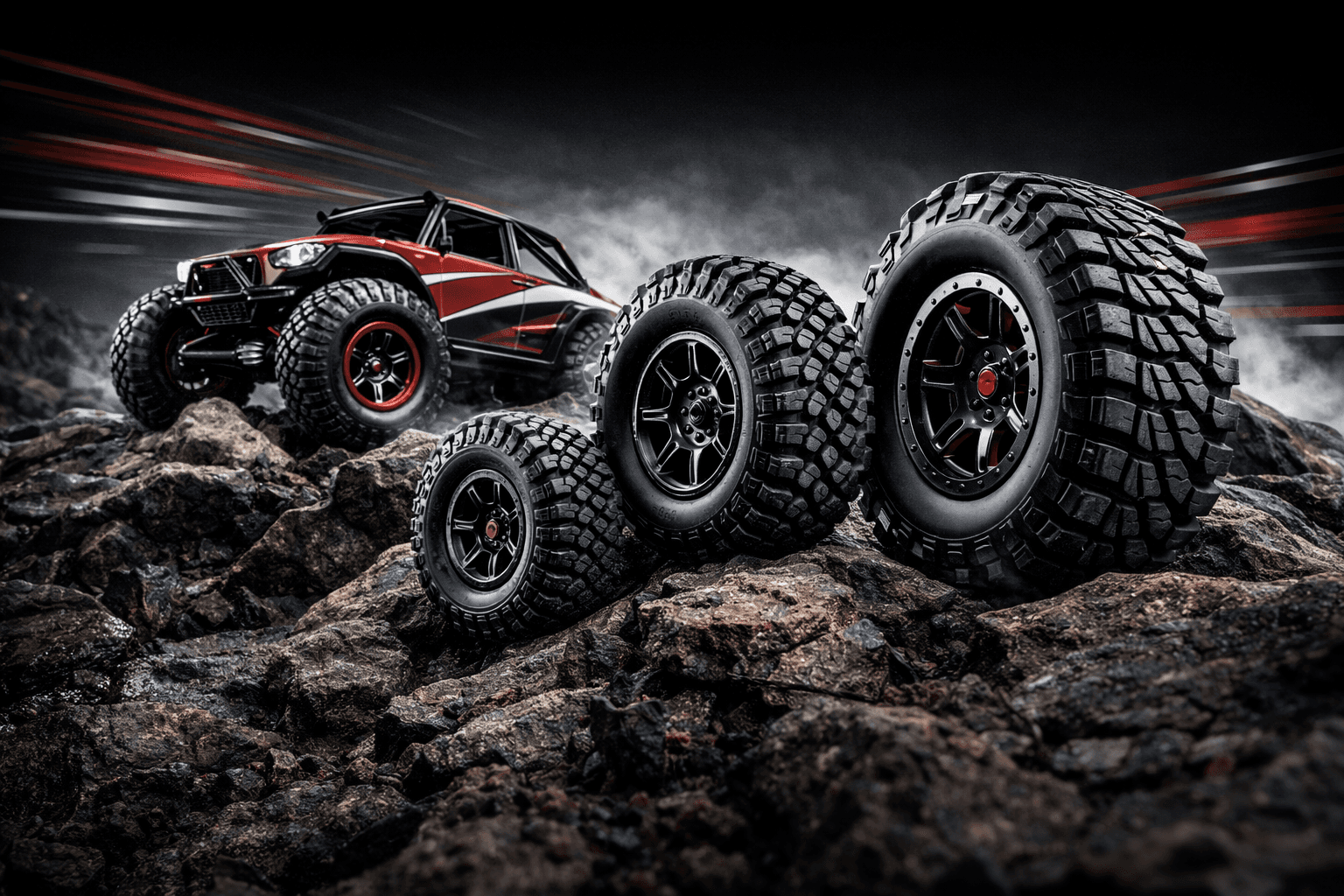
Tires are the single most important upgrade you can make on a crawler — more impactful than suspension tuning, more impactful than electronics. The right rubber is the difference between scaling a vertical rock face with confidence and sliding off halfway up. This guide covers everything you need to know about rc crawler tire sizes, compounds, tread patterns, and the best rc crawler tires for your specific rig.
This post contains affiliate links. If you make a purchase through these links, we may earn a commission at no extra cost to you.
RC Crawler Tire Sizes Explained — 1.0, 1.9 & 2.2
This is hands-down the most confusing thing for new crawler owners. When you see "1.9 inch tires," that number does not refer to the outer diameter of the tire. It refers to the wheel bead diameter — the inner measurement where the tire seats against the rim. Understanding this is the key to buying tires that actually fit your crawler.
1.0" Tires — Mini Crawlers
The 1.0" class is built for the booming 1/24 and 1/18 scale mini crawler segment. If you own an Axial SCX24, a Traxxas TRX-4M, or a similar micro rig, this is your size. For a full breakdown of scale classes and what they mean, see our RC car scale sizes guide.
These tires are tiny — roughly the diameter of a stack of quarters — but the market has exploded as mini crawling has gone mainstream. Selection is growing fast, and performance-oriented options now exist at every price point.
- Typical outer diameter: 50–58mm (~2.0"–2.3"), with oversized options reaching 62–64mm
- Popular brands: Injora (market leader), Hot Racing, RC4WD micro
- Price range: $8–$20 per set of 4
1.9" Tires — The Standard
This is the king of crawler tire sizes. If you own a 1/10 scale crawler — TRX-4, SCX10 II/III, Element Enduro, Redcat Gen8 — you almost certainly run 1.9" wheels. Over 80% of crawlers on the trail run this size, and the aftermarket selection is staggering.
I swapped the stock rubber on my TRX-4 for a set of Pro-Line Hyrax 1.9" in G8 compound, and the difference was immediate. Rocks that used to stop me cold became effortless. The increase in traction from a quality 1.9" aftermarket tire over stock rubber is genuinely difficult to overstate.
- Typical outer diameter: 108–121mm (~4.3"–4.75"), varies by tire model
- Competition standard for most Class 1 and Class 2 crawler events
- Scale-accurate appearance that mirrors real 1:1 off-road trucks
- Price range: $15–$50 per pair
2.2" Tires — Bigger & Specialized
The 2.2" class puts bigger rubber under rigs like the Axial Wraith, RR10 Bomber, and custom builds. The larger bead diameter means a taller, wider tire overall — more ground clearance, a more aggressive stance, and additional presence on the trail.
Some competition classes run 2.2", and rock bouncer and trail truck builds frequently use this size. Fewer options exist than in the 1.9" class, but the major brands all have strong 2.2" lineups.
- Typical outer diameter: 130–147mm (~5.25"–5.75")
-
Best for: Wraith, RR10, custom builds, some comp classes, rock bouncers
- Price range: $18–$45 per pair
Quick Size Guide — Which Do I Need?
| Crawler | Tire Size | Stock Tires |
|---|---|---|
| Axial SCX24 | 1.0" | Nitto Trail Grappler M/T 1.0 |
| Traxxas TRX-4M | 1.0" | Traxxas Canyon Trail 1.0 |
| Axial SCX10 III | 1.9" | Nitto Trail Grappler M/T 1.9 |
| Traxxas TRX-4 | 1.9" | Canyon Trail 1.9 |
| Element Enduro | 1.9" | General Grabber X3 1.9 |
| Redcat Gen8 | 1.9" | Interco IROK Super Swamper 1.9 |
| Axial Wraith | 2.2" | Ripsaw 2.2 |
| Axial RR10 Bomber | 2.2" | BFG Baja T/A KR3 2.2 |
| Axial SCX6 | 2.9" | BFGoodrich KM3 2.9 |
Tire Compound — Why It Matters More Than Tread
Compound is the rubber formulation — specifically, how soft or hard the tire material is. Softer compound deforms more under load, creating a larger contact patch against the terrain and generating more grip. On rock especially, compound softness is everything.
Soft / Super Soft Compound
This is what you want for crawling. Soft compound tires mold themselves to micro-texture on rock surfaces, generating grip that would be impossible with a firmer rubber. It's why competition crawlers universally run soft compound — when a gate or obstacle requires maximum traction, there's no substitute.
Pro-Line designates their crawler-grade soft rubber as G8 (standard soft) and Predator (super soft, sticky competition compound). Pit Bull's equivalent is Alien Kompound — their stickiest formulation, described by fans as having an almost adhesive quality on rock. RC4WD's newest tires use the X2S³ (Super Soft & Super Sticky) compound as their top-tier option.
The trade-off is durability. Soft compound wears faster — but at crawler speeds, "faster" is relative. I ran the same set of RC4WD Goodyear Wrangler 1.9s for almost a year of weekly trail runs before they showed real wear. Crawler tires last forever compared to bashing tires. The slow speed means minimal abrasion.
Medium / Standard Compound
Medium compound is what most RTR crawlers ship with. It's a reasonable all-rounder: more durable than soft, better grip than hard, and perfectly adequate for casual trail running on mixed terrain. If you're not trying to push technical limits, stock compound is fine. The moment you want to improve performance, though, go soft.
Hard / Firm Compound
Hard compound prioritizes durability above all else. Scale builds that live on the shelf and occasionally roll across a garden path, long-distance trail builds where tire longevity matters, and — surprisingly — mud and sand running, where compound softness matters less than tread pattern and debris-shedding ability matters more. Some crawlers deliberately choose hard compound for mud because soft rubber grabs dirt and packs solid, killing grip.
The bottom line: Soft compound is almost always the right choice for crawling performance. Unless you specifically need durability or are building a mud/sand runner, go soft. Every time.
Tread Patterns — Matching Terrain
Compound gets you grip at the molecular level. Tread pattern determines how that grip is delivered across different surfaces.
Aggressive Lug / Rock Crawling
Deep, widely spaced independent lugs that bite into rock edges and crevices. These tires look mean and perform accordingly on technical terrain. Examples: Pro-Line Hyrax, Pit Bull Rock Beast, RC4WD Interco TSL/Bogger. The open spacing also provides some self-cleaning ability in light mud. Want to test how different tire setups perform? Our crawler course ideas guide has plenty of terrain challenges to dial in your setup.
All-Terrain / Trail
Moderate tread depth with a versatile pattern that handles dirt, gravel, roots, and light rock without specializing in any one surface. These are the most scale-accurate designs — they look like the all-terrain tires you'd see on a real truck. Examples: Pro-Line BFGoodrich KO2, RC4WD Goodyear Wrangler All-Terrain Adventure, Pro-Line Trencher. The ideal choice for trail running, mixed-surface driving, and scale builds where appearance matters.
Mud Terrain
Large, paddle-style lugs with wide channels between them. The design throws mud rearward and prevents clogging, maintaining grip where a finer tread would pack solid and become useless. Examples: Pro-Line Interco Bogger, RC4WD Goodyear Wrangler MT/R. If you run swampy trails, wet clay, or anything consistently muddy, a dedicated rc crawler mud tire is transformative.
Scale / Street
Realistic tread patterns that accurately reproduce the look of full-size truck tires. Minimal performance advantage — rc crawler street tires are selected for appearance, not crawling capability. Best for display builds, scale photography, and light trail use where looks matter more than grip limits.
Foam Inserts — Don't Skip Them
Here's something beginners don't always know: RC crawlers don't run air pressure. The tire's shape and structure come entirely from the foam insert packed inside it. Without foam, the tire collapses under load, the sidewall folds, the contact patch becomes unpredictable, and steering goes vague. Proper rc crawler tire foam inserts are non-negotiable.
Dual-stage foam is the performance choice. A firm, closed-cell inner ring prevents rollover and keeps the tire on the rim under lateral load. A softer, open-cell outer foam conforms to terrain for grip and compliance. Crawler Innovations (CI) pioneered this design and remains the gold standard — their Lil' Nova dual-stage foams come in multiple heights (4.0", 4.25", 4.50", 4.75") to match your tire diameter and rig weight.
Single-stage foam is the budget option. Uniform density throughout — it works fine for casual trail use and is what most RTR crawlers ship with. Upgrade to dual-stage when you want to improve performance.
Tuning tip: More foam = stiffer sidewall = more stable on side-hill traverses. Less foam = more flex = better rock wrapping on technical terrain. CI's Lil' Nova foams include a tuning ring for fine adjustments without buying new foam. Price range: $10–$15 per pair.
Beadlock Wheels — What They Are & Why They Matter
Standard RC wheels hold tires in place with glue. RC crawler beadlock wheels use a bolted ring that physically clamps the tire bead between the inner wheel and an outer retention ring — no glue required.
This is standard practice in crawling for good reason. Beadlock wheels let you swap tires in minutes instead of destroying them with solvent. The tire can never pop off the rim even when foam is compressed hard. And the external beadlock ring is scale-accurate — it matches the look of full-size beadlock wheels used in real-world off-road racing.
The bolted ring adds weight at the outermost point of the wheel, which lowers your crawler's center of gravity and improves stability on off-camber terrain. Aluminum beadlocks add even more useful mass low on the chassis — a genuine performance benefit, not just cosmetic.
Plastic beadlock wheels (stock on most RTR crawlers) are light and functional. Aluminum beadlock wheels ($20–$35 per set) are heavier, more durable, and look significantly better. Wheel size must match tire size: 1.9" wheels for 1.9" tires, no mixing.
Best RC Crawler Tires by Size (2026)
Best 1.0" Tires — SCX24 & TRX-4M
The 1.0" aftermarket is Injora's world right now. Their S5 compound tires deliver outstanding grip at prices that make them an obvious first upgrade for any mini crawler owner. If you're new to the hobby and comparing entry-level options, check our beginner's guide first.
Injora 1.0" S5 Rock Terrain Tires ($10–$15 per set of 4) — The category leader. Multiple tread designs available (T1005, T1008, T1011), super soft S5 compound, and wide enough selection to dial in the look you want. Foam inserts sold separately but Injora combo packs are available.
Hot Racing SXTF1019C 1.0" Micro Z Tire ($12–$18 per set of 4) — The main alternative, and it ships with foam inserts included. Performance is solid, and the included foam makes it a complete out-of-the-box upgrade. Availability can be spotty — worth checking if Injora's specific tread style doesn't appeal to you.
Best 1.9" Tires — TRX-4, SCX10, Enduro
This is where the tire market gets serious. Five tires cover the full range from trail runner to competition crawler.
Pro-Line Hyrax 1.9" G8 ($25–$35 per pair) — The best rock crawling tire in the 1.9" class, full stop. Deep independent lugs, 4.73" outer diameter, included foam inserts, and G8 compound that delivers consistent grip across temperatures. I've watched these tires find purchase on rocks that looked completely impassable. The Predator compound version exists for competition use if you need the extra stickiness.
RC4WD Goodyear Wrangler MT/R 1.9" ($20–$30 per pair) — The best scale tire in the 1.9" class. Officially licensed Goodyear tread, 4.7" outer diameter, 1.87" wide footprint (one of the wider 1.9" options), foam included. Looks absolutely stunning on any trail truck build and performs better than you'd expect from a scale-first design.
Pit Bull Rock Beast XL 1.9" Alien Kompound ($30–$40 per pair) — The competition favorite and the stickiest tire on this list. Pit Bull's Alien Kompound grips rock with an almost adhesive quality, performs exceptionally in both wet and dry conditions, and holds up surprisingly well given its softness. Foam inserts included. Availability is inconsistent — order when you see them in stock.
Pro-Line BFGoodrich KO2 1.9" G8 ($22–$32 per pair) — The best all-terrain option. A smaller 4.35" outer diameter gives it a realistic, properly-scaled look. Dual sidewall molding lets you choose your preferred appearance. Excellent for trail running and mixed terrain, and it looks phenomenal on any scale 4x4 build.
RC4WD Interco Super Swamper TSL Bogger 1.9" ($18–$28 per pair) — The budget classic. At 4.7" outer diameter with the iconic Bogger tread, this tire offers serious traction at the lowest price on this list. If you're just getting into 1.9" aftermarket tires and want a significant upgrade without breaking the bank, start here.
Best 2.2" Tires — Wraith & RR10
Pro-Line Hyrax 2.2" G8 ($28–$38 per pair) — Same legendary Hyrax design scaled up to 2.2", at a commanding 5.75" outer diameter. Memory foam inserts included. If the 1.9" Hyrax is the best rock crawling tire in its class, the 2.2" version earns the same title for Wraith and RR10 owners.
Pit Bull Rock Beast II 2.2" Alien Kompound ($32–$42 per pair) — Competition-grade grip in the 2.2" format. Massive 5.75" outer diameter, 2.22" wide footprint, and that signature sticky Alien Kompound. Note: foam inserts are not included with the 2.2" version — budget for Crawler Innovations foams separately.
Pro-Line BFGoodrich Krawler T/A KX 2.2" G8 ($25–$35 per pair) — The all-terrain option for 2.2" rigs. At 5.25" outer diameter it sits closer to stock Wraith tire height, which keeps your gear ratio happy. Deep, independent tread blocks, included foam inserts, and a tire that handles rocks, dirt, and roots with equal confidence.
Pro Tips — Getting the Most From Your Crawler Tires
Weight your tires — Pack 15–30g of lead or steel weight inside each tire before installing foam. The first time I tried this on my 1.9" setup, I was genuinely skeptical. But the extra 20 grams per tire lowered my center of gravity just enough that side-hill traverses went from sketchy to confident. It's a $5–$10 upgrade that actually works. You can even 3D print custom weight holders and brackets — our 3D printing guide covers exactly this kind of low-cost custom fab.
Trim your foams — Cutting foam inserts shorter than the tire cavity creates more sidewall flex, allowing the tire to wrap around and grip irregular rock surfaces. More foam equals a stiffer, more stable sidewall. Less foam equals more flex and better terrain contact. Experiment with both depending on the terrain you run most.
Stagger compounds — Advanced crawlers sometimes run softer compound up front (for maximum steering grip and bite) with a slightly firmer rear compound for consistency and durability. Worth experimenting once you've dialed in the rest of your setup.
Don't glue beadlock tires — The entire point of a beadlock wheel is tool-free tire swapping. If the tire is slipping, tighten the beadlock ring screws evenly — don't reach for the CA glue.
Clean after mud runs — Mud left packed in tire treads hardens between sessions and dramatically reduces grip on your next trail. A quick rinse with a garden hose and an air dry is all it takes to keep your compound performing at its best. Check our crawler course ideas to set up varied terrain challenges that let you test different tire setups back to back.
FAQ
Q: What size tires does my RC crawler need?
The tire size you need matches your wheel's bead diameter — 1.0" for mini crawlers like the SCX24 and TRX-4M, 1.9" for full-size 1/10 scale crawlers like the TRX-4, SCX10, and Element Enduro, and 2.2" for larger rigs like the Axial Wraith and RR10. When in doubt, check your wheel — the size is usually stamped or printed on the inner face of the rim. The number refers to the inner bead diameter, not the outer tire size.
Q: Are soft compound tires better for crawling?
Yes, in almost every situation. Soft compound rubber deforms against rock micro-texture and generates dramatically more grip than medium or hard compound. The only downside is slightly faster wear — but at the slow speeds of crawling, even soft tires last for months of regular use. Unless you're specifically building a mud runner or want maximum longevity above all else, always choose soft compound.
Q: Do I need foam inserts in my crawler tires?
Absolutely — crawlers don't run air pressure, so foam inserts provide the tire's structure and shape. Without foam, the tire collapses under load, the sidewall folds under lateral stress, and handling becomes unpredictable. Dual-stage foams from Crawler Innovations are the performance choice; single-stage foam works fine for casual use. Never run a crawler tire without foam.
Q: What are the best 1.9" crawler tires?
For rock crawling performance, the Pro-Line Hyrax G8 is the benchmark. For scale appearance combined with solid performance, the RC4WD Goodyear Wrangler MT/R is hard to beat. For competition or maximum grip, the Pit Bull Rock Beast XL in Alien Kompound is the community's favorite. All three are excellent choices depending on your priorities — and all three are available on Amazon with fast shipping.
Q: Can I use 2.2" tires on a 1.9" crawler?
No — the bead diameters are physically incompatible. A 2.2" tire will not seat on a 1.9" wheel. The tire would simply fall inward or fail to hold a proper bead. You need matching sizes across the board: 1.9" tires on 1.9" wheels, 2.2" tires on 2.2" wheels, with no cross-compatibility between classes.
Conclusion
Tires are the number one upgrade on any crawler — pick the right size, go soft compound, pair with quality dual-stage foam inserts, and your rig will perform at a level stock rubber can never reach. Start with the Pro-Line Hyrax 1.9" G8 as your baseline for 1.9" rigs — it's the tire that defines the category.
Building a new crawler from scratch? Check out our best crawler kits guide for the right starting platform. New to the hobby entirely? Our RC crawlers complete guide covers everything from your first purchase to trail-ready setup.