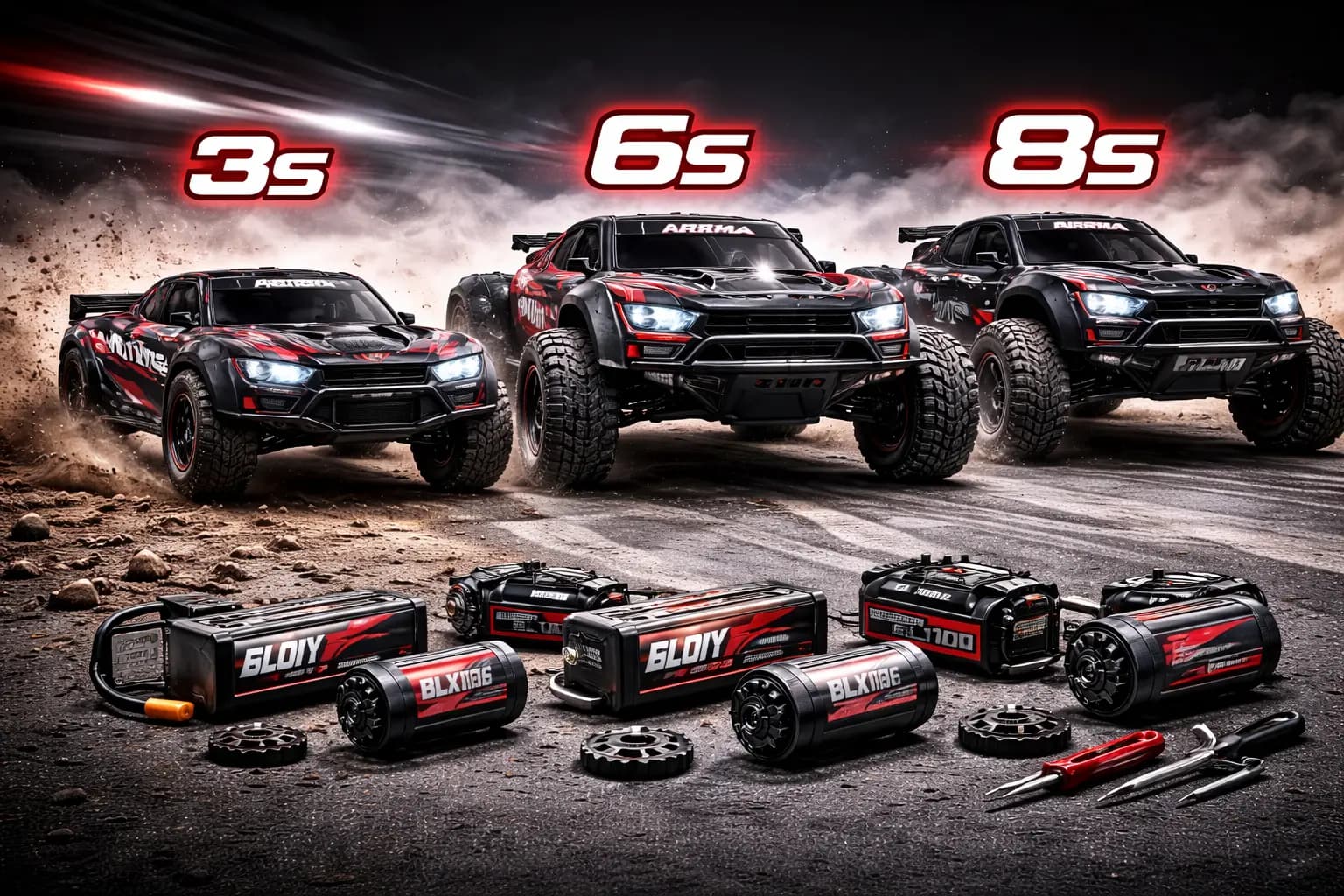
Arrma builds RC cars for people who actually drive them hard. Not shelf queens, not parking lot cruisers — trucks and buggies designed to eat dirt jumps, bounce off curbs, and keep running when you inevitably send them full speed into something solid. That's been the brand's DNA since day one, and it's exactly why Arrma has gone from scrappy newcomer to the biggest threat Traxxas has ever faced.
Owned by Horizon Hobby, Arrma occupies a unique spot in the market: aggressive pricing, overbuilt chassis designs, and a tiered lineup that makes choosing the right model surprisingly straightforward. While Traxxas dominates shelf space at hobby shops and name recognition among casual buyers, Arrma has quietly won over the dedicated basher community with vehicles that consistently punch above their price tag.
This guide covers the entire Arrma lineup from the $150 Grom series all the way up to the $1,000 8S monsters. Every tier, every model, honest takes on what works and what doesn't — plus concrete recommendations based on how you actually plan to drive. Whether you're buying your first RC car or your fifth Arrma, this is the reference page.
This post contains affiliate links. If you make a purchase through these links, we may earn a commission at no extra cost to you.
Arrma's Philosophy — Built to Bash
Arrma's core identity comes down to three things: extruded aluminum chassis plates, a sliding gear mesh system that lets you swap pinion gears without shimming, and a commitment to brushless power at every price point that matters. Where other brands might cut costs on drivetrain components, Arrma tends to overbuild the mechanical parts and save money on electronics — a philosophy that resonates with hobbyists who upgrade radios and servos anyway.
The genius of Arrma's lineup is the tier system. Every model falls into a clear power category — Grom, 3S (now branded 223S), 6S, or 8S — and the number tells you exactly what LiPo battery it's designed for. A 3S model runs on a 3-cell 11.1V battery. A 6S model runs on two 3S packs in series for 22.2V. Simple, intuitive, and it eliminates the confusion that plagues other brands where you need to cross-reference compatibility charts just to figure out what battery fits.
The recent 223S rebranding takes this further. Current mid-tier models accept both 2S and 3S batteries with no hardware changes — start mellow at 35 mph on 2S, then unlock 50+ mph on 3S when your skills catch up. Combined with Dynamic Stability Control (DSC) and adjustable throttle limiting, Arrma has made its mid-range lineup genuinely beginner-friendly without neutering the performance ceiling.
The Grom Lineup — Arrma's Entry Point
The Grom series is where Arrma does something almost no other brand bothers with: ships a complete, ready-to-run package with battery and charger in the box. No hidden costs, no $80 LiPo surprise at checkout. You open it, charge the included 2S Spektrum Smart battery via USB-C, and you're driving.
The Granite Grom is the smallest at 1/18 scale, running the brushed MEGA 380 motor and priced at $149.99. It's tiny, it's fun, and it's genuinely tough for its size. The Typhon Grom moves up to 1/14 scale in a low-slung buggy shape, while the Mojave Grom offers a 1/16 scale desert truck design at $169.99. All share waterproof electronics, metal-geared drivetrains, oil-filled shocks, and a clipless quick-release body system that makes post-crash body swaps tool-free.
For drivers wanting more from the small-scale platform, the brushless Typhon Grom 223S ($209.99 without battery, $249.99 with) and Mojave Grom 223S ($229.99/$269.99) are serious performers. Running a 4500Kv brushless motor, they'll hit 50+ mph on a 3S pack — genuinely shocking speed from something that fits in a backpack.
If you're choosing between Groms, here's the short version: the Granite Grom is the cheapest way in, the Typhon Grom handles the best due to its low center of gravity, and the Mojave Grom looks the coolest with its Baja desert truck styling. We've done a full head-to-head of all three Groms if you want the detailed breakdown. And if you already own a Mojave Grom and want to push it further, check out our best Arrma Mojave Grom upgrades guide.
The 3S Lineup — Best Bang for Your Buck
This is where Arrma moves the most metal, and for good reason. The 223S-branded 3S lineup delivers brushless 4WD performance starting at $339.99 — a price point where Traxxas is still selling brushed trucks. The V4 generation brought across-the-board improvements: DSC stability control, SLT3 transmitter, a new 3100Kv brushless motor, upgraded metal-gear servo, and 2S/3S compatibility on every model.
The Granite 223S ($369.99) is the monster truck that built Arrma's reputation. Huge Fortress tires, a wheelie bar, and a chassis that absorbs punishment like nothing else at this price. It's the single most recommended beginner Arrma for good reason — the monster truck form factor forgives sloppy driving, and the parts commonality with other 223S models keeps repair costs low. Weighing the Granite 223S against the Traxxas Stampede? Our Granite vs Stampede breakdown covers exactly how they compare as beginner-friendly bashers.
The Senton 223S ($339.99) is the short course truck variant — lower profile, nerf bars protecting the body sides, and a slightly more planted feel through corners. If you're bashing in mixed terrain and want something that looks more like a real truck, the Senton is your play. We have a detailed Senton 3S review covering its strengths and quirks.
The Vorteks 223S ($339.99) shares the Senton's 1/10 scale platform but adds a stadium truck body with a roof skid plate and Katar multi-terrain tires. It splits the difference between the Granite's go-anywhere attitude and the Senton's stability. Read our full Arrma Vorteks 3S BLX review for the deep dive.
The Typhon 223S ($369.99) is the outlier — a 1/8 scale buggy that's physically larger than everything else in this tier. Its high-downforce wing and low stance make it the best handler here, especially on loose dirt and tracks. If you plan to hit any kind of organized bash event or backyard track, the Typhon is the right call.
The Big Rock 223S ($369.99) wraps the Granite's platform in a crew cab pickup truck body. Same performance, different aesthetics. If you want the muscle-truck look over the monster truck silhouette, Big Rock all day.
Arrma also added 2WD 223S models as a lower entry point: the Vorteks 223S 2WD and Fury 223S 2WD at $249.99. These are legit brushless trucks at a price that competes with brushed offerings from other brands. The Fury is a dedicated short course truck that's entirely new to the Arrma lineup.
At the top of the 3S range sit the Infraction 3S and Vendetta 3S — premium street machines running faster 3900Kv motors, DX3 transmitters, and 100A Smart ESCs. The Vendetta is Arrma's fastest stock 3S model at 70+ mph. We've reviewed the Vendetta 3S BLX in detail if speed is your priority.
The 6S Lineup — Where Arrma Shines
Ask any experienced RC basher which tier is Arrma's best, and the answer is always the same: 6S. This is the sweet spot where the brand's build quality, power delivery, and pricing converge into something genuinely hard to beat. Every 6S model runs the Firma 4074 2050Kv motor with a 150A Smart ESC, delivering 60-80+ mph depending on configuration.
The Kraton 6S V6 is the flagship — a 1/8 scale monster truck that received a significant update incorporating EXB-grade components into the standard RTR. That means a 7075 T6 aluminum chassis, limited-slip center diff, enlarged dual-bearing hubs, and the Firma 150A Smart V2 ESC. At roughly $500, it's arguably the best all-around basher in any brand's lineup at any price.
The Notorious 6S V6 shares the Kraton's updates but with a shorter wheelbase optimized for wheelies and backflips. If stunt driving is your thing, the Notorious was literally designed for it.
The Typhon 6S remains on the V5 platform and is the most agile 6S model thanks to its buggy form factor. Lower, faster through corners, and an absolute weapon on dirt tracks.
The Outcast 6S EXB is the premium stunt truck — full EXB hardened components, a wheelie bar, and Back-Flip tires purpose-built for aerial tricks.
Moving up to 1/7 scale, the Infraction 6S V2 and Felony 6S are the street bash kings. Both hit 80+ mph, but the Infraction's functional handbrake — a real disc brake on the rear axle controlled from the DX3's third channel — makes it the more playful of the two. The Felony's retro muscle car styling turns heads at every bash session.
The Fireteam 6S rounds out the 1/7 scale lineup with military-inspired styling and similar performance to its street siblings.
If you're trying to choose between 3S and 6S versions of the same model, we've broken down the differences in our Arrma Infraction 3S vs 6S and Arrma Typhon 3S vs 6S comparisons.
The 8S Lineup — Maximum Carnage
The 8S tier exists for people who looked at a 6S Kraton and thought "I need this, but bigger and angrier." These are 1/5 scale trucks — we're talking 30+ inches long, 15+ pounds, and powered by the massive Firma 5687 1100Kv motor. Both retail at $999.99 and require two 4S LiPo batteries wired in series.
The Kraton 8S EXB is a speed monster truck built on a 5mm-thick CNC aluminum chassis with 20mm bore shocks. The Outcast 8S EXB shares the identical drivetrain but adds stunt-focused geometry, a wheelie bar, and a roll cage center tower.
Why only two 8S models? Simple economics and physics. At this scale, every crash is expensive, every repair takes longer, and the running costs (batteries, tires, replacement parts) are roughly triple what you'd spend on a 6S truck. These are purpose-built machines for experienced drivers who understand the commitment. They're not for beginners, they're not for small yards, and they're absolutely glorious if you have the space and budget.
For a detailed breakdown of how the tiers compare side-by-side, our Arrma 3S vs 6S vs 8S guide covers the real-world differences in cost, performance, and maintenance.
Arrma vs Traxxas — The Eternal Debate
This is the question that fuels a thousand forum arguments, and the honest answer is: neither brand is universally better. They serve different priorities, and the right choice depends on what matters most to you.
Arrma wins on raw value. Dollar for dollar, you consistently get more truck — more power, better stock components, and an open battery ecosystem that saves real money over time. The IC5/EC5 connector system means any compatible LiPo from any manufacturer plugs right in, while Traxxas locks you into their proprietary TRX iD batteries. Over the life of a truck, that flexibility can save $100+ on batteries alone.
Traxxas wins on convenience and support. Their parts availability is simply unmatched — the Traxxas Slash alone has over 500 replacement parts stocked at virtually every hobby shop in America. Arrma's parts catalog is smaller per model, and back-order issues still pop up for specific components. Traxxas also offers phone-based customer service seven days a week and a robust warranty process that Arrma can't quite match.
Community support splits along experience lines. Newer hobbyists lean Traxxas for the hand-holding. Experienced bashers lean Arrma for the performance-per-dollar, especially in the 6S segment where Arrma is widely considered king.
We've dedicated an entire article to this debate with model-by-model comparisons. You can also check out our head-to-head matchups: Traxxas Slash vs Arrma Senton, Traxxas X-Maxx vs Arrma Kraton 8S, and Arrma Granite vs Traxxas Stampede.
Batteries, Chargers & What You Need Besides the Car
Here's the reality check that catches many first-time Arrma buyers off guard: outside the Grom brushed series, no Arrma model includes a battery or charger. That's $100-$200 in additional costs you need to plan for on day one.
The good news is you don't need to buy Spektrum Smart batteries to run an Arrma truck. Any LiPo with an EC5 connector (backwards-compatible with Arrma's IC5 plugs) works perfectly. Brands like Zeee, CNHL, and Gens Ace offer excellent 3S 5000mAh packs in the $25-$40 range — roughly one-third the cost of the Spektrum equivalent. You lose Smart telemetry features, but most bashers don't miss them.
For 3S models, grab a 3S 11.1V 5000mAh 50C+ hardcase pack with an EC5/IC5 connector. For 6S, you need two 3S packs wired in series. For 8S, two 4S 14.8V packs — and the community strongly recommends 7000-8000mAh capacity for adequate runtime at this scale.
A decent charger is equally important. A dual-port balance charger like the SkyRC D100 or Spektrum S250 runs $80-$130 and will handle any battery in the Arrma ecosystem. Avoid cheap single-cell chargers — they're slow and don't balance-charge, which shortens battery life and can be a safety concern.
For a complete deep dive on LiPo selection, read our RC LiPo battery guide. We also cover charger recommendations in our best RC car battery chargers roundup. And if you're still deciding between brushed and brushless, our brushed vs brushless RC motors explainer covers the fundamentals.
Which Arrma Should You Buy?
After running through the entire lineup, here's the bottom line based on what you actually need:
Your first RC car ever: Start with the Granite Grom ($149.99) if budget matters or if you're buying for a younger driver. Battery and charger included, zero hidden costs, genuinely fun. If you want to skip the brushed learning curve and go straight to brushless, the Granite 223S V4 ($369.99 plus ~$120 for battery and charger) is the single best entry point in the hobby right now.
Pure basher, dirt and jumps: The Kraton 6S V6 (~$500) is the community's consensus king. It handles everything from backyard jumps to skatepark sessions with equal confidence, and the V6 updates brought EXB-level durability to the standard RTR.
Speed demon: The Vendetta 3S hits 70+ mph on a single 3S battery for under $450 total. If you need more, the Infraction 6S V2 or Felony 6S will push 80+ mph at the 1/7 scale.
Tight budget, maximum fun: The Fury 223S 2WD or Vorteks 223S 2WD at $249.99 are the cheapest brushless Arrma trucks, and they're genuinely excellent for the money. Don't overlook 2WD — it's lighter, simpler to maintain, and teaches throttle control better than 4WD.
Already experienced, want the best Arrma makes: The Kraton 6S EXB or Outcast 6S EXB represent the peak of Arrma's engineering at a price that's still hundreds less than competing 6S platforms.
For broader recommendations beyond the Arrma ecosystem, check out our guides to the best RC cars for beginners and best RC trucks & bashers.
Frequently Asked Questions
Q: Is Arrma better than Traxxas?
Neither brand is objectively better across the board. Arrma delivers more performance per dollar and uses an open battery ecosystem that saves money long-term. Traxxas offers superior parts availability, broader dealer support, and a more established aftermarket. For pure bashing at the 6S level, Arrma is widely considered the better value. For beginners who want maximum hand-holding and easy parts access, Traxxas has the edge. The best approach is to choose based on what specific model fits your driving style, not brand loyalty.
Q: What does 3S, 6S, 8S mean for Arrma?
The number refers to the LiPo battery cell count the model is designed for. A 3S battery has three cells at 11.1V, a 6S has six cells at 22.2V, and an 8S has eight cells at 29.6V. More cells means more voltage, which translates directly to more speed and power. Arrma's tier system makes it simple: pick the number that matches your experience level and budget. The 223S models add extra flexibility by accepting both 2S and 3S batteries with no modifications.
Q: Are Arrma RC cars waterproof?
Arrma markets all current models as having waterproof electronics, but they don't publish a specific IP rating. In practice, this means splash-resistant — driving through puddles, wet grass, and light rain is generally fine. Full submersion will likely damage the servo and receiver over time. Best practice after wet runs: blow out the chassis with compressed air or a leaf blower, remove the body and let everything air-dry, and consider adding a bead of silicone sealant around the receiver box if you regularly drive in wet conditions.
Q: Where can I buy Arrma RC cars?
The primary retailer is Horizon Hobby (horizonhobby.com), which is Arrma's parent company and carries the complete lineup including online exclusives. AMain Hobbies is the community's most-recommended authorized dealer with excellent parts inventory. Amazon carries most models at competitive prices — just stick to listings sold by Amazon directly or authorized sellers. Local HobbyTown stores, as part of the Horizon Hobby dealer network, commonly stock Arrma vehicles and parts on the pegboard. Avoid unfamiliar discount websites — counterfeit and scam Arrma sites are widespread.
Q: What's the best first Arrma RC car?
For absolute beginners or younger drivers, the Granite Grom at $149.99 with included battery and charger is the zero-friction starting point. For teens and adults ready to commit to the hobby, the Granite 223S V4 at $369.99 (plus battery and charger) is the overwhelming community recommendation — its monster truck format forgives mistakes, the 2S/3S flexibility lets you scale up gradually, and parts are widely available and affordable.
Q: Are Arrma parts easy to find?
Easier than they used to be, but still not as easy as Traxxas. Horizon Hobby and AMain Hobbies stock most common replacement parts. The 3S/223S tier has the best parts availability due to its massive popularity and shared platform components. The 6S tier is solid. Where things get tricky is with specific items for less popular models or during peak demand — back-orders on certain suspension components and diff parts are still reported by community members. Pro tip: order common wear items like A-arms, shock shafts, and diff outdrives proactively so you have them on hand when something breaks.
Conclusion
Arrma has earned its reputation as the basher's brand. The 223S rebranding smartly unified the mid-range lineup, the V6 updates brought premium durability to standard pricing, and the tier system remains the clearest way to navigate any RC brand's lineup. The 6S segment is where Arrma truly has no peer — nothing from any competitor matches that combination of performance, build quality, and price.
The honest weak spots? Parts availability still trails Traxxas, the stock servo on 3S models should be stronger for the price, and rising costs across the lineup have tested community patience. None of these are dealbreakers, and all of them are improving.
If you're ready to pick your first Arrma, the Granite 223S on Amazon is where most people should start. If you want something smaller and self-contained, grab a Granite Grom on Amazon and you'll be bashing within the hour.
Whatever you choose, check out our individual Arrma reviews and head-to-head comparisons across the silo for detailed takes on every model mentioned here. Welcome to the Arrma side.