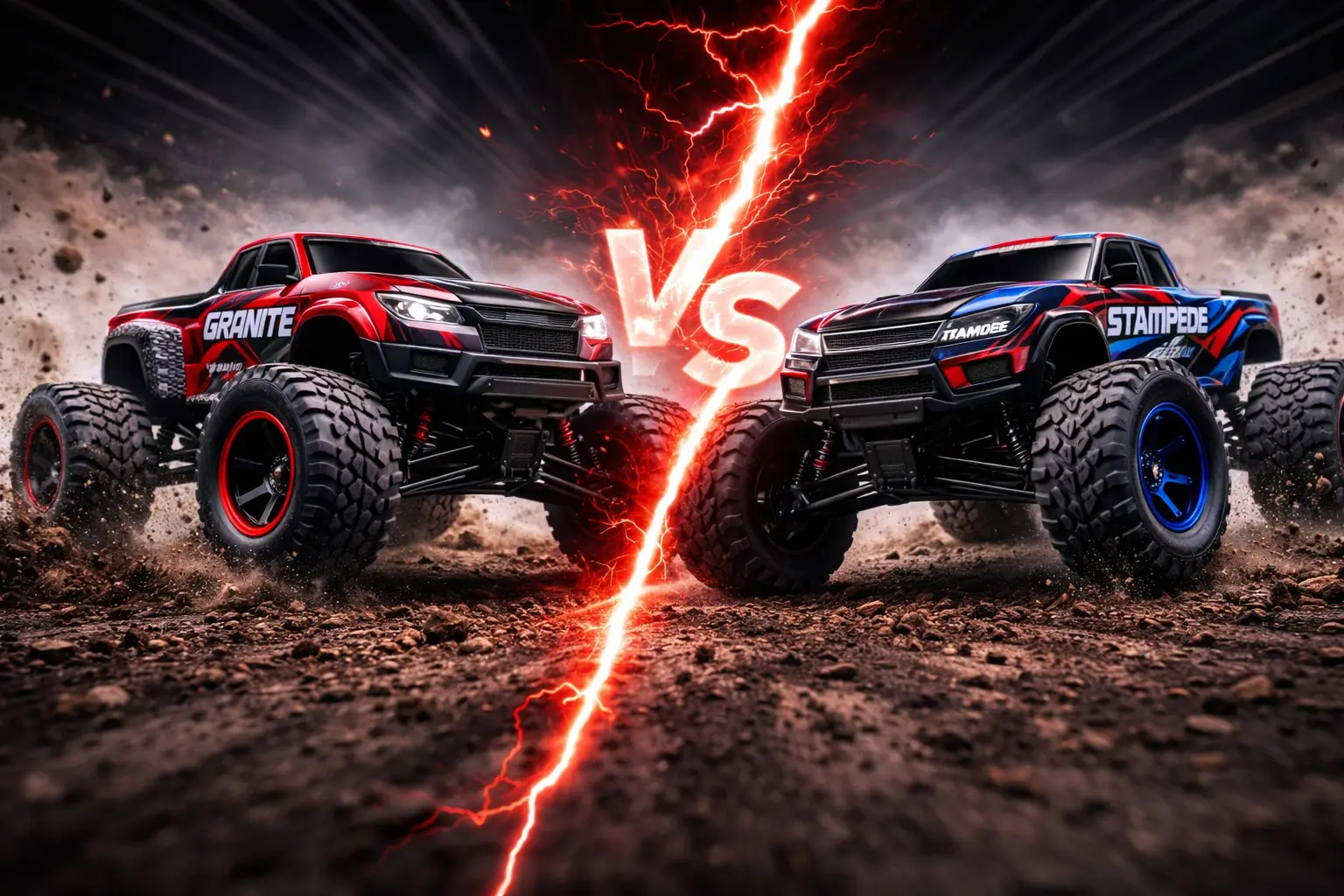
The same question comes up on RC forums every single day: Arrma Granite or Traxxas Stampede? These two 1/10-scale monster trucks have been fighting for the same wallet for years, and for good reason — both are legitimate first bashes, both survive rookie mistakes, and both put a massive grin on your face. What follows is the most complete side-by-side comparison you’ll find, built from hands-on experience with both trucks and backed by spec data straight from the manufacturers.
This post contains affiliate links. If you make a purchase through these links, we may earn a commission at no extra cost to you.
Quick Answer: Which Should You Pick?
If your budget is tight and you want the most truck per dollar, get the Arrma Granite 3S BLX. It’s $130 cheaper than the Stampede VXL, comes with better stock hardware, and holds up to serious bashing.
If you want the safest out-of-box experience, the biggest aftermarket ecosystem, and industry-best customer support, get the Traxxas Stampede 4x4 VXL. You pay a premium, but you’re buying into 30+ years of parts availability and a feature set that genuinely helps beginners.
Here’s why in detail.
Understanding the Lineups: It’s Not Just One vs One
This is the trap most first-time buyers fall into: they hear “Granite vs Stampede” and assume they’re comparing one truck against another. In reality, both names cover a whole family of vehicles — and comparing the wrong pair is like comparing a Honda Civic to a Mustang GT and being surprised they feel different. Before you can make a smart decision, you need to know which version you’re actually looking at.
Traxxas Stampede Versions
| Version | Drive | Motor | Price (MSRP) | Battery Included? |
|---|---|---|---|---|
| Stampede 2WD XL-5 HD | 2WD | Brushed (Titan 12T) | ~$229 | ✅ NiMH + USB-C |
| Stampede 2WD BL-2s | 2WD | Brushless 3300Kv | ~$249–279 | ❌ |
| Stampede 2WD VXL | 2WD | Velineon 3500Kv | ~$319 | ❌ |
| Stampede 4x4 XL-5 | 4WD | Brushed (Titan 12T) | ~$329 | ✅ NiMH |
| Stampede 4x4 BL-2s | 4WD | Brushless 3300Kv | ~$329–349 | ❌ |
| Stampede 4x4 VXL | 4WD | Velineon 540XL | ~$449 | ❌ |
A quick note on the Traxxas Stampede 4x4 vs 2WD decision: these are completely different platforms, not just one model with extra wheels. The 4x4 VXL received a major rebuild on a new Hoss/Maxx-derived chassis, making it a significantly larger and more capable truck than its 2WD sibling. If you’re shopping Stampede, that guide will save you a lot of confusion.
Arrma Granite Versions
| Version | Drive | Motor | Price (MSRP) | Battery Included? |
|---|---|---|---|---|
| Granite Grom | 4WD (1/18 scale) | Brushed 380 | ~$130–149 | ✅ 2S LiPo + USB-C |
| Granite 4X4 Mega 550 | 4WD | Brushed 12T 550 | ~$270 | ✅ NiMH |
| Granite 3S BLX V3 | 4WD | Firma 3200Kv | ~$319 | ❌ |
| Granite 223S BLX V4 | 4WD | Spektrum 3100Kv | ~$369 | ❌ |
Important: There is no current 2WD Arrma Granite. The old Granite Boost 4X2 (2WD brushed) is discontinued. If someone tells you the Granite is 2WD, they’re referencing old information. The entire current Granite lineup is 4WD — which actually makes it better value at the budget tier, not worse.
The Arrma Grom is worth mentioning for anyone who wants to start even smaller and cheaper — at 1/18 scale with a 2S LiPo included out of the box, it’s a fantastic first RC for younger drivers or limited spaces.
The Fairest Comparison
For a true apples-to-apples match, there are two main pairings worth exploring:
Budget duel (~$230–270): Arrma Granite 4X4 Mega 550 vs Traxxas Stampede 2WD XL-5 HD. Brushed motors, batteries included, similar price points — but the Granite is 4WD and the Stampede is 2WD.
Main event (~$320–450): Arrma Granite 3S BLX V3 vs Traxxas Stampede 4x4 VXL. Both brushless, both 4WD, both serious performers. This is the comparison 90% of buyers are actually making, so it’s where we’ll spend most of our time.
Specs Face-Off
The two trucks that matter most — spec for spec:
| Spec | Arrma Granite 3S BLX V3 | Traxxas Stampede 4x4 VXL |
|---|---|---|
| Price (MSRP) | $319.99 | $449.95 |
| Scale | 1/10 | 1/10 |
| Length | 18.74” / 476mm | 20.24” / 514mm |
| Width | 13.46” / 342mm | 13.10” / 333mm |
| Wheelbase | 11.3” / 287mm | 11.62” / 295mm |
| Weight (no battery) | 6 lbs 4 oz / 2.83 kg | 6.3 lbs / 2.9 kg |
| Ground clearance | 1.85” / 47mm | 2.75” / 70mm |
| Drivetrain | 4WD shaft-driven | 4WD Torque-Biasing Center Drive |
| Motor | Firma 3660, 3200Kv brushless | Velineon 540XL, ~2400Kv brushless |
| ESC | BLX100 — 100A continuous | VXL-3s — 200A continuous / 320A peak |
| Radio | Spektrum SLT3 3-channel | Traxxas TQi 2-channel + TSM |
| Stability control | None (V3) | TSM (gyro-based, knob-adjustable) |
| Servo | Spektrum S651 — metal-gear, 101 oz-in | Traxxas 2075 waterproof |
| Top speed (3S) | 50+ mph | 60+ mph |
| Tires | dBoots Fortress MT | 5.3” Sledgehammer |
| Hex size | 14mm | 12mm (universal) |
| Extreme HD kit | ❌ | ✅ Factory-installed |
| Self-righting | ❌ | ✅ (requires 3S) |
| Training mode | Throttle limiter (50/75/100%) | ESC-based 50% power |
| Wheelie bar | ✅ | ✅ |
| Waterproof | ✅ | ✅ |
| Battery included | ❌ | ❌ |
| Warranty (electronics) | 2-year Horizon Hobby | Lifetime |
The $130 price gap is the headline number here. Both trucks need a battery and charger to run — budget an extra $50–80 for a quality 3S LiPo and charger on top of either truck’s MSRP.
Performance: How They Actually Drive
Speed & Acceleration
Both trucks hit genuinely alarming speeds on 3S LiPo. The Granite 3S BLX’s 3200Kv motor is tuned for higher RPM, which translates to a very linear, aggressive pull to top speed — independently tested at around 45–50 mph, with the 50+ mph claim achievable with aggressive gearing. The Stampede VXL’s 540XL motor runs at a lower Kv (~2400Kv) but is a physically larger motor that produces more torque, pushing the truck to 60+ mph with optional pinion swaps.
For everyday bashing in a park or cul-de-sac, the difference isn’t dramatic — both are fast enough that you’ll lose them at full throttle if you’re not paying attention. The Stampede has a more “violent” hit off the line due to torque; the Granite pulls harder mid-range.
Jumping & Air Time
The Granite’s lower center of gravity gives it noticeably better in-air stability. It holds a flatter attitude over jumps and lands nose-level without much fuss. The Stampede — particularly the 2WD version — is rear-heavy, which means it tends to pitch forward over jumps and require some throttle to keep the nose up in the air. The 4x4 VXL is more balanced than the 2WD version but still tail-heavy by design.
If you’re building jump ramps in your backyard, the Granite is the more confidence-inspiring truck in the air. BigSquidRC’s multi-truck shootout gave the Stampede the edge in pure jumping fun, citing its loftier launches — but that comes with a less predictable landing.
Wheelies & Fun Factor
This is where the Stampede, especially the 2WD, earns its legendary status. I still remember the first time I pinned the throttle on my old Stampede 2WD on pavement — it stood up on the rear wheels and just stayed there, rolling backward, for a solid three seconds. I laughed out loud. No other stock RC I’ve owned matched that party trick so effortlessly.
The Stampede 4x4 VXL with its Torque-Biasing Center Drive can pull controlled wheelies on demand — it’s just not quite as natural or theatrical as the 2WD’s constant wheelie-mongering. The Granite 3S BLX can wheelie on 3S, but it takes more effort; 4WD simply distributes torque across four wheels instead of piling it all on the rear.
If wheelies are your primary hobby, the Stampede 2WD wins outright.
Handling & Stability
The Granite is the better handler, full stop. Its center of gravity is lower, weight distribution is more even, and on both pavement and loose dirt it tracks straighter and recovers from corrections more predictably. The Stampede’s rearward bias makes it prone to traction rolling — applying too much throttle mid-corner while it’s leaning can flip it.
The Stampede VXL offsets this with TSM (Traxxas Stability Management) — a gyro-based system that detects yaw rotation and automatically corrects the steering. For a complete beginner, TSM is a genuine lifesaver. It makes the Stampede considerably easier to drive fast without spinning out. The Granite V3 doesn’t have an equivalent — you’re relying on your own thumbs. (The newer Granite V4 adds DSC — Dynamic Stability Control — but that’s a $50 premium over the V3.)
Durability: Which One Takes More Abuse?
Granite: Built to Bash
Arrma built the Granite’s reputation around surviving punishment. The composite chassis is notably rigid, the metal internal differential gears are spec’d the same as their 4S vehicles, and the hardware uses hex screws throughout — a small detail that matters enormously when you’re doing roadside repairs in a parking lot with a hex driver rather than hunting for a Phillips head that strips on contact.
After owning a Granite 3S BLX for close to a year of regular bashing — curbs, gravel berms, the occasional tree root — the only thing that gave out was a tie rod after a direct rock impact. That was it. The drivetrain, shocks, and plastic arms all survived sessions that would have hospitalized cheaper trucks.
The most common failure points: diff input yokes at very high throttle (especially if you’re slamming 3S into full-reverse repeatedly), the stock servo on really violent crashes (worth upgrading anyway), and the receiver box can let in water if you’re running through deep puddles without sealing it first.
Stampede: Proven Track Record
The Stampede’s 30-year track record speaks for itself — if it were truly fragile, it wouldn’t still be selling. But community consensus is honest about its weak spots. The body plastic is thin and gets brittle with age. The stock plastic driveshafts are the number-one failure point on the older 4x4 platform — they can snap in under ten seconds on 3S LiPo if you’re aggressive. The newer 4x4 VXL (#90376-4) ships with the Extreme HD upgrade kit factory-installed, which replaces the weakest components and largely addresses the driveshaft problem.
Long-term owner math on the old Stampede 4x4 platform was brutal: one forum veteran calculated he’d spent over $800 in upgrades and repairs on top of his initial $400 purchase over a decade of ownership. The new VXL platform is meaningfully better, but the reputation for eating parts under aggressive driving is earned.
Verdict: Durability
Stock-for-stock, the Arrma Granite 3S BLX is the more durable truck. It starts with better hardware and requires fewer immediate upgrades to handle serious bashing. The Stampede 4x4 VXL’s HD factory kit improves the situation, but you’re still paying a premium for components the Granite includes at a lower price.
Parts, Support & Aftermarket
Parts Availability
This is where Traxxas wins decisively, and it’s not close. Traxxas has been building the Stampede since 1994 and the parts ecosystem reflects that. Walk into almost any local hobby shop in the US and you’ll find Traxxas parts on the shelf. The Stampede 4x4 platform shares components with the Slash 4x4, Rustler 4x4, and Hoss 4x4 — so the compatible parts pool is enormous.
Arrma parts are primarily an online order. Horizon Hobby stocks everything, AMain Hobbies is excellent, and Amazon carries the common wear items. But if you snap an arm on Saturday morning and want to be running again that afternoon, Traxxas wins.
Parts Cost Comparison
| Common Part | Arrma Granite 3S | Traxxas Stampede 4x4 VXL |
|---|---|---|
| Stock A-arms (front pair) | ~$8–12 | ~$7–10 |
| RPM A-arms, front pair | ~$16–20 | ~$12–13 |
| RPM A-arms, rear pair | ~$16–20 | ~$12–13 |
| Body shell (painted) | ~$35–45 | ~$40–55 |
| Tires (pair, stock) | ~$22–28 | ~$22–28 |
| Shocks (set of 4) | ~$35–45 | ~$40 |
| Servo | ~$19.99 (S651) | ~$39–54 (Traxxas 2075) |
| Bearing kit | ~$33 | ~$30–35 |
Two things jump out: RPM A-arms are cheaper for Traxxas (~$12 vs ~$20 per pair), and the Traxxas servo replacement costs 2–3x more than the Arrma S651. Overall parts costs are roughly similar, though Traxxas’s larger selection means more price competition.
One important technical note: the Arrma Granite uses a 14mm hex on its wheel hubs. This is non-standard — the industry default is 12mm. Traxxas uses 12mm, which means the Stampede is compatible with the enormous Pro-Line, JConcepts, and generic tire universe. Running non-stock rubber on the Granite requires a 17mm hex conversion kit (~$29) or hunting for 14mm-specific options. It’s a fixable limitation, but it’s worth knowing upfront.
Aftermarket Upgrades
Traxxas has a dramatically larger aftermarket, built on decades of platform popularity. RPM makes 10+ product categories for the Stampede. Hot Racing offers 50+ SKUs. Pro-Line and JConcepts have massive body and tire selections. The Slash 4x4 platform overlap means solutions designed for other Traxxas trucks often fit the Stampede.
Arrma’s aftermarket is growing quickly — RPM, Hot Racing, GPM, RCAWD, and Integy all make Granite parts — but it’s still meaningfully smaller. The Granite also shares a platform with the Big Rock, Senton, and Typhon 3S, which helps expand compatible parts.
Electronics: What You Get Out of the Box
Radio System
The Spektrum SLT3 (Granite) is a clean, lightweight 3-channel transmitter with 50/75/100% throttle limiting — useful for teaching new drivers. What it lacks is any active stability assistance. You’re relying on your own inputs.
The Traxxas TQi (Stampede VXL) is a more feature-rich system. TSM (Traxxas Stability Management) uses a gyro in the receiver to detect and correct unwanted yaw rotation in real time — it’s genuinely helpful for beginners, particularly on slippery surfaces. The TQi also supports Traxxas Link app connectivity (telemetry, data logging), stores 30 model memories, and offers full expo and endpoint adjustment.
For an experienced driver, the SLT3 is fine. For a complete beginner, the TQi’s TSM is a meaningful advantage that actively prevents the fishtailing and spinouts that frustrate new drivers.
Motor & ESC
The Arrma BLX100 ESC is rated at 100A continuous — solid for a 1/10 truck. It runs cool, has built-in fan cooling, and has proven reliable across thousands of packs. The Firma 3660 3200Kv motor is tuned for speed and runs well within its thermal limits on 3S.
The Traxxas VXL-3s runs at 200A continuous with 320A peak — nearly double the continuous current rating of the BLX100. The Velineon 540XL motor is physically 25% longer than a standard 3500 motor, produces more torque, and is the same unit found in the Traxxas Maxx. The Traxxas system is more powerful on paper, and the torque delivery shows in real-world driving.
The Traxxas electronics also come with a Lifetime Electronics Warranty — the best coverage in the industry. Horizon Hobby offers a standard 2-year warranty on Arrma electronics. For a beginner worried about burnout or crash damage, that lifetime coverage matters.
Value for Money
At MSRP, the Granite 3S BLX is $130 cheaper than the Stampede 4x4 VXL. Add a 3S LiPo and charger and you’re looking at roughly $380–420 all-in for the Granite versus $510–550 for the Stampede.
What the Stampede gives you for that extra money: TSM stability control, self-righting, a 200A ESC, the Extreme HD kit factory-installed, a lifetime electronics warranty, and access to a vastly larger parts ecosystem. These aren’t trivial features — they represent real value, especially for a beginner who doesn’t want to source upgrades or deal with repairs.
What the Granite gives you for less money: better stock hardware (metal-gear servo, full bearings, hex screws, retained hinge pins), a more modern chassis design, and a truck that’s already bash-ready without needing immediate upgrades.
BigSquidRC summed it up well when they gave the Granite an A+ for value, writing that at $299 it delivers performance and durability that would cost significantly more from any other brand. The Stampede VXL isn’t a rip-off — it’s priced for what it includes — but the Granite’s value proposition is genuinely hard to beat.
Best Upgrades for Each
Top 3 Granite Upgrades
- RPM A-arms (front + rear) — ~$35–40 total. The single best insurance policy for the Granite. RPM’s glass-filled nylon won’t break on standard bashing impacts that would snap stock arms.
- Bearing kit — ~$33. The stock bearings are fine, but a full Fast Eddy rubber-sealed kit (27 bearings) extends drivetrain life significantly if you run in any kind of dirt or grit.
- 3S LiPo battery (5000mAh) — ~$35–50. Running 2S is fine, but 3S is where the Granite BLX truly comes alive. A 5000mAh pack gives you 20–25 minutes of bash time and is worth every penny.
Top 3 Stampede Upgrades
- RPM A-arms (front + rear) — ~$22–26 total. RPM’s Stampede arms are industry-proven and cheaper than the Granite equivalent. Install them before the first bash session.
- Bearing kit — ~$30–35. The Stampede uses bronze bushings in some locations rather than sealed bearings. A full bearing replacement is a noticeable smoothness upgrade.
- 3S LiPo battery — ~$35–50. Same logic as the Granite — the VXL system is designed for 3S and that’s where the 60+ mph claims live. The VXL-3s ESC handles 3S without complaint.
The Scoreboard
| Category | Granite Wins | Stampede Wins | Tie |
|---|---|---|---|
| Price / Value | ✅ | ||
| Top Speed | ✅ | ||
| Jumping | ✅ | ||
| Wheelies | ✅ (2WD) / tie (4x4) | ||
| Handling & Stability | ✅ (raw) | ✅ (with TSM) | |
| Durability (stock) | ✅ | ||
| Parts Availability | ✅ | ||
| Parts Cost | ✅ | ||
| Electronics Quality | ✅ | ||
| Beginner Features | ✅ | ||
| Aftermarket | ✅ | ||
| Fun Factor | ✅ |
Which One Should YOU Buy?
Buy the Arrma Granite If…
- You have a strict budget. At $130 less than the Stampede VXL, the Granite 3S BLX frees up money for a battery, charger, and your first set of RPM arms.
- You’re a confident driver (or planning to become one). Without TSM, the Granite rewards good inputs — it’s not harder to drive, just less electronically assisted.
- You prioritize raw durability. Stock-for-stock, the Granite takes more abuse before breaking.
- You want a modern platform. The Granite’s design is newer and more refined. The Stampede’s architecture, however improved, still shows its 1990s roots.
- You’ll be running in water or wet grass regularly. Seal the receiver box and the Granite handles wet conditions well.
→ Check current price on Amazon
Buy the Traxxas Stampede If…
- You’re a complete beginner who wants TSM. Traxxas Stability Management actively corrects your mistakes. For someone who has never driven an RC truck at speed, this is genuinely helpful.
- You want self-righting. Press a button, the truck flips itself over. Simple, practical, satisfying.
- Your local hobby shop carries Traxxas. Being able to walk in for a part on a Saturday afternoon has real value.
- You want the largest possible upgrade and parts ecosystem. No RC brand comes close to Traxxas’s aftermarket depth.
- You value the Lifetime Electronics Warranty. Traxxas stands behind their electronics in a way no other brand does.
→ Check current price on Amazon
Budget Alternative: The Brushed Matchup
Not ready to go brushless? The comparison changes but the dynamic stays similar. The Arrma Granite 4X4 Mega 550 ($270 with battery) is 4WD with full ball bearings and hex hardware. The Traxxas Stampede 2WD XL-5 ($230 with battery) is 2WD, lighter, and comes with a superior 4” ground clearance that makes it a better option in deep grass or rough gravel — plus those legendary wheelies.
The Granite gives you more drivetrain for $40 more. The Stampede gives you simplicity, lighter weight, and more fun on smooth surfaces. Neither is a wrong answer at that price.
For anyone wanting to dive deeper into how these two brands compare across their entire lineup, our Traxxas vs Arrma brand comparison breaks it down model by model. And if you’re still early in the RC research process, the RC Cars for Beginners buying guide is the place to start before committing to any specific truck.
FAQ
Q: Is the Arrma Granite faster than the Traxxas Stampede?
At the brushless tier, the Stampede 4x4 VXL is faster than the Granite 3S BLX — 60+ mph versus 50+ mph on 3S LiPo. However, the Granite is faster in the budget brushed comparison: the Granite 4X4 Mega 550 (4WD, 30+ mph) outpaces the Stampede 2WD at similar price points. For most bashers, both brushless trucks reach speeds that are more than enough — the difference only matters if you’re specifically chasing top speed numbers.
Q: Which is better for a beginner, Granite or Stampede?
It depends on what “better” means to you. The Traxxas Stampede 4x4 VXL is better for the first few hours — TSM stability management, training mode, and self-righting make it genuinely more forgiving for drivers who have never handled a fast RC truck. The Arrma Granite is better long-term value — more durable stock hardware means fewer early repairs and less frustration. If budget is tight, start with the Granite. If you want maximum protection against beginner mistakes, spend the extra $130 for the Stampede.
Q: Are Traxxas Stampede parts easier to find than Arrma Granite parts?
Yes, significantly. Traxxas has 30+ years of distribution built up, and the Stampede shares platform parts with multiple other Traxxas models. Most local hobby shops carry Traxxas parts on the shelf. Arrma parts are excellent quality but primarily available online through Horizon Hobby, AMain Hobbies, and Amazon — which means waiting a day or two for shipping if something breaks mid-session.
Q: Can I use the same batteries in both trucks?
Yes. Both the Granite 3S BLX and Stampede 4x4 VXL are compatible with 2S and 3S LiPo hardcase batteries. The physical connectors are different — Arrma uses IC5, Traxxas uses their proprietary High-Current connector — so you’ll need an adapter or separate batteries, but the chemistry and voltage are identical. A quality 3S LiPo 5000mAh with the appropriate adapter works great in either truck.
Q: Is the Arrma Granite more durable than the Stampede?
Stock-for-stock, yes — the community consensus and professional reviews consistently rate the Granite as more durable out of the box. It has better hardware (metal-gear servo, full ball bearings, hex screws), a more modern chassis, and the same internal diff gears as ARRMA’s 4S vehicles. The Stampede 4x4 VXL’s factory-installed Extreme HD kit closes the gap considerably, but even with it, the Granite’s raw build quality tends to hold up better in prolonged bashing.
Q: Granite 3S vs Stampede 4x4 VXL: which is the better value?
The Granite 3S BLX is the better value at $130 less — it delivers roughly 80% of the Stampede’s capability for 70% of the price, and it does so with better stock durability. The Stampede’s premium is justified by TSM, self-righting, a more powerful ESC, Lifetime Electronics Warranty, and a vastly larger aftermarket. Value depends on what you’re optimizing for: if it’s pure capability-per-dollar, the Granite wins; if it’s total feature set and long-term parts support, the Stampede earns its price.
Final Thoughts
Thirty years after its introduction, the Traxxas Stampede is still one of the most recognizable names in RC. The Arrma Granite has spent the last decade quietly building a reputation as the truck that punches above its weight class. Neither deserves to lose this fight — they’re both genuinely excellent.
The Granite wins on value and durability. The Stampede wins on features, aftermarket, and beginner-friendliness. The “better” truck is the one that matches your priorities, and now you know exactly what those priorities are worth.
Ready to pull the trigger? Check the Arrma Granite 3S BLX on Amazon — or the Traxxas Stampede 4x4 VXL — and go bash something.