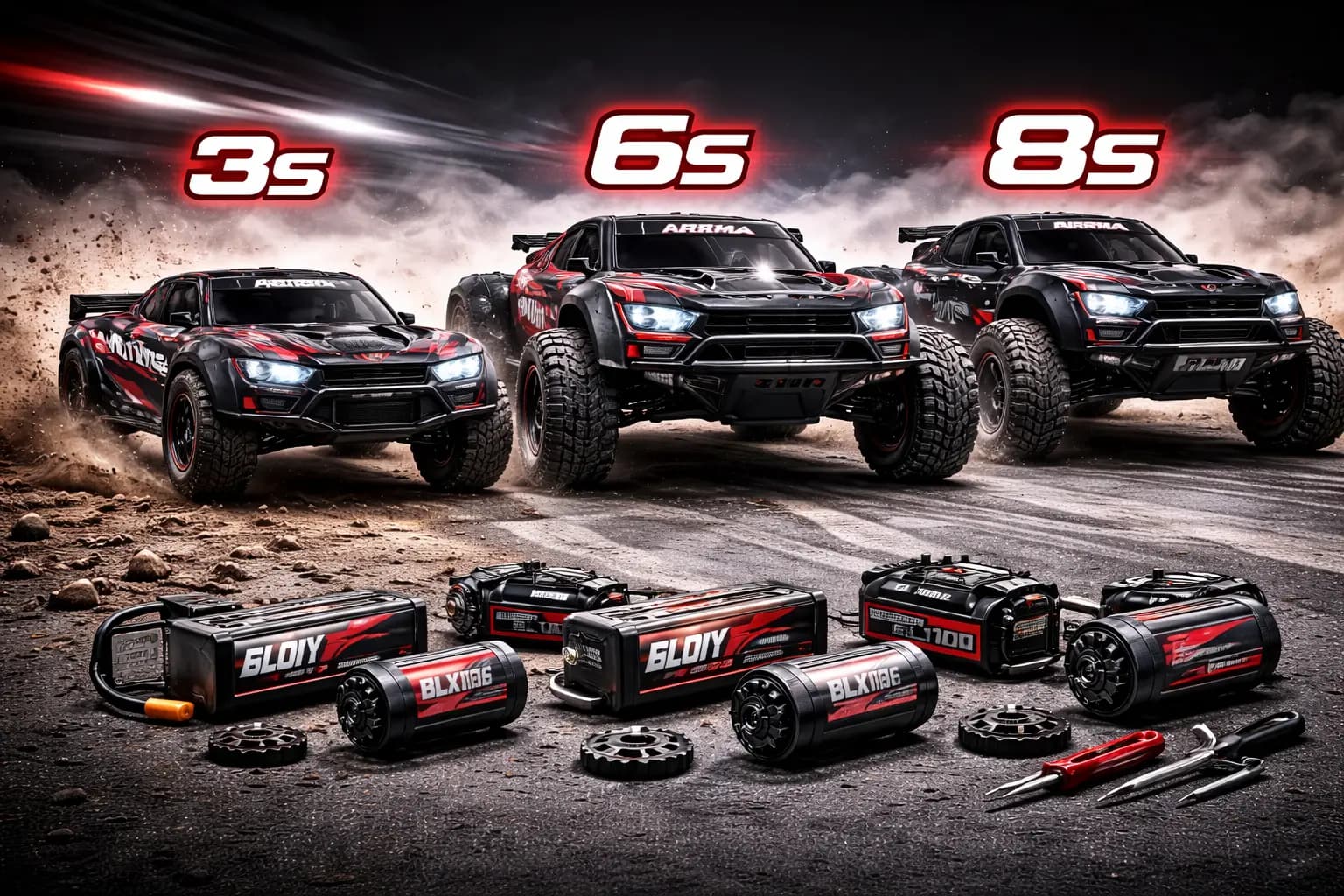
Arrma organizes its entire lineup around one variable: how much voltage your battery system delivers. Three tiers — 3S, 6S, and 8S — and each one represents a fundamentally different vehicle with a different chassis, motor, drivetrain, scale, and price tag to match. The number isn’t just a spec — it tells you what kind of RC hobbyist you’re buying for. Get it wrong and you’ll either wish you’d spent more or wonder what you’re supposed to do with a 24-pound monster truck in your suburban backyard. This guide breaks down every model, every dollar, and every tradeoff so you can pick the right tier on the first try.
This post contains affiliate links. If you make a purchase through these links, we may earn a commission at no extra cost to you.
How Arrma’s Power Tiers Work
LiPo batteries are rated in “S” — the number of cells wired in series. Each cell holds 3.7V nominal, so a 3S pack runs at 11.1V, a 6S at 22.2V, and an 8S setup at 29.6V. More voltage means more motor power, which is why a 6S Arrma doesn’t just go faster than a 3S — it’s an entirely different machine, built on a bigger chassis with a heavier-duty drivetrain to handle the load.
What most people don’t realize when they first look at Arrma’s lineup is that choosing a tier is really choosing what kind of RC hobbyist you want to be. The 3S tier is 1/10 and 1/8 scale — nimble, affordable, easy to run anywhere. The 6S tier jumps to 1/8 and 1/7 scale with aluminum chassis construction and serious power. The 8S tier goes to 1/5 scale (or a 1/7 speed machine for the Limitless 120) — these are vehicles that come in at 24+ pounds and demand proper open space to run safely.
Each tier has its own motor, ESC, battery format, connector type, radio system, and build quality. They share a brand name and a design philosophy. Almost nothing else.
Every Arrma Model by Power Tier
This is the master reference table. All current 2024–2026 models, organized by tier.
3S Lineup
| Model | Scale | Type | Motor | ESC | Top Speed | Price |
|---|---|---|---|---|---|---|
| Vorteks DSC 223S 2WD | 1/10 | Stadium Truck (2WD) | Spektrum 3100Kv | SLT 80A 2-in-1 | 50+ mph | $$ |
| Mini Kraton 3S DSC | 1/16 | Speed Monster Truck | Spektrum 3100Kv | SLT 80A 2-in-1 | ~35 mph | $$ |
| Granite 4X4 223S DSC | 1/10 | Monster Truck | Spektrum 3100Kv | SLT 80A 2-in-1 | 50+ mph | $$ |
| Typhon 223S 4X4 | 1/8 | Speed Buggy | Spektrum 3100Kv | SLT 80A 2-in-1 | 50+ mph | $$ |
| Vorteks 223S 4X4 | 1/10 | Stadium Truck (4WD) | Spektrum 3100Kv | SLT 80A 2-in-1 | 50+ mph | $$ |
| Senton 223S DSC 4X4 | 1/10 | Short Course Truck | Spektrum 3100Kv | SLT 80A 2-in-1 | 50+ mph | $$ |
| Big Rock 223S DSC 4X4 | 1/10 | Monster Truck (LWB) | Spektrum 3100Kv | SLT 80A 2-in-1 | 50+ mph | $$ |
| Infraction 4X4 3S BLX | 1/8 | Street Bash Truck | Firma 3660 3900Kv | Firma 100A Smart | 65+ mph | $$ |
6S Lineup
| Model | Scale | Type | Motor | ESC | Top Speed | Price |
|---|---|---|---|---|---|---|
| Typhon 6S BLX | 1/8 | Speed Buggy | Firma 4074 2050Kv | Firma 150A Smart | 70+ mph | $$$ |
| Kraton 6S BLX V6 | 1/8 | Speed Monster Truck | Firma 4074 2050Kv | Firma 150A Smart | 65+ mph | $$$ |
| Talion 6S EXB RTR | 1/8 | Speed Truggy | Firma 4074 2050Kv | Firma 150A Smart | 60+ mph | $$$ |
| Outcast 6S EXB RTR | 1/8 | Stunt Truck | Firma 4074 2050Kv | Firma 150A Smart | 60+ mph | $$$ |
| Mojave 6S BLX V2 | 1/7 | Desert Truck | Firma 4074 2050Kv | Firma 150A Smart | 60+ mph | $$$ |
| Fireteam 6S BLX | 1/7 | Speed Assault Vehicle | Firma 4074 2050Kv | Firma 150A Smart | 60+ mph | $$$ |
| Kraton 6S EXB V6 | 1/8 | Monster Truck (EXB) | Firma 4074 2050Kv | Firma 150A Smart | 65+ mph | $$$ |
| Notorious 6S BLX V6 | 1/8 | Stunt Truck | Firma 4074 2050Kv | Firma 150A Smart | 60+ mph | $$$ |
| Infraction 6S BLX AVC | 1/7 | Street Bash Truck | Firma 4074 2050Kv | Firma 150A Smart | 80+ mph | $$$ |
| Felony 6S BLX AVC | 1/7 | Street Bash Muscle Car | Firma 4074 2050Kv | Firma 150A Smart | 80+ mph | $$$ |
| Big Rock 6S BLX | 1/7 | Monster Truck | Firma 4074 2050Kv | Firma 150A Smart | 60+ mph | $$$ |
8S Lineup
| Model | Scale | Type | Motor | ESC | Top Speed | Price |
|---|---|---|---|---|---|---|
| Limitless 120 8S BLX RTR | 1/7 | Speed Machine | Firma 4685 1450Kv | Firma 160A Smart V2 | 120+ mph | $$$ |
| Kraton 8S EXB RTR | 1/5 | Speed Monster Truck | Firma 5687 1100Kv | Firma 160A Smart V2 | 55+ mph | $$$ |
| Outcast 8S EXB RTR | 1/5 | Stunt Truck | Firma 5687 1100Kv | Firma 160A Smart V2 | 55+ mph | $$$ |
A few important notes on the table above. All 3S off-road models (Granite, Senton, Typhon, Vorteks, Big Rock) are V4 “223S DSC” units — they feature DSC stability control and a new 2-in-1 ESC/receiver. The Infraction 3S BLX runs older V3 electronics with the superior Firma 100A Smart ESC and DX3 radio with AVC, making it the most sophisticated 3S package despite being the oldest platform. Within the 6S lineup, 1/8 scale models (Kraton, Typhon, Outcast, Notorious, Talion) are physically smaller than 1/7 scale models (Infraction, Felony, Mojave, Fireteam, Big Rock 6S). The 8S Kraton and Outcast at 1/5 scale are legitimately enormous at 24+ pounds without batteries.
3S vs 6S vs 8S — Technical Differences Explained
Scale & Size
Size is the most visceral difference between tiers, and photos don’t fully prepare you for the real thing. A 6S Arrma next to a 3S looks like an adult standing next to a child. The 8S makes the 6S look small.
Typical 3S off-road vehicles (1/10 scale) measure around 18–21 inches long with a wheelbase of roughly 13–14 inches. The 6S 1/8 scale trucks stretch to 22–25 inches and weigh roughly twice as much. The 1/7 scale 6S on-road models are even larger at 26–29 inches with wheelbases around 16–17 inches. The 8S Kraton and Outcast are a full 31+ inches long, 22+ inches wide, and weigh roughly 24 pounds before you add the two 4S LiPo packs.
For practical running space: the 3S is genuinely happy in a suburban backyard, a parking lot, or a local park. The 6S needs room — a large park, an open field, or an empty lot. The 8S demands space you have to specifically seek out.
Motor & ESC
| Tier | Motor | KV Rating | ESC | Amps |
|---|---|---|---|---|
| 3S (V4) | Spektrum 3100Kv | 3,100 | SLT 80A 2-in-1 | 80A |
| 3S (V3 on-road) | Firma 3660 | 3,900 | Firma 100A Smart | 100A |
| 6S | Firma 4074 | 2,050 | Firma 150A Smart V2 | 150A |
| 8S (1/5) | Firma 5687 | 1,100 | Firma 160A Smart V2 | 160A |
| 8S (1/7 Limitless) | Firma 4685 | 1,450 | Firma 160A Smart V2 | 160A |
Lower KV ratings produce more torque per revolution and are paired with higher voltage to achieve massive total power. The 8S Firma 5687 at 1,100Kv pumps out extreme torque figures that explain how a 24-pound truck can still launch off ramps and flip in the air. The higher KV on 3S motors is what gives them their characteristic snap and agility — lots of RPM, lighter chassis, instant response.
Chassis & Build
The platform gap between 3S and 6S is where the real quality story lives. V4 3S models use ventilated composite (plastic) chassis that are light, flexible, and inexpensive to replace from discount parts sellers. The 6S standard BLX models move to anodized 6061 aluminum, while EXB and newer V6 models step up to 7075 T6 CNC aluminum — the same aircraft-grade alloy used in performance automotive parts. The 8S EXB uses 5mm thick 7075 T6 CNC aluminum, laser-etched.
Drivetrain complexity scales with the tier as well. V4 3S models now include a three-differential setup (front, center, rear) — a genuine upgrade over older generations. The 6S and 8S platforms add all-metal differential internals, steel driveshafts, and larger-bore shocks (20mm bore with 6mm thick shafts on the 8S vs smaller bore on 3S).
The chassis difference matters when you crash. A composite 3S chassis might flex or crack — and replacing it is cheap. An aluminum 6S chassis handles the same hit without damage. But if you do crack aluminum, the part costs more. In practice, lighter 3S cars generate less crash inertia, somewhat balancing out the durability math.
Connectors & Batteries
All Arrma BLX brushless models across all tiers use IC5/EC5 connectors — the robust 5mm gold-pin standard. IC3 connectors are only found on Arrma’s budget Mega (brushed) lineup and are not a 3S BLX thing.
Where the tiers genuinely differ is battery configuration. Your connector type determines your battery ecosystem, and the 6S runtime math catches a lot of buyers off guard:
- 3S cars: Run one 3S LiPo pack (11.1V). One battery, one run. Simple.
- 6S cars: Run two 3S LiPo packs in series through dual ESC connectors (or a single 6S pack). You need packs in matching pairs. Start with four if you want two consecutive runs.
- 8S cars: Run two 4S LiPo packs in series. Need pairs again. Much more expensive per pair.
The critical upside: if you own 3S batteries and upgrade to a 6S car, those exact batteries work in the new car. You just need a second matching pack per run. That’s one of the most underappreciated transition benefits in the whole tier discussion.
The Real Cost — Total Ownership by Tier
Here’s what nobody fully accounts for when they’re comparing sticker prices.
| Cost Item | 3S Tier | 6S Tier | 8S Tier |
|---|---|---|---|
| Vehicle | $ | $$ | $$$ |
| Batteries × 2 runs (4 packs for 6S/8S) | $ | $$ | $$$ |
| Charger (capable for tier) | $ | $$ | $$$ |
| Spare parts — Year 1 estimate | $ | $$ | $$$ |
| Replacement tires (1 set) | $ | $$ | $$$ |
| Year 1 Total | $ | $$ | $$$ |
The 6S tier costs roughly 1.7–1.9× the total investment of 3S. The 8S tier runs nearly 3× the cost of 3S. Battery costs are where most people get surprised — the LiPo guide breaks down every option.
Here’s something I tell everyone who’s trying to decide between 3S and 6S while watching their budget: by the time I had two 6S batteries, a capable dual-output charger, and replaced the first broken A-arm after an enthusiastic concrete-curb encounter, I’d spent far more than the sticker price on my first 6S setup. My 3S all-in was considerably less. Both numbers were worth it for what I got, but I wish someone had been explicit about the math beforehand. Know your real budget before you choose your tier — the sticker price is just the beginning. Batteries and repairs are where the real spending happens.
Practical battery recommendations for each tier:
For 3S, a pair of Gens Ace 3S 5000mAh packs gives you back-to-back runs with a basic charger. For 6S, Gens Ace 6S 5000mAh packs are a clean single-pack solution, or grab pairs of matched 3S packs. For 8S, Gens Ace 4S 6500mAh packs in matched pairs is the standard approach.
One charger to rule them all: A dual-output charger capable of 6S, like the Spektrum S2100, handles 3S, 4S, and 6S packs in every tier. Buying it upfront is the most future-proof move, even if you start with 3S.
Performance Comparison
| Category | 3S | 6S | 8S |
|---|---|---|---|
| Speed Range | 50–65 mph | 60–80+ mph (on-road 80+) | 55+ mph (1/5) / 120+ mph (Limitless) |
| Acceleration | Snappy, immediate | Aggressive, planted | Immense torque, deliberate |
| Handling / Agility | ⭐⭐⭐⭐⭐ — Light, nimble | ⭐⭐⭐⭐ — Powerful, composed | ⭐⭐⭐ — Heavy, momentum-based |
| Durability (parts survival) | ⭐⭐⭐ — Plastic flexes/cracks | ⭐⭐⭐⭐ — Aluminum absorbs impact | ⭐⭐⭐⭐⭐ — Built for extreme abuse |
| Repair Cost (per incident) | $ Low | $$ Medium | $$$ High |
| Space Needed | Backyard, driveway, local park | Medium parks, parking lots | Large open fields only |
| Wow Factor | ⭐⭐⭐ | ⭐⭐⭐⭐ | ⭐⭐⭐⭐⭐ |
| Fun Per Dollar | ⭐⭐⭐⭐⭐ | ⭐⭐⭐⭐ | ⭐⭐⭐ |
More power doesn’t always mean more fun. It means more of a specific kind of fun. The 3S wins on agility and cost, the 6S wins on raw performance and build quality, and the 8S wins on pure spectacle. The counterintuitive finding on the table above: the 1/5 scale 8S Kraton is actually slower than most 6S models in outright top speed, because 24 pounds of truck puts a ceiling on velocity regardless of voltage. The 8S’s power goes into insane torque and massive airtime, not straight-line speed — that’s the Limitless 120’s job.
The Arrma 3S Tier — Best For Most People
The honest case for 3S is this: it’s not a compromise. It’s a different vehicle for a different set of priorities, and for many hobbyists those priorities make 3S the right choice every single time you head out to bash.
I started with a Granite 3S and told myself it was “all the power I’d ever need.” Three months later I was ordering a Kraton 6S. But here’s the thing: the Granite didn’t stop being fun. I still throw it in the trunk for casual sessions where I don’t want to worry about battery costs, running space, or the hassle of hauling a larger car. Three years later, both vehicles still get regular time. The 3S is the one you grab when you just want to go have fun without thinking about it.
The V4 “223S DSC” generation of 3S vehicles is genuinely excellent. Center differentials, DSC stability control with selectable modes, clipless body systems, and waterproof electronics came standard — meaningful upgrades that bring 3S much closer to 6S in feature count, if not raw power.
Best 3S picks:
Arrma Granite 4X4 223S DSC — Best overall 3S. The most popular Arrma ever made. Monster truck stance, DSC stability control, and goes anywhere. Perfect first RC car or casual basher. Check price on Amazon →
Arrma Senton 223S DSC 4X4 — Best for beginners. The enclosed short course body protects the drivetrain from debris and direct impacts better than open-wheel designs. Our Arrma Senton 3S review is our top pick for a first 3S truck. Check price on Amazon →
Arrma Typhon 223S 4X4 — Best handling 3S. Low buggy profile and exceptional cornering make this the choice if you care about how it drives, not just how it crashes. See our Arrma Typhon 3S vs 6S comparison for a deep dive. Check price on Amazon →
Arrma Infraction 4X4 3S BLX — Best on-road 3S. V3 electronics including the Firma 100A Smart ESC, DX3 radio with AVC, and sway bars make this the most sophisticated 3S package. Hits 65+ mph on pavement. Check price on Amazon →
If you’re not sure which tier to pick, 3S is almost always the right answer. If you end up wanting more, you can always go bigger later — and you’ll still use the 3S.
The Arrma 6S Tier — For the Committed Hobbyist
The 6S tier is where Arrma really flexes. These are serious machines — aluminum chassis, metal driveshafts, heavy-duty shocks, and enough power to genuinely get away from you if you’re not ready for it. The jump from 3S to 6S isn’t incremental. It’s a different category.
That said, the 6S is more approachable than the sticker shock suggests. You can run 2× 2S packs (4S total) through the dual ESC connectors while you’re learning — a factory-endorsed tuning option that brings the power down to roughly 3S levels with better build quality underneath. Dial in to 100% when you’re ready.
I told myself for a full month that I wouldn’t buy a 6S. Then I drove a friend’s Kraton 6S at a park and understood immediately why everyone says to just skip ahead. The 3S is faster than you need. The 6S is more than you can fully use — which is exactly the point. The community’s favorite phrase for this tier: “make a lion a kitten.” You can always turn the power down. You can’t turn a 3S into a 6S.
For on-road, the Infraction 3S vs 6S comparison shows how the tier difference plays out on pavement — and the 6S wins on every objective measure.
Best 6S picks:
Arrma Typhon 6S BLX — Best overall 6S. The community’s single most recommended Arrma model at any tier. Works as a basher, speed car, or track machine. Lowest-priced entry into true 6S performance. Check price on Amazon →
Arrma Kraton 6S BLX V6 — Best basher 6S. The icon. Monster truck stance, ridiculous air, and the V6’s 7075 T6 chassis means it’s tougher than any previous generation. The 6S EXB version adds aluminum bulkheads, limited-slip center diff, and steel turnbuckles. Check price on Amazon →
Arrma Felony 6S BLX AVC — Best on-road 6S. Our Arrma Felony 6S review covers the flagship on-road speed machine — muscle car body, 80+ mph capability, and AVC stability control keeping it planted through high-speed corners. Check price on Amazon →
The Arrma 8S Tier — The Extreme End
The first time I saw a Kraton 8S in person, I finally understood why people call it the “RC equivalent of a monster truck show.” It is genuinely enormous — two feet wide, over two and a half feet long, and 24 pounds of metal and rubber before you add batteries. The owner at the field that day told me he budgets a significant amount every month in parts and consumables. He was grinning when he said it. The 8S is not a casual purchase — it’s a lifestyle commitment.
There are currently three 8S RTR options:
Arrma Kraton 8S EXB RTR — The definitive large-scale monster truck. 5mm 7075 T6 CNC aluminum chassis, Firma 5687 1100Kv motor, massive 20mm bore shocks, 6mm shock shafts, and the Firma 160A Smart V2 ESC. Needs two Gens Ace 4S 6500mAh packs to run. Check price on Amazon →
Arrma Outcast 8S EXB RTR — Same platform as the Kraton, stunt truck configuration. If you want to do massive backflips with a vehicle the size of a small dog, this is what you buy. Check price on Amazon →
Arrma Limitless 120 8S BLX RTR — The outlier. 1/7 scale, 11.6 lbs, and capable of 120+ mph with the included optional speed gearing and aero kit. For those who want maximum velocity rather than maximum scale. Check price on Amazon →
The 8S exists for people who think a 6S Kraton isn’t big enough. That’s a very specific — and very fun — kind of person.
Running reality check: The 1/5 scale 8S trucks need large open fields. Not just a bigger park — specifically large flat areas where a 24-pound machine doing 55 mph doesn’t become a projectile hazard. Factor in the logistics of physically carrying the vehicle back if the battery dies at distance. These are real considerations that forum veterans mention constantly.
Can You Upgrade a 3S Into a 6S?
No. And this question comes up constantly in forums, so let’s be clear: a 3S car and a 6S car are entirely different platforms. Different scale, different chassis material, different gearbox geometry, different body, different shock design, different wheel and tire sizing. There is no upgrade path that takes a Granite 3S and turns it into a Kraton 6S.
What you can take with you when you move up: batteries (3S packs work directly in 6S cars, you just need matching pairs), charger (one good dual-output charger handles everything), and your radio (if you’re on DSMR, most equipment binds to the new vehicle). Your tools and hardware knowledge transfer too.
The temptation to heavily upgrade a 3S car is real, and the community advice on this is unanimous: don’t do it. A fully upgraded 3S with aftermarket shocks, motor, and ESC becomes a fantastic 3S. It doesn’t become a 6S. And by the time you’ve spent the money on those upgrades, you’ve spent 6S money on a 1/10 scale composite chassis car. Buy the right platform from the start.
Your 3S batteries can absolutely be reused if you upgrade to a 6S car — that’s one of the best features of the Arrma ecosystem. Just confirm you have packs in matched pairs, since 6S cars use two packs in series simultaneously.
Which Tier Should YOU Buy?
| Your situation | Recommended tier & model |
|---|---|
| 🟢 First RC car ever | 3S — Granite 4X4 223S or Senton 223S |
| 🟢 Budget under $500 total | 3S — Any V4 model |
| 🟢 Small backyard or limited space | 3S — More nimble, works anywhere |
| 🟡 Already own a 1/10 scale RC | 6S for a meaningful step up |
| 🟡 Budget $700–$900 total | 6S — Typhon 6S BLX is the best entry point |
| 🟡 Want the most popular Arrma | Typhon 6S or Kraton 6S V6 |
| 🟢 Want on-road speed under $500 | 3S — Infraction 3S BLX |
| 🟡 Want on-road speed, higher budget | 6S — Felony 6S or Infraction 6S |
| 🔴 Large open space + $1,500+ budget | 8S — Kraton 8S EXB |
| 🔴 Want ultimate speed, not scale | 8S — Limitless 120 |
When in doubt, start 3S. You can always go bigger later — and you’ll still use the 3S.
FAQ
Q: Is Arrma 6S worth the extra money over 3S?
For most dedicated hobbyists, yes. The 6S brings a fundamentally better-built vehicle — aluminum chassis, metal driveshafts, larger shocks, more powerful electronics — that you’ll grow into rather than out of. The total Year 1 investment for 6S is substantially higher than for 3S, which is a real gap. If budget is a genuine constraint, 3S is absolutely fun and capable. If you can stretch to 6S, the community consensus is you won’t regret it.
Q: Can I run 6S batteries in a 3S Arrma?
No. The 3S ESC has overvoltage protection and will not run on 6S power. Running higher voltage than rated will damage or destroy the ESC. The correct approach is to buy the proper 6S platform if you want 6S performance — don’t try to push more voltage through a 3S car.
Q: What’s the fastest Arrma RC car?
The Limitless 120 8S BLX RTR at 1/7 scale with the included speed gearing and aero kit is capable of 120+ mph — making it the fastest Arrma you can buy RTR. For off-road, the 6S on-road models (Infraction, Felony) hit 80+ mph on smooth surfaces. The 1/5 scale 8S Kraton and Outcast top out around 55 mph due to their massive weight.
Q: Which Arrma is best for beginners?
The Senton 223S DSC 4X4 or Granite 4X4 223S DSC are both excellent first cars. The Senton’s enclosed body protects the drivetrain from direct impacts, which beginners appreciate. The Granite’s monster truck stance handles rougher terrain and absorbs landings well. Both include DSC stability control and a throttle limiter on the transmitter — genuinely useful training tools.
Q: How much does it cost to maintain an Arrma 6S?
Budget a modest amount for spare parts in Year 1, assuming moderate bashing frequency. Common expenditures include A-arms, tie rods, shock rod ends, and occasionally body shells. The aluminum chassis rarely needs replacement. Running on smooth surfaces vs. rough terrain makes a significant difference in part longevity. Most 6S owners find that running consistently costs a manageable amount per month once they’ve built up a spare parts supply.
Conclusion
Three tiers, three distinct hobbies wearing the same Arrma badge. The 3S tier delivers the best value per dollar of fun — approachable, affordable, genuinely capable, and cheap to run anywhere. The 6S tier is where Arrma’s engineering fully expresses itself — proper build quality, serious performance, and a lineup broad enough to cover every driving style. The 8S tier is for the committed enthusiast who wants spectacle and scale that simply can’t come from a smaller vehicle, and who budgets accordingly.
There’s no wrong tier — only wrong expectations. Know your space, know your budget, and buy the tier that matches both.
Start with the Granite 3S, the Typhon 6S, or the Kraton 8S EXB depending on your tier — and see our Arrma Typhon 3S vs 6S comparison and Infraction 3S vs 6S guide for deep-dive reviews on the most popular models in each lineup.