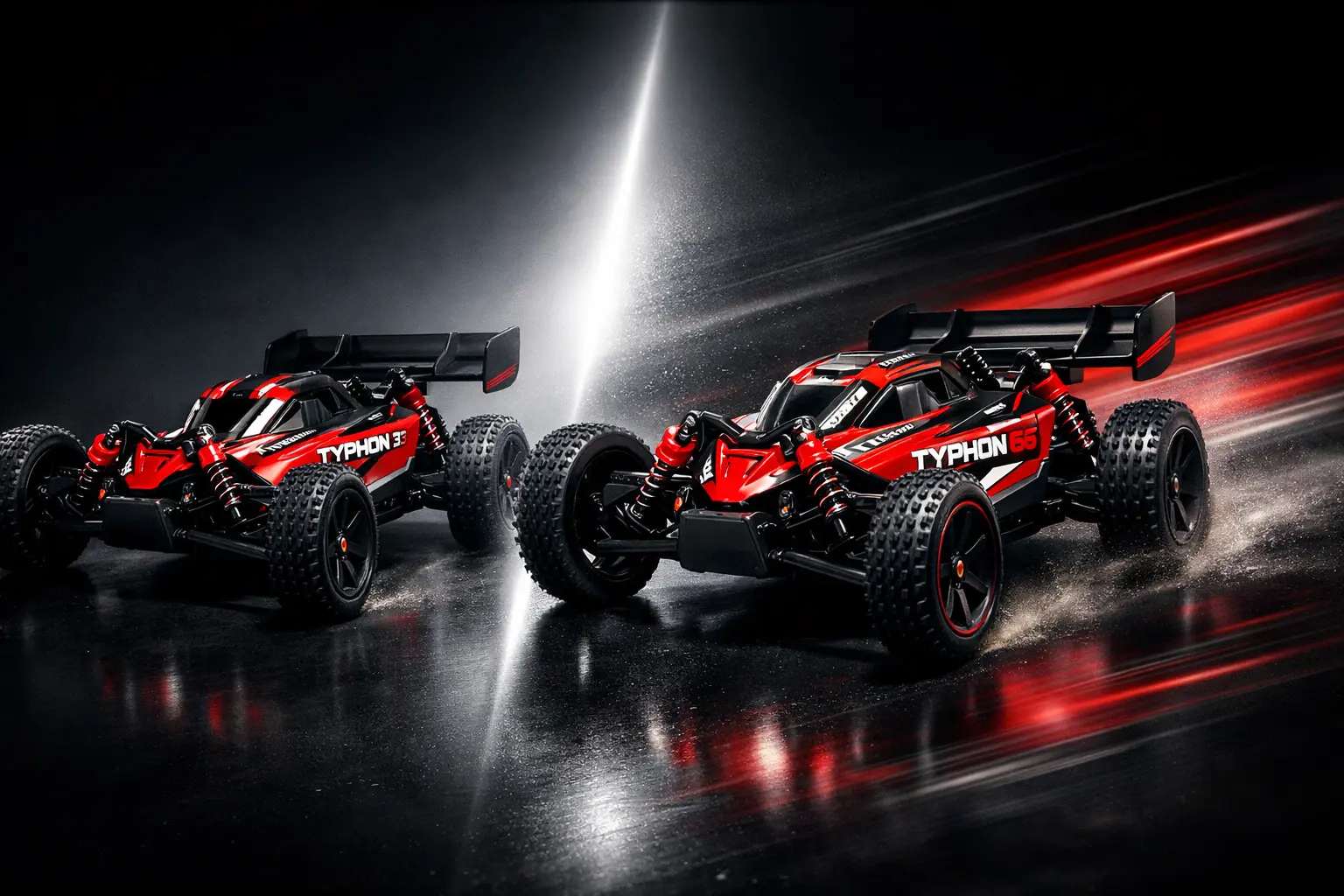
The Arrma Typhon is the best-selling 1/8 scale RTR buggy on the planet — and it comes in two versions that share a name, a silhouette, and almost nothing else. Picking the wrong one isn’t just a budget mistake; it’s a completely different bashing experience. Here’s everything you need to know to get it right.
This post contains affiliate links. If you make a purchase through these links, we may earn a commission at no extra cost to you.
Typhon 3S vs 6S — They’re NOT the Same Truck
This is the thing most comparison articles get wrong, and it costs people money. The Typhon 3S and Typhon 6S are not the same vehicle running on different batteries. They are distinct platforms — different chassis materials, different drivetrain architecture, different motor mounts, different shock hardware, different electronics packages, different structural philosophies. Swapping a 6S battery into a 3S won’t turn it into a 6S. It’ll let the magic smoke out.
The 3S (currently the refreshed Typhon 223S, model ARA4306V4) runs a composite chassis with a 3200Kv motor and an 80A integrated ESC/receiver. The 6S (V5, ARA8606V5) is built around a 3mm 6061-T6 anodized aluminum chassis, a 2050Kv motor, and a Smart-capable Firma 150A ESC. The 6S weighs nearly two pounds more — not because it’s bigger (both are true 1/8 scale with virtually identical footprints), but because aluminum and steel replaced composite and plastic throughout.
Choosing between them isn’t about voltage. It’s about what kind of basher you are, how much open space you have, and how often you’re willing to open your wallet for repairs.
Full Specs Comparison
Note on model lineup: The legacy Typhon 3S V3 (ARA4306V3) is discontinued. The current 3S is the Typhon 223S (ARA4306V4) at $369.99, which added a center differential, DSC stability control, clipless body mounting, and a new integrated ESC/receiver versus the old V3. Specs below reflect the current production models.
| Spec | Typhon 223S (3S) | Typhon 6S V5 |
|---|---|---|
| Model number | ARA4306V4 | ARA8606V5 |
| Scale | 1/8 | 1/8 |
| Motor | Spektrum 3100Kv brushless | Firma BLX4074 2050Kv brushless |
| ESC | Spektrum 80A (integrated ESC/Rx) | Firma Smart 150A |
| Radio | Spektrum SLT3 2.4GHz | Spektrum SLT3 2.4GHz |
| Receiver | 8010RX (integrated w/ gyro) | SR315 dual protocol |
| Smart telemetry | No | Yes |
| DSC stability control | Yes (4 modes) | No |
| Differentials | 3 (front/center/rear) | 3 (front/center/rear) |
| Center diff | Yes (new on 223S) | Yes |
| Chassis material | Composite | 3mm 6061-T6 aluminum |
| Shock body | Composite / plastic | 16mm aluminum bore |
| Shock towers | Composite | Anodized aluminum |
| Shock shafts | 3mm | 4mm |
| Servo | S662 | S652 (160 oz-in) |
| Battery connector | IC5 | IC5 |
| Battery voltage | 2S–3S LiPo | 4S–6S LiPo |
| Top speed (stock) | ~38–42 mph (stock pinion) | ~52–55 mph (stock pinion) |
| Top speed (optimized) | ~55–58 mph (upgraded pinion) | 60–65 mph (speed pinion installed) |
| Weight (no battery) | ~5 lbs 11 oz (2.58 kg) | ~7 lbs 9 oz (3.42 kg) |
| Length | 511mm / 20.12” | 510mm / 20.08” |
| Wheelbase | 328mm / 12.91” | 328mm / 12.91” |
| Width (rear) | 306mm / 12.05” | 310mm / 12.2” |
| Tires | dBoots 2-HO | dBoots Katar B |
| Body mounting | Clipless | Body clips |
| Colors | 4 options | Black or Red/Black |
| MSRP | $369.99 | $499.99 |
Key takeaways from the table: The 223S closed the center diff gap that made the old V3 look weak next to the 6S. The 6S still dominates on chassis construction, shock hardware, and maximum power. The 6S is physically the same size — but almost 2 lbs heavier, entirely from metal replacing plastic throughout the vehicle.
Check Typhon 223S (3S) on Amazon →
Check Typhon 6S V5 on Amazon →
Neither Typhon includes a battery — our LiPo battery guide helps you pick the right one and covers charger recommendations too.
Arrma Typhon 223S (3S) — Review
Performance on the Dirt
The Typhon 3S was my introduction to 1/8 scale, and the jump from a 1/10 Slash was eye-opening. The buggy stance, the way it eats rough terrain, the cornering grip on dirt — it’s a completely different animal. For $370, it punches way above its weight class.
On a 3S 5000mAh LiPo, stock gearing gets you around 38–42 mph, which sounds modest on paper but feels absolutely wild in a backyard or at a local park. Swap to a larger pinion (17T–20T — a $5–10 upgrade) and you’re pushing GPS-verified 55–58 mph. The lightness works in the buggy’s favor here: it rotates cleanly in corners, responds quickly to mid-air throttle corrections on jumps, and generally feels planted without being sluggish.
The new DSC stability control is a genuine addition, not marketing fluff. With DSC engaged, the buggy corrects oversteer automatically — useful for newer drivers at higher speeds. Four modes let you dial in how much intervention you want. It’s the kind of feature you don’t know you need until you’re bashing loose gravel at 50 mph.
Battery runtime on a 5000mAh 3S pack runs about 20–25 minutes of mixed bashing — longer than most 6S runs by a healthy margin, and Gens Ace 3S 5000mAh packs are available for $35–50 each.
Build Quality
The composite chassis is the honest weakness here. It handles normal bashing well, but cold-weather bashing or big landings can introduce flex or cracks that aluminum simply absorbs. The plastic-bodied shocks are functional but require more attention — they develop play over time and benefit from aluminum shock cap upgrades early on. The composite shock towers are the other known stress point under repeated hard landings.
Everything else impresses for the price. The transmission feels tight, the center diff (new on the 223S) transformed the power delivery compared to the old V3’s slipper-only setup, and the clipless body mounting is a legitimate quality-of-life upgrade over fumbling with body clips mid-session.
The Numbers
Strengths: Price-to-performance ratio, agility, low repair costs, DSC stability control, 4 color options, excellent for track racing, clipless body mount, 20–25 min runtime on 3S.
Weaknesses: Composite chassis limits long-term durability in heavy bashing, plastic-bodied shocks need attention, 3S ceiling limits top-end speed, no Smart telemetry.
Rating: 8.5/10 — An outstanding 1/8 buggy that dramatically overachieves at $370, particularly with the 223S upgrades. The ceiling is 3S, which is more than enough for most people.
Arrma Typhon 6S V5 — Review
Performance on the Dirt
A buddy brought his Typhon 6S to our usual bashing spot and I ran my 3S alongside it for an afternoon. In a straight line at moderate speed, the difference is real but not dramatic — both are fast and neither is slow. Where the 6S separates itself completely is in raw authority. Punch the throttle from a standstill and the 6S rotates, wheelies, and launches in a way the 3S can’t replicate. It has a personality. The 3S is a fast buggy. The 6S is a statement.
Running the stock 16T pinion on a 6S pack delivers around 52–55 mph. Install the 20T speed pinion (it ships in the box — just not factory-installed) and GPS-verified speeds land at 60–65 mph in normal conditions. The 70+ mph claim requires optimal conditions, a high-C battery, and smooth asphalt, but it’s achievable. What I noticed more than raw top speed was the mid-range power — the 6S pulls hard from 30 mph to 60 mph in a way that the 3S simply can’t.
The 4S-to-6S flexibility is underrated. Running a 4S pack on the 6S gives you roughly the same speed as the 3S on 3S, which makes it an excellent “learning mode.” One vehicle covers a broad experience range depending on the battery you reach for.
His repair bill after that bashing session was also twice mine. The 6S’s extra mass and power let it shrug off hits that would flip my 3S — but when it does have a catastrophic hit, the costs are proportional.
Build Quality — What’s Actually Better Than the 3S
The gap is substantial. The 3mm aluminum chassis is in a different league from the 3S composite. It absorbs impacts that would crack composite and doesn’t flex under sustained hard bashing. The 16mm aluminum-bore shocks with 4mm shafts are proper performance components — they stay consistent across temperature changes, resist leaking longer, and handle repeated heavy landings without complaint. Aluminum shock towers complete the picture.
Steel driveshafts, metal diff outdrives, captured ball ends that resist popping out — these are parts chosen for an 1/8 platform expected to run at 60 mph and survive. When an owner describes hitting a road reflector at 90+ mph, cartwheeling 30+ times, and only breaking a rear hub carrier, that’s the aluminum platform doing exactly what it was designed to do.
The Firma 150A Smart ESC adds telemetry capability — you can monitor voltage, current draw, temperature, and power consumption in real time through compatible Spektrum equipment. Not essential for casual bashing, but genuinely useful for understanding what’s happening inside your vehicle.
The Numbers
Strengths: Aluminum chassis and shock hardware, 4S–6S voltage flexibility, Smart telemetry, incredible acceleration and high-speed authority, survives catastrophic crashes better structurally.
Weaknesses: 6S LiPo packs cost $60–80+ each and require a capable charger, expensive to repair when catastrophic damage occurs, heavier weight makes jumps less forgiving, no DSC stability control, shorter runtime (~15–20 min on 6S), destroys tires quickly at full power.
Rating: 9/10 — The better long-term platform for serious bashers. The aluminum construction and 4S–6S flexibility justify the $130 premium for anyone planning to stay in the hobby.
Head-to-Head — Where Each Wins
| Category | Winner | Why |
|---|---|---|
| Top Speed | 6S | 60–65 mph vs 55–58 mph at equivalent effort |
| Handling / Agility | 3S | Lighter, faster direction changes, better cornering |
| Big Jumps | 6S | Mass + power lets it launch farther and shrug off harder landings |
| Parts Survival Rate | 3S | Less force on everything, DSC reduces crash severity |
| Repair Cost | 3S | Chassis ~$12, A-arms ~$8 vs 6S chassis ~$80+ |
| Fun Factor | Tie | Different kinds of fun — precision vs spectacle |
| Value for Money | 3S | Outstanding performance at $370 |
| Impressiveness | 6S | Full-throttle 6S from a standstill ends conversations |
| Battery Cost | 3S | 3S 5000mAh at $35–50 vs 6S 5000mAh at $60–80 |
| Beginner Friendly | 3S | DSC stability control, lower speeds, lower repair costs |
| Long-term Platform | 6S | Aluminum chassis, 4S–6S flexibility, Smart telemetry |
| Track Racing | 3S | Lighter, more agile; many tracks prohibit 6S |
| Structural Durability | 6S | Aluminum vs composite — not close |
The 3S wins more categories on this list. The 6S wins the ones that make your jaw drop. When forum veterans tell newcomers to buy the 6S, they’re prioritizing that last point — the visceral experience of a 2050Kv motor on a 6S pack is something the 3S can approximate but never fully replicate.
Who Should Buy the Typhon 223S (3S)?
- ✅ Your first 1/8 scale buggy — the 223S’s DSC stability control makes it genuinely approachable
- ✅ Total budget under $500 all-in (buggy + battery + charger)
- ✅ Stepping up from a 1/10 brushless truck and want to feel the difference immediately
- ✅ Bashing in backyards, parks, or tight spaces where 60 mph is irrelevant
- ✅ Interested in local track racing (many tracks cap at 3S / prohibit 6S)
- ✅ Want lower ongoing maintenance costs — parts are cheap, repairs are fast
- ✅ Multiple kids or drivers sharing the vehicle — DSC limits damage from ham-fisted throttle control
- ❌ Not the right call if: you have acres of open land and want to see how fast RC cars can actually go
- ❌ Not the right call if: you’re experienced with brushless RC and know 3S will feel mild within weeks
Want something smaller first? The Arrma Grom series is a great entry point before committing to 1/8 scale. If you prefer a short course truck body over a buggy, the Arrma Vorteks is another 3S option worth considering.
Who Should Buy the Typhon 6S V5?
- ✅ You’ve already run 3S brushless and want to feel the step up
- ✅ Budget of $650–750 all-in (buggy + two 6S packs + capable charger)
- ✅ Open spaces: fields, empty parking lots, long dirt roads
- ✅ You want one vehicle that can grow with your skills (run 4S first, add 6S later)
- ✅ Speed runs, big jumps, and bragging rights genuinely matter to you
- ✅ You want Smart telemetry and long-term platform support
- ✅ “Buy once, cry once” resonates with you — pay more now, less in regrets later
- ❌ Not right if: it’s your first brushless RC car and you have no experience with fast vehicles
- ❌ Not right if: tight budget — two quality 6S packs alone add $120–160 to your total
- ❌ Not right if: small bashing areas — 60+ mph in a backyard is a neighbor complaint and a broken fence waiting to happen
See our complete guide to Arrma RC cars for the full lineup including the Kraton, Notorious, and Talion.
Can You Upgrade a 3S Into a 6S?
No. The community has tried, documented the process exhaustively, and the verdict is unanimous: it doesn’t make financial or practical sense.
The 3S and 6S share the same name and roughly the same exterior dimensions. That’s where compatibility ends. Different chassis geometry, different motor mounts, different bulkhead dimensions, different shock towers, different drivetrain components — even if you transplanted the 6S electronics into the 3S chassis (people have done this for speed runs), you’re sitting on a composite chassis running 150A through components designed for 80A. It works until it doesn’t.
What you CAN upgrade on the 223S (3S):
A well-upgraded 3S becomes an excellent 3S. The ceiling doesn’t change, but the experience improves meaningfully with the right mods:
- Pinion gear upgrade (17T–20T): unlocks the 55+ mph potential — $5–10
- Aluminum shock caps: prevents the most common failure point — $15–25
- Budget servo upgrade (DS3225 or similar): fixes the centering inconsistency — $15–30
- Hot Racing aluminum steering components: eliminates slop in the front end — $25–35
- Bearing kit: always do this first — $12–18
The cost math: Typhon 223S at $370 + $100 in upgrades = $470 for an excellent 3S platform on a composite chassis with 3S electronics. Typhon 6S at $500 = aluminum chassis, aluminum shocks, 150A Smart ESC, 4S–6S flexibility, metal driveshafts, and a 65+ mph ceiling out of the box. For $30 more than the upgraded 3S, you get a fundamentally superior platform.
The 3S with upgrades becomes a fantastic 3S. It doesn’t become a 6S.
Typhon vs the Competition
| Model | Brand | Scale | Power System | Price | Best For |
|---|---|---|---|---|---|
| Typhon 223S | Arrma | 1/8 | 3S brushless | ~$370 | Beginners, track racing, tight spaces |
| Typhon 6S V5 | Arrma | 1/8 | 4S–6S brushless | ~$500 | Experienced bashers, speed, open terrain |
| Traxxas Slash 4x4 VXL | Traxxas | 1/10 | 3S brushless | ~$390–430 | Parts availability, Traxxas ecosystem |
| Traxxas Rustler 4x4 VXL | Traxxas | 1/10 | 3S brushless | ~$380–400 | Grass bashing, self-righting needed |
| Traxxas E-Revo 2.0 | Traxxas | 1/10* | 6S brushless | ~$630+ | Monster truck bashing, self-righting |
| Arrma Senton 3S | Arrma | 1/8 | 3S brushless | ~$300–370 | Same as Typhon 3S, short course body style |
| Arrma Kraton 6S | Arrma | 1/8 | 4S–6S brushless | ~$480–550 | Monster truck form factor, max air time |
*The E-Revo labels itself 1/10 but is physically larger than most 1/8 vehicles at 11.2 lbs.
The Typhon’s competitive advantage is unique: there is no other mainstream 1/8 RTR buggy at this price point. Every competitor here is either a truck, a monster truck, or a different size class. If the low-slung buggy stance with a proper diffuser, aggressive A-arm geometry, and proper racing body lines matters to you — and it should, because it affects handling meaningfully — the Typhon is essentially your only option under $600 in RTR form.
Best Upgrades for the Arrma Typhon (3S & 6S)
Upgrades for the Typhon 223S (3S)
1. Bearing kit — do this first, always.
The stock bushings develop slop quickly. A full Arrma Typhon bearing kit runs $12–18 and makes an immediate, noticeable difference in drivetrain smoothness. This applies to the 6S too. Install it within the first few packs.
2. Aluminum shock caps
The number one early failure on the 3S platform. Aluminum shock caps at $15–25 prevent the frustrating mid-session rebuild when a plastic cap cracks on a hard landing.
3. Budget servo upgrade
The DS3225 at around $15 resolves the steering inconsistency issues documented across dozens of forum threads. More responsive, better centering, and more resistant to stripping under hard impacts.
4. Pinion gear upgrade
A 17T or 20T pinion (verify compatibility with your motor shaft) unlocks the speed that the stock 3S motor is fully capable of delivering. Monitor motor temperatures with an infrared thermometer for the first few runs — a quick touch test works in a pinch. Pairs well with a Gens Ace 3S 5000mAh pack for best results.
Upgrades for the Typhon 6S V5
1. Install the speed pinion (it’s already in the box)
This isn’t a purchase — the 20T speed pinion ships inside the box but isn’t factory-installed. Swap it in before your first run. It’s the difference between 52 mph and 62 mph for free.
2. Bearing kit
Same advice as the 3S. An Arrma Typhon bearing kit runs $12–18 and is the first thing to install.
3. Diff fluid tuning
The most impactful performance upgrade that costs almost nothing if you buy fluid in bulk. Community-proven weights: 60,000 cSt front diff, 100,000 cSt center diff, 20,000 cSt rear diff. Eliminates excessive wheelies, dramatically improves corner stability, and makes the power actually usable on loose surfaces.
4. Servo upgrade
The stock servo is adequate, but at 150A of available power, the steering system is the limiting factor in aggressive driving. ProTek RC 350T or Reefs RC servos are popular choices. Pair with an aluminum servo mount to handle the increased forces.
A Gens Ace 6S 5000mAh pack in the $60–80 range is the recommended battery to pair with the 6S stock — pick up two for a full session.
FAQ
Q: How fast is the Arrma Typhon 3S?
On stock gearing (15T pinion) with a quality 3S 5000mAh LiPo, expect GPS-verified speeds of 38–42 mph. Swap to a 17T–20T pinion and you’re looking at 55–58 mph. Arrma’s “50+ mph” marketing claim is achievable with modest gearing changes and a high-C battery, but not out of the box at stock settings.
Q: How fast is the Arrma Typhon 6S?
Stock gearing (16T pinion) on a 6S pack delivers 52–55 mph. Install the included 20T speed pinion and expect 60–65 mph in normal bashing conditions. The 70+ mph claim in Arrma’s marketing requires a high-C 6S pack, the speed pinion, smooth asphalt, and optimal conditions — achievable, but not your everyday bashing speed.
Q: Can I run 6S batteries in the Typhon 3S?
No. The Typhon 3S supports a maximum of 3S (11.1V). Running 6S (22.2V) through the 3S’s 80A ESC and 3100Kv motor will destroy your electronics immediately. They are separate platforms with separate electronics packages designed for their respective voltage ranges.
Q: Is the Arrma Typhon 3S good for beginners?
Yes — especially the current Typhon 223S, which added DSC Dynamic Stability Control with four selectable modes. DSC automatically corrects oversteer and can be set to limit throttle response, making the 223S genuinely approachable for new drivers. The 3S ceiling also means mistakes are less catastrophic and repairs are less expensive. It’s the recommended entry point into 1/8 scale brushless RC.
Q: Arrma Typhon vs Traxxas Slash — which is better?
They’re different vehicles for different purposes. The Traxxas Slash 4x4 VXL is a 1/10 short course truck with Traxxas’s unmatched dealer network and TSM stability management. If parts availability from a local hobby shop is critical, Traxxas wins. If you want more scale (1/8), proper buggy handling, and more raw performance at the same price, the Typhon wins. Head-to-head on dirt with experienced drivers, the Typhon 6S is in a different performance bracket than the Slash 4x4 VXL.
Conclusion
The verdict is clear. If someone asked me right now “which one should I get?” — I’d ask one question: how often do you want to replace parts, and how much open space do you have?
First 1/8 scale car, limited space, or budget under $500 all-in → Typhon 223S (3S), no hesitation. The center diff, DSC stability control, and clipless body make the 223S the best 3S Typhon ever made, at a price that leaves room for batteries and a charger.
Experienced with brushless RC, open terrain, and willing to spend $650+ all-in → Typhon 6S V5, without looking back. The aluminum chassis, 4S–6S flexibility, and Smart-capable electronics are worth the premium. You’ll know within five minutes that you made the right call.
Whatever you buy, install the bearing kit first. Trust the process.
→ See our complete guide to Arrma RC cars for the full lineup breakdown.