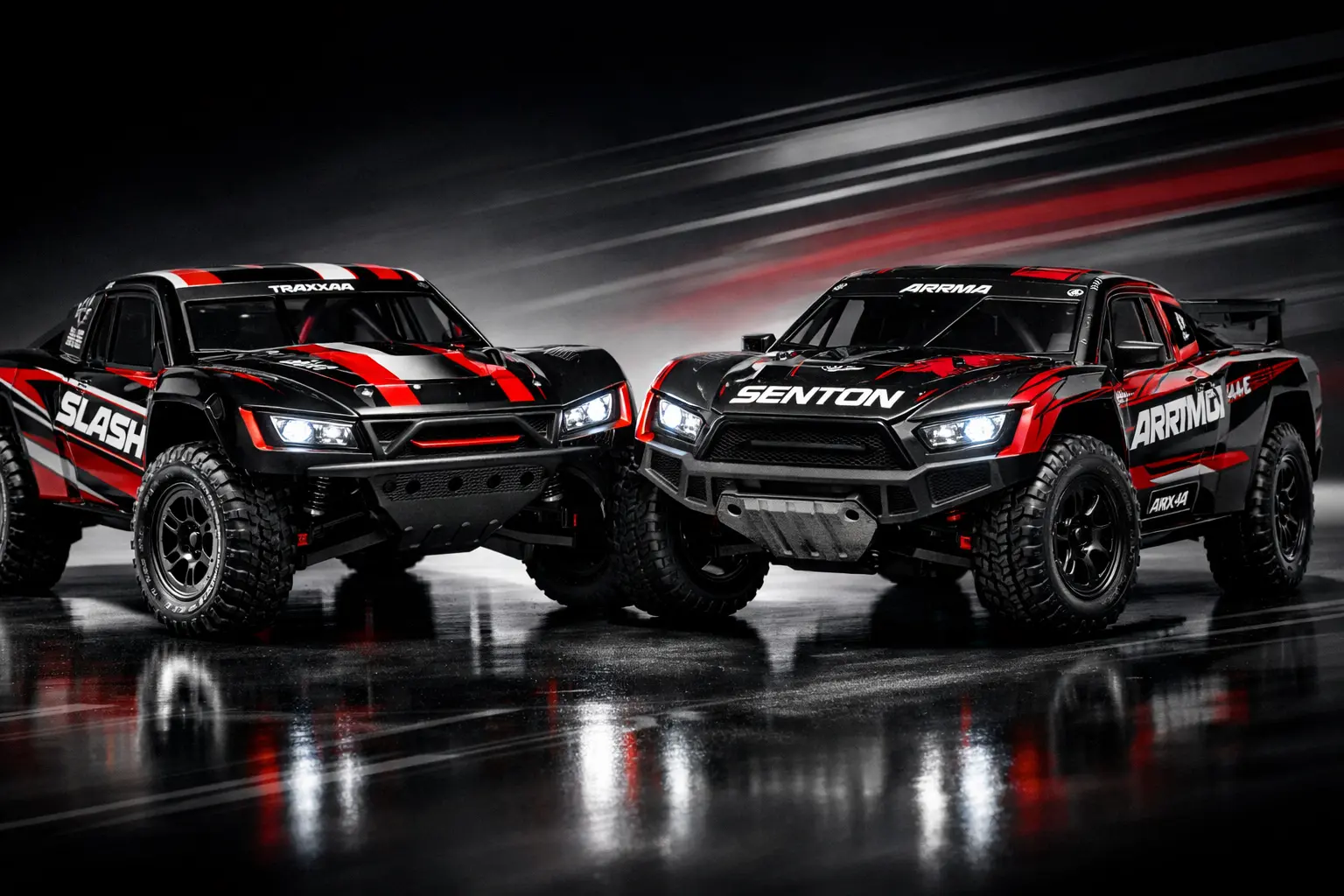
The Traxxas Slash and the Arrma Senton are the two short course trucks you’ll see recommended everywhere — every “what should I buy” thread on Reddit, every hobby shop counter conversation, every YouTube buying guide. Two trucks. Same category. Completely different philosophies. If you’re trying to pick between them, this breakdown covers every angle: speed, durability, parts, racing, value, and who should actually buy which.
This post contains affiliate links. If you make a purchase through these links, we may earn a commission at no extra cost to you.
Quick Verdict — Slash or Senton?
Before we get into the detail, here’s where each truck wins:
| Category | Winner | Why |
|---|---|---|
| Top Speed | Slash | Higher-Kv motor, can gear for 60+ mph on 3S |
| Handling & Stability | Senton (bashing) / Slash (racing) | Senton wider and heavier; Slash more agile |
| Out-of-Box Durability | Senton | 1/8-scale drivetrain components, heavier build |
| Parts Availability | Slash | 500+ OEM parts, found at Walmart and any LHS |
| Aftermarket & Upgrades | Slash | Largest RC aftermarket on the planet |
| Value for Money | Senton | Tougher truck, ~$20 cheaper, fewer required upgrades |
| Beginner Friendly | Slash 2WD | Battery + charger included, Training Mode, TSM |
| Racing | Slash | Active Spec Slash classes at tracks nationwide |
| Pure Bashing | Senton | Takes more punishment before breaking |
Both are excellent. Neither will disappoint you. Here’s why each earns its reputation.
Which Versions Are We Comparing?
Both brands make multiple versions across different price points and drivetrain configurations. Getting this clear up front matters.
Traxxas Slash — current lineup:
| Model | Drive | Power System | MSRP | Best For |
|---|---|---|---|---|
| Slash 2WD XL-5 HD | 2WD | Titan 12T brushed / XL-5 | $259.95 | Beginners, families, racing |
| Slash 2WD BL-2s | 2WD | 3300Kv brushless / BL-2s | ~$249.95 | Budget brushless entry |
| Slash 2WD VXL HD | 2WD | Velineon 3500Kv / VXL-3s + TSM | $379.95 | Speed, racing, light bashing |
| Slash 4X4 VXL HD | 4WD | Velineon 3500Kv / VXL-3s + TSM | $399.95 | All-terrain, serious bashing |
| Slash 4X4 Ultimate | 4WD | Velineon 3500Kv / VXL-3s + TSM | $539.95 | Full aluminum, race-ready |
The Slash 2WD XL-5 is the only model that includes a battery and charger. Every other Slash ships without a power source — budget accordingly.
Arrma Senton — current lineup:
| Model | Drive | Power System | MSRP | Best For |
|---|---|---|---|---|
| Senton 4X2 BOOST (w/ battery) | 2WD | 550 MEGA brushed | ~$199.99 | Budget beginners |
| Senton 4X2 BOOST | 2WD | 550 MEGA brushed | ~$179.99 | Tightest budgets |
| Senton 223S DSC V4 | 4WD | Spektrum 3100Kv BLX / DSC | $379.99 | Bashers, 3S all-terrain |
The older Senton 4X4 3S BLX V3 (ARA4303V3, ~$329.99) is still findable at some dealers but is being phased out. The V4 “223S DSC” is the current flagship and what most people are now choosing. No Senton 6S exists — that platform was discontinued. There’s no Senton 4X4 Mega in current production either, though some NOS units still show up online.
For this comparison, we’re primarily matching the Slash 4X4 VXL HD ($399.95) against the Senton 223S DSC V4 ($379.99). These are the trucks most buyers are choosing between. Where relevant, we’ll call out the 2WD Slash comparison for budget or beginner shoppers.
Full Specs: Slash 4X4 VXL vs Senton 223S DSC
| Spec | Traxxas Slash 4X4 VXL HD | Arrma Senton 223S DSC V4 |
|---|---|---|
| Scale | 1/10 | 1/10 |
| Price | $399.95 | $379.99 |
| Motor | Velineon 3500Kv brushless | Spektrum 3100Kv brushless |
| ESC | VXL-3s (~100A, waterproof) | SLT 80A 2-in-1 (waterproof) |
| Radio System | TQi 2.4GHz (2-ch, 30-model memory) | Spektrum SLT3 2.4GHz (3-ch) |
| Stability Control | TSM (dial-adjustable 0–100%) | DSC (4 preset modes) |
| Drive | Shaft-driven 4WD | Shaft-driven 4WD |
| Differentials | Front + rear (no center) | Front + center + rear |
| Top Speed (3S) | 60+ mph (optional gearing) | 50+ mph |
| Top Speed (2S, typical) | 35–45 mph | 35+ mph |
| Weight (no battery) | 5.31 lbs (2.41 kg) | ~6.06 lbs (2.75 kg) |
| Wheelbase | 12.75” (324mm) | 12.87” (327mm) |
| Length | 22.36” (568mm) | 21.97” (558mm) |
| Width | 11.65” (296mm) | 12.01” (305mm) |
| Battery Included | ❌ (iD connector, 2S/3S LiPo) | ❌ (IC5 connector, 2S/3S LiPo) |
| Waterproof | Yes | Yes |
| Clipless Body | ✅ | ✅ |
| Telemetry Capable | Yes (optional wireless module) | No |
| Warranty | Traxxas Lifetime Electronics | Arrma 1-year limited |
A few things jump out immediately. The Slash has a higher-Kv motor and a slightly more powerful ESC, which explains the speed advantage. The Senton’s center differential (the key V4 upgrade over the V3) improves power distribution across all four wheels, especially on loose surfaces. The Senton is also roughly 12 ounces heavier — not a flaw, just the price of beefier internals. Battery connectors differ between brands (Traxxas iD vs Arrma IC5), so batteries aren’t cross-compatible without adapters. Factor that in if you’re already invested in one ecosystem.
Head-to-Head — Category by Category
Speed & Acceleration
Winner: Slash
On paper and in practice, the Slash 4X4 VXL is the faster truck. The Velineon 3500Kv motor paired with the VXL-3s ESC and Traxxas’s optional high-speed gearing delivers 60+ mph on 3S — though honestly, most people run 2S on a baseball field and see a very usable 35–45 mph. The Senton 223S tops out around 50+ mph on 3S with stock gearing, which is entirely fast enough to terrify anyone watching.
Acceleration is where the Senton’s extra weight works slightly against it. The Slash feels snappier off the line — partly the higher-Kv motor, partly the 12-ounce weight difference. If you’re drag-racing down a cul-de-sac, the Slash wins. If you’re blasting across a field on mixed terrain, the gap narrows considerably because the Senton stays planted where the Slash can get squirrely.
If top speed is a priority, the Slash VXL 4X4 is the clear choice. Not sure about brushed vs brushless? We break it down here.
Handling & Stability
Winner: Depends — Senton for bashing, Slash for racing
I’ve run both of these back-to-back on the same loose dirt track with a few jumps and some rutted sections. The Slash felt more nimble and playful — you can throw it around, flick it sideways, and it responds immediately. The Senton felt more deliberately planted, like it wanted to be pointed at something and hammered full throttle in a straight line. Neither is “better.” They just have different personalities. The Slash wants to be thrown around; the Senton wants to be aimed and launched.
The width difference matters more than the numbers suggest. The Senton’s 12-inch width versus the Slash’s 11.65 inches gives it a wider stance that noticeably reduces tip-over tendency at speed. Combined with the extra mass, it sits lower in corners and resists oversteer more naturally. The center differential on the V4 also smooths out traction on gravel and loose dirt.
Both trucks now have electronic stability systems — Traxxas TSM on the Slash, Arrma’s new DSC on the Senton V4. TSM has been in production for nearly a decade and is genuinely excellent, offering smooth, continuously variable adjustment via a dial on the TQi transmitter. DSC arrived with the V4 and uses four preset modes. Early community feedback is positive but suggests DSC isn’t quite as refined as TSM’s granular control yet. On jumping behavior, both trucks land flat and predictably — the Senton’s extra weight keeps it more stable in the air, while the Slash can rotate more on asymmetric landings, which is fun until it isn’t.
Durability & Build Quality
Winner: Senton
This is the Senton’s biggest selling point and the one that surprises most first-time buyers. Arrma designed the Senton’s drivetrain around components from their 1/8-scale platform — larger diffs, thicker driveshafts, beefier suspension geometry — packed into a 1/10-scale body. It’s deliberately overbuilt for its class, and it shows.
I’ve owned more Traxxas Slash trucks than I care to admit. My first was a brushed 2WD that I ran for two years straight — crashed it into everything imaginable, broke plenty of A-arms, bent more driveshafts than I can count. The Slash takes punishment, but it does need help getting there. Within the first month of running a brushless Slash hard, experienced hobbyists routinely replace the caster blocks with aluminum units ($18), swap the A-arms for RPM parts ($11/pair), and upgrade the driveshafts to HD Traxxas or MIP X-Duty units (~$10–45/pair). That’s $40–80 in defensive upgrades before you’re really confident in the truck.
The Senton surprised me when I first got one. I expected a solid truck, but the thing genuinely resists breaking. The most common Senton failure points are the stock Spektrum servo (swap it for a $30–45 aftermarket unit and it’s permanently fixed), the front lower A-arms (RPM replacements available), and the stock dBoots tires (they shred on 3S power; replace with Pro-Line Trenchers or Badlands at ~$35). That’s often it for months of hard bashing.
Both trucks are waterproof in the “survive a puddle and light rain” sense. Neither ships with a formal IP rating.
Parts Availability
Winner: Slash — and it’s not close
If you’ve read anything about Traxxas, you’ve heard this. The Slash has been in continuous production since 2008, and Traxxas catalogs over 500 OEM replacement parts for it. That number explodes when you add RPM, Pro-Line, Hot Racing, JConcepts, MIP, Tekno, STRC, Castle Creations, and Robinson Racing to the equation — easily 1,000+ unique SKUs from third parties alone. Walk into virtually any hobby shop in North America and you’ll find a section of Slash parts. They sell them at Walmart. Amazon returns 37+ pages of results. You can break something at 2 PM and be running again by dinner.
Arrma parts are available, primarily through AMain Hobbies and Amazon, but local hobby shop shelf presence isn’t comparable. Arrma lists roughly 70 OEM parts for the Senton, and finding them same-day at a random hobby shop is a gamble in many areas. The Arrma forum community strongly recommends keeping a small parts stash on hand — lower A-arms and spare servo horns especially — precisely because next-day ordering isn’t always an option. It’s not a dealbreaker, but it changes how you think about repairs.
Aftermarket & Upgrade Ecosystem
Winner: Slash — by a country mile
The Slash is the Honda Civic of RC trucks. It’s not always the fastest or cheapest, but every tuner on the planet makes parts for it. RPM Racing makes dozens of Slash components in multiple colors with their famous lifetime breakage warranty. Pro-Line bodies for the Slash number in the dozens — Ford F-150s, Baja Bugs, Silverados, desert trucks, dirt oval racing shells from JConcepts. Hot Racing sells full aluminum conversion kits. Brushless conversion kits, LCG chassis conversions, 4WD upgrade kits for 2WD trucks — you can build literally anything out of a Slash platform. The upgrade path never ends, and the community has explored every inch of it.
The Senton’s aftermarket has grown meaningfully, especially since it shares its 3S platform architecture with the Granite, Big Rock, and Typhon. RPM A-arms are available, Hot Racing covers aluminum upgrades, Pro-Line makes compatible Bash Armor. But in raw volume, depth, and creative community modding, the Senton trails the Slash by a substantial margin.
Racing Potential
Winner: Slash — no contest
This one is simple. Spec Slash classes exist at hobby tracks nationwide and remain active. Coastal RC Speedway published updated Spec Slash rules in January 2025. ROCCK Racing runs dedicated Slash classes. Traxxas publishes an official Slash Spec Racing Setup Guide. The format — everyone on a stock Slash 2WD with the Titan 12T motor and Traxxas tires — is a uniquely accessible gateway to competitive RC racing for casual hobbyists who don’t want to buy a purpose-built race buggy. Even Arrma forum members buy Slashes specifically to participate.
The Senton has zero dedicated racing presence. No track runs a Spec Senton class. Its 1/8-scale-derived weight is uncompetitive against purpose-built 1/10 SCTs, and most spec racing mandates 2S LiPo where the Senton was optimized for 3S. It was designed as a basher and excels at that role — but if there’s any chance you’ll want to line up at a track someday, only one of these trucks gives you that option. If you’re also considering a stadium truck for racing, check our Traxxas Rustler comparison as well.
Value for Money
Winner: Senton (slight edge)
At comparable price points — $399.95 for the Slash 4X4 VXL vs $379.99 for the Senton 223S — the Senton delivers more durable hardware out of the box. You spend less on defensive upgrades in year one, and the included center differential and DSC system are features you’d pay extra to add to a Slash.
A realistic year-one cost breakdown:
| Cost Item | Slash 4X4 VXL HD | Senton 223S DSC V4 |
|---|---|---|
| Truck | $399.95 | $379.99 |
| 3S LiPo battery | ~$50 | ~$50 |
| Balance charger | ~$50 | ~$50 |
| Defensive upgrades (RPM arms, HD shafts for Slash; servo + tires for Senton) | ~$70–100 | ~$60–80 |
| Crash repairs over the year | ~$40–60 | ~$30–50 |
| Estimated year-one total | ~$610–660 | ~$570–610 |
The Senton saves you roughly $30–80 over a full year, mostly because its beefier stock components don’t demand as many immediate replacements. A quality 3S LiPo is the first purchase regardless of which truck you choose.
Beginner Friendliness
Winner: Slash 2WD (with caveats)
For a true beginner or a family buying a first RC, the Slash 2WD XL-5 HD ($259.95) is the more thoughtful recommendation. It’s the only option in this comparison that includes a battery and charger — you can genuinely unbox it and be driving within 30 minutes. The Titan 12T motor keeps top speed at a manageable 30 mph on the included NiMH, the Training Mode limits throttle for young drivers, and TSM is standard on higher-tier models.
The Slash ecosystem also matters for beginners who don’t yet know how to source parts: when something breaks, and something always breaks, the ability to find a replacement at a local hobby shop or even Walmart is enormously valuable. You’re not waiting 5 days for an online order.
That said, the Senton BOOST (battery-included version, ~$200) is a legitimate beginner option for families on a tighter budget. The 2WD brushed BOOST is calmer than any 3S brushless truck and comes complete. New to RC altogether? Our beginner’s guide walks through all the basics before you buy.
The Slash Advantage — Why People Keep Coming Back
I’ve owned multiple Slashes over the years, and the reason I keep coming back to the platform isn’t pure loyalty. It’s the ecosystem. When you own a Slash, you’re not just owning a truck — you’re buying into the most extensively supported RC vehicle ever made. Every time a part breaks, there are three different companies making a stronger replacement. Every time you want a new look, there are dozens of licensed body options. Every time you get curious about racing, there’s a class for that.
The Slash debuted in 2008 and essentially created the short course truck category. Seventeen years and multiple major updates later, it still sells in enormous numbers because Traxxas keeps refining it and the aftermarket keeps growing around it. The EHD (Extreme Heavy Duty) upgrades now standard across the lineup address many of the weak-point complaints that dogged earlier versions. It’s not a truck you’ll outgrow — it’s a platform you can build for years.
“The Slash is the Honda Civic of RC trucks. It’s not the fastest, it’s not the cheapest, but there’s a reason everyone trusts it.”
The Senton Advantage — Why It’s Gaining Ground
The Senton 223S V4 earns its reputation the honest way: by being overbuilt, underpriced, and willing to absorb crashes that send Slash owners to the parts bin. The move to a three-differential drivetrain in the V4 generation was significant — center diffs are common on higher-end platforms but rare on $380 SCTs — and DSC finally answers the stability-control advantage that TSM gave the Slash for years.
Arrma’s growing reputation is real and community-driven. RC veterans who can see past brand familiarity often reach for the Senton specifically because the drivetrain is simply beefier at this price point. It’s not a truck that needs apologizing for. For a deeper dive into the hardware, read our full Arrma Senton 3S review.
“The Senton doesn’t have the Slash’s legacy, but it doesn’t need it. It earns trust on its own merits.”
Who Should Buy Which?
| If You… | Get the… | Because… |
|---|---|---|
| Want the safest, most supported choice | Slash 4X4 VXL | Parts everywhere, massive community, proven 17-year track record |
| Want the best durability per dollar | Senton 223S V4 | Overbuilt drivetrain, fewer required upgrades out of the box |
| Plan to race at a local track | Slash 2WD XL-5 | Spec Slash classes exist nationwide; no equivalent for Senton |
| Want pure bashing with minimal wrenching | Senton 223S V4 | Breaks less often, center diff for rough terrain |
| Are a total beginner or buying for a kid | Slash 2WD XL-5 | Battery + charger included, Training Mode, TSM, LHS support |
| Want maximum upgrade options | Slash 4X4 VXL | 1,000+ aftermarket parts, limitless customization |
| Want a modern, fully-featured platform | Senton 223S V4 | Center diff + DSC + wider stance = more capable basher |
| Have kids who will crash it constantly | Senton 223S V4 | Takes harder hits before breaking; fewer mid-session repairs |
| Have the tightest possible budget | Senton BOOST (~$180–200) | Cheapest entry to hobby-grade SCT territory |
| Want everything and budget is no concern | Slash 4X4 Ultimate ($540) | Aluminum shocks, LCG chassis, aluminum suspension, telemetry |
FAQ
Q: Is the Traxxas Slash or Arrma Senton better for beginners?
For most beginners, the Traxxas Slash 2WD XL-5 HD is the more practical starting point. It’s the only option that ships with a battery and charger (genuinely ready to run for ~$260), offers Training Mode to limit throttle for inexperienced drivers, and gives you access to the most well-stocked parts network in the hobby. If budget is tighter, the Arrma Senton BOOST at ~$180–200 (battery-included version) is a legitimate alternative — it’s calmer than any 3S truck and includes everything you need. What you give up is the Slash’s unmatched local parts availability.
Q: Which is faster — the Slash VXL or the Senton 3S?
The Slash 4X4 VXL is faster. Its Velineon 3500Kv motor paired with the VXL-3s ESC and optional high-speed gearing can hit 60+ mph on 3S LiPo. The Senton 223S tops out around 50+ mph on 3S with stock gearing. On a typical 2S setup — which is how most people actually run — both trucks sit in the 35–45 mph range and the difference is less pronounced. The Slash wins on outright top speed; the Senton wins on stability at any speed.
Q: Is the Traxxas Slash still worth it in 2026?
Yes, without question. Recent updates added factory Extreme Heavy Duty (EHD) components across the lineup, addressing the historic weak points. At $399.95 for the 4X4 VXL HD, it’s competitively priced against the Senton V4, and the aftermarket ecosystem, racing availability, and local parts support remain unmatched by any competitor. The Slash isn’t the newest design in the segment, but it’s the most comprehensively supported.
Q: Can you race an Arrma Senton?
Technically yes, but practically no. No track runs a dedicated Senton racing class. The Senton’s 1/8-scale-derived drivetrain and heavier weight make it uncompetitive against purpose-built 1/10 SCT race platforms. Most spec SC racing mandates 2S LiPo power, while the Senton is tuned for 3S. If any part of your plan involves lining up at a local track, get the Slash 2WD — active Spec Slash classes run at tracks nationwide.
Q: Traxxas Slash 2WD or 4X4 — which should I get?
For beginners and racers: the 2WD. It’s cheaper ($259.95 including battery), lighter, more forgiving for learning, and is the only format with active racing classes. For bashers and experienced hobbyists: the 4X4 VXL HD ($399.95). Four-wheel drive handles rougher terrain, corners more predictably at speed, and distributes power more evenly. If you’re torn, consider what surfaces you’ll mostly run on — pavement and parking lots favor 2WD’s lighter, snappier character; grass, gravel, and mixed terrain favor 4WD traction. Not sure? Our beginner’s guide walks through the 2WD vs 4WD decision in more detail.
Conclusion
The Slash and the Senton are both excellent trucks. There is no wrong choice here — just different priorities. The Slash is the safe pick for ecosystem, racing, local support, and maximum upgrade potential. It’s been the definitive short course truck for 17 years for good reason. The Senton is the smarter pick for pure bashing durability, slightly better out-of-box value, and a modern platform that takes a hit and keeps going. You won’t regret either one.
Check current pricing and availability:
- 🔗 Traxxas Slash 4X4 VXL HD on Amazon — ~$399.95
- 🔗 Arrma Senton 223S DSC V4 on Amazon — ~$379.99
- 🔗 Traxxas Slash 2WD XL-5 HD on Amazon (battery included) — ~$259.95