The Arrma Vorteks 3S BLX is the sleeper of the Arrma lineup. While everyone argues about the Typhon vs. the Granite, the Vorteks quietly delivers the best balance of speed, handling, and durability in the entire 3S range — and it does it for the same money. This is the full review: specs, real-world driving impressions, known issues, upgrade recommendations, and a head-to-head against every other Arrma 3S truck. If you’ve been sleeping on the Vorteks, this is your wake-up call.
This post contains affiliate links. If you make a purchase through these links, we may earn a commission at no extra cost to you.
Arrma Vorteks 3S BLX — Specs & What’s in the Box
The Vorteks is a 1/10-scale 4WD stadium truck built on Arrma’s modular 3S 4X4 chassis — the same platform shared across the Granite, Senton, and Typhon. What sets it apart is the aggressive gearing and premium electronics package that push it to the top of the lineup for outright speed.
| Spec | Detail |
|---|---|
| Scale | 1/10 |
| Type | Stadium Truck (4WD) |
| Motor | Spektrum Firma 3660, 3200Kv brushless |
| ESC | Spektrum Firma 100A Smart Waterproof, 3S |
| Radio | Spektrum DX3 Smart DSMR transmitter + SR6200A AVC receiver |
| Drivetrain | 4WD, mid-motor, shaft drive |
| Differentials | Front & rear metal gear diffs, slipper clutch center |
| Shocks | Oil-filled coil-over, composite bodies |
| Chassis | Molded composite tub |
| Wheelbase | 287mm (11.3”) |
| Dimensions (L × W × H) | 470 × 338 × 163mm |
| Weight | ~2.95 kg (without battery) |
| Ground Clearance | 40mm |
| Top Speed | 50–55 mph stock (3S LiPo); 60+ mph with included 20T pinion |
| Price | ~$280–$380 RTR |
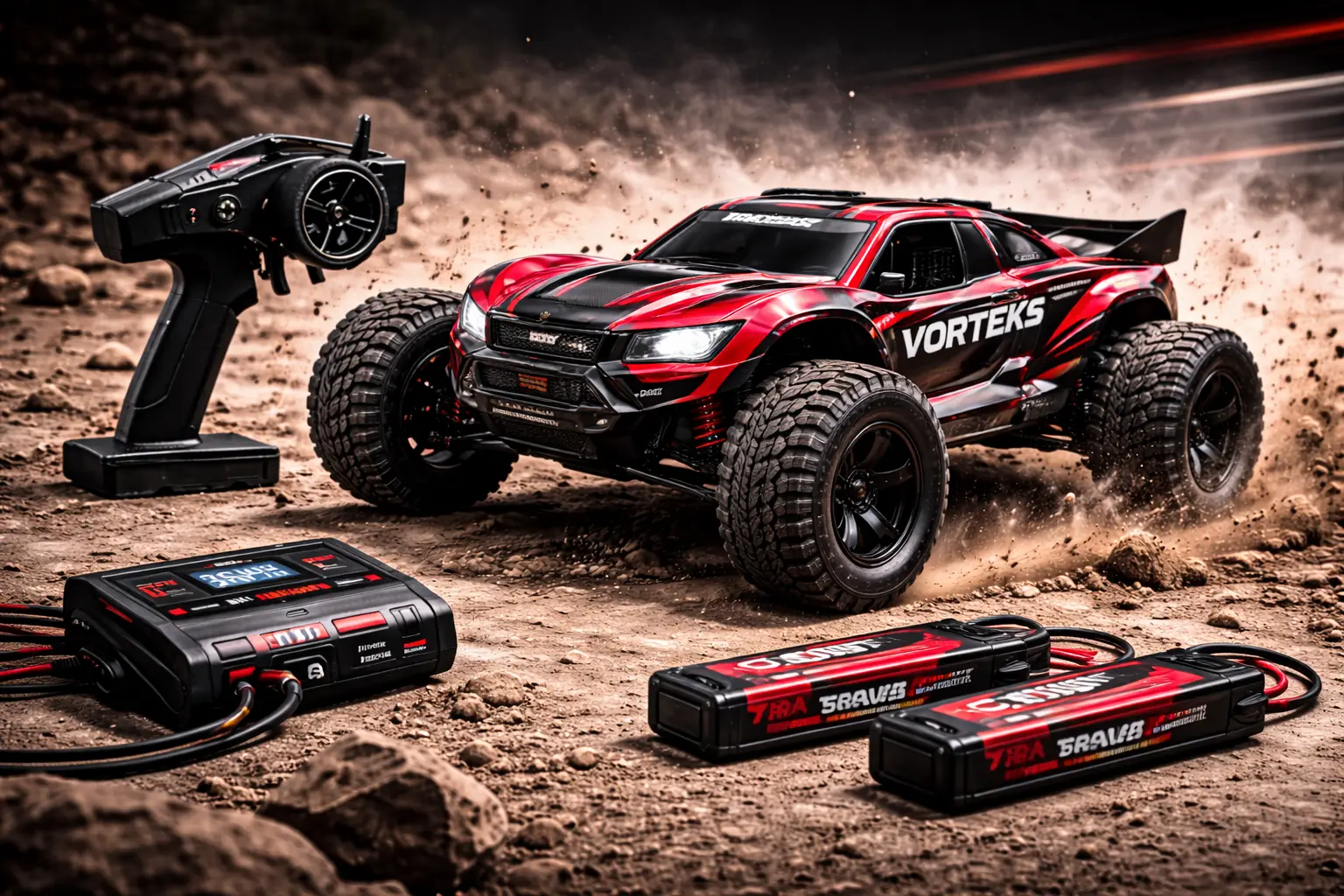
What’s in the box: fully assembled truck, Spektrum DX3 Smart transmitter, 20T speed pinion (bonus gear for extra velocity), multi-tool, hex wrenches, and manual. No battery, no charger, no AA batteries for the transmitter.
What you’ll need: a 3S LiPo battery with IC5/EC5 connector ($30–$50) and a compatible balance charger ($35–$70). Budget an extra $60–$100 on top of the truck price. Need help choosing the right charger? Our charger guide has you covered. The Firma brushless system is a full step up from basic brushed motors — expect serious power from the first run.
Check Price on Amazon | Available at Horizon Hobby
Driving Experience — What the Vorteks Is Actually Like
Speed
The Vorteks 3S is stupid fast for a stadium truck. I’ve clocked mine at just over 53 mph with a radar gun on flat pavement with the stock 18T pinion — and that was with a pack that wasn’t even fully charged at the start of the run. Swap to the included 20T speed pinion and owners consistently hit 58–62 mph on 3S, which is faster than most people expect from a bashing truck in this price range. On dirt and grass, realistic speeds are more like 35–40 mph, which is still more than enough to clear jumps and genuinely send it.
The brushless Firma 3660 3200Kv motor pulls hard from a standstill and keeps pulling through the mid-range. There’s no lag, no hesitation. On 2S, the Vorteks calms down to around 30–35 mph, which is actually a great mode for beginners learning throttle control before stepping up to the full 3S experience.
One thing to know: at 60 mph with the 20T pinion, battery runtime is short and motor temps climb. For sustained high-speed runs, stick with the stock 18T pinion and a quality 5000mAh 3S pack.
Handling
The stadium truck body geometry does something meaningful for handling that gets overlooked in comparisons. At 163mm tall, the Vorteks has the lowest center of gravity of any truck in Arrma’s 3S lineup — lower than the Typhon, lower than the Granite, lower than the Senton. At speed, that translates directly to stability. It doesn’t fight you. It doesn’t want to roll. You can push it harder before the wheels start to lift than you can with the Granite.
On pavement, the Vorteks tracks straight at high speed and turns predictably. On dirt, it hooks up well and the four-wheel drive keeps it planted through corners. It handles mixed terrain better than a buggy because of the higher ride height and bigger tire footprint — it rolls over obstacles the Typhon would get hung up on.
Jumping & Air
This is where the Vorteks really earns its reputation. The stadium truck body shape acts like a wing — the truck levels out in the air naturally. Launch it off a dirt jump at speed and it hangs flat, floats, and comes down clean. The suspension absorbs hard landings on 3S without drama. Contrast that with the Typhon, which can nose-dive if you catch bad air, and you’ll appreciate what the Vorteks body style buys you.
I’ve run mine over the same dirt jump table about 200 times at this point. The consistency of how it flies and lands is genuinely impressive. You stop worrying about the landing and just focus on hitting the jump clean.
Durability
I’ve had my Vorteks 3S for about eight months and it’s become the truck I grab when I just want to drive without thinking. No prep, no fuss — charge a 3S pack and go. It’s taken dozens of full-speed crashes into curbs, concrete barriers, and other trucks, and the worst I’ve had to replace is a set of shock caps and one A-arm. The composite tub chassis absorbs impacts by flexing rather than cracking, and the A-arms are designed to be the sacrificial part — they break before the chassis does. That’s intentional. A $10 pair of A-arms beats a destroyed chassis every time.
The drivetrain — diffs, driveshafts, spur gear — is overbuilt for 3S power at normal bashing loads. The weak points are the plastic shock bodies (which eventually leak) and the slipper clutch, which needs occasional adjustment if you’re landing jumps on throttle regularly.
Known Issues & Honest Criticisms
Every truck has weak points. The Vorteks is one of the most reliable platforms in its class, but there are a handful of issues worth knowing before you buy.
Shock bodies leak over time. The stock composite-body shocks use O-rings that degrade after extended use. You’ll eventually see oil weeping around the shaft. The fix is aluminum shock bodies — either Arrma’s own 6S units (direct swap) or third-party full-aluminum sets ($25–$40 for all four). Check Price on Amazon. Do this proactively and you’ll never deal with leaky shocks.
Servo power is adequate, not exceptional. The Spektrum S651 that comes stock delivers 97 oz-in of torque — fine for casual bashing but noticeably sluggish at 50+ mph. A 25kg+ metal gear servo upgrade ($25–$40) is one of the most commonly recommended mods on the ARRMA forum. Check Price on Amazon.
Motor bearing contamination. The sealed power module can trap dirt and debris near the motor bearing. This is a known platform-level issue across all Arrma 3S 4X4 trucks, not Vorteks-specific. Riders who bash in dirty conditions regularly should keep an eye on motor temps and be prepared to replace bearings periodically.
The lexan body is thin. It does the job, but it’ll show the marks of hard bashing. Expect to replace it after a season of regular use — that’s normal for any basher body, and replacement bodies are cheap and widely available.
No battery or charger included. This is standard across most hobby-grade bashers, but at this price point it’s worth flagging. Budget $60–$100 for the battery and charger you’ll need on day one. See our charger guide for recommendations.
Honest take: these are minor issues. The Vorteks has no fundamental design flaws. The platform is solid, parts are plentiful, and the community knowledge base is massive.
Arrma Vorteks vs. Typhon 3S
My buddy runs an Arrma Typhon 3S BLX (~$280–$330) and we drive together every weekend. The comparison comes up constantly. The Vorteks is more stable at speed because of the stadium truck body — the lower profile keeps it planted at 50+ mph where the Typhon can get squirrely. In the air, the Vorteks is far more forgiving: it levels out naturally, while the Typhon can nose-dive if you catch it wrong.
The Typhon counters with a longer wheelbase (328mm vs. 287mm), which gives it more predictable cornering on smooth terrain and slightly better stability at the very top of its speed range. The buggy body also sheds a bit of weight and sits lower for a sleeker profile.
Both trucks use the same motor and ESC — the hardware quality is identical. The difference is purely body style and suspension geometry. For bashing in parks, dirt lots, and mixed terrain, the Vorteks is the more forgiving and versatile choice. The Typhon is better if you primarily run smooth surfaces or tracks. If you’re new to RC, the Vorteks is more beginner-friendly — harder to roll and more consistent in the air. Check our bashers guide for a wider comparison across brands.
Arrma Vorteks vs. Granite 3S
The Arrma Granite 3S BLX (~$280–$330) is a monster truck — taller, with 47mm of ground clearance versus the Vorteks’ 40mm — and that extra height makes it king for tall grass, rough backyard terrain, wheelies, and slow-speed stunt work. It’s also slightly more forgiving at lower speeds, which makes it genuinely great for very new drivers.
The Vorteks wins on speed (60+ mph vs. 50+ mph for the Granite), stability at speed, and jumping consistency. If your priority is going fast and hitting jumps well, the Vorteks is the better tool. If you want the monster truck experience — chunky tires, maximum ground clearance, wheelie bar — go Granite. If you’re completely new to RC, the Granite’s slower throttle response at the same input makes it a little gentler to learn on. See our beginner’s guide for a full breakdown of which truck suits which skill level.
Arrma Vorteks vs. Senton 3S
This is the closest matchup in the lineup. The Arrma Senton 3S BLX (~$280–$330) is a short-course truck — lower profile at 210mm tall, wider body, longer wheelbase at 327mm, and a scale-realistic trophy truck look. Performance is nearly identical between the two on flat surfaces.
Where they differ: the Vorteks has slightly more ground clearance (40mm vs. 32mm on the Senton), which matters on rougher terrain. The Senton’s longer, wider body offers more protection for the chassis in side-on impacts. Honestly, pick based on which body style you prefer — the hardware underneath is essentially the same truck. The Vorteks is marginally better for off-road versatility; the Senton is the pick if you love the short-course look.
Best Arrma Vorteks Upgrades
Tires — The #1 Upgrade ($20–$35/set)
The stock dBoots Katar tires are adequate on mixed terrain but wear faster than premium compounds and give up traction on loose dirt and pavement. Upgrading to Duratrax Lineup or Pro-Line Badlands tires noticeably improves cornering grip and braking distance. This is the upgrade with the most immediate real-world impact for the least money.
Check Duratrax Lineup on Amazon | Check Pro-Line Badlands on Amazon
Aluminum Shock Bodies ($25–$40 for all four)
The stock plastic shock bodies will eventually leak — it’s a matter of when, not if. Full aluminum shock sets are a permanent fix that also look sharper and hold oil weight better over time. Do this upgrade before the leaks start, not after.
Metal Servo Horn ($5–$10)
The stock plastic servo horn strips under hard steering loads — particularly common during high-speed cornering or when the front wheels catch a curb. A metal horn is a $5–$8 insurance policy that takes five minutes to install and prevents a surprisingly annoying failure mode.
RPM A-Arms ($10–$15/pair)
The stock A-arms are intentionally designed to break — they’re the sacrificial component that protects the chassis and diffs during impacts. RPM A-Arms (RPM 81492 front, RPM 81502 rear) are near-indestructible nylon composite replacements that are cross-compatible with the Granite, Big Rock, and Senton 4X4 since they all share the same part numbers. If you’re tired of mid-session arm replacements, RPMs are the answer.
Better Servo ($25–$40)
The stock S651 is the first thing serious bashers replace. Any metal-gear servo rated at 25kg+ torque makes a noticeable difference in steering speed and confidence at high velocity. Pay attention to spline count — 23T fits directly, while 25T servos require a servo saver swap.
Replacement Body (When It’s Trashed) ($25–$50)
The stock lexan body will eventually get destroyed — that’s what happens when you bash hard. Painted replacement Arrma Vorteks bodies (~$50) and clear bodies for custom painting ($33–$42) are available from Arrma directly. The Pro-Line 2022 Ford F-150 Raptor clear body also fits the Vorteks if you want a scale look.
Check Price on Amazon | Available at Horizon Hobby
FAQ
Is the Arrma Vorteks good for beginners?
Yes — it’s one of the best 3S trucks for someone stepping up from toy-grade RC. It’s stable, tough, and predictable. Run it on 2S first to get a feel for throttle control, then switch to 3S when you’re comfortable with the speed. The AVC stabilization system in the DX3 radio also helps new drivers maintain control. Just know that 3S is genuinely fast — respect it and you’ll be fine.
How fast does the Arrma Vorteks go?
50–55 mph on the stock 18T pinion with a 3S LiPo on flat pavement. Swap to the included 20T speed pinion and owners consistently hit 58–62 mph in controlled conditions. On 2S, expect around 30–35 mph. Speed varies with surface, temperature, and battery charge level — these are real-world owner-verified numbers, not marketing claims.
What battery does the Arrma Vorteks need?
A 2S or 3S LiPo with an IC5 or EC5 connector (the two are physically and electrically compatible). A 5000mAh hardcase 3S LiPo is the minimum sweet spot for decent runtime. Many owners go to 7000–8000mAh packs because the aggressive gearing drains smaller batteries in 10–15 minutes of hard bashing. Battery and charger are not included — see our charger guide to pair the right charger with your pack. Check 3S LiPo options on Amazon.
Is the Vorteks better than the Typhon?
Different tools. The Vorteks is faster in a straight line, more stable at speed, and more consistent in the air — it’s the better all-around basher for mixed terrain and jumping. The Typhon is better in corners and on smooth tracks. For all-around bashing, most experienced owners pick the Vorteks. For track-style driving on smoother surfaces, the Typhon edges it out.
What are the most common Arrma Vorteks problems?
Shock body leaks and A-arm breaks are the two most common issues — both are cheap and easy to fix with parts costing $10–$40. Motor bearing contamination from dirt ingress is the next most reported problem among long-term owners; keeping the power module area clean and watching motor temps reduces the risk significantly. The platform itself is very reliable and all failure points are well-documented with established community fixes.
Conclusion
The Vorteks 3S BLX is arguably the best value in Arrma’s 3S lineup — the fastest truck in the family, the most stable at speed, and one of the most consistent jumpers in its price class. It doesn’t get the hype of the Typhon or the personality of the Granite, but on the metrics that matter — speed, handling, durability, value — it delivers where it counts. If you’re building out your first serious basher rig, the Vorteks deserves to be at the top of your list. If you’re upgrading from something slower, it’ll surprise you.
New to RC entirely? Start with our beginner’s guide to find the right starting point. Picking up a Vorteks and need a charger? Our charger guide covers everything you need. Want a smaller, more affordable entry into the Arrma ecosystem first? Check out the Arrma Grom series.
Check Price on Amazon | Available at Horizon Hobby