This post contains affiliate links. If you make a purchase through these links, we may earn a commission at no extra cost to you.
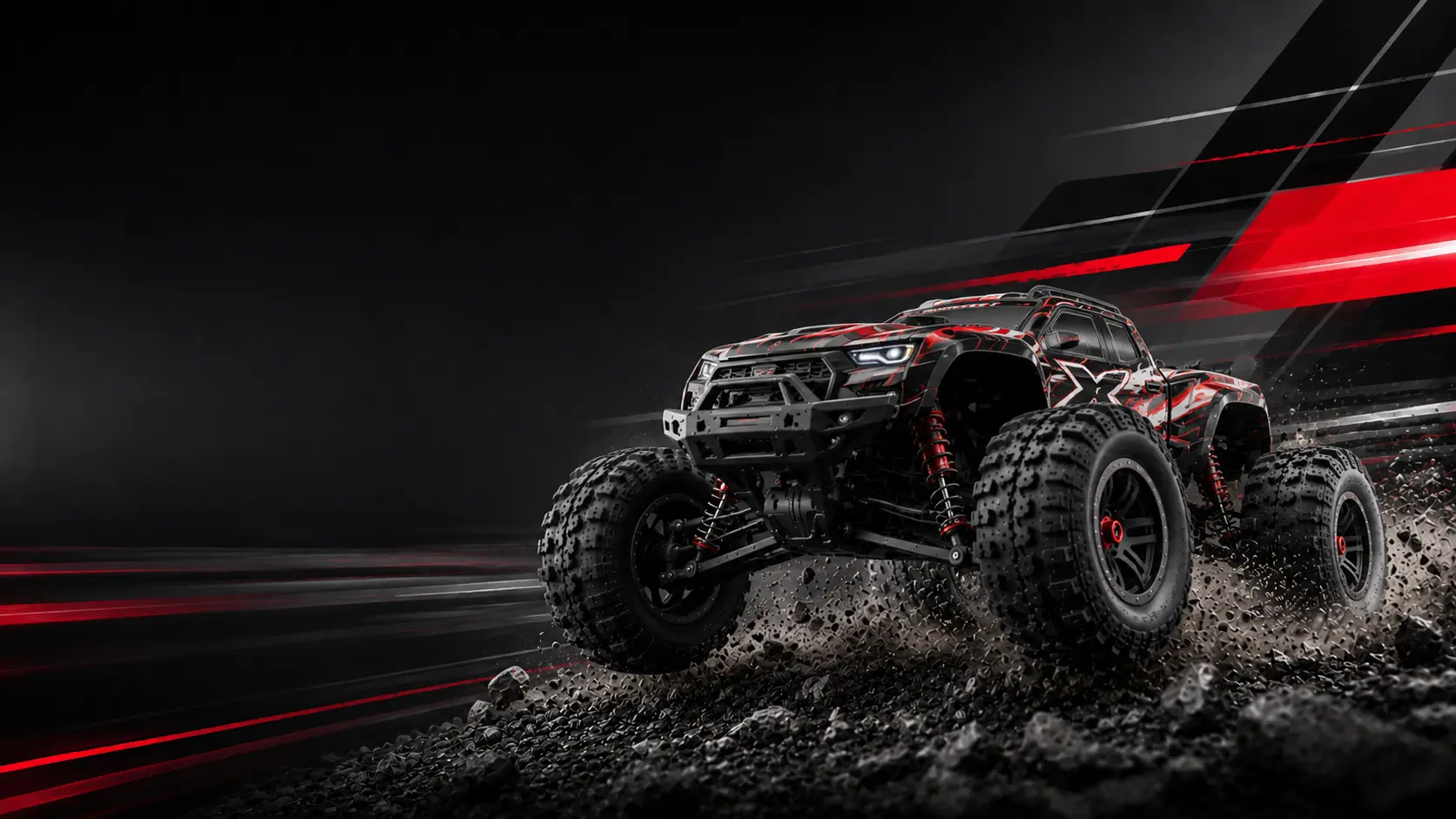
The first time I lifted the Traxxas X-Maxx out of its box, my Slash 4×4 was sitting right there on the workbench. I set the X-Maxx next to it and genuinely laughed out loud. The thing is enormous. Not "big RC car" enormous — more like "is this street-legal?" enormous. Eight-inch tires. A wheelbase nearly 19 inches wide. A body that your average cat could comfortably nap on.
That size is the whole point. The X-Maxx has been Traxxas's halo monster truck since late 2015, and it remains one of the most recognizable — and most debated — RC vehicles on the market. It runs on a dual 4S LiPo setup for a combined 8S total, pushing a Big Block Velineon motor through an overbuilt driveline that's earned a reputation for surviving abuse that would destroy smaller trucks outright.
But at $1,100+ before you even buy batteries, it's not a truck you buy casually. The real question in this review: does the X-Maxx still justify that premium in a market where the Arrma Kraton 8S is a serious rival and Traxxas's own Maxx 4S delivers 80% of the experience at half the price? Let's get into it.
Traxxas X-Maxx — Specs at a Glance
| Spec | Detail |
|---|---|
| Scale | "Maxx-Scale" (marketed as 1/5; current retailer listings vary — 1/5 to 1/7, see note below) |
| Motor | Velineon 1200XL Big Block brushless, 4-pole, 48 × 110 mm (marketed 1200kV; replacement part #3491 labeled 1275kV) |
| ESC | Velineon VXL-8s, waterproof, 8S LiPo max (33.6V) |
| Radio | TQi 2.4GHz, 5-channel, TSM (Traxxas Stability Management), Traxxas Link app compatible |
| Servo (stock) | Traxxas 2085-series, ~365 oz-in — adequate, but not optimal for 1/5 scale (see Upgrades) |
| Battery system | Traxxas iD plug, 2× 4S in series (8S), 30+ volts; recommended: 2× Traxxas 2890X 4S 6700mAh |
| Wheelbase | 18.92" (480 mm) |
| Length | 29.84" (758 mm) |
| Width (track) | 21.26" (540 mm) |
| Height | 13.79" (350 mm) |
| Ground clearance | 4.0" (102 mm) |
| Weight (no batteries) | 19.1 lb (8.66 kg) — loaded, roughly 20 lb |
| Tire diameter | 8.0" standard / 8.4" Belted Sledgehammer (current RTR) |
| Top speed (stock) | 50+ mph on stock 15T/54T gearing; 60+ mph with included 18T/46T alternate gearing |
| Self-righting | Yes — button on TQi transmitter |
| Waterproof | Yes — full waterproof electronics |
| Current RTR model | 77096-4 (Belted Sledgehammer tires, four colors); 77086-4 (original non-belted, some colors still listed) |
| Current street price | ~$1,099–$1,199 (truck only, no batteries or charger) |
A note on scale: Traxxas officially calls the X-Maxx "Maxx-Scale" and has historically cited 1/5, but current retailer pages from AMain Hobbies and HobbyTown list the 77096-4 as 1/6. Whatever the technical ratio, the practical point is the same: this is a large-format vehicle in a class by itself among mass-market electric monster trucks. For more context on how RC scale sizes work, see our RC car scale sizes explained guide.
→ Check the current price on Amazon
What Makes the X-Maxx Different? (Scale Matters)
Traxxas launched the X-Maxx in late 2015, initially configured for 6S power. At the time, the RC monster truck world had a pretty clear ceiling: 1/10 scale trucks like the Traxxas Maxx or the E-Revo were the big dogs. Above that, you had the occasional niche large-scale build, but nothing mass-market and RTR. The X-Maxx changed that. It created a category — the mainstream, RTR, ready-to-bash large-format monster truck — that simply hadn't existed before.
The difference between a 1/10 truck and the X-Maxx isn't just size. It's presence. When you run a Slash or a Maxx 4S, it's a great RC experience. When you run an X-Maxx, bystanders stop what they're doing. The 8-inch tires roll over obstacles that 1/10 trucks bounce off. The ground clearance of 4 full inches means curbs, rocks, and drainage channels are basically non-events. Running through a section of deep grass that would strand a Stampede? The X-Maxx doesn't even slow down.
Traxxas built several key features into the platform that distinguish it from everything else at this scale. The self-righting function — activated by a button on the TQi radio — uses the motor and brake system to flip the truck right-side up in a couple of seconds. No retrieving a 20-pound truck that landed on its lid in the middle of a field. The Traxxas Stability Management (TSM) system actively counteracts oversteer, which matters a lot on a truck this heavy moving at 50+ mph. There's also the Traxxas iD battery system, which identifies your packs automatically and configures the ESC accordingly. Convenient? Yes. But it also means you're tied to Traxxas batteries or aftermarket iD-compatible packs to avoid bypassing the system entirely.
The X-Maxx is also Traxxas's Halo product — the truck in the lineup that makes everything else seem reasonable by comparison. It serves a real purpose for a specific buyer: someone who wants the most dramatic bashing experience possible, who has the space (and vehicle) to transport a 30-inch truck, and who has the budget to feed it two premium 4S packs per session. That's not everyone. But for those buyers, nothing else quite scratches the same itch.
For a full look at where the X-Maxx fits in Traxxas's broader lineup, check out our complete Traxxas brand guide. For a brushless motor explainer on what makes the Big Block 1200XL worth paying attention to, we've got you covered there too.
X-Maxx — Bashing & Speed Performance
On 8S, the X-Maxx pulls with authority. Stock top speed is rated at 50+ mph on the standard 15T/54T gearing, and Traxxas includes a faster 18T/46T pinion/spur set in the box that pushes the truck past 60 mph if conditions allow. Realistically, most X-Maxx owners never need the speed gearing — 50 mph in an 8.66 kg truck with an 8-inch tire footprint is already more than enough to keep things interesting.
Where the X-Maxx genuinely shines is in raw bashing versatility. The combination of massive ground clearance, huge tires, and significant vehicle mass means the X-Maxx absorbs terrain in a way smaller trucks can't. I've run it through sections of the local park that I'd normally avoid with a 1/10 — rutted ground, chunky gravel, patches of long grass — and the X-Maxx treated all of it like a mildly interesting texture to roll over.
Jumping is spectacular. The truck has enough weight and chassis stiffness to hold a predictable arc in the air, and the 4-inch ground clearance on landing means you're not scraping electronics on the way down. Full-throttle off a dirt jump and the X-Maxx gets genuinely airborne — the kind of jumps you see in slow-motion videos. Self-righting is more than a gimmick here: when you land inverted off a particularly ambitious angle, holding the button and watching the truck flip itself upright feels like a genuinely satisfying engineering trick every single time.
The waterproofing is legitimate. The VXL-8s ESC, TQi receiver, and 2085-series servo are all sealed. I ran mine through standing water and a wet grass section after a rain, and everything kept working without issue. You're not going to drown this truck in a puddle. A full water crossing is realistic as long as the water isn't deep enough to float the chassis — and even then, the buoyancy from the big tires buys you some margin.
On pavement, the X-Maxx is fast and dramatic, but tire wear is a real consideration. Running those 8-inch tires on asphalt at speed burns rubber noticeably faster than dirt or grass. If you're doing mostly street runs, budget for replacement tires more frequently, or look at harder-compound aftermarket options. Dirt, gravel, and grass are where this truck is happiest. See our best RC trucks and bashers guide for how the X-Maxx compares against the full field of bash trucks.
Build Quality & Durability
The X-Maxx's reputation as a near-bulletproof basher is largely earned, but "bulletproof" has limits at this power level. Let's be honest about what holds up and what doesn't.
What's genuinely tough: The composite nylon chassis tub is thick and energy-absorbing. The metal driveshafts are massively oversized for the scale. The differentials are sealed and oil-filled. The VXL-8s ESC is one of the most refined 8S controllers on the market — it runs cool, the LVC (Low Voltage Cutoff) is reliable, and the Traxxas iD system adds a legitimate safety layer by preventing ESC misconfiguration. The body shell is thicker than most in the class, and Traxxas's clipless body retention system means no lost body clips — a genuine quality-of-life win at this scale. The wheels and tires are massive enough to soak up low-speed impacts that would crack the rims on a smaller truck.
What breaks: Here's where I'll be straight with you.
The cush-drive input shaft (TRA 7786X) is the X-Maxx's most frequently reported failure point on hard, asymmetrical impacts — side landings, concrete wall strikes, that kind of abuse. The stock part is serviceable for normal bashing but will let go eventually under repeated hard use. The Hot Racing SXMX38CDA S2 spring-steel input shaft replacement is the go-to fix, and it's a weekend install.
The stock 2085-series steering servo delivers ~365 oz-in of torque. On a truck this size, with 8-inch tires, that's adequate for casual bashing but starts to feel strained at high speed or in thick mud. It's not a disaster out of the box — don't let that stop you from buying the truck — but a servo upgrade is realistically on your to-do list within the first few months of regular running.
Tire glue has historically been an issue at high speed on the non-belted Maxx tires — the rubber can debead from the wheel. This is specifically why Traxxas moved to factory-belted Sledgehammer tires on the current 77096-4 RTR. The belted construction resists balloon-out at speed. If you're buying used or running the older 77086-4, make sure the tire glue is fresh or add your own CA reinforcement bead.
Transport and storage are real logistical challenges that nobody mentions enough. The X-Maxx is 29.84 inches long, 21.26 inches wide, and 13.79 inches tall. It does not fit in a standard RC car bag. It does not fit in a compact car's trunk without removing the body or angling it awkwardly. You need an SUV, a pickup bed, or a dedicated roll cart. Plan accordingly before you bring this thing home.
For aftermarket body protection and shell options compatible with the X-Maxx, check our best Traxxas X-Maxx body shells guide.
X-Maxx Versions & Updates Over the Years
Understanding which X-Maxx you're buying — or finding used — matters. Here's the actual timeline:
| Period | Version | Key Details |
|---|---|---|
| Late 2015 | X-Maxx 6S (77076-4) | Original launch — Velineon VXL-6s ESC, Velineon 1600 motor, ~32 mph on 3S 3900mAh. Shortly after launch (Jan 2016), CPSC issued a recall on ~4,900 units and 140 standalone ESCs due to a fire hazard in the VXL-6s. Resolved via replacement ESC program. |
| January 2017 | 8S Upgrade Kit (#7795) released | VXL-8s ESC, 1200XL motor, Cush Drive, Torque-Biasing Center Drive, and beefed driveline. Existing 6S X-Maxx owners could upgrade. Retail RTR transitioned to 8S model 77086-4. |
| 2018–2022 | 77086-4 production | Multiple color editions (Solar Flare, Rock n Roll, Blue, Red, Green, Orange). WideMaxx Suspension Kit (7895) added to aftermarket catalog — widens track by 2.36" (60 mm). ESC firmware updates via Traxxas Link. |
| 2024 | Current 77096-4 Belted RTR | Factory-fitted belted Sledgehammer tires (8.4" diameter). Updated graphics. Available in Blue, Green, Red, Orange. Included gearing upgrade option (18T pinion/46T spur in box). 77097-4 Ultimate variant also exists with additional hop-ups pre-installed. |
| 2025–2026 | No major revision | Current production continues. No chassis or electronics overhaul announced. The 77086-4 is still listed in some Solar Flare/Rock n Roll colors. |
Buying used: If you find a used X-Maxx, the 8S models (77086-4 and later) are the ones to target. Avoid the original 77076-4 6S version unless it's already been updated. Check that the VXL-8s ESC (not the older VXL-6s) is installed, and ask about the cush-drive and CV shaft condition before buying.
X-Maxx vs Arrma Kraton 8S — The 1/5 Battle
This is the comparison everyone asks about. The Arrma Kraton 8S EXB is the X-Maxx's most direct rival, and the honest answer is that each truck has meaningful advantages depending on your priorities.
| Spec | Traxxas X-Maxx 8S | Arrma Kraton 8S EXB |
|---|---|---|
| Scale | "Maxx-Scale" / ~1/5 | 1/5 |
| Top speed (stock) | 50+ mph / 60+ with gearing | 55+ mph |
| Weight (no batts) | 19.1 lb (8.66 kg) | 24.2 lb (11 kg) |
| Motor | Velineon 1200XL (~1200–1275 kV) | Spektrum FIRMA 5687 1100 kV |
| ESC | VXL-8s | Spektrum FIRMA 160A V2 Smart |
| Stock servo | Traxxas 2085 (~365 oz-in) | Spektrum S6510 (~820 oz-in) |
| Radio | TQi 2.4GHz w/ TSM | Spektrum DX3 DSMR w/ AVC + Smart telemetry |
| Self-righting | Yes | No |
| Chassis material | Composite nylon tub | 5 mm 7075-T6 aluminum plate (EXB) |
| Body style | Tall monster truck stance | Lower-CG speed monster w/ rear wing |
| Price (US) | ~$1,100–$1,200 | ~$899–$1,000 |
For the full picture on Arrma's broader lineup, see our Arrma RC cars guide, and our Arrma Kraton 6S review for context on the smaller sibling.
Where the Kraton 8S EXB wins: The Kraton's aluminum EXB chassis plate, hardened bulkheads, and beefier stock servo (820 oz-in vs ~365 oz-in) give it a structural edge on flat-landing big air and raw ground-pounding impact. The Spektrum Smart ecosystem provides real-time telemetry via Bluetooth — you can see voltage, motor temperature, and amp draw on your phone during a run. AVC (Active Vehicle Control) is Arrma's version of stability management, and the Kraton 8S EXB is legitimately faster out of the box on its stock gearing. And the price advantage — roughly $100–$200 cheaper depending on where you buy — is real.
Where the X-Maxx wins: The X-Maxx is nearly 5 pounds lighter than the Kraton 8S EXB, which has a bigger impact on durability than most people expect — less mass behind every impact. Self-righting is not a gimmick when you're running a truck that regularly inverts itself; it's a functional feature that saves minutes of retrieving per session. The composite chassis flexes and absorbs energy rather than transmitting it to bulkheads. The sealed drivetrain handles mud and wet conditions with notably less drama. And the Traxxas parts ecosystem — available at virtually every hobby shop in the country with next-day shipping in many cases — is an underrated advantage for anyone who runs their truck hard.
Bottom line: If you want raw speed and structural rigidity, the Kraton 8S EXB is the pick. If you want the complete large-scale bash experience with self-righting, lighter weight, and simpler maintenance, the X-Maxx is the truck. They're genuinely different machines, and "better" depends entirely on your use case.
→ Check the Kraton 8S price on Amazon
The Arrma Kraton 8S — not to be confused with the Kraton 6S or the Arrma Outcast 6S (which is the stunt truck variant) — is the specific competitor here. The Arrma Limitless is another beast entirely, oriented toward speed runs rather than bashing.
X-Maxx vs Traxxas Maxx 4S — The Sibling Gap
This is arguably the more important comparison for most buyers, because the Maxx 4S and X-Maxx are often cross-shopped against each other at very different price points.
| Spec | X-Maxx 8S | Traxxas Maxx 4S V2 |
|---|---|---|
| Scale | ~1/5 (Maxx-Scale) | 1/10 |
| Length | 29.84" (758 mm) | 22.50" (572 mm) |
| Wheelbase | 18.92" (480 mm) | 13.85" (352 mm) |
| Weight (no batts) | 19.1 lb (8.66 kg) | 10.4 lb (4.7 kg) |
| Motor | 1200XL Big Block (~1200 kV) | Velineon 540XL (2400 kV) |
| ESC | VXL-8s (8S capable) | VXL-4s (4S max) |
| Top speed | 50+ / 60+ mph | 55+ / 60+ mph (faster with gearing) |
| Battery requirement | 2× 4S packs | 1× 4S pack |
| Battery cost per session | ~$320 (2× Traxxas 2890X) | ~$160 (1× Traxxas 2890X) |
| Price RTR (no batt) | ~$1,099–$1,199 | ~$599–$769 |
| Self-righting | Yes | Yes |
| Transport | SUV/truck required | Fits in any car trunk |
| Indoor use | Not practical | Possible in large spaces |
The honest takeaway: the Maxx 4S is genuinely fast (stock top speed actually exceeds the stock X-Maxx gearing), shares the same Traxxas ecosystem (TQi, TSM, iD batteries, self-righting), and delivers a very satisfying bash experience. You can charge it with a single-port charger, toss it in the trunk of a Civic, and run it in a large parking lot. The X-Maxx requires two packs, a dual-port charger, and a vehicle large enough to haul something the size of a large piece of carry-on luggage.
What does the extra $400–$600 (plus $160 in extra batteries) get you with the X-Maxx? Scale presence. The visual and tactile experience of a truck that rolls over obstacles instead of bouncing off them. The ability to run through terrain that would strand the Maxx. And a machine that draws a crowd at any bashing session in a way that a 1/10 truck — however capable — simply doesn't.
If you're upgrading from a smaller truck and want to understand where the Maxx 4S sits in the lineup, read our Traxxas Maxx 4S review for the full comparison. For battery logistics at this scale, our RC LiPo battery guide covers everything you need to know about the dual 4S setup, iD compatibility, and pack care.
→ Check the Traxxas Maxx 4S V2 price on Amazon
The Traxxas Sledge is another Traxxas option worth mentioning in this space — it's a race-pace 6S truck with a very different character — but it's in its own category and we'll cover it separately. Similarly, the Traxxas Hoss 4×4 VXL sits at a different scale and use case that's worth exploring if you want something more park-friendly.
Best Upgrades for the X-Maxx
The X-Maxx is capable enough stock that you don't need to modify it immediately. But there's a clear priority order for upgrades based on what actually fails and what makes the truck meaningfully better.
1. Servo Upgrade — 2085X or 2085R (Priority: High)
The stock 2085-series servo at ~365 oz-in is the weakest link in the stock driveline for anyone who bashes hard. The Traxxas 2085X (~450 oz-in metal gear) is the established first upgrade — direct swap, plug-and-play, significant improvement in steering response and centering at high speed. If you want more, the 2085R/2085RL (650 oz-in) is the step up from there.
→ Check the Traxxas 2085X servo on Amazon
Budget: $60–$110 depending on the 2085 variant.
2. Cush-Drive Input Shaft & CV Drive Shafts — Steel Upgrade (Priority: High)
The stock cush-drive input shaft (TRA 7786X) and stock CV drive shafts are the most commonly broken parts on hard impacts. Hot Racing's SXMX38CDA S2 spring-steel cush-drive input shaft is the standard fix for the transmission input side. Their XMX288CE steel HD CV drive shafts (with aluminum hex ends) address the axle side. These are the parts that let X-Maxx owners say "it survives everything" — because they replaced the soft points.
→ Search Hot Racing X-Maxx steel upgrades on Amazon
Budget: $30–$60 per set depending on which shaft you're replacing.
3. Batteries — 2× Quality 4S Packs (Priority: Essential)
You can't run this truck without them. The Traxxas 2890X 4S 6700mAh iD hardcase LiPo is the factory-recommended pack and, for all practical purposes, the right choice for most X-Maxx owners. It fits the tray, works with iD auto-configuration, and provides a solid runtime — roughly 20–30 minutes of moderate bashing per pair. You need two. Buy both at once; you'll want them.
→ Check the Traxxas 2890X 4S 6700mAh battery on Amazon
Budget: ~$160 per pack, ~$320 for the pair.
For everything you need to know about managing LiPo packs at this scale, see our RC LiPo battery guide (linked in the sibling comparison section above).
4. Dual-Port Charger — Traxxas EZ-Peak Live Dual (Priority: Essential)
A single-port charger on two 6700mAh packs is a multi-hour wait between sessions. The Traxxas EZ-Peak Live Dual (model 2973) charges both packs simultaneously, supports 4S iD recognition, and has onboard 200W output. It is effectively mandatory equipment if you're serious about running the X-Maxx regularly.
→ Check the Traxxas EZ-Peak Live Dual on Amazon
Budget: ~$200. See our full RC car battery charger guide for alternatives and comparisons.
5. WideMaxx Suspension Kit — Traxxas #7895 (Priority: Medium)
The WideMaxx kit widens the X-Maxx's track by 2.36 inches (60 mm) total, significantly improving high-speed stability and reducing rollover tendency on banked turns. It comes in five colors to match the truck's body and includes all necessary hardware. This is the upgrade that makes the X-Maxx handle like it looks like it should — planted and wide.
→ Check the WideMaxx Suspension Kit on Amazon
Budget: ~$100–$130.
6. Body Protection — Pro-Line Brute Bash Armor (Priority: Medium)
Pro-Line's Brute Bash Armor body for the X-Maxx is made from thick, flexible TPU-style material that dramatically outlasts the stock polycarbonate body under hard running. It comes pre-cut and in white or black. The tradeoff is slightly heavier weight, but for anyone running the truck regularly on rough terrain, the reduced body replacement cost pays off quickly.
→ Check the Pro-Line Brute Bash Armor body on Amazon
Budget: ~$55–$70.
7. RPM Bumpers (Priority: Low-Medium)
The stock X-Maxx bumpers do their job, but RPM's replacement front and rear bumper mounts are noticeably more durable under repeated impacts and look cleaner on the truck. A simple, cost-effective protection upgrade.
→ Check RPM X-Maxx bumpers on Amazon | RPM Front Bumper Mount
Budget: ~$12–$15 per bumper.
8. Transmitter Upgrade — Spektrum DX5 Rugged (Priority: Low)
The TQi is a capable radio with solid range, TSM integration, and Traxxas Link telemetry support. Most X-Maxx owners never need to replace it. But if you run in wide-open spaces at high speed and want more channels, better thumb feel, or Bluetooth telemetry without using your phone, the Spektrum DX5 Rugged is the logical step up. Compatible with the TQi receiver via spectrum crossover or dedicated RX swap.
→ Check the Spektrum DX5 Rugged on Amazon
For a full breakdown of upgrade radio options across all RC platforms, see our best RC car transmitters guide.
Budget: ~$230–$250.
9. Pinion Gear Speed Upgrade (Priority: Situational)
Traxxas includes the 18T/46T alternate gearing set in the box with the current RTR. If you've already installed it and want to push further, hardened steel pinion/spur combos from the aftermarket reduce the chance of gear stripping at high pinion ratios. Only relevant if you're chasing top speed. Budget: ~$25–$45.
FAQ
Q: How big is the X-Maxx actually?
The X-Maxx measures 29.84 inches long, 21.26 inches wide, and 13.79 inches tall — roughly the footprint of a large rolling carry-on suitcase but taller. The tires alone are 8 inches in diameter. If you've only owned 1/10-scale trucks, put two of them end-to-end to get an approximate sense of the X-Maxx's length. It genuinely does not fit in a compact car's trunk without removing the body and tilting it, and transport is something you should plan for before purchase.
Q: How fast is the X-Maxx stock?
On the stock 15T/54T gearing with two fully charged 4S packs, the X-Maxx is factory-rated at 50+ mph. Traxxas includes an alternate 18T/46T gearing set in the box that Traxxas rates at 60+ mph. Both figures are on flat, firm ground with fresh packs; real-world speeds on grass or dirt will be lower. The Arrma Kraton 8S EXB is marginally faster on stock gearing (~55+ mph), but for most bashing applications, 50 mph in a truck this size is more than enough.
Q: X-Maxx vs Arrma Kraton 8S — which one should I buy?
Buy the X-Maxx if you prioritize self-righting, lighter weight, the Traxxas parts ecosystem, and all-conditions versatility. Buy the Kraton 8S EXB if you want more stock servo torque, a stiffer aluminum chassis, and a slightly lower price of entry. Both are excellent large-scale bashers. The Kraton 8S EXB is not the same vehicle as the Arrma Kraton 6S — it's a dedicated 1/5-scale machine with completely different hardware. Neither one is a clear "winner" — they're genuinely different designs built around different philosophies.
Q: Is the X-Maxx worth double the price of the Maxx 4S?
If you have the budget, the space, and the specific itch for a large-format monster truck, yes. The scale presence, terrain capability, and sheer spectacle of the X-Maxx are genuinely different from a 1/10 truck — it's not just bigger, it's a qualitatively different experience. However, if transport is a challenge, if you're running in limited space, or if the $500+ in batteries and charger on top of the truck price feels steep, the Maxx 4S delivers most of the Traxxas bashing experience at half the running cost. It's the smarter practical choice for most buyers.
Q: Can I run the X-Maxx on a single 4S LiPo to save battery cost?
You can — the VXL-8s ESC is backward-compatible with 4S — but the experience is significantly reduced. On 4S, the 1200XL motor is dramatically underpowered for a truck this size. Top speed drops substantially, throttle response is sluggish, and the X-Maxx stops feeling like a monster truck and starts feeling like a very heavy, underperforming large-scale vehicle. If budget is the concern, the Traxxas Maxx 4S on a single 4S pack will outrun an X-Maxx on 4S and cost half as much to do it. Run the X-Maxx on 8S, or don't run it.
Conclusion
The Traxxas X-Maxx is exactly what it claims to be: the most complete, ready-to-bash, large-format electric monster truck on the mass market. After years of production, the platform remains relevant because the core formula is hard to beat — an overbuilt driveline, waterproof electronics, self-righting, Traxxas iD battery integration, and a parts ecosystem broad enough that you'll almost never wait on a repair. The move to factory-belted Sledgehammer tires on the current 77096-4 RTR addressed the most common complaint from the original run. The WideMaxx upgrade is a genuine improvement. And the truck's reputation for surviving abuse that would total most other vehicles is well-deserved.
That said, this is not a truck for everyone. You're looking at $1,100+ for the RTR, $320 for the battery pair, and $200 for the dual charger — a realistic all-in entry cost of around $1,500. You need a large vehicle to transport it, a substantial outdoor space to run it, and a realistic plan for ongoing parts maintenance (servo upgrade and steel CV shafts are practically expected within a few months of regular use). If the Maxx 4S covers your needs, it's the smarter buy. If raw speed is the goal and you can live without self-righting, the Arrma Kraton 8S EXB is a compelling alternative. And if you're curious about the Traxxas Sledge — a different kind of large-scale truck built more for race pace than all-terrain bashing — that one deserves its own look.
But if you want the most dramatic, most capable, most conversation-starting RTR bashing truck that Traxxas builds? The X-Maxx is still the answer in 2026. It's a truck that rewards the investment — as long as you go in with clear eyes about what that investment actually costs.
→ Check the current X-Maxx 8S price on Amazon — and see our full Traxxas brand guide for the complete lineup, or our best RC trucks & bashers hub to compare the X-Maxx against the full field before you commit.