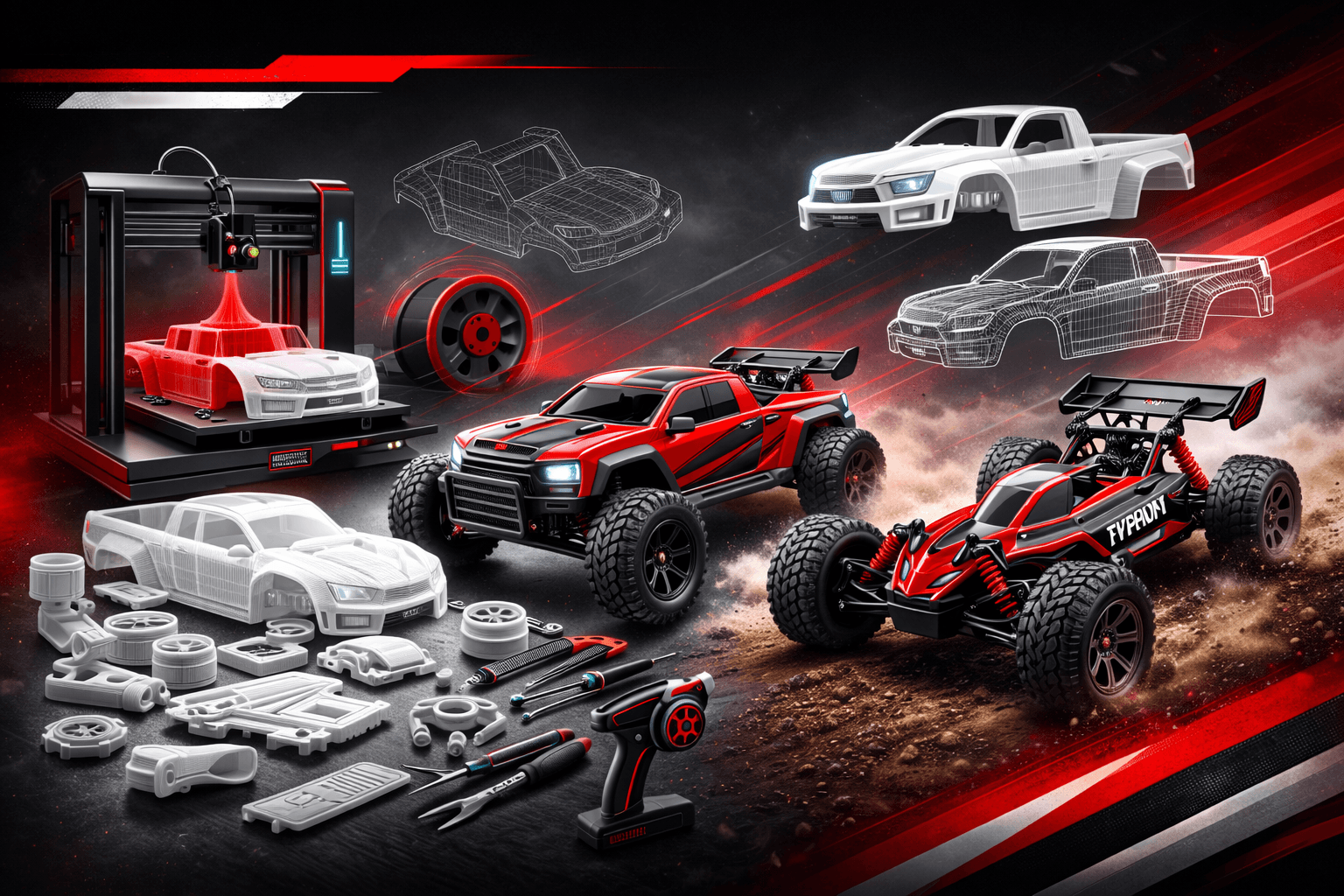
A $200 3D printer can replace your hobby shop for parts, accessories, and custom upgrades. Whether you're printing a replacement shock tower at midnight or designing a fully custom crawler body, 3D printing is the most powerful tool an RC hobbyist can add to their bench. This guide covers what you can (and can't) print for RC, which filaments actually hold up, where to find the best STL files, and which printers are worth buying in 2026.
This post contains affiliate links. If you make a purchase through these links, we may earn a commission at no extra cost to you.
What Can You 3D Print for RC Cars?
Replacement Parts
The "I broke it at 9 PM on a Sunday" scenario is where 3D printing earns its keep. Shock towers, body mounts, bumpers, skid plates, and servo mounts are all excellent candidates — parts that are annoying to source, overpriced to ship, and genuinely printable in PETG or Nylon at home. The key word is low-stress structural: a servo mount that holds a servo in place is fine in PETG. An axle housing that takes repeated torque loads under 6S power is not.
I printed my first RC part — a shock tower for my SCX10 — in PLA. It lasted exactly one trail run before snapping in half. That's when I learned the hard way that PLA is for prototyping, not for anything that takes stress. PETG changed everything. Same print, PETG, same shock tower — still on the car after two seasons.
Upgrade Parts
This is where the hobby gets interesting. Instead of printing a stock replacement, you design something better than what came in the box. Custom bumpers with heavier wall counts, wider body mounts, GoPro mounts, fan shrouds, and integrated winch mounts for crawlers are all common improvements. One of my favorite prints ever was a custom drift body mount in Fusion 360 that lets me swap bodies in 10 seconds without clips. It's one of those small things that makes you wonder why the manufacturer didn't think of it first. If you're into drift kits, the ability to prototype fit and function in cheap PLA before committing to an aluminum part is genuinely game-changing.
Scale Accessories (Crawlers Especially)
This is where 3D printing truly shines in the RC hobby. My crawler is probably 40% 3D printed at this point — roof rack, light bar mounts, interior dashboard, tool boxes, jerry cans, scale driver figure, skid plates. The printer paid for itself in the first three months just on crawler accessories alone. The crawler community has built an entire ecosystem around printed scale details, and the variety of available STL files is staggering.
You can also print entire crawler course obstacles — rock gates, bridges, ramps, articulation testers, seesaw elements, and more. Check out our crawler course ideas guide for 3D-printable course builds that work at any scale.
Body Shells
Full body shells are possible but demanding — they require large print beds and very thin walls to look right. More practical are body accessories: spoilers, diffusers, canards, wide body kits, and custom mounts. Some designers on Printables and Cults3D sell complete printed body shells that print in sections and glue together. Results vary. Lexan bodies are still better for durability and impact resistance, but printed bodies offer custom designs that no polycarbonate manufacturer will ever produce. For a broader look at what's available before you commit to printing, our drift bodies guide covers the full landscape of shell options across both materials.
Full 3D Printed RC Cars
Yes, people build entire RC cars from scratch — chassis, suspension, body, the works. The OpenRC F1 by Daniel Norée has over 330,000 downloads on Thingiverse and is the most famous example: a 1:10 F1 car where almost everything prints, and you only need to purchase electronics, bearings, and hardware. The Tarmo5 by Engineering Nonsense is a 2WD rear-drive street racer that hits around 40 mph — an impressive number for a mostly printed vehicle. 3D Sets sells premium STL packages for beautifully detailed 1:8 scale crawlers ($25–$79 per model) that run on a proprietary belt-drive system.
These are projects, not replacements for a commercial hobby-grade car. A fully printed car takes time, iteration, and the right filament choices. But the build experience is genuinely rewarding, and the community support around all three of these platforms is excellent.
Best Filaments for RC Car Parts
This is the most important section in this guide. Filament choice makes or breaks 3D printed RC parts. The wrong material can mean a part that looks great, fits perfectly, and shatters on first use.
| Filament | Strength | Flexibility | Heat Resistance | Best For | RC Rating |
|---|---|---|---|---|---|
| PLA | Medium | Low (brittle) | Low (warps in sun/car) | Prototyping, cosmetics only | ⭐⭐ |
| PETG | Good | Moderate | Moderate (~80°C) | Most RC parts, accessories | ⭐⭐⭐⭐ |
| ABS | Good | Moderate | Good | Functional parts, outdoor use | ⭐⭐⭐ |
| ASA | Good | Moderate | Excellent + UV resistant | Outdoor parts, sun-exposed | ⭐⭐⭐⭐ |
| Nylon (PA/CoPA) | Excellent | High | Good (~180°C) | High-stress parts, mounts | ⭐⭐⭐⭐⭐ |
| TPU | Low-Medium | Very high | Moderate | Bumpers, tire inserts, dampeners | ⭐⭐⭐⭐ |
| Carbon Fiber blends | Excellent | Low | Good | Stiff structural parts | ⭐⭐⭐⭐ |
The Short Answer
PETG for 90% of RC parts — strong enough, easy to print, weather-resistant, and forgiving. Nylon (CoPA) for anything that takes serious stress — shock towers, A-arms, motor mounts. Its glass transition is around 180°C vs PETG's 80°C, and it absorbs impacts that would snap PETG clean. TPU for impact absorption — bumpers, body mount cushions, tire inserts. PLA for cosmetic-only items — scale accessories that never leave a shelf or see sunlight. Never use PLA for structural or outdoor parts — it warps in heat, snaps under impact, and degrades with UV exposure.
ASA deserves a special mention for outdoor RC use: it has the same printability profile as ABS but with dramatically better UV resistance. Any exterior part that lives in sunlight — fenders, body panels, skid plates — should be ASA, not PETG.
Recommended brands on Amazon:
- Overture PETG (1 kg, ~$18–$22) — Check Price on Amazon
- Polymaker PolyLite PETG (1 kg, ~$22–$25) — Check Price on Amazon
- Overture Nylon CoPA (1 kg, ~$26–$37) — Check Price on Amazon
- SainSmart TPU 95A (0.8 kg, ~$20–$28) — Check Price on Amazon
- Hatchbox PLA (1 kg, ~$18–$22, for cosmetic/scale accessories only) — Check Price on Amazon
Where to Find RC Car 3D Print Files
Free STL Sources
Thingiverse is the largest collection by sheer volume — search "RC car," "SCX10," or any specific model name and you'll find thousands of results. Quality varies wildly, documentation is often thin, and the search can be erratic. But for raw variety, nothing competes. It's the home of the original OpenRC F1 with its 330,000+ downloads.
Printables (by Prusa) has grown into the highest-quality free source, with better curation, active designer engagement, and strong community feedback loops. The Tarmo5 is hosted here (7,600+ downloads), and several 3D Sets accessory packs are available free as add-ons. Start here before Thingiverse for quality-critical parts.
Cults3D operates as a mixed free/paid marketplace with over 4,800 RC car files, including 933+ free models. It's particularly strong for body shells, drift accessories, and complete crawler course systems. There are over 1,600 SCX24-specific models on the platform alone.
MyMiniFactory offers curated content with generally better quality control than Thingiverse. Knight Customs — arguably the most prominent name in RC crawler accessories — has an active profile here.
Reddit communities including r/3Dprinting, r/rccars, and r/radiocontrol share files regularly and are excellent for finding model-specific parts that haven't made it to the big platforms yet.
Paid / Premium STL Sources
3D Sets (3dsets.com) is the gold standard for complete 3D-printed RC vehicles. Their models are beautifully engineered, come with sliced G-code files for Prusa printers, detailed build guides, and tested hardware lists. Prices run $25–$79 per model with over 20 designs available, from Land Rover–style crawlers to American muscle cars and massive 6×6 off-road trucks. The community has created 186+ free add-on accessories on Printables. Available at 3dsets.com (direct purchase, no Amazon).
Individual designers on Etsy and Patreon often specialize in specific platforms or vehicle types — scale crawler accessories for the TRX-4, SCX24 upgrade packs, custom drift parts. Paid files are almost always better tested, better documented, and better supported than free ones.
Designing Your Own
The ultimate skill in RC 3D printing is measuring a broken part, designing an improved version, and printing it. Fusion 360 (free for personal use) is the standard for RC part design — parametric modeling means dimensions are easy to adjust when fitment is off. TinkerCAD is genuinely useful for simple parts and is beginner-friendly enough to learn in an afternoon. OnShape runs entirely in a browser, which makes it practical across devices and useful for collaborative designs.
Best 3D Printers for RC Car Parts (2026)
You do not need an expensive printer. An Ender 3 with PETG handles 95% of RC printing needs. But the right printer for your specific use case matters — and the market has shifted significantly toward faster, more capable machines at lower prices.
Budget Pick: Creality Ender 3 V3 SE (~$169–$199)
The Honda Civic of 3D printers. The Ender 3 V3 SE offers a 220 × 220 × 250 mm build volume, Sprite direct-drive extruder (260°C hotend, 100°C bed), CR Touch auto-leveling, and a 32-bit silent mainboard — all for under $200. It prints PETG and TPU well, and the community is enormous: every problem you'll encounter has already been solved and documented online. The open frame means ABS and ASA require a DIY enclosure, but for PETG-focused RC printing, it covers almost everything.
Mid-Range Pick: Bambu Lab A1 Mini (~$199–$219)
The A1 Mini delivers 500 mm/s printing with full auto-calibration in a compact 180 × 180 × 180 mm footprint. It's faster and less finicky than the Ender 3, and the software experience is significantly better. The trade-off: the 80°C heated bed and open frame limit it to PLA, PETG, and TPU. ABS, ASA, and Nylon are not supported. The smaller build volume is also a constraint for larger RC body panels. For builders who primarily work with PETG on smaller parts, it's an excellent choice — but serious RC printing will hit its material limits.
Best Overall: Bambu Lab P1S (~$399)
The P1S is the printer I'd recommend to any serious RC builder. Its fully enclosed CoreXY design with a 256 × 256 × 256 mm build volume, 300°C all-metal hotend, 100°C heated bed, activated carbon filter, and 500 mm/s print speed unlocks every material that matters for RC: ABS, ASA, Nylon, Polycarbonate, plus PLA, PETG, and TPU. The enclosed chamber maintains stable internal temperatures (~40–50°C), which is what Nylon and ABS actually need to avoid warping and delamination. At $399 (down from its original $699 launch price), it's exceptional value. This is the "set it and forget it" printer — auto-calibration, a polished app, and reliable results without constant tinkering.
For Large Parts & Bodies: Creality K1 Max (~$450–$550)
The K1 Max brings a 300 × 300 × 300 mm build volume — large enough to print full 1/5 scale body shells or large chassis plates in a single piece. It's fully enclosed with a 120°C heated bed (the highest of the four), 600 mm/s top speed, AI LiDAR for first-layer monitoring, and a hardened steel nozzle that handles carbon-fiber filaments natively. ABS, ASA, Nylon, and PC are all supported without modification. The software ecosystem is less polished than Bambu's, but for sheer build size, nothing in this price range competes.
3D Printing Tips for RC Parts
These are the settings and habits that separate parts that survive a trail run from parts that don't.
Print orientation is structural. Layer lines are weak in tension perpendicular to the print direction. Orient parts so the highest stress direction runs along the layers, not across them. A shock tower printed flat fails differently than one printed upright — choose orientation based on where the load actually goes.
Use more walls (perimeters), not more infill. For functional RC parts, set 4–5 wall perimeters minimum. Wall thickness provides far more strength and stiffness than infill percentage. A part with 5 walls at 20% infill is stronger and uses less filament than one with 2 walls at 50% infill.
Infill: 30–50% for functional parts. Use gyroid or cubic patterns — they distribute stress more evenly than grid or lines. Never go below 25% for anything structural. Scale accessories that take no load can print at 15%.
Slow down for strength. Faster printing means weaker layer adhesion. For PETG RC parts, aim for 40–60 mm/s on perimeters. Save maximum speed for infill.
Test fit before trail day. Print one, check fitment, iterate if needed. That's the entire advantage of 3D printing over ordering a replacement part — use it.
Post-processing matters. Sand mating surfaces for clean fits, drill holes to correct diameter (printed holes are always slightly undersized), and use a heat gun carefully on PETG for minor fitment adjustments. For Nylon, always dry the filament for 8+ hours at 65°C before printing, and store it in a sealed bag with desiccant between sessions.
What You Should NOT 3D Print (Buy Instead)
3D printing complements the RC parts catalog. It doesn't replace the parts catalog. Some components should always be purchased:
Gears require precision dimensional tolerances and material hardness that FDM printing cannot reliably achieve. Buy steel or molded nylon gears from your manufacturer.
Bearings and bushings — obviously.
High-RPM drivetrain components — spur gears, pinions, differentials. They fail under rotational stress at speeds and loads that printed parts can't handle.
Primary load-bearing suspension components for high-power vehicles. A-arms on a 6S basher bash take enormous peak loads on impact. TPU bumpers can absorb impact; A-arms under constant bash loads are a different conversation.
Anything safety-critical. If a part fails and the car goes out of control toward people or traffic, it shouldn't be printed plastic.
Know where printing adds value and where it introduces risk. The answer is usually "accessories, mounts, brackets, and cosmetics — yes; drivetrain and primary structural members on high-power rigs — no."
FAQ
Can you 3D print an entire RC car from scratch?
Yes — projects like the OpenRC F1, Tarmo5, and 3D Sets crawler kits prove it's entirely possible. They're excellent builds and the communities around them are active and supportive. They won't match commercial hobby-grade cars in durability or performance, but they're genuinely fun projects and a great way to understand both RC mechanics and 3D printing.
What's the best filament for RC car parts?
PETG for the vast majority of parts — it's strong, weather-resistant, reasonably flexible, and easy to print. Nylon (CoPA) for high-stress components like shock towers, A-arm mounts, and motor mounts. TPU for anything that needs to absorb impacts: bumpers, body mount cushions, tire inserts. PLA only for cosmetic scale accessories that will never take mechanical load or sit in sunlight.
Do I need an expensive printer for RC parts?
No. A $169–$199 Creality Ender 3 V3 SE printing PETG handles 95% of RC printing needs. The upgrade argument for something like the Bambu P1S is about material versatility (Nylon, ASA, ABS), not whether you can print RC parts at all. Start cheap, upgrade when you hit a specific limitation.
Where can I find free RC car STL files?
Thingiverse and Printables are the two largest free sources. Printables generally has better quality control. For model-specific parts, search your car's name plus "STL" or "3D print" on either platform, and check Reddit communities like r/rccars — community members share niche model files that don't make it to the big platforms.
Are 3D printed RC parts as strong as stock plastic parts?
Depends entirely on the filament and print settings. PETG and Nylon parts printed with 4–5 walls and 30–40% infill can match or exceed injection-molded stock plastic parts in many applications. PLA is significantly weaker than stock and should never be used structurally. The failure mode also differs — printed parts in PETG tend to crack along layer lines rather than shattering the way stock ABS parts sometimes do.
Conclusion
3D printing turns you from an RC consumer into an RC manufacturer — the distinction matters. A $169 printer and a spool of PETG means you can print a broken part the night before a trail run, design a better body mount than what came in the box, and build a scale crawler rig that no hobby shop stocks. Start there. Print some crawler accessories, learn the machine, dial in your PETG settings, then expand into Nylon when you need it.
The best overall printer for most RC builders is the Bambu Lab P1S (~$399) — it handles every material you'll ever need and requires minimal fiddling. Check Price on Amazon
Looking for things to print? Our crawler course ideas guide includes 3D-printable obstacles and accessories for every scale. New to the hobby entirely? Our beginner's guide will help you find your first car before you start printing parts for it.