This post contains affiliate links. If you make a purchase through these links, we may earn a commission at no extra cost to you.
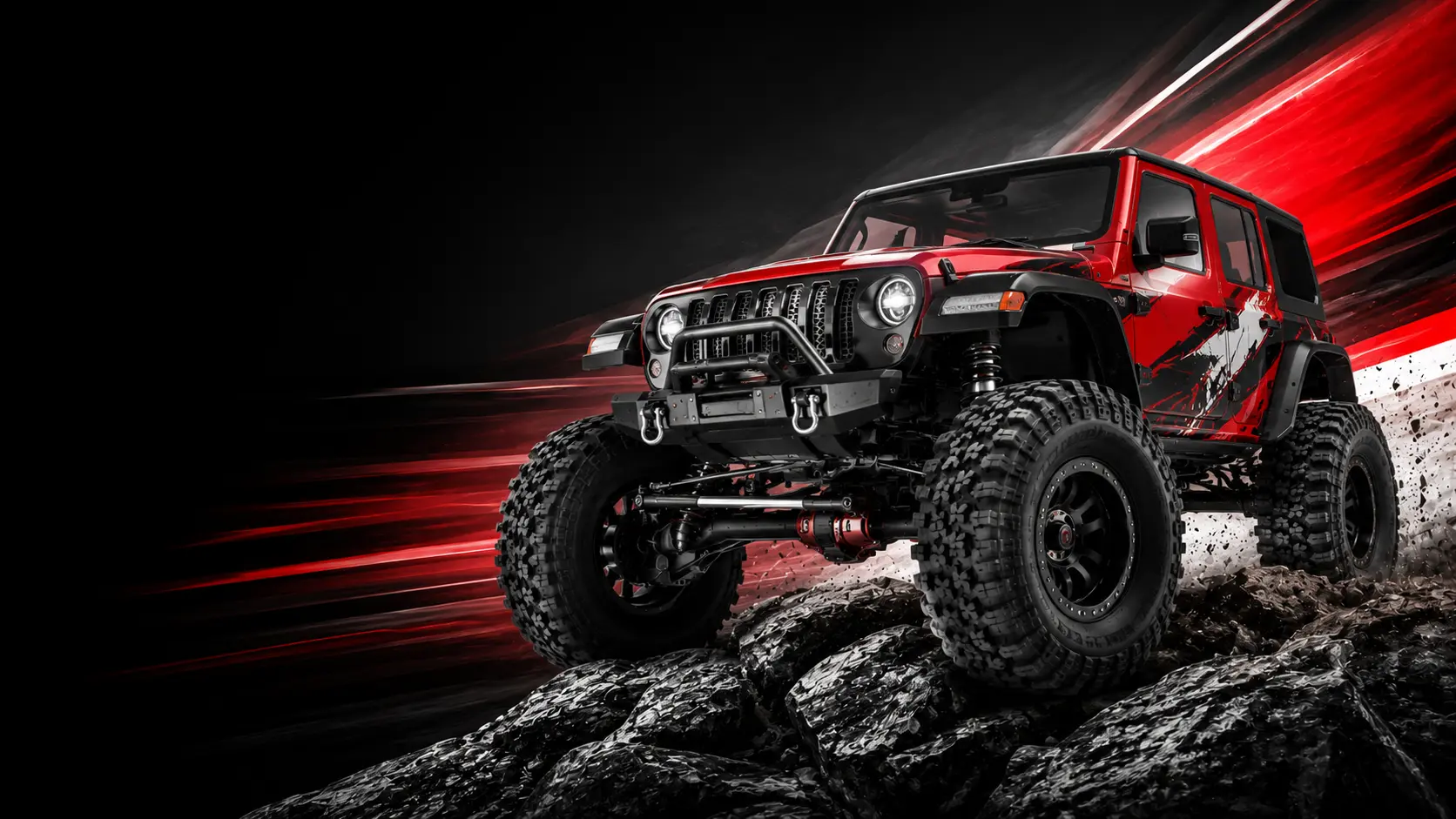
I set my SCX6 next to my SCX10 III on the driveway and my neighbor genuinely slowed his car down to ask if that was a real ride-on Jeep for kids. It's not. It's a 25-pound brushless RC crawler that's roughly the length of your coffee table, and it's one of the most bizarre, polarizing, and oddly compelling things Axial has ever built. The SCX6 Jeep JLU Wrangler Rubicon isn't trying to be the most capable crawler on paper — it doesn't have portal axles, it's not the fastest, and you'll never run it indoors without turning it into a furniture-destroying event. What it does instead is change the entire experience of scale crawling by making the scale uncomfortably, magnificently real. Is that worth $1,099? That's exactly what this review is about.
Axial SCX6 Jeep JLU — Specs at a Glance
Before diving in, a few corrections to what you might have read elsewhere. The SCX6 runs straight AR90 axles, not portals. And its motor is brushless, not a brushed 550. These matter for how you evaluate it.
| Spec | Detail |
|---|---|
| Scale | 1/6 (approximately 4× the volume of a 1/10) |
| SKU | AXI05000T1 (green) / AXI05000T2 (silver) |
| Price (RTR) | $1,099.99 MSRP |
| Length | 33.55 in (852 mm) |
| Width | 14.88 in (378 mm) |
| Height | 14.55 in (370 mm) |
| Wheelbase | 19.74 in (501 mm) |
| Ground Clearance | 4.25 in (107.9 mm) |
| Weight (RTR, no battery) | ~25 lbs (11.3 kg); ~26–27 lbs with two 3S packs |
| Drivetrain | Full-time shaft-driven 4WD |
| Axles | AR90 straight axles, heavy-duty spool, metal helical ring & pinion, front universals |
| Suspension | 3-link Panhard (front) / 4-link (rear), aluminum-bodied coil-over shocks |
| Transmission | 2-speed metal-gear (high/low, servo-shifted from transmitter) |
| Gear Ratio | 23.73:1 low / 7.20:1 high |
| Motor | Spektrum Firma 1200 Kv sensored brushless |
| ESC | Spektrum Firma Crawler 120A Smart, waterproof |
| Steering Servo | Spektrum S905 waterproof, 40 kg class, metal gear (~537 oz-in @ 6V) |
| Transmitter | Spektrum DX3 Smart 2.4 GHz DSMR |
| Battery | 2S–3S LiPo (not included); standard or shorty compatible |
| Tires | 7-inch BFGoodrich KM3 M/T on Black Rhino Primm 3-piece beadlock wheels |
| Lights | LED headlights + LED taillights, stock |
| Body | Licensed Jeep JLU Wrangler Rubicon polycarbonate, opening doors & hood, full interior |
| Released | October 2021 |
→ Check the current price on Amazon
Why 1/6 Scale? (And What It Means in Real Life)
When Axial launched the SCX6 in October 2021, they weren't iterating on an existing size class — they were creating one. Before the SCX6, the crawler market lived in a comfortable 1/10-scale box, with occasional forays into 1/12 and the odd 1/8. There was nothing purpose-built, scale-accurate, and Jeep-licensed in 1/6. Axial stepped into that void.
To understand what 1/6 actually means compared to your existing fleet of 1/10 crawlers, consider this: volume scales as the cube of the linear dimension. A 1/6 model is 1.67× bigger in every direction than a 1/10, which translates to roughly 4× the volume. On the driveway, this means the SCX6 is longer than most kitchen counter tops (852 mm, just under 34 inches), wider than a standard sheet of paper is long, and heavy enough that you instinctively use two hands — every single time.
The real-world dimensions hit differently than any spec sheet prepares you for. The first time I walked out to pick it up after a run, I grabbed it one-handed out of habit and immediately understood why your back is going to hate this hobby. At ~25 pounds with two 3S packs, the SCX6 is closer in carry-weight to a loaded toolbox than to anything else in the RC world. Transport is a commitment. This is not a truck you toss in a backpack. You need a proper bag, a dedicated corner of your trunk, and preferably a friend when you're doing anything on rocky terrain where you might need to reset the truck.
The licensed Jeep JLU Wrangler Rubicon body is the whole point of the exercise. JLU is Jeep shorthand for Wrangler Unlimited — the four-door generation that debuted with the 2018 model year (the JL platform, replacing the JK). The Rubicon trim is the top off-road spec: Rubicon badges, the seven-slot grille, proper fender flares, the full-size spare tire carrier on the rear. Axial's license runs through Stellantis (parent of the Jeep marque), and the body shows it — this isn't a generic Jeep-shaped shell. Neighbors ask what year it is.
Who is this truck actually for? Scale enthusiasts who want the most realistic-looking crawler on the trail — photographers, diorama builders, collectors. Outdoor-only drivers with access to genuine terrain (a parking lot with some rocks isn't going to cut it). People who've been running 1/10 crawlers for years and want something that makes the scale feel genuinely immersive. And, honestly, people who just want the most jaw-dropping RC truck at the club run. If any of those describe you, read on. If you mostly run in your basement or garage and live in an apartment, skip to the SCX10 III section — you'll thank yourself later.
SCX6 — On-Trail Performance
The first time I ran the SCX6 through actual woods — not a parking lot, but real Pennsylvania forest with root systems, embedded rocks, and uneven ground — I realized I needed to treat it differently than any crawler I'd owned before. At 25 pounds, the SCX6 doesn't get stuck the way a 1/10 gets stuck. It gets stuck authoritatively. It leans against an obstacle and stays there. Carrying it back from 40 feet into the tree line is an event.
But when it's moving? It's something else entirely. Rocks that would have stopped my SCX10 III cold — genuine 6-inch boulders — became something the SCX6 climbed without drama. The sheer mass works in your favor on obstacles: momentum and tire contact area do work that technique alone can't replicate at 1/10. The BFGoodrich KM3 tires have real sidewall volume, real lugs, and real footprint — when they bite into dirt or grip a ledge, they grip like the full-size tires they're modeled after.
The 2-speed transmission is one of the SCX6's underrated features. Low range gives you 23.73:1 for maximum crawling control — the truck almost refuses to roll if you let off the throttle, which is exactly what you want when picking a line across a technical section. High range at 7.20:1 opens up enough speed to reposition between obstacles without feeling like you're watching paint dry. You shift from the transmitter, and it works cleanly. This is a feature the $470 SCX10 III doesn't have.
The Spektrum Firma 1200 Kv sensored brushless motor (and 120A ESC) give the SCX6 smooth, controllable power delivery. Sensored brushless at 1/6 scale means the motor stays in sync even at ultra-low throttle inputs — critical for crawling where you're often barely moving. You won't be running this motor hot under normal conditions. The 120A ESC has headroom to spare for 3S.
What genuinely surprised me was crossing a drainage ditch that ran about 6 inches deep across the trail — a puddle that would have drowned a 1/10 crawler outright. The SCX6's ground clearance (4.25 inches) and body height handled it without a second thought. It's waterproof, though don't confuse waterproof with submersible.
The downsides are real and you need to know them before you buy. Indoor running is impossible — the truck is simply too big for any normal room, and the turning radius is substantial. Speed is deliberately slow; this is a scale crawler built for crawling pace, and if you need anything resembling fast, you're in the wrong aisle. And the steering servo, while rated at 40 kg, has a documented community consensus that it struggles to handle the mass of the truck under hard load — more on that in the upgrades section.
Build Quality & Durability
The chassis is an aluminum-spined affair that feels genuinely robust in hand. Unlike the thin, stamped-aluminum chassis on 1/10 crawlers, the SCX6's frame has real material to it — you're not worried about flexing it on a hard tip-over. The coil-over shocks are aluminum-bodied, oil-filled, and dial in nicely for the weight; the long travel suspension soaks up drops that would harsh-out a smaller rig.
The AR90 axles use metal helical ring and pinion gears with a heavy-duty spool (locked front and rear). The front axles use CV/universal joints rather than standard driveshafts, giving a better steering angle. Overall the axle hardware feels appropriate for the scale and weight — Axial didn't cheap out here.
The polycarbonate body is where you need to temper expectations slightly. The body detail is phenomenal — opening doors with functional hinges, a hood that swings open to reveal a replica V8 engine cover, full interior with a driver figure and dashboard, working LED head and taillights. But polycarbonate at this scale, on a 25-pound truck, means that hard rollovers on rocks will test the side mirrors and antenna first. The mirrors are the most common first casualty. If you're running gnarly terrain regularly, body reinforcement tape on the lower panel edges is worth doing pre-emptively.
Where the community has documented actual weak points: the stock plastic link ends are the primary fragility. At 25 pounds of weight pressing down through the suspension on technical terrain, the ball ends on the stock links have been consistently reported as failure points — not in casual use, but under sustained hard-crawling load. The panhard mount at the front axle has also been cited for flex under load, which compounds the steering feel issue. Additionally, some early-production batches shipped with the slipper clutch under-torqued in the transmission, requiring a disassembly and proper adjustment out of the box. Check your slipper if the truck feels like it's slipping in 2nd gear immediately after purchase.
The stock servo — the Spektrum S905 at 40 kg — is the most debated component. It's a legitimate waterproof, metal-gear unit and it's not a bad servo in isolation. The problem is the math: 25 pounds of truck, an aggressive steering angle, and any kind of side-hill pressure add up to more load than 40 kg handles confidently. Almost every experienced SCX6 owner upgrades the steering servo within the first few sessions. Consider it part of the purchase cost.
The Scale Realism Factor — Why People Pay $1000 for a Jeep
Let me make the case for the SCX6 on pure scale merit, because this is genuinely the strongest argument for the truck — stronger than any crawling performance argument.
The Jeep JLU Rubicon licensed body is one of the most detail-accurate RC bodies on the market at any scale. Axial's licensing deal with Stellantis produced a body where the seven-slot grille is proportioned correctly, the Rubicon badging is placed where Stellantis put it on the actual 2018+ JLU, and the body contours follow the real door shapes and fender flares. At six inches away, standing still, the SCX6 reads as a real object. It registers in your peripheral vision as a Jeep.
The functional details go further than most people expect from a RTR. The doors open on actual hinges — not just body clips, real functional door hinges with a satisfying swing and return. The hood opens and stays open, revealing a molded engine cover. The interior has bucket seats, a dashboard, and a driver figure. The rear carries a spare tire on a functioning carrier. The headlights and taillights are LED, stock, and they light up correctly front and rear when you flip the power on. The chrome trim accents and Rubicon door sill graphics are molded-in rather than sticker-applied.
For scale photographers, this truck is a content machine. You can compose shots at ground level where the SCX6 looks identical to a real Wrangler in the frame — with the right lens and distance, the trick disappears entirely. It's one of the few RTR crawlers that functions as a diorama-quality display piece as well as a runner.
This collector/display dimension is real and it's part of why the $1,099 price is defensible for a specific buyer. If you've built up a scale accessories collection — recovery gear, scale winches, roof racks, jerry cans — the SCX6 wears them at a proportion that makes them look like real equipment, not toys. On a scale accessories setup, the SCX6 creates a whole different visual impact than the same gear on a 1/10.
For car shows, RC club meets, and trail days where the vibe is as much about the trucks as the driving, the SCX6 is an immediate conversation piece. At 1/6 scale, it legitimately stops people who don't know anything about RC.
SCX6 vs SCX10 III — The Scale Dilemma Within Axial
Here's the comparison most people actually need, and there's a twist worth knowing upfront: the smaller, cheaper SCX10 III with portals actually has portal axles. The SCX6 doesn't. That's not a criticism — it's a feature tradeoff — but it reshapes how you think about what you're getting.
| Axial SCX6 Jeep JLU | Axial SCX10 III Jeep JLU (Portals) | |
|---|---|---|
| Scale | 1/6 | 1/10 |
| Wheelbase | 501 mm | 312 mm |
| Weight | ~25 lbs (11.3 kg) | ~6.5 lbs (2.9 kg) |
| Price (RTR) | ~$1,099 | ~$469–$499 |
| Axles | AR90 straight, heavy-duty spool | AR45 portal axles |
| Motor | Brushless 1200 Kv sensored | Brushed 540 35T |
| Transmission | 2-speed high/low | Single speed |
| Battery | 2S–3S LiPo | 2S/3S LiPo |
| Transport | Two hands, dedicated transport | One hand, backpack-friendly |
| Indoor viability | No | Yes |
| Aftermarket ecosystem | Growing niche | Enormous |
| Running cost | Higher (larger batteries, 2.9" tires pricier) | Lower |
The SCX10 III's portal axle advantage is real on technical terrain — portals lower the differential, increasing ground clearance beyond what the axle diameter alone provides. They're also a mechanical statement: the SCX10 III with portals feels like the more engineered crawler from a features standpoint.
But the SCX6 brings three things the SCX10 III can't match: the 1/6 physical presence that makes rocks feel genuinely large, a brushless drivetrain with significant headroom, and a 2-speed transmission for high/low range. At 1/10 scale, a brushless motor on the SCX10 III is an upgrade. On the SCX6, it's stock.
For a deep-dive on that platform, check our dedicated SCX10 III review.
Who should buy the SCX10 III instead: Anyone on a budget, anyone without consistent access to large outdoor terrain, anyone who values a massive aftermarket community and easy parts availability, anyone who needs to run occasionally indoors. The SCX10 III is also simply a better choice if you're earlier in the hobby and still developing your crawling skills — at 6.5 pounds, recovering from a mistake costs you less.
Who should buy the SCX6: Scale-first enthusiasts who want the most realistic 1/6 presence on the trail, experienced crawlers who want something genuinely different, collectors who value the licensed Jeep detail, and anyone with a large outdoor run area who wants to feel like the terrain is actually challenging.
→ Check the SCX10 III on Amazon
SCX6 vs Traxxas TRX-4 Defender — Scale Competition
The Traxxas TRX-4 Defender is the other scale crawler that serious buyers consider at this level of the hobby, and the comparison is genuinely interesting because they occupy very different design philosophies despite both being "scale trail crawlers."
A note before we get into specs: this comparison uses the TRX-4 Defender platform generally (see our Traxxas TRX-4 guide for the full lineup history, and our TRX-4 Bronco review for a body-specific look). The Traxxas TRX-4 Defender review will be covered in a dedicated article — the Defender-specific model deserves its own treatment.
| Axial SCX6 Jeep JLU | Traxxas TRX-4 Defender | |
|---|---|---|
| Scale | 1/6 | 1/10 |
| Price | ~$1,099 | ~$580–$620 |
| Motor | Brushless 1200 Kv sensored | Brushed Titan 21T 550 |
| ESC | Spektrum Firma 120A Smart | Traxxas XL-5 HV (waterproof) |
| Axles | AR90 straight, spool | Portal axles, front & rear |
| Differentials | Locked front & rear (spool) | Remote-locking front & rear (transmitter) |
| Transmission | 2-speed (servo-shifted) | 2-speed (servo-shifted) |
| Cruise Control | No | Yes (Traxxas Cruise Control) |
| Scale body | Licensed Jeep JLU Rubicon | Licensed Land Rover Defender |
| Weight | ~25 lbs | ~5 lbs |
| Transport | Two hands, dedicated bag | One hand, standard bag |
| Indoor viability | No | Yes |
| Battery | 2S–3S LiPo | NiMH 4–7 cell or 2S–3S LiPo |
The TRX-4 is the more feature-rich truck at 1/10 scale. Portal axles with independently remote-lockable front and rear differentials — selectable from the transmitter — is a genuinely premium feature that gives you real-time terrain adjustment that the SCX6's locked spool can't match. Traxxas Cruise Control (hold a speed and let off the trigger) is one of those features that sounds gimmicky until you're hand-filming a trail run and realize you don't have a spare thumb. These are real-world advantages.
The SCX6 punches back with its brushless drivetrain (the TRX-4 ships with a brushed Titan 21T), its 120A ESC versus the XL-5 HV, and most importantly: scale. The TRX-4 at 1/10 looks like a nice RC truck. The SCX6 at 1/6 looks like you accidentally shrank someone's actual Jeep. For trail photography and show-quality presence, there is no competition — the SCX6 wins by default purely because of size.
The practical verdict: if you want more driving features and flexibility, the TRX-4 is the smarter $600 spend. If you want the most immersive scale experience on large outdoor terrain and you're fine with a single setup, the SCX6 delivers something the TRX-4 simply cannot.
Best Upgrades for the SCX6
Ranked by immediate impact on the ownership experience:
1. Servo Upgrade — Do This First
This is the single most impactful upgrade and the one the community agrees on universally. The stock Spektrum S905 at 40 kg is fine for the motor and ESC it's paired with, but at 25 pounds of truck weight on technical terrain, it works harder than it should and fatigues under sustained load. The fix is moving to a 1/5-scale servo.
The Savöx SV-1270TG HV is the most commonly recommended option — digital, titanium gear, 35 kg-cm at 7.4V, designed for 1/5 applications, and available with the hardware to mount directly with aftermarket servo mounts. Budget around $110–$140.
→ Check the Savöx SV-1270TG on Amazon
The Hitec HS-7955TG is the alternative — titanium gear, coreless motor, approximately 333 oz-in at 6V. Slightly older design but proven in the 1/5 world. Budget around $150–$170.
→ Check the Hitec HS-7955TG on Amazon
See our best RC crawler servos guide for a full comparison of options at this torque class.
2. Aluminum Link Ends / Full Link Set — Do This Second
The plastic ball ends on the stock links are the most common breakage point, particularly the panhard link and the lower rear links. They hold up for casual running but give out under sustained load on real terrain. The Treal Hobby aluminum 7075 link sets for the SCX6 are the most accessible Amazon option — upper set, lower set, and high-clearance lower links are all separately available.
→ Treal SCX6 Aluminum Upper Links on Amazon
Budget roughly $45–$80 per set depending on which links you prioritize. Do the lower links and panhard first.
3. Brass Knuckles / C-Hubs — Stability and CG Improvement
The SCX6 sits tall and feels it on side-hills. Brass front knuckles and C-cups serve two purposes: they lower the center of gravity slightly by adding mass to the lowest point of the front suspension, and they're significantly stiffer than the stock plastic under load, which directly addresses the steering flex that compounds the servo issue.
→ Powerhobby Brass SCX6 Knuckles + C-Cups on Amazon
4. Battery Upgrade — Quality 3S Matters More at This Scale
The SCX6 runs 2S–3S, and 3S is where you want to be for meaningful performance. At 25 pounds, a weak or cheap 3S pack will sag under load and give you a fraction of the run time a quality pack delivers. Gens Ace 5000 mAh 60C hardcase packs are the community standard — they're the right size for the adjustable battery tray and they deliver consistent voltage under load. Run two simultaneously if your tray setup allows (many owners do).
→ Gens Ace 3S 5000mAh 60C on Amazon
See our RC LiPo battery guide for sizing and connector advice for 1/6 scale.
5. Quality Charger — Required Upgrade If You're Running Dual 3S
If you're running two 3S packs (which you should be to maximize run time), a dual-port charger is the quality-of-life upgrade that saves you 45 minutes per session. The iSDT D2 Mark 2 handles dual 3S at up to 14A per port — quick, compact, AC direct.
→ iSDT D2 Mark 2 Dual Port Charger on Amazon
See our best RC car battery chargers guide for alternatives at different budgets.
6. Tire Upgrade — When the Stock BFGs Wear Out
The stock BFGoodrich KM3 tires are actually very good. They're appropriately sized, have real lug depth, and grip well on rock and dirt. When they eventually wear or tear (the 2.9" bead format means these aren't cheap to replace), the Pro-Line Hyrax XL G8 is the top aftermarket alternative — designed for 1/6 scale, 2.9" bead, compound options for different terrain.
→ Pro-Line 1/6 Hyrax XL G8 2.9" Tires on Amazon
See our RC crawler tires guide for a full breakdown of 2.9" tire options.
7. Transmitter Upgrade — When the DX3 Feels Limiting
The Spektrum DX3 Smart that ships with the SCX6 is competent but limited — three channels, basic adjustments. If you want more channel assignments for a winch, aux lights, or a dedicated gear-shift override, the Spektrum DX5 Rugged is the obvious step up. Waterproof, five channels, and purpose-built for off-road use with gloves on.
→ Spektrum DX5 Rugged on Amazon
See our best RC car transmitters guide for a full comparison.
8. Scale Accessories
This is where the SCX6 rewards investment in a way no 1/10 can match. A 1/6 scale winch looks like a real Warn winch. Jerry cans in 1/6 look like actual fuel cans. Roof rack with gear strapped down reads as real at a glance. Investing in scale RC accessories makes more visual sense on this platform than anywhere else in the hobby. Budget $50–$150 for a starter scale accessories kit and photograph it on natural terrain. You'll see why.
FAQ
Q: Is the SCX6 worth the $1,000+ price?
Depends entirely on your use case. If you're primarily a driver who wants the best crawling performance per dollar, the answer is probably no — a well-built SCX10 III or a TRX-4 gives you more crawling features (portal axles, locking diffs) for less money. If you're a scale enthusiast who wants the most visually authentic RC crawler on the market — one that photographs like a real Jeep and creates genuine reactions at club runs — then yes, the SCX6 is worth it. Factor in the mandatory servo upgrade (~$120) as part of the purchase price.
Q: How big is the SCX6 actually?
Bigger than you expect, even after reading the specs. At 852 mm long (just under 34 inches), 378 mm wide, and 370 mm tall, it's roughly the size of a medium dog. It weighs approximately 25 pounds without batteries — closer to 26–27 lbs fully loaded with two 3S packs. You will use two hands every single time you pick it up. It does not fit in a standard RC car bag. Transport requires a dedicated soft-sided case or a padded bin in your truck bed.
Q: Does the SCX6 have portal axles?
No — and this surprises a lot of people. The SCX6 runs AR90 straight axles with a heavy-duty spool (locked front and rear). The differential is locked, not portal. Interestingly, the smaller and cheaper SCX10 III (with portals) actually has AR45 portal axles. The SCX6 compensates with sheer mass, large tire footprint, and a 2-speed transmission rather than portals. For most real-world scale crawling at 1/6, this isn't a limiting factor — the ground clearance is generous at 4.25 inches — but it's worth knowing before you buy.
Q: Can you run the SCX6 indoors?
Realistically, no. At 34 inches long and 15 inches wide, it turns living rooms into obstacle courses and destroys carpet edges. The turning radius is substantial and requires room to work with. The SCX6 is strictly an outdoor truck — it needs real terrain (gravel driveways, rocky hillsides, forest trails, dirt courses) to make sense. If you have a large garage with open concrete, you can do slow runs for photography or setup, but that's the extent of viable indoor use.
Q: How long does a 3S battery last in the SCX6?
At crawling pace on technical terrain, expect 30–45 minutes per 5000 mAh 3S pack. Running two packs simultaneously (the battery tray accommodates dual-pack setups) doubles this to 60–90 minutes, which is a realistic trail session. The brushless motor and 120A Smart ESC are efficient at crawling pace, so battery life is better than you might expect given the truck's size. Always charge with a quality balance charger (see our best RC car battery chargers guide) and store 3S packs at storage voltage if you're not running within a few days.
Conclusion
The Axial SCX6 Jeep JLU Wrangler Rubicon is one of the strangest value propositions in the RC hobby — and I mean that as a compliment. It won't win on features-per-dollar (the TRX-4 Defender's portal axles, remote diffs, and Cruise Control at $580 make a strong case), and it won't win on aftermarket depth (the SCX10 III has years of community support and a catalog that dwarfs the SCX6's). What it wins on is the thing no spec sheet captures: at 1/6 scale with a licensed Jeep JLU Rubicon body, running on real terrain, it creates a completely different experience from anything else in the crawler segment. The scale is real in a way that changes how you perceive the terrain.
The honest checklist for who should buy it: you have consistent access to genuine outdoor terrain, you're comfortable with the $1,099 purchase price plus a servo upgrade out of the gate, you have somewhere to store and transport a 25-pound truck, and you care as much about how the truck looks and photographs as how it performs technically. If all of those are true, the SCX6 is a genuinely special piece of the hobby that you won't regret.
If any of those are false — especially the outdoor terrain access or the transport reality — look seriously at the SCX10 III instead (full breakdown in our SCX10 III review). Half the price, portal axles, fits in a backpack, runs in your driveway. Or compare the full Axial lineup — from the SCX24 micro-crawler to the Capra tube chassis to the SCX6 — in the complete Axial brand guide linked below.
The SCX6 isn't a truck for everyone. For the person it's built for, there's nothing else like it.
→ Check the current price on Amazon — and see our complete Axial brand guide for the full lineup or our RC crawlers guide to compare the SCX6 against the full field before you commit.