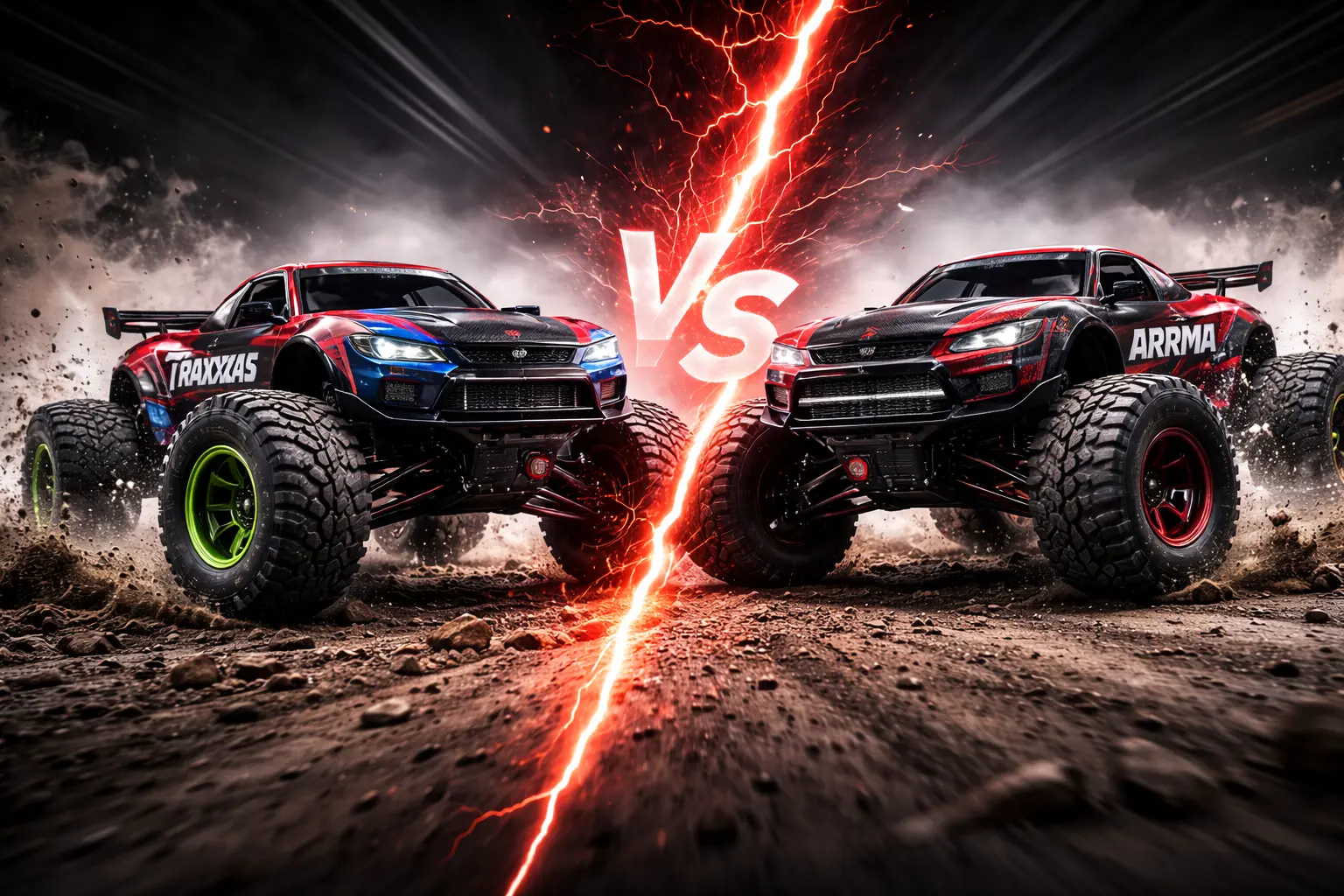
“Traxxas vs Arrma” is the single most argued debate in the RC hobby — the kind that hijacks comment sections, dominates r/rccars threads, and turns otherwise reasonable people into brand loyalists. I’ve been running both for years, and I’ll give you the honest answer upfront: neither brand wins outright. What changes is which brand wins for you. Here’s everything you need to make that call.
This post contains affiliate links. If you make a purchase through these links, we may earn a commission at no extra cost to you.
Traxxas at a Glance
Founded in 1986 in McKinney, Texas, Traxxas is the #1-selling RTR RC brand on the planet. The privately held company pioneered ready-to-race vehicles, waterproof electronics, and the first 100 mph production RC car (the XO-1). Today, the lineup spans over 60 active models — from the $150 LaTrax Teton all the way up to the $1,700 X-Maxx Ultimate. For a deep dive into every model they make, check out the Complete Guide to Traxxas RC Cars.
Traxxas’s philosophy is plug-and-play simplicity. The iD battery system auto-detects pack chemistry and capacity so chargers configure themselves instantly. The TQi radio links to the Traxxas Link app for telemetry, speed readouts, and ESC tuning. TSM (Traxxas Stability Management) acts like electronic stability control, cutting tail-out crashes for new drivers. Training Mode limits throttle to 50% on VXL models. Traxxas even offers toll-free phone support seven days a week (888-TRAXXAS).
The flip side is an intentionally closed ecosystem. Traxxas batteries use proprietary connectors that require adapters for standard XT60 or EC5 packs, and Traxxas-branded LiPo packs cost 30–50% more than comparable third-party cells. The company enforces strict MAP (Minimum Advertised Price) pricing across all retailers — you will never find a Traxxas on sale. Whether that tradeoff is worth it depends entirely on how much you value convenience.
Arrma at a Glance
Arrma launched in 2009 in the UK — the name itself is derived from “armour,” which tells you everything about the brand’s core identity. After Hobbico’s bankruptcy in 2018, Horizon Hobby acquired Arrma and folded it into an ecosystem that also includes Axial, Losi, Spektrum, and Pro-Line. That parent company integration shows up directly in the vehicles: every Arrma ships with Spektrum electronics, an industry-respected radio brand that Traxxas owners often buy separately as an upgrade.
For a complete look at every Arrma model available, head to the Complete Guide to Arrma RC Cars.
Arrma organizes its lineup by voltage tier, not body style — an approach that makes the power progression immediately legible. The Grom series (1/18–1/16 scale, $150–$270) starts things off. The new 223S platform ($260–$380) runs both 2S and 3S LiPo packs on the same truck, giving beginners a built-in growth path. Dedicated 3S BLX models like the Typhon and Senton sit around $320. The 6S BLX flagship tier ($550–$700) includes the Kraton, Notorious, Talion, Mojave, Outcast, Felony, and Fireteam. At the apex, the 8S EXB models — Kraton 8S and Outcast 8S — push past $1,000 with full 7075-T6 aluminum chassis construction.
The EXB roller concept deserves a specific mention: these rolling chassis ship without electronics, letting experienced builders install their own preferred gear. That’s a philosophy opposite to Traxxas in almost every way — and it’s exactly what makes Arrma so compelling to the performance-chasing crowd.
Head-to-Head: 7 Key Factors Compared
1. Durability & Build Quality
The honest answer here is that both brands are durable — they just arrive at that result through different engineering philosophies.
Traxxas builds with high-grade, impact-resistant nylon and modular component design. Parts are engineered to flex and break at controlled failure points rather than transmitting crash energy to more expensive components. The result: A-arms and shock towers snap in big hits, but they cost a few dollars to replace and take five minutes to swap. This “sacrifice and replace” model has kept generations of Slash owners bashing without fear.
Arrma leans into metal reinforcement. The 6S and 8S platforms feature 7075-T6 aluminum chassis plates, sealed gearboxes, steel center driveshafts, and EXB-grade construction on flagship models. A stock Kraton 6S will survive impacts that would shatter the equivalent Traxxas platform. The tradeoff is that when aluminum bends — and at 6S power levels, it eventually will — the repair bill is higher.
I noticed this difference firsthand when I put my first Arrma Typhon 3S through a concrete curb head-on. The truck bounced off, straightened itself out, and drove away. My Traxxas Slash in the same scenario would have needed A-arms at minimum. That said, I’ve had both trucks lose parts in big hits — the Arrma just tends to go longer before it happens.
Verdict: Arrma edges ahead for stock toughness at all power levels. Traxxas wins for repairability — parts are cheaper, easier to source, and faster to swap.
2. Value for Money
This is where Arrma consistently pulls ahead, and the data is unambiguous. Arrma undercuts Traxxas in every comparable matchup: the Senton 3S BLX ($320) vs the Slash 4x4 VXL ($400), the Granite 3S BLX ($320) vs the Stampede 4x4 VXL ($480), the Kraton 6S V6 ($550) vs the Maxx V2 ($580). In most cases, the Arrma is running more voltage, larger scale, and comparable or faster top speeds at a lower price.
The proprietary battery ecosystem compounds the price gap. Once you account for Traxxas-branded LiPo packs running $50–$80 vs $25–$45 for equivalent third-party EC5 packs that plug straight into an Arrma, the total cost of ownership favors Arrma even more.
Verdict: Arrma wins value for money at every tier, most significantly in the $300–$600 bracket.
3. Parts Availability & Cost
Traxxas has built an unrivaled parts network over 35+ years. Walk into virtually any hobby shop in America and the Traxxas section will be the largest wall in the building. The Slash alone has over 500 documented parts and accessories. The company supports models a decade old. Traxxas.com rarely shows “out of stock” on structural components.
I learned how valuable this was when I snapped a Slash rear arm at a bash session and walked into a local hobby shop 20 minutes later with a new one for $8. No shipping wait, no forum hunting for the part number — just a quick repair and back to bashing by afternoon.
Arrma’s parts situation has improved meaningfully under Horizon Hobby’s ownership, but it still lags. Forum threads on arrmaforum.com regularly document parts going out of stock during model refreshes, sometimes for months. Local hobby shop stocking is growing but inconsistent. The aftermarket is expanding — RPM now covers V5 6S and EXB platforms, Hot Racing produces parts for about a dozen Arrma lines — but the total catalog is roughly a third of Traxxas’s.
Verdict: Traxxas wins, and it isn’t close. For anyone bashing hard and regularly, this advantage is worth paying for.
4. Upgrade & Aftermarket Support
Traxxas’s aftermarket is the most developed in the RC hobby, period. RPM Racing Products, Hot Racing (1,000+ Traxxas SKUs), GPM Racing, Pro-Line, MIP, Integy, and STRC all produce extensive catalogs. The Slash and Stampede have entire aftermarket sub-industries dedicated to them. Whatever you want to upgrade — suspension geometry, motor mounts, chassis stiffness, skid plates — someone makes it, usually for under $20.
Arrma’s upgrade scene is growing fast. RPM now covers the 6S EXB lineup, Hot Racing produces shock towers, chassis braces, and servo mounts, and the EXB platform itself is essentially a pre-upgraded truck from the factory. The open IC5 connector standard means any third-party motor and ESC can drop right in without soldering — a genuine advantage for those planning electronics upgrades.
Verdict: Traxxas for breadth and maturity of aftermarket. Arrma gaining fast, especially at 6S where the EXB platform needs fewer upgrades to begin with.
5. Electronics (Motor, ESC, Radio)
Traxxas VXL electronics — Velineon motors and VXL ESCs — produce smooth, predictable power with excellent waterproofing. The TQi radio is one of the best stock RTR transmitters available, with Traxxas Link Bluetooth for telemetry, RPM, temperature monitoring, and adjustable TSM via a thumb wheel. Recent models include the upgraded Velineon 540XL motor across the Stampede and Maxx platforms, delivering noticeably more torque than older setups.
The notable weakness: Traxxas’s 30-day electronics warranty is widely criticized as inadequate compared to the standard 1-year hobby industry norm. VXL ESCs are also less user-programmable than Spektrum units, and many VXL models lack cooling fans out of the box.
Arrma’s Spektrum Firma system ships with cooling fans on both motor and ESC, Smart telemetry via a one-wire connector, and more accessible programming. The SLT3 radio on 223S models is functional but considered basic — many owners upgrade to the Spektrum DX3 or DX5. The Horizon Hobby 2-year warranty on electronics is a significant advantage over Traxxas’s 30 days.
The battery question is where Arrma’s open ecosystem philosophy pays off most clearly. IC5 and EC5 connectors are industry standards — plug in any compatible battery natively, no adapters, no soldering. Traxxas’s proprietary plug requires adapters for third-party packs, and many experienced Traxxas owners eventually re-solder their entire fleet to IC5 or XT60.
Verdict: A genuine split. Traxxas wins on radio quality and TSM stability features. Arrma wins on battery ecosystem openness, warranty length, and motor/ESC cooling.
6. Beginner Friendliness
Traxxas built its entire brand identity around making RC accessible to newcomers, and it shows. Training Mode halves throttle output. TSM reduces fishtailing and loss of control. Self-righting ships standard on multiple models. The iD charging system eliminates the most common beginner mistake (wrong charger settings). And 7-day phone support means you can call on a Sunday afternoon when your truck stops working mid-bash.
For an absolute beginner who has never held an RC transmitter, I always point them to Traxxas. The Stampede 4x4 BL-2s in particular is nearly crash-proof for a new driver — TSM alone prevents the kind of high-speed wall contact that kills first-run enthusiasm.
Arrma’s 223S platform added Dynamic Stability Control and a three-stage throttle limiter (50/75/100%) in 2024, closing the gap meaningfully. But the documentation is lighter, there’s no phone support equivalent, and Horizon Hobby’s online troubleshooting is less intuitive than Traxxas.com’s guided approach.
For a complete guide covering both brands for new drivers, see RC Cars for Beginners: The Complete Buying Guide.
Verdict: Traxxas wins clearly. The gap is narrowing at the 223S entry level, but the overall ecosystem remains significantly more beginner-oriented.
7. Community & Resale Value
Traxxas commands the larger community by a significant margin — not because Arrma enthusiasts are fewer, but because Traxxas has 35+ years of accumulated owners. Facebook groups for individual Traxxas models each run into the tens of thousands of members. YouTube coverage is enormous, and that community size translates directly into faster answers to technical questions, more build documentation, and a healthier used market.
Traxxas also holds resale value exceptionally well. A used Slash 4x4 VXL in good condition typically sells for 60–70% of retail. MAP pricing prevents the brand from being devalued by clearance sales, keeping used prices stable.
Arrma’s community is passionate and growing, particularly on arrmaforum.com and r/rccars, where it often attracts a more technically engaged audience. Resale value is decent but trails Traxxas, partly because Horizon Hobby’s periodic price increases on Arrma models make used pricing volatile.
Verdict: Traxxas wins on community size and resale value. Arrma holds its own on community enthusiasm and technical depth.
Model-by-Model Matchups
Traxxas Slash 4x4 VXL vs Arrma Senton 3S BLX
| Spec | Traxxas Slash 4x4 VXL | Arrma Senton 3S BLX V3 |
|---|---|---|
| Price | ~$400 | ~$320 |
| Scale | 1/10 | 1/10 |
| Drive | 4WD | 4WD |
| Motor | Velineon 3500Kv | Firma 3660 3200Kv |
| ESC | VXL-3s | BLX100 100A |
| Top Speed | 60+ mph | 50+ mph |
| Wheelbase | 11.65 in | 11.3 in |
| Best For | All-around beginner | Value-focused basher |
The Slash is faster and comes with TSM — ideal for beginners who want stability aids. The Senton costs $80 less, runs industry-standard IC5 connectors, and includes a metal-geared servo at stock. For someone already comfortable with RC vehicles, the Senton is the smarter buy. For a first truck, the Slash’s safety net justifies the premium.
Check Price — Traxxas Slash 4x4 VXL | Check Price — Arrma Senton 3S BLX
For a full breakdown of these two trucks, see our dedicated Traxxas Slash vs Arrma Senton head-to-head.
Traxxas Stampede 4x4 VXL vs Arrma Granite 3S BLX
| Spec | Traxxas Stampede 4x4 VXL | Arrma Granite 3S BLX V3 |
|---|---|---|
| Price | ~$480 | ~$320 |
| Scale | 1/10 | 1/10 |
| Drive | 4WD | 4WD |
| Motor | Velineon 540XL | Firma 3660 3200Kv |
| ESC | VXL-4s | BLX100 100A |
| Top Speed | 60+ mph | 50+ mph |
| Tire Size | 5.3 in | 5.0 in |
| Best For | Power + self-righting | Best budget monster truck |
The Stampede received a major recent upgrade with the Velineon 540XL — the same motor found in the Maxx — making it significantly more capable than its price alone suggests. The Granite at $160 less is an extraordinary deal for a 4WD brushless monster truck. Budget-conscious buyers should start here; performance seekers will appreciate the Stampede’s upgraded power plant.
Check Price — Traxxas Stampede 4x4 VXL | Check Price — Arrma Granite 3S BLX
Traxxas Rustler 4x4 VXL vs Arrma Typhon 3S BLX
| Spec | Traxxas Rustler 4x4 VXL | Arrma Typhon 3S BLX |
|---|---|---|
| Price | ~$430 | ~$320 |
| Scale | 1/10 stadium truck | 1/8 buggy |
| Drive | 4WD | 4WD |
| Motor | Velineon 3500Kv | Firma 3660 3200Kv |
| ESC | VXL-3s | BLX100 100A |
| Top Speed | 65+ mph | 50+ mph |
| Wheelbase | 11.62 in | 12.91 in |
| Best For | Speed + stability | Terrain handling + value |
These aren’t a perfect body-style match, but they’re the most commonly cross-shopped pair at this tier. The Rustler is faster and lower to the ground with better stability aids. The Typhon is physically larger at 1/8 scale, handles rough terrain better thanks to its buggy geometry, and shares chassis DNA with the 6S platform — making it an upgradeable base for higher voltage down the road. For $110 less and a bigger truck, the Typhon is exceptionally compelling.
Check Price — Traxxas Rustler 4x4 VXL | Check Price — Arrma Typhon 3S BLX
Traxxas Maxx 4S vs Arrma Kraton 6S BLX
| Spec | Traxxas Maxx V2 | Arrma Kraton 6S V6 |
|---|---|---|
| Price | ~$580 | ~$550 |
| Scale | 1/10 | 1/8 |
| Drive | 4WD | 4WD |
| Motor | Velineon 540XL | Firma 2400Kv 6S |
| ESC | VXL-4s | 150A Smart V2 |
| Top Speed | 60+ mph | 65+ mph |
| Weight | ~8.5 lbs | ~12.4 lbs |
| Best For | Agility + self-righting | Raw bashing power |
At near-identical prices, this matchup defines the rivalry. The Maxx V2 is a 1/10 truck — lighter, more nimble, easier to self-right, and more fun in tighter spaces. The Kraton 6S V6 is a 1/8-scale beast with a 7075-T6 aluminum chassis, a 150A Smart ESC, and a built-in motor cooling fan at stock. Community consensus is that the Kraton 6S is the better pure basher; the Maxx is the more versatile, playful platform. The tiebreaker is your driving environment.
Check Price — Traxxas Maxx 4S | Check Price — Arrma Kraton 6S BLX
Traxxas X-Maxx 8S vs Arrma Kraton 8S EXB
| Spec | Traxxas X-Maxx 8S | Arrma Kraton 8S EXB |
|---|---|---|
| Price | ~$1,200 | ~$1,000 |
| Scale | 1/5 | 1/5 |
| Drive | 4WD | 4WD |
| Motor | Velineon 1200XL Big Block | Castle 2028 |
| ESC | VXL-8s | Castle Mamba Monster X 8S |
| Top Speed | 50+ mph | 55+ mph |
| Weight | ~19.1 lbs | ~24.2 lbs |
| Best For | Playful driving + self-righting | Maximum build quality |
This is the most genuinely split matchup in the comparison. The X-Maxx is lighter by 5 lbs — a meaningful difference that translates to longer run times, more airtime on jumps, and less destructive energy in crashes. It self-rights. The Kraton 8S EXB counters with a stronger steering servo (820 oz-in vs 365), a faster top speed, the superior Spektrum DX3 transmitter, and industry-standard IC5 connectors — all for $200 less. If you’re building the ultimate long-term bash platform, the Kraton EXB chassis wins. If you want the most fun truck to drive right out of the box, the X-Maxx’s lighter weight and self-righting tend to flip the calculus.
Check Price — Traxxas X-Maxx 8S | Check Price — Arrma Kraton 8S EXB
Scoreboard: Traxxas vs Arrma Summary
| Category | Traxxas Advantage | Arrma Advantage | Verdict |
|---|---|---|---|
| Durability | Repairability, cheap plastic parts | Tougher stock construction, metal chassis | Arrma (stock) / Traxxas (repair) |
| Value for Money | — | Lower price at every tier | Arrma |
| Parts Availability | Unmatched — everywhere, always | Improving but inconsistent | Traxxas |
| Upgrade / Aftermarket | Largest aftermarket in the hobby | Growing fast, open IC5 ecosystem | Traxxas (for now) |
| Electronics | TQi radio, TSM, VXL smoothness | Open connectors, 2-yr warranty, cooling fans | Tie |
| Beginner Friendliness | Training Mode, TSM, phone support | 223S throttle limiting, DSC | Traxxas |
| Community & Resale | Larger community, better resale | Passionate enthusiast base | Traxxas |
| Model Range | 60+ models, crawlers, mini, drag | Voltage-tiered system, EXB rollers | Tie |
So, Which Brand Should YOU Pick?
Pick Traxxas If…
You’re buying your first RC car. The combination of Training Mode, TSM, iD auto-charging, self-righting, and 7-day phone support makes Traxxas the most forgiving brand for a newcomer. The Traxxas Stampede 4x4 VXL is arguably the best first serious RC truck on the market.
Parts availability is your top priority. If you bash hard, parts will break. Being able to walk into any hobby shop in the country and leave with what you need — not waiting days for shipping — is a real-world advantage no spec sheet captures.
You want a crawler. The TRX-4 and TRX-4M lineup has no Arrma equivalent. If scale crawling is on your radar at all, Traxxas is the only answer in this comparison.
Resale value matters to you. Traxxas MAP pricing keeps the used market stable. If there’s any chance you’ll sell the truck in two years, a Slash or Maxx will hold its value better than the Arrma equivalent.
Pick Arrma If…
You’re in the $300–$700 bracket and want maximum performance per dollar. The Arrma Typhon 3S BLX at $320 and the Arrma Kraton 6S BLX at $550 are genuinely difficult to beat on specs per dollar at their respective price points.
You already own batteries and don’t want a proprietary system. If you have a stash of EC5 or IC5 packs, every Arrma runs them natively. No adapters, no compatibility headaches, no soldering sessions.
You’re planning electronics upgrades. Arrma’s open platform philosophy makes swapping ESCs, motors, and receivers straightforward. The EXB roller concept is purpose-built for this use case.
You bash at the 6S tier or above. Community consensus is clearest here: the Kraton 6S is widely regarded as the best value at its price point in the entire hobby. At 8S, the Kraton EXB’s build quality is the best production chassis available.
When It Honestly Doesn’t Matter
If you’re a casual driver — running a few packs on weekends, bashing at the park, not regularly pushing above 40 mph — both brands will serve you equally well for years. At that usage level, the decision should come down to which truck catches your eye visually, which one your local hobby shop stocks, and whether $80–$160 in savings means something to your budget. Both brands build trucks that are deeply, genuinely fun. Don’t let anyone on Reddit convince you otherwise.
For a broader look at how both brands stack up against the rest of the market, see Best RC Car Brands Ranked.
FAQ
Q: Is Traxxas or Arrma better for beginners?
Traxxas is the stronger pick for first-time buyers. Training Mode, TSM stability management, auto-detecting iD chargers, and 7-day phone support create a uniquely forgiving entry experience. Arrma’s newer 223S line has closed the gap with built-in throttle limiting and DSC, but the overall Traxxas ecosystem is still more beginner-oriented. Either brand’s entry-level brushless truck will perform well — Traxxas just makes the first few months less stressful.
Q: Which is more durable, Traxxas or Arrma?
Arrma trucks are generally tougher at stock configuration — particularly at the 6S and 8S tiers, where EXB-grade aluminum chassis and sealed gearboxes absorb punishment that would break a Traxxas. However, when Traxxas parts break, they’re cheap, widely available, and fast to swap. The most resilient RC vehicle long-term is often the one whose replacement parts you can get immediately. Both brands are durable; they take different approaches to surviving crashes.
Q: Are Traxxas parts easier to find than Arrma parts?
Yes, significantly. Traxxas parts are available at virtually every hobby shop in the country, on Amazon with Prime shipping, and directly from Traxxas.com — often same-day locally. Arrma parts have improved under Horizon Hobby’s ownership but still go out of stock more frequently and see less consistent local shop availability. For high-frequency bashers, this is one of Traxxas’s most meaningful real-world advantages.
Q: Is Arrma cheaper than Traxxas?
Yes — Arrma undercuts Traxxas at every comparable price tier, from $80 at the entry level to $200 at the flagship level. Arrma’s open IC5 battery ecosystem also reduces long-term running costs compared to Traxxas’s proprietary connector and premium-priced branded packs. Total cost of ownership is consistently lower with Arrma.
Q: Can I use Traxxas batteries in an Arrma car?
Not directly. Traxxas uses a proprietary high-current connector with an embedded iD chip that is not compatible with Arrma’s IC5 (or standard EC5) ports. You would need a Traxxas-to-EC5 adapter, available from multiple aftermarket suppliers for around $5–$10. Many experienced hobbyists eventually re-solder their Traxxas fleet to IC5 or XT90 connectors to standardize their entire battery ecosystem.
Q: Which brand has better resale value?
Traxxas. The company’s strict MAP pricing policy means trucks rarely go on sale, keeping the used market stable. A used Slash 4x4 VXL or Maxx in good condition typically resells at 60–70% of retail. Arrma holds decent resale value, but periodic Horizon Hobby price increases and less consistent street pricing make the used market somewhat less predictable.
Final Thoughts
After years running both brands — from a first Slash that took more abuse than it deserved, to an Arrma Typhon 3S that genuinely surprised me with how little I had to fix after its first few bashing sessions — the conclusion I keep landing on is the same: the RC hobby wins when both of these brands exist and keep pushing each other.
Traxxas built the most accessible, best-supported RC ecosystem in the world, and for beginners, first-time buyers, or anyone who values walking into a hobby shop and leaving with everything they need, that infrastructure is genuinely worth paying for. Arrma built vehicles that prioritize raw performance, open standards, and value-per-dollar — and for experienced bashers who know what they want, the Kraton 6S or Typhon 3S represent some of the best trucks ever made at their price points.
The “best” RC brand is the one that matches how you actually drive. Dig into the Complete Guide to Traxxas RC Cars and the Complete Guide to Arrma RC Cars for the full model-by-model breakdowns. Then pick the truck that excites you, charge the battery, and go bash something.