The battery is the single biggest lever you can pull on any Traxxas truck. Not a motor swap, not new tires — the battery. And the very first decision you have to make is 2S or 3S. Get that right and everything else follows. This guide gives you the compatibility charts, real speed figures, honest takes on Traxxas OEM vs. aftermarket, and a clear verdict on when to upgrade — so you can stop guessing and start ripping.
This post contains affiliate links. If you make a purchase through these links, we may earn a commission at no extra cost to you.
2S vs 3S — What’s the Actual Difference?
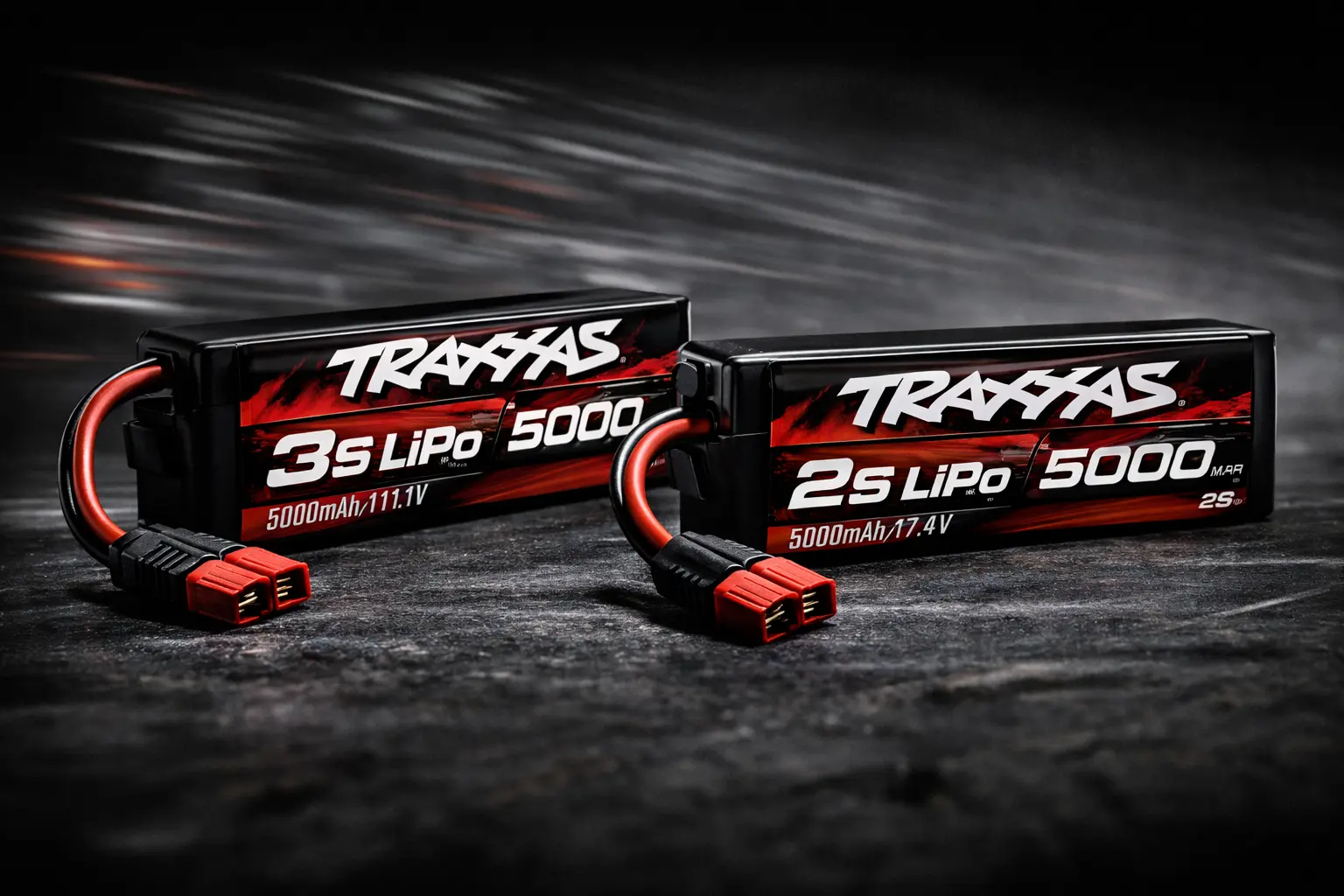
A LiPo cell nominally runs at 3.7V. Put two of them in series and you get 7.4V — that’s 2S. Three cells in series gives you 11.1V — that’s 3S. More voltage means the motor spins faster at the same throttle input, which translates directly into higher top speed and sharper acceleration.
| Spec | 2S LiPo | 3S LiPo |
|---|---|---|
| Nominal Voltage | 7.4V | 11.1V |
| Typical Speed Gain (vs. stock) | Baseline | +50–80% on VXL trucks |
| Acceleration | Linear, predictable | Sharp, can catch you off guard |
| Wheelie Risk | Low–moderate | High — expect frequent nose-ups |
| Motor Heat | Manageable | Significant — cooling fan recommended |
| ESC Heat | Low | Moderate to high — monitor temps |
| Runtime (5000mAh) | ~25–30 min bashing | ~18–22 min bashing |
| Wear on Parts | Normal | Accelerated — driveshafts, gears, slipper |
| Best For | Beginners, kids, tight spaces, crawlers | Experienced bashers, speed runs, open fields |
I ran my Slash 4x4 on 2S for the first month and thought it was plenty fast. Then I dropped in a 3S pack and it was like a completely different truck — the acceleration pinned the body back and the first wheelie caught me completely off guard. Going back to 2S after that felt like driving in slow motion.
The key thing to understand: 3S isn’t just faster — it changes how the truck drives. The throttle response becomes snappier, the front end gets light at full send, and any mistake happens in a fraction of the time you’d have to react on 2S. It’s not inherently dangerous, but it demands respect.
Which Traxxas Models Support 2S, 3S, or Both?
This is the section most people actually need. Compatibility depends on the ESC installed — not the motor, not the chassis. Here’s the full breakdown:
| Model | 2S Compatible | 3S Compatible | 4S / 6S / 8S | Recommended | Notes |
|---|---|---|---|---|---|
| Slash 4x4 VXL | ✅ ~35 mph | ✅ 60+ mph* | ❌ | 3S for speed, 2S for beginners | VXL-3s ESC |
| Slash 2WD VXL | ✅ | ✅ | ❌ | 2S to start | VXL-3s ESC |
| Slash 2WD Brushed | ✅ 2S max | ❌ | ❌ | 2S LiPo or NiMH | XL-5 ESC — 3S will fry it |
| Rustler 4x4 VXL | ✅ ~30–35 mph | ✅ 65+ mph* | ❌ | 3S (self-righting needs 3S) | VXL-3s ESC |
| Rustler 2WD VXL | ✅ | ✅ | ❌ | 3S for wheelie fun | VXL-3s ESC |
| Stampede 4x4 VXL | ✅ ~25 mph | ✅ 60+ mph* | ❌ | 2S for kids | VXL-3s ESC |
| Stampede 4x4 Brushed | ✅ 2S max | ❌ | ❌ | 2S LiPo or NiMH | XL-5 ESC — 3S will fry it |
| Hoss 4x4 VXL | ✅ ~40 mph | ✅ 60+ mph* | ❌ | 3S — built for it | VXL-3s, 540XL motor |
| Bandit VXL | ✅ | ✅ 70+ mph* | ❌ | 3S with speed pinion | VXL-3s, lightweight buggy |
| Maxx | ❌ | ✅ (reduced) | ✅ 4S — 60+ mph* | 4S (single pack) | VXL-4s ESC — 2S not supported |
| Mini Maxx | ✅ 2S only | ❌ | ❌ | 2S (included) | BL-2s ESC |
| E-Revo 2.0 | ❌ | ✅ (2×3S = 6S) | ✅ 2×3S (6S) | Dual 3S | VXL-6s ESC |
| X-Maxx | ❌ | ✅ (2×3S = 6S) | ✅ 2×4S (8S) | Dual 4S | VXL-8s ESC |
| Sledge | ❌ | ✅ (2×3S = 6S) | ✅ 2×3S (6S) | Dual 3S | VXL-6s ESC |
| TRX-4 / TRX-4M | ✅ | ✅ | ❌ | 2S for crawling | XL-5 HV ESC — both voltages work |
| TRX-4M | ✅ 2S only | ❌ | ❌ | 2S (included) | Micro crawler — tiny 750mAh pack |
Speed claims require optional high-speed gearing on flat pavement. Real-world stock gearing speeds are 10–20 mph lower.
The golden rule: if your truck has a VXL ESC, it handles both 2S and 3S without any changes to the truck. Just swap the battery. If it has a standard XL-5 brushed ESC, you’re limited to 2S maximum — 3S will burn it out.
For the multi-battery models (E-Revo, X-Maxx, Sledge), the VXL ESC reads the combined series voltage. Two 3S packs wired in series = 6S input to the ESC. Never mix different capacity or chemistry packs.
Running a Stampede? Our Stampede 4x4 vs 2WD comparison includes battery recommendations for each version.
Traxxas Power Cell Batteries — Worth the Premium?
Traxxas’s in-house Power Cell lineup covers everything from compact 1400mAh 3S packs for crawlers to 6700mAh 4S bricks for the X-Maxx. All Power Cells share identical electrical specs: 25C continuous / 50C burst discharge rating, 12AWG Maxx Cable silicone wiring, and the proprietary iD connector system.
Current Power Cell lineup with pricing:
| Part # | Config | Capacity | Best For | Street Price |
|---|---|---|---|---|
| 2843X | 2S 7.4V | 5,800mAh | All 1/10 VXL trucks — most popular 2S | ~$60–70 |
| 2869X | 2S 7.4V | 7,600mAh | Max runtime on 2S | ~$75–90 |
| 2872X | 3S 11.1V | 5,000mAh | Slash 4x4, Maxx Slash, Sledge — most popular 3S | ~$70–80 |
| 2857X | 3S 11.1V | 6,400mAh | XO-1, Drag Slash, premium bashing | ~$100–120 |
| 2889X | 4S 14.8V | 5,000mAh | Maxx (single), X-Maxx (×2) | ~$100–120 |
| 2890X | 4S 14.8V | 6,700mAh | X-Maxx and XRT — premium 4S | ~$160 |
What the iD system actually does:
The iD connector is fully proprietary. Inside each Power Cell is an RFID chip that communicates battery chemistry, cell count, capacity, recommended charge rate, and cycle history to any compatible EZ-Peak charger. When you plug in, the charger auto-detects everything — no menus, no settings, just press Start and walk away. It also uses physical balance terminal pins to verify cell count as a hardware failsafe.
For someone who’s never used a LiPo before, this is genuinely useful. The risk of destroying a battery through incorrect charge settings drops to essentially zero.
The downsides are real:
The 2843X (2S 5800mAh) costs $60–70 and is rated at 25C continuous. An equivalent Gens Ace 2S 5000mAh is available for $32–40 at 50C continuous — double the C-rating for half the price. Two Zeee 3S 5200mAh 80C packs run $35–45 total — less than a single Traxxas 3S at $70–80. The Power Cells are also only offered in a handful of capacities, so there’s no path to a larger pack within the ecosystem without a significant price jump.
The iD ecosystem also creates lock-in. Every advantage of auto-detection disappears the moment you buy an aftermarket battery. And if you ever want to use a proper hobbyist charger with features like storage mode, discharge cycling, or cell resistance monitoring, you’ll need the Traxxas iD Adapter (#2938) just to access those functions.
Honest verdict: The Power Cell makes sense for one specific buyer — someone new to RC who wants zero-hassle charging and is fine paying a premium for that convenience. For everyone else, the aftermarket saves you real money that can go into drivetrain upgrades.
I started with the Traxxas Power Cell because of the iD convenience — plug in, auto-detect, done. But at almost double the price of a Gens Ace with the same specs, I eventually switched. The Gens Ace with a Traxxas adapter has been running flawlessly for months now, and the money I saved bought me the motor cooling fan I needed for 3S anyway.
Best Aftermarket Batteries for Traxxas Trucks
The aftermarket LiPo market for Traxxas is mature and well-tested. Three brands consistently rise to the top of community recommendations across r/traxxas, r/rccars, and RC Talk.
Overview comparison:
| Battery | Cell Count | Capacity | C-Rating | Connector | Price | Best For |
|---|---|---|---|---|---|---|
| Gens Ace 2S 5000mAh | 2S 7.4V | 5,000mAh | 50C/100C burst | Deans/XT60 | ~$32–40 | Best overall 2S |
| Zeee 2S 5200mAh | 2S 7.4V | 5,200mAh | 50C–80C | Deans/XT60 | ~$14–18/pack | Budget 2S — often sold as 2-pack |
| Gens Ace 3S 5000mAh | 3S 11.1V | 5,000mAh | 50C/100C burst | Deans/XT60 | ~$35–45 | Best overall 3S |
| Zeee 3S 5200mAh | 3S 11.1V | 5,200mAh | 80C | Deans/XT60 | ~$18–22/pack | Budget 3S — best value per dollar |
Best Aftermarket 2S for Traxxas
Top pick: Gens Ace 2S 5000mAh 50C (~$32–40)
Gens Ace is the de facto standard recommendation in the RC community for a reason. The cells are consistent, the advertised C-rating holds up under load, and these packs routinely last 3–5 years with normal care. At 50C continuous — double the Traxxas Power Cell — they deliver cleaner power under hard acceleration with less voltage sag. Available in soft and hard case versions; hard case fits Traxxas battery trays cleanly. The main connector is Deans T-plug or XT60 depending on the variant, requiring either a simple adapter or a quick resolder.
Budget pick: Zeee 2S 5200mAh 80C (~$14–18 per pack)
Zeee packs often sell as 2-packs at $27–35, making the per-unit cost roughly one-quarter of the Traxxas 2843X. The advertised 80C C-rating is aggressive — real-world performance is closer to 50–60C under sustained load — but at this price, even two or three replacements over time costs less than a single Traxxas pack. Perfect for a new owner who wants an inexpensive way to double runtime by rotating two packs.
Best Aftermarket 3S for Traxxas
Top pick: Gens Ace 3S 5000mAh 50C (~$35–45)
The same reliability and cell quality that makes Gens Ace the 2S standard carries over here. The 50C rating matters more on 3S because the motor pulls harder current under hard acceleration, and a saggy cell under load is where electronics get stressed. Gens Ace is the battery many experienced bashers run before upgrading to competition-level brands like SMC or MaxAmps.
Budget pick: Zeee 3S 5200mAh 80C (~$18–22 per pack)
At $35–45 for a 2-pack, this is the answer to “I want to try 3S without spending $80.” Community members consistently recommend Zeee as a legitimate budget option — not premium, but perfectly safe and functional for bashing. Run these until you know 3S is your thing, then invest in Gens Ace or better.
Traxxas Plug vs. Adapter — What You Need to Know
Most aftermarket batteries come with a Deans T-plug (T-connector) or XT60 — not a Traxxas connector. There are three ways to handle this:
Option 1: Buy a pre-made adapter. A Traxxas to XT60 adapter or Traxxas to EC5 adapter costs $5–10 and plugs between the battery and the truck’s lead. Simple, reversible, and lets you run the same packs in multiple brands of trucks. The downside is a small additional connection point that can loosen over time and theoretically introduces minor resistance.
Option 2: Resolder the connector. Replace the battery’s T-plug or XT60 with a Traxxas connector directly. Permanent, clean, and eliminates the adapter. Requires basic soldering skills and the right connector ($2–5). This is what most experienced hobbyists do.
Option 3: Buy batteries with native TRX connectors. HRB and a handful of other brands sell packs specifically wired with Traxxas-style connectors. Slightly less common but eliminates all adapter concerns from day one.
Most new owners go with Option 1 first, then migrate to Option 2 once they’re comfortable with a soldering iron. Either approach is safe and widely used.
Traxxas Chargers & the iD System
The EZ-Peak lineup covers everything from a basic single-port charger to a 200W dual-output flagship. Which one you need depends on how many batteries you run and how quickly you want to charge them.
| Charger | Part # | Max Output | LiPo Support | Ports | Price | Best For |
|---|---|---|---|---|---|---|
| EZ-Peak Plus | 2970 | 4A / 40W | 2S–3S | 1 | ~$55–65 | Most buyers — handles all 2S and 3S packs |
| EZ-Peak Plus 4S | 2981 | 8A / 75W | 2S–4S | 1 | ~$85–100 | Maxx owners who need 4S support |
| EZ-Peak Live | 2971 | 12A / 100W | 2S–4S | 1 | ~$95–110 | Bluetooth app monitoring, faster charging |
| EZ-Peak Dual | 2972 | 8A / 100W | 2S–3S | 2 | ~$110–140 | Two-truck or two-battery owners |
| EZ-Peak Live Dual | 2973 | 26A / 200W | 2S–4S | 2 | ~$155–170 | Serious bashers with high-output needs |
How the iD auto-detect works: each iD-equipped Power Cell battery contains an embedded chip. When plugged in, the charger reads chemistry, cell count, capacity, and recommended charge rate automatically. It also uses the physical balance plug pins as a secondary confirmation of cell count — one, two, or three pins engaged tells the charger whether it’s looking at a 2S, 3S, or 4S pack. The result is a completely hands-off charging experience with no user input required.
Charging non-Traxxas batteries on an EZ-Peak charger: all EZ-Peak models include a manual “Advanced Mode” accessible by holding the mode button for several seconds. In this mode, you plug the battery’s balance lead into the front panel balance port and manually set chemistry, cell count, and charge current. Works fine — you just lose the auto-detection convenience. Most users set up their preferred settings once and the charger remembers them.
Charging Traxxas iD batteries on a third-party charger: you’ll need the official Traxxas iD Charging Adapter (part #2938, ~$10–15), which converts the single iD plug into a standard power lead plus JST-XH balance lead. Compatible with virtually any quality hobbyist charger — ISDT, SkyRC, Hitec, Venom, etc.
For a full breakdown of both Traxxas and third-party charger options, check out our best RC car charger guide.
When to Upgrade from 2S to 3S
There’s no single right answer — it depends entirely on who’s driving and where. Here’s how to think through it.
Upgrade to 3S when:
- You’ve spent at least 10–20 hours on 2S and feel fully in control of the truck at full throttle
- You bash in open spaces — parking lots, fields, trails with room to move
- You want wheelies on demand and don’t mind nose-ups
- You’ve already upgraded key wear parts: cooling fan, aluminum motor mount, steel spur gear, CVD driveshafts
- Your driving environment has a hard surface where motor temps stay manageable
Stay on 2S when:
- You’re new to RC or buying for a child
- You bash in tight spaces — backyard, small parking lot, indoors
- You want maximum runtime without stopping to let electronics cool
- You want the truck to last longer without parts breakage
- You’re running in hot weather or tall grass where thermals are already a concern
Pro tip: if you’re running 3S in a Traxxas VXL truck, keep an eye on your motor temps for the first few runs. My Rustler’s motor was hitting 180°F on a hot day until I adjusted the gearing. The ESC’s thermal protection kicked in twice before I figured that out. Get an IR thermometer ($15–20), check after every 5-minute run, and stay under 160°F on the ESC and 180°F on the motor. If you’re hitting those numbers, you’re either over-geared or running in conditions that demand a cooling fan.
The Traxxas Hoss review covers one of the best trucks to experience the 2S-to-3S jump on — its lower gearing keeps motor temps more manageable than the Slash, and the extra weight absorbs the power spike more predictably than lighter buggies.
For a deeper dive into LiPo specs, safety, and brands, check out our complete RC LiPo battery guide.
Start with 2S, and when you find yourself wishing for more every single run — that’s when you know you’re ready for 3S.
FAQ
Q: Can I run 3S in a Traxxas Slash?
Yes, if your Slash has the VXL brushless system (Slash 4x4 VXL, Slash 2WD VXL). The VXL-3s ESC is rated for 2S and 3S LiPo out of the box. On 3S, a Slash 4x4 VXL reaches 45–55 mph on stock gearing, with 60+ mph possible using the optional speed pinion. If your Slash has the XL-5 brushed ESC (standard Slash 2WD), it is limited to 2S maximum — 3S will damage the electronics.
Q: Do I need a different charger for 3S?
Not if you already own a Traxxas EZ-Peak Plus (2970) — it handles 2S and 3S natively. If you own the older EZ-Peak Live (2971) single-port model, that also supports 2S–4S. The only charger you’d need to upgrade is if you own a very old Traxxas charger without balance charging capability. Any modern LiPo balance charger from a third-party brand (SkyRC, ISDT, etc.) handles both 2S and 3S.
Q: Will 3S damage my Traxxas truck?
Not immediately and not inherently — the VXL-3s ESC is designed for it. What 3S does is dramatically accelerate wear on mechanical parts: driveshafts snap more easily under the torque spikes, the slipper clutch takes more abuse, gears wear faster, and servos get stressed by more powerful responses. Running 3S on a completely stock, unmodified truck is possible, but most experienced users recommend upgrading to CVD driveshafts, a steel spur gear, and a motor cooling fan before committing to regular 3S use.
Q: Are Traxxas batteries better than Gens Ace?
On paper, Gens Ace wins on specs: 50C continuous vs. 25C for the Power Cell, lower price per unit, and comparable or better real-world longevity according to the community. Where Traxxas wins is convenience — the iD auto-detect system genuinely simplifies charging for beginners, and the Lifetime Exchange Program adds some long-term value. If you’re comfortable using a standard LiPo balance charger manually or with an adapter, Gens Ace is the better value proposition. If you want the absolute simplest charging experience and don’t mind paying more per pack, Traxxas Power Cells deliver that.
Q: How long does a 3S LiPo last in a Traxxas truck?
Runtime on a 5000mAh 3S pack runs approximately 18–22 minutes of active bashing, or up to 25–30 minutes of mixed light use and crawling. Testing on a Slash 4x4 VXL shows roughly a 25–30% shorter runtime on 3S versus 2S at equal capacity — not because 3S is electrically less efficient, but because 3S encourages more aggressive driving. Battery lifespan in terms of charge cycles is typically 200–400 cycles for quality packs with proper care, or roughly 2–5 years depending on usage frequency and how well you follow LiPo storage protocols.
Conclusion
For most new Traxxas owners, the right call is to start on 2S, go aftermarket. A Gens Ace or Zeee 2S 5000–5200mAh pack at $18–40 delivers genuinely fast performance, won’t punish the drivetrain, and leaves money in your pocket for the upgrades that 3S will eventually demand. When you’re ready to make the jump, the Gens Ace 3S 5000mAh is the community-tested pick — consistent cells, real 50C output, and priced at roughly half of what Traxxas charges for the equivalent Power Cell. Get a cooling fan, check your gearing, monitor your temps, and you’ll wonder why you waited so long to make the switch.
See our complete guide to Traxxas RC cars for the full lineup breakdown, model comparisons, and upgrade paths.