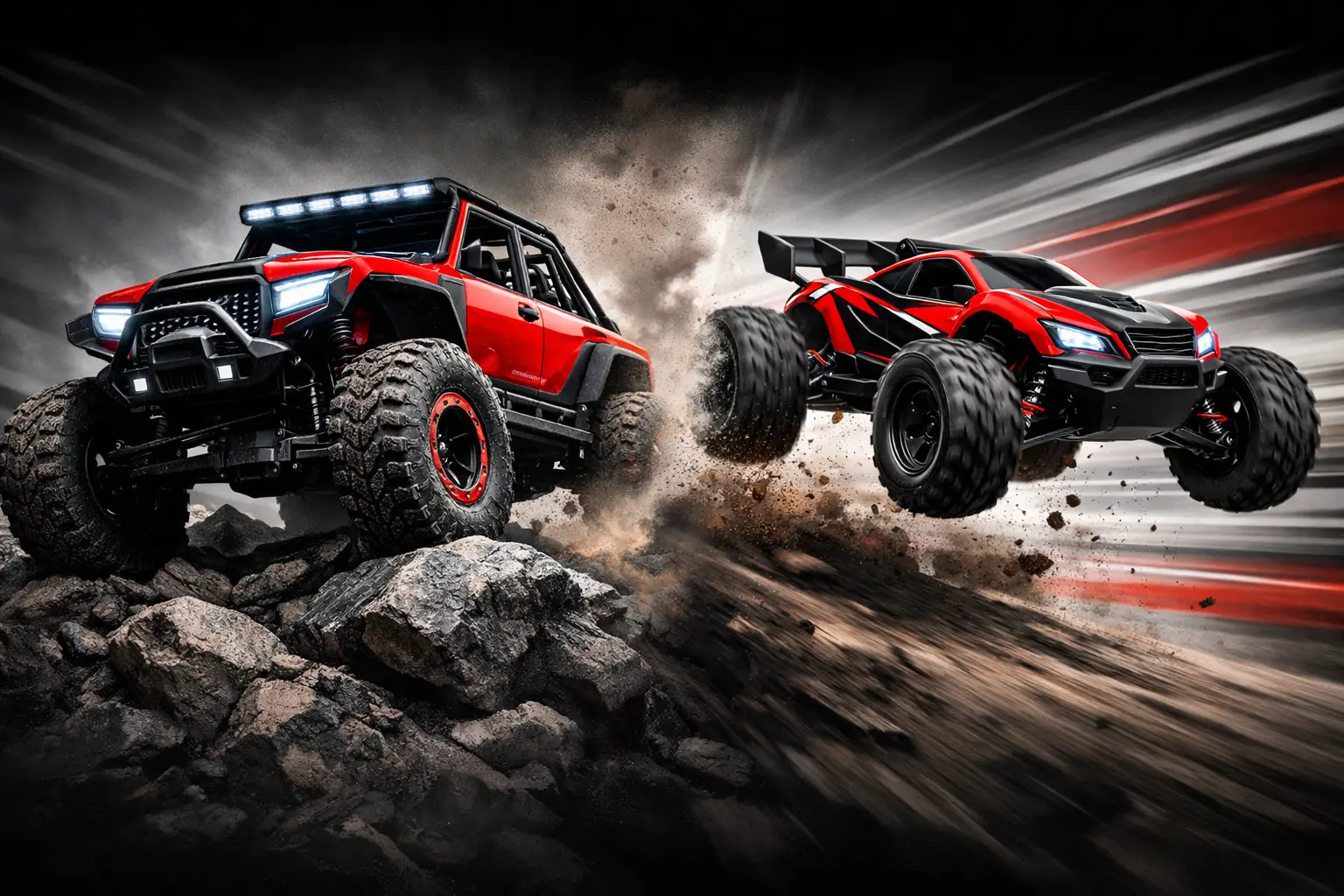
Picture this: one guy is standing at the edge of a rock pile, watching his truck inch its way over a boulder with surgical throttle control — not a sound except for the soft whir of a motor and the crunch of tires on granite. Twenty miles away, another guy is launching a Kraton off a dirt ramp, both hands in the air, screaming. His truck just cleared six feet of airtime and somehow survived the landing. Both are having the time of their lives. Both are playing with RC cars. These are two completely different hobbies — and this guide will help you figure out which one is yours.
This post contains affiliate links. If you make a purchase through these links, we may earn a commission at no extra cost to you.
What Is RC Crawling?
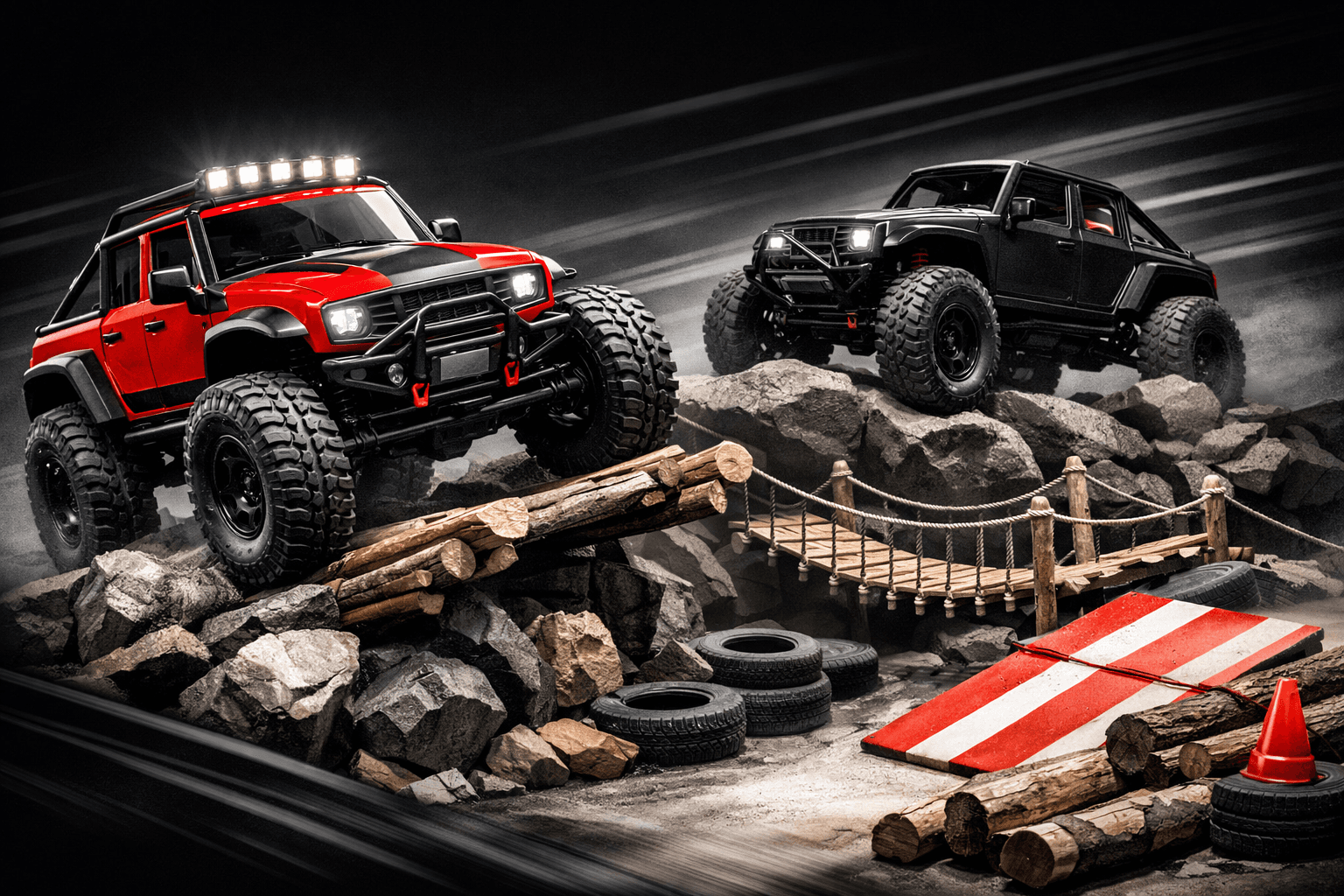
RC crawling is the art of navigating rugged, technical terrain at low speed with maximum precision. Where most RC disciplines reward going fast, crawling rewards going smart — reading a line, managing weight transfer, placing each tire exactly where it needs to go to maintain traction without tipping. The slower you can go while still making forward progress, the better.
The philosophy borrows directly from full-size 4×4 off-roading: scale realism, trail etiquette, and the patience to problem-solve your way through terrain that looks physically impossible. Crawlers run massive articulation suspension, purpose-built traction tires, and low-range gearing that gives you torque at a standstill. It’s less about speed and more about capability.
The hobby breaks into several distinct flavors. Trail running is the most relaxed — realistic-looking trucks navigating natural dirt paths and rocky terrain. Comp crawling is purpose-built competition with gate-based scoring, extreme tube chassis builds, and portal axles designed for one thing: defeating obstacles. Scale building is the craft branch of the hobby, where hobbyists spend dozens of hours adding interiors, working lights, weathering effects, and miniature accessories to create rolling dioramas. And then there’s micro crawling — 1/24 scale rigs like the Axial SCX24 that let you build an indoor rock garden on your kitchen counter or your desk.
I didn’t expect to fall for crawling. My first two RC cars were bashers — I wanted speed, I wanted chaos, I wanted to jump things. Then a buddy brought his TRX-4 to a trail day, and I humored him. Forty-five minutes later I was completely absorbed, trying to find the perfect line through a rocky section I’d already failed six times. That was the beginning of my second hobby addiction.
A typical crawling session looks like this: you park at a trailhead or set up an obstacle course, battery in, and spend 90 minutes to two hours slowly working through challenges. Batteries last forever at crawling speeds. The conversation flows between attempts. Nobody’s in a rush. When you finally nail a line that’s been defeating you all afternoon, the satisfaction hits completely differently from anything bashing ever delivered. It’s the RC equivalent of solving a puzzle.
For a full deep-dive into the crawler category, check out our RC Crawlers: Everything You Need to Know Before You Buy.
What Is RC Bashing?
RC bashing is driving your RC car with zero rules, zero structure, and maximum throttle. There’s no track, no competition format, no judging. You find open terrain — a parking lot, a skate park, a field, a BMX track — and you go absolutely full send. Jumps, crashes, wheelies, drifts, backflips: all encouraged, none required.
The appeal is immediate and visceral. Brushless bashers run 50–70+ mph. They launch 6 feet off ramps. They flip, roll, and survive impacts that would destroy lesser machines. The whole point is to push the vehicle past what seems reasonable and watch what happens next — which is usually spectacular.
Bashing styles range from backyard bashing (the universal entry point — literally everyone starts here) to park bashing (skate parks and dirt lots with natural obstacles), speed runs (chasing flat-ground top speed with vehicles that can exceed 100 mph), and freestyle (deliberate stunts, practiced jumps, and the art of making a crash look intentional). YouTube culture has shaped the bashing community more than almost any other RC discipline — channels like Kevin Talbot’s (3.38 million subscribers, 1.6 billion views) have introduced millions of people to what a properly equipped basher can actually do.
My own bashing story started with a Traxxas Slash I got for Christmas at 16. First session ended with a broken A-arm and a grin I couldn’t explain. I fixed it, went back out, and spent the next two years learning the hard way that throttle control is a real skill and replacement parts are a real expense. But the moment a jump goes exactly right — the car rotates perfectly, lands nose-first, and keeps going — there’s nothing quite like it.
A bashing session runs hot and fast. You show up, rip through 2–3 batteries in 45–90 minutes, and walk away slightly adrenaline-fried and already scrolling for the next spot. Sessions are social — there’s always someone watching, always someone egging you on to send the bigger gap. The energy is completely different from crawling: louder, more chaotic, and more likely to end with you laughing at a spectacular self-inflicted disaster.
For a full guide to the best off-road bashers, see our Best RC Trucks & Bashers: Off-Road Buying Guide.
Head-to-Head: 8 Key Differences
1. The Fun Factor
Both hobbies deliver genuine, lasting fun — but through completely different mechanisms.
Crawling fun is technical and accumulative. The satisfaction builds slowly: first you can’t get over that rock, then you sort of can, then you nail it clean, then you start helping others find lines. There’s a zen quality to a crawling session that bashers sometimes dismiss until they’ve actually tried it. The problem-solving loop is genuinely addictive. Scale builders find additional layers of fun in detailing and customization that have nothing to do with driving at all.
Bashing fun is immediate and explosive. The first time you hit 50 mph in a parking lot, your brain lights up like a pinball machine. Jumps deliver pure dopamine. Crashes are funny rather than tragic because the cars are built to survive them. The social spectacle aspect — having non-hobbyists watch your 1/8 scale monster truck backflip off a ramp — is a unique kind of fun that crawling simply can’t replicate.
Neither is objectively better. They hit completely different parts of your brain.
2. Skill & Learning Curve
Both hobbies are easy to start and deep to master — but the skills required are different.
Crawling demands precision throttle control, an understanding of weight transfer, and the ability to read terrain and choose lines. These skills take real time to develop. The upside: crashes happen at very low speed, so the penalty for mistakes is minimal. You learn by repetition without constantly rebuilding your truck.
Bashing is easier to pick up immediately (“point the car, hit the throttle”) but developing real skill — smooth throttle management at 60 mph, consistent jump landings, controlled drifts — takes genuine practice. The penalty for mistakes is parts. You’ll break things during the learning curve, and that’s just part of the deal.
3. Cost to Get Started
This is where scale matters enormously. Most RTR vehicles at 1/10 and larger ship without batteries or charger — budget an additional $80–$150 for a quality LiPo + charger combo.
| Category | RC Crawling | RC Bashing |
|---|---|---|
| Entry RTR | $140–$370 | $170–$350 |
| LiPo Battery | $25–$50 | $35–$70 |
| Charger | $30–$60 | $30–$60 |
| Total to Start | $200–$480 | $240–$480 |
The Axial SCX24 at ~$140 is a genuine outlier — it ships with battery and charger included, making it the most accessible entry point in either hobby. Most 1/10 setups on both sides end up in the $350–$500 all-in range.
4. Ongoing Costs & Maintenance
This is where crawling and bashing truly diverge.
Crawling has low mandatory maintenance costs. Slow speeds mean you rarely break structural parts. The spending you’ll do is mostly voluntary: better tires ($20–$40/pair), a stronger servo ($30–$80), scale accessories (mirrors, light bars, scale figures), and eventually a better body. This spending is addictive but completely optional. A crawler can run for years on its stock setup.
Bashing extracts a parts tax. Stock A-arms ($5–$15/pair) are designed as sacrificial fuses — they’re meant to break so harder parts don’t. Body shells get destroyed. Driveshafts snap under high-torque landings. Shock towers crack. Budget $100–$300/year for a moderate weekly basher; aggressive bashers often spend $300–$500+. The upgrade trap is particularly real here: replacing stock plastic arms with aluminum sounds sensible until the upgraded arm transfers force directly to your chassis, cracking a $80 bulkhead instead of a $12 arm.
Battery consumption also differs dramatically. Bashers get 15–25 minutes per pack at full throttle; crawlers get 45–90+ minutes. For the same battery count, crawlers get roughly 3–5× more run time.
5. Space & Location
Crawling wins this category decisively. The Axial SCX24 and Traxxas TRX-4M run beautifully in a living room, on a desk, or in a small backyard. Full-size 1/10 crawlers thrive in garden beds, local hiking trails, rocky riverbeds, and any natural terrain with interesting features. You can set up a legitimately challenging course in a 10×10 foot area with rocks, sticks, and a handful of boards.
Bashing needs room — real room. A skate park, a large open parking lot, a dirt field, a gravel pit. You can do backyard bashing, but a backyard that’s genuinely fun at 50 mph is a large backyard. Many bashers cite finding good locations as one of the hobby’s real friction points, especially in urban areas.
6. Time Per Session
A crawling session typically runs 1.5–3 hours at a relaxed pace, with conversations, multiple attempts at the same obstacle, and long battery life reducing the urgency. It’s an afternoon activity, not a quick burn.
A bashing session runs 30–90 minutes of high-intensity driving, limited primarily by how many batteries you brought. At 15–20 minutes per pack with a 3S vehicle, two batteries gives you 30–40 minutes before you’re done. Many bashers drive hard, go home, charge, repeat.
Neither is better — it depends entirely on what kind of session you want.
7. Social & Community
Both hobbies have enormous, welcoming communities — but the vibe is completely different.
The crawling community skews toward organized events, clubs, and structured fun. Major events like USTE (Ultimate Scale Truck Expo in Williston, Florida) bring hundreds of crawlers together for trail running, show-n-shine judging, and community workshops. The RECON G6 traveling series runs at off-road parks nationwide with “Hands Off Ground” scale-realism rules. Forums like RCCrawler.com have millions of posts. The community tends to skew slightly older and more methodical — a lot of people who love craftsmanship and detail work end up in crawling. For a deeper look at competitive crawling, see our RC Crawler Competition Guide.
The bashing community is massive, informal, and YouTube-first. Kevin Talbot’s channel alone has driven millions of people into the hobby. Facebook bashing groups organize park meetups spontaneously. The ARRMA Forum has hundreds of thousands of members. Bashing is social in an immediate, spontaneous way — you show up at a park with your truck and you’ve instantly got an audience.
8. Long-Term Depth & Customization
Both hobbies are effectively bottomless in their customization potential — just in different directions.
Crawling depth runs toward mechanical optimization and creative expression: upgraded axles, better differentials, custom suspension links, and then the entire world of scale building — scratch-built bodies, painted interiors, working LED light bars, functional spare tires, and scale accessories that make a crawler indistinguishable from a 1/10 scale movie prop. The hobby has a genuine craft dimension that has no equivalent in bashing.
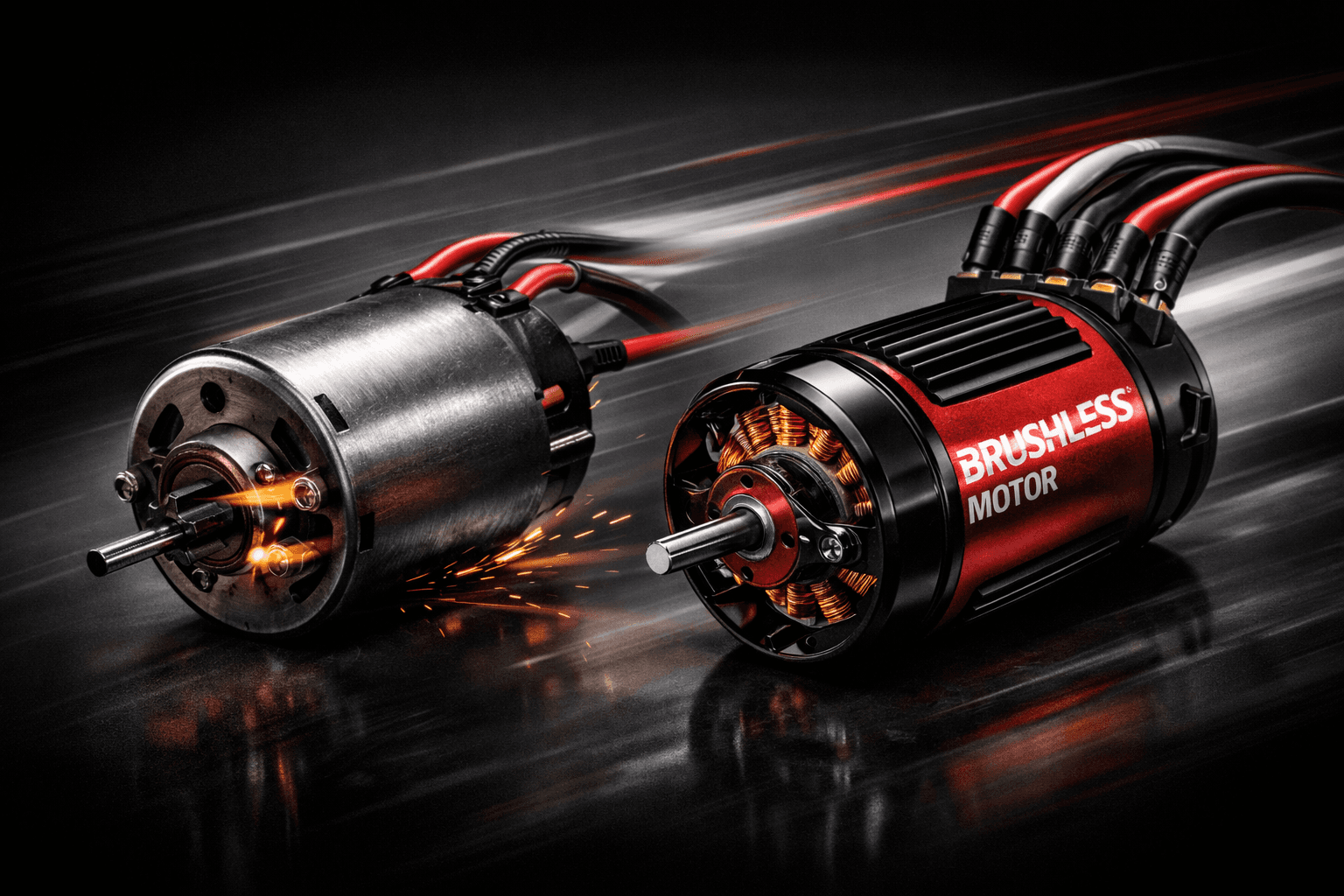
Bashing depth runs toward performance escalation: brushed to brushless, 2S to 3S to 6S, stock to EXB chassis, bone-stock to full RPM arms and aluminum everything. The progression from “Granite 3S that goes fast” to “custom 8S monster” is a multi-year, multi-thousand-dollar journey that plenty of bashers happily embark on.
The Comparison Table
| Factor | RC Crawling | RC Bashing | Edge |
|---|---|---|---|
| Fun Factor | Technical, zen, puzzle-solving | Adrenaline, spectacle, social | Tie |
| Learning Curve | Harder technique, easier on hardware | Easy to start, steep on wallet | Crawling |
| Entry Cost | $200–$480 | $240–$480 | Tie |
| Ongoing Costs | Low (optional upgrades) | High (mandatory repairs) | Crawling |
| Space Needed | Backyard / living room | Large open area required | Crawling |
| Session Length | 1.5–3 hours | 30–90 minutes | Crawling |
| Battery Life | 45–90+ min per pack | 15–25 min per pack | Crawling |
| Social Vibe | Organized, club-oriented | Spontaneous, park meetups | Tie |
| Long-Term Depth | Endless (craft + mechanical) | Endless (performance) | Tie |
| Adrenaline Level | 🟡 Low–Medium | 🔴 Very High | Bashing |
| Noise Level | 🟢 Quiet | 🔴 Loud | Crawling |
| Indoor Friendly | ✅ Yes (1/24 scale) | ❌ No | Crawling |
| Kid Friendly | ✅ Yes | ✅ Yes (with supervision) | Tie |
| Zen Factor | 🔴 Very High | 🟡 Low | Crawling |
Best Vehicles for Crawling
Best Beginner Crawler — Axial SCX24
The Axial SCX24 is the single best entry point in all of RC crawling. At ~$140–$160 with battery and charger included, it removes every barrier to getting started. The 1/24 scale format lets you run it anywhere — kitchen counter, bedroom floor, outdoor patio — while the chassis geometry and soft independent suspension perform surprisingly well on real terrain. The aftermarket is enormous: portal axles, brass weights, upgraded servo, multiple body options. Thousands of people who started with an SCX24 still own one years later after building entire fleets of larger crawlers. More micro crawler options in our Best RC Crawlers by Scale guide.
Best Mid-Range Crawler
Two options dominate at the 1/10 RTR level, and your choice depends on preference:
The Axial SCX10 III (~$350–$480) is the evolution of the most iconic crawler platform ever built. Portal axle options give it exceptional ground clearance; the steel-tube frame and scale V8 housing give it visual credibility. It’s the benchmark of the trail-running segment.
The Traxxas TRX-4 (~$400–$530) adds a 2-speed transmission and T-Lock differentials, giving you high range for faster trail speeds and low range for technical obstacles. The fully waterproof electronics mean you can run it in anything. If you want a crawler that can also hustle between obstacles on a trail day, the TRX-4 is hard to beat.
Both need a battery and charger — budget an extra $80–$130 for a quality 2S LiPo and charger combo.
Best Micro Crawler (Indoor)
The Traxxas TRX-4M (~$180–$230) scales the TRX-4’s legendary platform down to 1/18 with battery and charger included, delivering 60+ minutes of runtime. The High Trail Edition adds more ground clearance and a more aggressive look. It runs beautifully indoors and outdoors, making it the best bridge between micro convenience and full-scale performance.
Best Vehicles for Bashing
Best Beginner Basher — Arrma Granite 3S BLX
The Arrma Granite 3S BLX (~$280–$330) is the community’s most-recommended entry-level brushless basher. The 3S brushless system pushes 50+ mph, the 1/10 monster truck format handles rough terrain without complaint, and the ARRMA parts network means you’ll never wait long for replacement components. The modular “power module” design makes maintenance straightforward. Bring it home, add a 3S LiPo and charger (~$100–$130 extra), and you have a legitimate basher for under $450 total.
Best Mid-Range Basher — Traxxas Slash 4x4 VXL
The Traxxas Slash 4x4 VXL (~$370–$430) has been one of the best-selling RC vehicles in the world for over a decade for good reason. The short course truck format handles dirt, grass, gravel, and pavement with equal confidence. Traxxas Stability Management (TSM) helps new drivers keep it pointed in the right direction at speed. The VXL brushless system is fast, programmable, and has years of proven reliability. Add a 3S LiPo and charger to the all-in total.
Best Premium Basher — Traxxas Maxx 4S
The Traxxas Maxx 4S (~$500–$570 without battery) is the sweet spot between the accessible mid-range and the monstrous X-Maxx. The self-righting feature recovers the truck automatically after flips, WideMaxx stance dramatically improves stability, and Sledgehammer tires bite into nearly any surface. The 4S power system hits 60+ mph and handles real air time without drama. At around $700–$750 all-in with a quality 4S LiPo and charger, it’s the best true premium bash platform money can buy without crossing into X-Maxx territory.
Why Not Both? The Case for Owning a Crawler AND a Basher
Here’s the thing nobody tells you when you’re choosing between crawling and bashing: the majority of long-term RC enthusiasts end up doing both. Not because they couldn’t choose, but because they discovered the two hobbies fill completely different needs. Crawling is a Sunday afternoon with coffee. Bashing is a Saturday with friends and trash talk. They’re not competing for the same slot in your schedule.
The $140 Axial SCX24 has converted more dedicated bashers into crawler addicts than any other vehicle in history. It’s cheap enough to buy on a whim, and interesting enough to keep you hooked. Conversely, borrowing a friend’s Arrma Granite for one afternoon has pushed many patient scale builders into their first backyard bash session.
The community has collectively arrived at a consensus: two dedicated vehicles always outperform one compromise hybrid. The good news is that a crawler-and-basher combo doesn’t have to break the bank.
Budget Combo (~$400–$500 total)
Arrma Granite 3S BLX ($330) + Axial SCX24 ($140)
The SCX24 ships with battery and charger — no extras needed. Add a single 3S LiPo + charger combo (~$100–$130) for the Granite and you have a legitimate basher and a legitimate crawler for under $600 total. This is the single best way to explore both hobbies without overcommitting. Both vehicles are beginner-appropriate, both have massive aftermarket support, and neither will leave you frustrated with build quality.
Mid-Range Combo (~$650–$850 total)
Traxxas Slash 4x4 VXL ($430) + Traxxas TRX-4M ($200)
The TRX-4M ships ready to run with battery and charger. The Slash needs a 3S LiPo + charger ($100–$130 extra). Staying within the Traxxas ecosystem means one app, one ecosystem of parts, and compatible batteries across both vehicles. The TRX-4M handles real outdoor trail work despite its micro size, and the Slash 4x4 is a proven mid-range basher with years of community support.
Hybrid Vehicles: The Best of Both Worlds?
The Losi Lasernut U4 (~$350 at Horizon Hobby) is the most serious attempt at bridging both worlds. Inspired by real Ultra4 rock racers, it pairs a brushless motor with rock racer geometry that handles both moderate technical terrain and faster off-road running. It’s a genuinely unique vehicle with a passionate community. See our full Losi Lasernut U4 Review for an in-depth look.
The honest verdict from the community: the Lasernut excels at its specific niche — rock racing — but isn’t truly competitive with a dedicated crawler on technical terrain, nor durable enough to match a real basher under sustained abuse. Trail trucks like the Element Enduro are a gentler middle ground for people who want one vehicle that leans toward crawling but can also move at trail speed.
If budget is tight, start with the Lasernut or a trail truck and explore both ends of the spectrum. Once you know which side pulls harder, invest in a dedicated machine for that discipline.
Quiz: Are You a Crawler or a Basher?
Answer honestly — add up your points and find out where you belong.
1. Your perfect Saturday afternoon looks like:
- A) Solving a challenging puzzle at your own pace, coffee in hand → +2 Crawler
- B) Yelling “SEND IT” with three friends in a parking lot → +2 Basher
2. When your RC car breaks, you:
- A) Take it as an opportunity to upgrade while you’re in there → +2 Crawler
- B) Fix it as fast as possible so you can get back out there → +2 Basher
3. Your available driving space is:
- A) A small backyard, apartment balcony, or local hiking trail → +2 Crawler
- B) A nearby park, open field, or skate park → +2 Basher
4. When you watch RC YouTube, you’re more drawn to:
- A) Scale builders painting tiny details or rock crawling trail runs → +2 Crawler
- B) Kevin Talbot sending a Kraton off a 10-foot ramp → +2 Basher
5. “Full send” makes you feel:
- A) Slightly anxious — that truck is going to break → +2 Crawler
- B) Physically excited — that’s the whole point → +2 Basher
6. How long do you want your RC session to be?
- A) 2–3 relaxed hours on a trail → +2 Crawler
- B) 45 minutes of pure intensity, then go home → +2 Basher
Score 8–12 Crawler points: You’re a crawler at heart. Start with the Axial SCX24 or jump straight to the SCX10 III — you’ll love the precision and depth of the hobby.
Score 8–12 Basher points: Get a brushless basher and never look back. The Arrma Granite 3S or Traxxas Slash 4x4 VXL will give you exactly what you’re looking for.
Score 6/6 or split: You’re a natural hobbyist who will end up with both. Start with whichever feels slightly stronger, then pick up the other side within 6–12 months. The Budget Combo above was built for you.
FAQ
Q: Is RC crawling or bashing better for beginners?
Both are genuinely beginner-friendly, but for different reasons. Crawling is forgiving on hardware — low speeds mean you rarely break things while learning — but it demands patience that not every beginner has. Bashing delivers faster rewards and is easier to pick up instinctively, but you’ll break parts during the learning curve. If budget is tight and you can’t afford regular part replacements, crawling is the smarter first choice. If you want instant excitement and don’t mind a learning tax in broken A-arms, start with a basher. Complete beginners should also check out our RC Cars for Beginners: The Complete Buying Guide before buying anything.
Q: Which is cheaper, crawling or bashing?
Entry costs are roughly comparable ($200–$500 all-in for either), but ongoing costs favor crawling significantly. Crawlers rarely break structural parts due to low speeds, so maintenance spending is mostly optional upgrades. Bashers break parts regularly — A-arms, driveshafts, body shells — and annual parts spending of $150–$400 is realistic for active bashers. Crawlers also get 3–5× more run time per battery, reducing battery costs over time.
Q: Can the same RC car be used for crawling and bashing?
Not really well. Vehicles optimized for crawling have soft suspension, low gearing, and torque-focused drivetrains that make them slow and vulnerable on bashing terrain. Bashers have stiff suspension and high-speed drivetrains that are terrible for technical rock work. The Losi Lasernut U4 is the most serious hybrid attempt and handles moderate versions of both, but it won’t match a dedicated vehicle at either discipline. The community consensus is clear: two purpose-built vehicles beat one compromise hybrid every time.
Q: Is RC crawling boring compared to bashing?
Only if patience isn’t your thing. Crawling is meditative rather than explosive — the satisfaction is technical and cumulative rather than immediate and visceral. Many dedicated bashers have been completely surprised to find themselves addicted to crawling once they actually tried it. The “boring” reputation comes entirely from people who’ve never spent 20 minutes trying to nail a single line on a rock garden. If you’ve genuinely tried it and it doesn’t click, that’s valid — not every hobby is for every person.
Q: What’s the best RC car if I want to do both crawling and bashing?
For a single vehicle that genuinely does both at a beginner level, the Losi Lasernut U4 ($350) is the most capable option. For a two-vehicle combo that does both properly, the Arrma Granite 3S + Axial SCX24 combo ($470–$490 total with extras) is the best value in the hobby right now — a true brushless basher and a full-capability crawler with battery and charger included, without breaking $500.
Your Move
There’s no wrong answer here. The RC hobby is big enough to contain two completely opposite philosophies — the zen of precision crawling and the chaos of full-send bashing — and both are genuinely great ways to spend your time and money.
If you want calm, technical, creative satisfaction with low ongoing costs and the freedom to drive anywhere: start crawling. If you want adrenaline, spectacle, and the thrill of speed: start bashing. And if your gut is telling you that both sound amazing? Trust it. The sweet spot most hobbyists eventually reach is one of each — a crawler for the patient days and a basher for when you need to send it.
Dive deeper into whichever side calls to you: RC Crawlers: Everything You Need to Know Before You Buy or Best RC Trucks & Bashers: Off-Road Buying Guide. See you on the trail — or at the ramp.