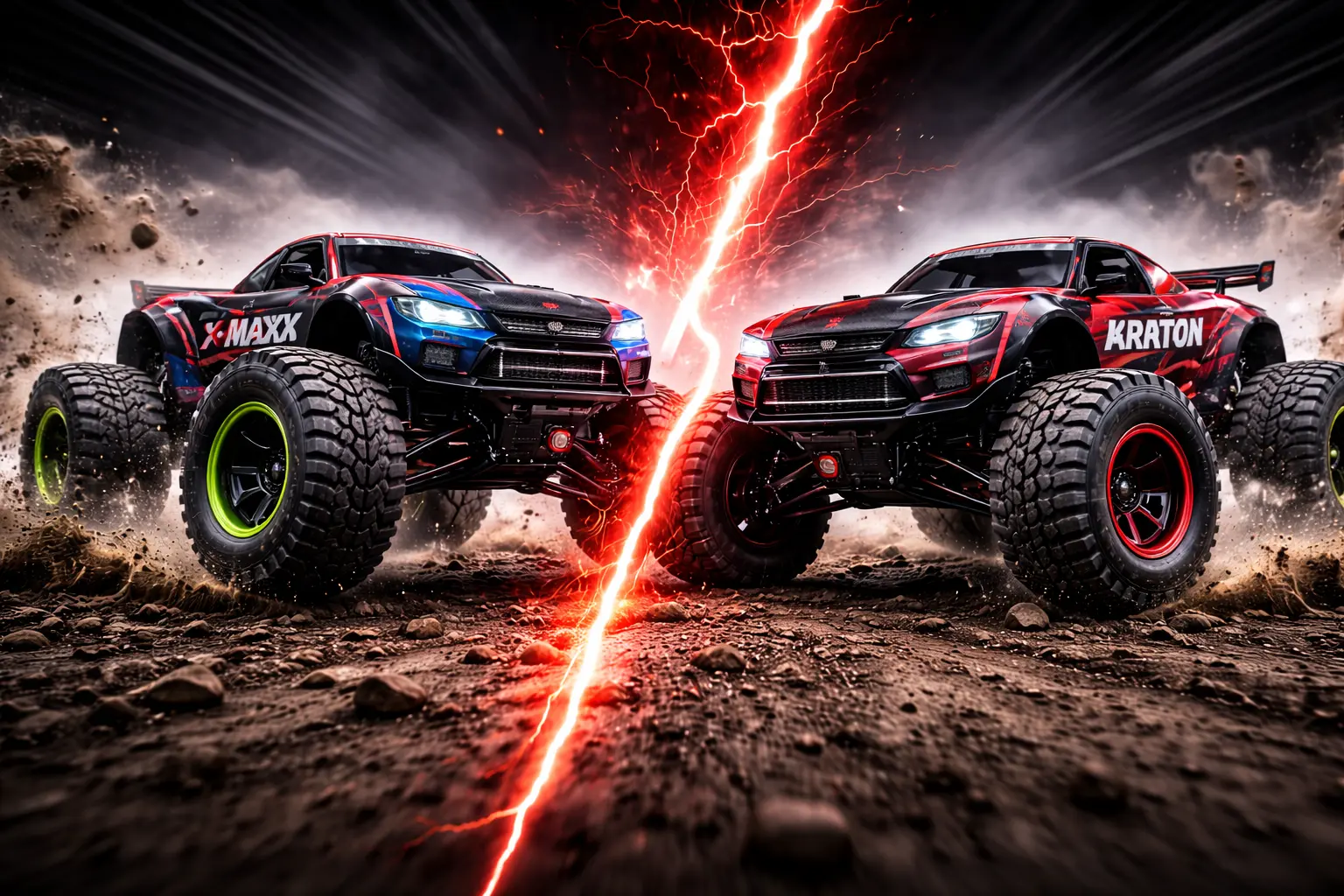
Eight hundred-plus dollars in your hands, standing in a parking lot, watching a 20+ pound monster truck punch a 4-foot gap and land on its roof — that’s the moment you realize the Traxxas X-Maxx and the Arrma Kraton 8S are in a category of their own. These two trucks have dominated the 1/5-scale bashing conversation for years, and the debate between them is genuinely one of the most heated in RC. Both run on dual 4S LiPo packs for devastating 8S power. Both can reach 40+ mph out of the box. Both will absolutely destroy anything smaller than themselves on a trail or a skatepark. But they feel and drive like completely different machines — and after running both extensively, I can tell you the choice matters more than most comparison guides admit.
This post contains affiliate links. If you make a purchase through these links, we may earn a commission at no extra cost to you.
Specs Face-Off: X-Maxx vs Kraton 8S
| Spec | Traxxas X-Maxx 8S | Arrma Kraton 8S EXB |
|---|---|---|
| Price | ~$1,199.95 | ~$1,099.99 |
| Scale | ~1/5 (“X-Truck”) | 1/5 |
| Length | 30.67” (779 mm) | 30.35” (771 mm) |
| Width | 21.3” (540 mm) | 23.7” (602 mm) |
| Height | 13.99” (355 mm) | 11.1” (282 mm) |
| Weight (no battery) | 19.1 lbs (8.66 kg) | 24 lbs 11 oz (~11.2 kg) |
| Wheelbase | 18.92” (480 mm) | 19.33” (491 mm) |
| Motor | Velineon 1200XL, 1275 Kv | Spektrum Firma 5687, 1100 Kv |
| ESC | VXL-8s, waterproof | Firma 160A V2 Smart, waterproof |
| Radio | TQi 2.4 GHz, 2-channel, TSM | Spektrum DX3, 3-channel, DSMR + AVC |
| Servo | ~365 oz-in (plastic gears) | S6510, 820 oz-in (steel gears) |
| Suspension Travel (front / rear) | 4.3” / 4.25” | ~3.5” / ~3.5” |
| Claimed Top Speed | 50+ mph | 60+ mph |
| Tested Top Speed (stock) | ~42 mph | ~42 mph |
| Battery | 2x 4S LiPo, Traxxas iD connector | 2x 4S LiPo, IC5/EC5 connector |
| Drivetrain | 4WD, 2 diffs + torque-biasing center | 4WD, 3 independent diffs |
| Waterproof Rating | Full waterproof electronics | Full waterproof electronics |
| Self-Righting | Yes | No |
| Built-in Telemetry | No (optional $30 module) | Yes (Smart ESC, native) |
Size & Presence
The first time I picked up the X-Maxx at my local hobby shop, I genuinely laughed. It’s not just big — it has a presence, like carrying a small dog that could eat your hand. At 13.99 inches tall with 7.48-inch Sledgehammer tires, it looks like a full-scale monster truck shrunk down by someone who thought 1/8 scale was too easy. When I set it on the ground, a kid walking past stopped and said “that’s not an RC car.” He was mostly right.
The Kraton 8S tells a different story. It’s wider at 23.7 inches — nearly 2.5 inches wider than the X-Maxx — which gives it a more aggressive, planted stance. But it sits noticeably lower with a distinctly motorsport silhouette, more truggy than monster truck. Less “look at me” presence, more “I will corner faster than you expect.”
The weight gap is where it gets real for everything that follows. The X-Maxx at 19.1 lbs is already substantial, but the Kraton at nearly 25 lbs is in another category entirely. That 5.6-pound difference shapes the durability, battery life, and handling story more than any single spec on the sheet.
Power & Speed
X-Maxx: Raw Power
The X-Maxx runs a single Velineon 1200XL motor (1275 Kv) paired with the VXL-8s ESC. It’s not a dual-motor system — the “8S” simply means two 4S packs in series pushing roughly 30 volts through one very large motor. The torque-biasing center drive sends power rearward under hard acceleration, which is why the truck pops wheelies at virtually any speed if you squeeze the trigger hard. GPS-tested stock speed lands around 42 mph on standard gearing, but with the included optional pinion it pushes past 50 mph. The power delivery is violent and immediate — no ramp-up, just instant grunt.
Kraton 8S EXB: Refined Aggression
The Kraton runs a Spektrum Firma 5687 motor (1100 Kv, 56 mm diameter) paired with the Firma 160A V2 Smart ESC. Despite the 60+ mph box claim, GPS tests land it at the same ~42 mph as the X-Maxx on stock gearing. The delivery feels smoother: three independent diffs distribute power evenly, keeping the truck planted under power in ways the X-Maxx simply cannot match. Arrma’s Smart integration streams motor RPM, ESC temperature, and battery voltage to the DX3 transmitter in real time — a meaningful advantage when you’re pushing the system hard.
Verdict: Power
Both trucks test to identical stock speeds, which should settle the “faster on the box” argument. The X-Maxx delivers more immediate, dramatic power with spectacular wheelie-popping capability. The Kraton feels more refined and inspires more confidence at sustained high speed. Spectacle: X-Maxx. Controlled high-speed performance: Kraton. Check X-Maxx price / Check Kraton price
Handling & Suspension
Jumping & Air Control
The Kraton 8S in the air is one of the most impressive sights in large-scale RC. Its center differential, lower CG, and wider stance allow it to fly remarkably flat — you can launch off a kicker ramp and make steering corrections mid-air with confidence. The X-Maxx doesn’t fly as flat, but it survives landings better than almost anything on the market. Those massive belted Sledgehammer tires and its lighter weight soak up impacts that would snap A-arms on the heavier Kraton. I’ve watched X-Maxx units take full-nose-dive landings from serious height and simply drive away. The Kraton in the same scenario would almost certainly need front arms replaced.
Cornering & Agility
This one isn’t close: the Kraton corners dramatically better. Its wider stance, lower center of gravity, and three-diff drivetrain make it handle like a scaled-up racing truggy. On hard surfaces at speed, the X-Maxx can feel top-heavy and prone to traction rolls. The Kraton carries speed through corners like it’s on rails. On loose dirt both trucks are entertaining, but on pavement the handling gap is obvious.
Self-Righting (X-Maxx Exclusive)
Press and hold the “Set” button on the TQi transmitter, and the X-Maxx pulses its drivetrain to rock itself back onto its wheels — typically completing the sequence in 2 to 4 cycles. It works reliably on reasonably flat surfaces and is genuinely quality-of-life improving during a bash session where you flip the truck half a dozen times. On steep terrain or deep sand it can struggle, but in most real-world bashing scenarios it just works. The Kraton has no equivalent feature.
Verdict: Handling
Cornering and precision: Kraton wins clearly. Jump survival and stunt latitude: X-Maxx wins clearly. Self-righting convenience: X-Maxx exclusive. The Kraton is the better driver’s truck; the X-Maxx is the better stunt truck.
Durability: Which One Survives Harder?
The community verdict on this question is remarkably consistent — even on Arrma-dedicated forums. The X-Maxx endures more abuse before breaking, and the reason is the weight gap. Every landing and every crash forces more energy through the heavier Kraton’s components. One dual-owner on the Arrma Forum said it best: “On a bad landing with either, I cringe when it is the K8S as I expect to see something broken. When it is the Xmaxx, it could land bad from high or tumble over and over down a hill, and doesn’t even cross my mind that something might be broken.” The community summary: weight kills parts — and that’s why the X-Maxx wins when big jumps are involved.
Common Break Points: X-Maxx
The stock servo is the near-universal first failure — plastic gears at only ~365 oz-in of torque, clearly underspecced for a 20-pound truck. Most experienced X-Maxx owners replace it within the first few months. After that: rear differential wear under heavy jumping, body shells tearing at mount points, and occasional shock shaft bends from direct impacts. In cold weather, composite plastics become noticeably more brittle. Replacement costs: servo ~$55–$70, rear diff ~$18–$22, shock shafts ~$15–$25.
Common Break Points: Kraton 8S EXB
Front A-arms are the first to go — multiple owners report breaks from moderate-height jumps, making aftermarket arms effectively mandatory within the first few months. Driveshafts bend on bad landings. The 5 mm aluminum chassis, while premium, will permanently deform from severe nose or tail impacts where the X-Maxx’s composite chassis flexes and springs back. Front hinge pins and wing mounts are regular replacement items. Some EXB V2 owners also report ESC voltage sag under sustained full-throttle loads. Replacement costs: A-arms ~$15–$18/pair, driveshaft set ~$73–$104, body shell ~$80–$115.
I’ve broken both trucks in memorable ways. My X-Maxx lost a rear A-arm on a full-throttle curb strike — one inexpensive part, back running in 15 minutes. My Kraton bent a front driveshaft on a nose-dive landing from maybe 8 feet. Not catastrophic, but more expensive and more disheartening in the moment.
Long-Term Reliability
After 6–12 months of regular hard bashing, X-Maxx owners consistently report lower repair bills than Kraton owners running equivalent intensity sessions. The X-Maxx parts are cheaper, more widely available, and the truck’s resilience means fewer breakages per session. The Kraton rewards more precise, controlled driving — it thrives when you’re jumping accurately, not relying on the truck to save poor inputs.
Verdict: Durability
X-Maxx wins for extreme, reckless bashing. The Kraton is genuinely tough and handles serious abuse, but at identical intensity, the lighter X-Maxx comes home with fewer broken parts more consistently.
Parts & Maintenance Cost
| Common Replacement Part | X-Maxx 8S Price | Kraton 8S EXB Price | Availability |
|---|---|---|---|
| A-arms (full set, 4 corners) | ~$50–$65 | ~$60–$73 | Both: widely available |
| Shock towers (front + rear) | ~$20–$25 | ~$14–$20 | Both: good |
| Differential (complete, 1 unit) | ~$18–$22 | ~$45–$59 | Both: good (X-Maxx notably cheaper) |
| Stock servo | ~$55–$70 | ~$50–$77 | Both: good |
| Body shell | ~$75–$80 | ~$80–$115 | X-Maxx: excellent; Kraton: variable |
| Driveshafts (full set) | ~$68–$80 | ~$73–$104 | Both: good |
| Wheels & tires (set of 4) | ~$126–$200 | ~$118–$236 | Both: good |
| Bearing kit — X-Maxx | ~$20–$30 | — | Excellent |
| Bearing kit — Kraton 8S | — | ~$20–$30 | Good |
Both trucks consume powerful chargers for their dual 4S packs. See our best RC car battery chargers guide for recommendations that handle the sustained load these systems demand.
Aftermarket Support
Hot Racing lists 117 X-Maxx products versus 47 Kraton 8S products — a 2.5x advantage in breadth. RPM, Pro-Line, Integy, and GPM Racing all offer deep X-Maxx catalogs. The Kraton is catching up through JBIRC billet aluminum chassis plates ($189), Vitavon upgrade kits ($100–$300+), and Avid RC bearings. One practical edge for the Kraton: standard 1/5-scale servo mount means direct servo swaps without adapters. The X-Maxx requires a proprietary adapter for any non-Traxxas servo fitment.
Verdict: Cost of Ownership
X-Maxx wins on parts cost, availability, and differential pricing. The Kraton’s superior stock servo means you may not need to upgrade electronics immediately. Over a full year of hard bashing, X-Maxx owners consistently report lower total repair bills. If you’re going the X-Maxx route, our Traxxas battery & charger guide covers everything you need to know about the iD ecosystem and compatible packs.
Electronics Quality
Radio System
The Traxxas TQi is a reliable 2-channel system with TSM (Traxxas Stability Management) for traction correction. Range exceeds 300 feet, and it integrates well with the Traxxas iD battery ecosystem for voltage monitoring — but only after adding the $30 Traxxas Link Wireless Module. Without it, you have no ESC temperature or real-time battery data.
The Spektrum DX3 is a 3-channel DSMR transmitter with TSM-equivalent stability and AVC (Active Vehicle Control) — Arrma’s active yaw-correction system that countersteers to maintain trajectory. The third channel controls differential lock settings. Most importantly, it displays real-time telemetry natively without any additional hardware. The DX3 is a genuinely more capable transmitter out of the box.
Smart Features
This is the Kraton’s most decisive advantage. The Firma 160A V2 Smart ESC streams live motor RPM, ESC temperature, current draw, and battery voltage to the DX3 transmitter and to the free Spektrum Dashboard app via Bluetooth. Programmable LVC thresholds protect packs precisely. The X-Maxx’s iD system auto-detects cell counts and sets basic LVC — convenient, but not in the same class as Smart. The $30 Traxxas Link module closes most of this gap, but it’s an added cost the Kraton owner doesn’t need.
Verdict: Electronics
Kraton 8S wins this category decisively. The 820 oz-in steel-gear servo, built-in Smart telemetry, AVC stability control, and 3-channel radio constitute a substantially more sophisticated stock electronics package. The X-Maxx’s first mandatory upgrade — the servo — addresses part of the gap, but at additional cost.
Best Upgrades for Each
Must-Have X-Maxx Upgrades
Servo upgrade (~$90–$120 total) — The most important X-Maxx upgrade, full stop. The Savox SV-0236MG ($69–$95) delivers 40 kg-cm of torque with steel gears. Requires a Hot Racing aluminum servo adapter ($25) for fitment. ProTek RC equivalents offer similar performance at comparable price.
RPM A-arms (~$100–$112 full set) — Lifetime warranty nylon arms available in Black, Blue, Green, or Orange. Sold per corner; a complete front-and-rear set requires four individual packages. Stronger than stock and dramatically cheaper than crash-induced failures.
WideMaxx Suspension Kit (~$95–$110) — The Traxxas factory kit widens the track by 2.36 inches with extended arms, driveshafts, and toe links. Near-mandatory if you run on pavement or hardpack — dramatically reduces traction rolling.
Full bearing kit (~$25–$45) — Hot Racing or TRB RC Precision kits replace every stock bearing. Reduces friction, smooths the drivetrain, and extends motor life with a single afternoon of wrenching.
Must-Have Kraton 8S EXB Upgrades
RPM A-arms (~$84 full set) — The mandatory first upgrade. Lifetime warranty, significantly stronger than stock. EXB models may require minor modifications for spring perch compatibility — check the RPM fitment notes before ordering.
Aluminum chassis brace (~$25–$50) — Hot Racing’s front and rear CNC braces reinforce the truck’s most common impact zones. Worth adding alongside the arms if you jump frequently.
Servo upgrade (~$50–$100, optional) — The stock S6510 is already excellent at 820 oz-in. Hardcore bashers who upgrade to Savox SV-0236MG+ or Spektrum S9020 report better steering feel under sustained load. Standard 1/5-scale mount means no adapter needed — a clean install.
Full bearing kit (~$35–$55, or ~$80–$100 ceramic) — Avid RC and UpGrade RC offer quality options. Ceramic bearings are worth the premium for high-RPM builds pushing beyond stock gearing.
The Final Scoreboard
| Category | X-Maxx Wins | Kraton 8S Wins | Draw |
|---|---|---|---|
| Size / Visual Presence | X | ||
| Power / Spectacle | X | ||
| Top Speed (stock) | Draw | ||
| Handling / Cornering | X | ||
| Jumping / Air Control | X | ||
| Landing Absorption | X | ||
| Self-Righting | X | ||
| Durability (extreme bashing) | X | ||
| Battery Runtime | X | ||
| Stock Electronics Quality | X | ||
| Stock Servo Quality | X | ||
| Built-in Telemetry | X | ||
| Parts Availability | X | ||
| Parts Cost | X | ||
| Aftermarket Depth | X | ||
| Value for Money | Draw |
Which One Should YOU Buy?
Buy the X-Maxx If…
You want the premier bashing experience from the truck that invented this category. Buy the X-Maxx if you jump off anything you find and need confidence the truck will survive your mistakes; if self-righting is a convenience you’ll genuinely use every session; if you’re already in the Traxxas ecosystem with iD batteries and chargers; if you want the deepest aftermarket support and lowest long-term parts cost; or if you want something that stops foot traffic at the park.
Check the Traxxas X-Maxx 8S on Amazon
Buy the Kraton 8S EXB If…
You want a precision performance machine that thrives when driven with intent. Buy the Kraton if you drive fast and corner hard; if superior stock electronics with real-time Smart telemetry matter to you; if you want AVC active vehicle control for better high-speed stability; if you’re in the Spektrum/DSMR ecosystem; if you use IC5/EC5 batteries and prefer standard connectors; or if you want the EXB platform as a base for a serious custom build.
Check the Arrma Kraton 8S EXB on Amazon
For a broader look at how Traxxas and Arrma compare across their complete lineups — not just the 8S flagships — check out our Traxxas vs Arrma brand comparison. And if you’re not sure 8S is the right entry point, our best RC trucks and bashers buying guide covers the full spectrum of bashing options across all power levels.
FAQ
Q: Is the X-Maxx bigger than the Kraton 8S?
The X-Maxx is taller (13.99” vs 11.1”) and has dramatically more ground clearance (4.2” vs 2.56”), giving it far more visual monster truck presence. The Kraton is actually wider (23.7” vs 21.3”) with a lower, more planted motorsport profile. Counterintuitively, the X-Maxx also weighs nearly 6 pounds less than the Kraton — which is arguably the most important size-related spec of all.
Q: Which is faster, the X-Maxx or the Kraton 8S?
Both trucks GPS-test to approximately 42 mph on stock gearing with 8S packs, regardless of box claims. Traxxas advertises 50+ mph and Arrma 60+ mph — both achievable through re-gearing, but not representative of out-of-box performance. In practice, stock speed is a draw between the two.
Q: Can I use the same batteries in both trucks?
Both require two 4S LiPo packs for 8S operation, but the connectors differ. The X-Maxx uses Traxxas’s proprietary High Current iD connectors, while the Kraton uses industry-standard IC5/EC5 connectors. Adapter cables let you swap packs between trucks. For a full breakdown of Traxxas’s battery and charging ecosystem, see our Traxxas battery & charger guide.
Q: Which is more durable for extreme bashing?
The X-Maxx survives harder crashes more consistently, a verdict even dual-owners on Arrma-dedicated forums agree with. The core reason is weight: the Kraton’s nearly 6-pound mass advantage translates into significantly more impact force on every bad landing. The X-Maxx’s composite chassis also flexes and springs back where the Kraton’s aluminum chassis permanently deforms when forces exceed its limits.
Q: How much does it cost to maintain an X-Maxx vs a Kraton 8S?
X-Maxx parts are generally cheaper — differentials cost roughly half what comparable Kraton diffs cost, and body shells run $30–$35 less. Global parts availability also favors the X-Maxx thanks to Traxxas’s decade-plus distribution network. Budget roughly $150–$300/year for moderate bashing on either truck, with the X-Maxx tending toward the lower end of that range.
Q: Is the X-Maxx worth the extra money over the Kraton?
The X-Maxx costs approximately $100 more than the Kraton 8S EXB RTR — a modest premium. If crash durability, self-righting, longer runtime, deeper aftermarket, and lower long-term parts cost are priorities, the X-Maxx justifies its price. If superior stock electronics, precision handling, and Smart telemetry matter more, the Kraton is excellent value at $1,099. These trucks are genuinely optimized for different bashing personalities — neither is the wrong choice.
Final Thoughts
After all the data, the forum threads, and the hours behind the wheel of both: there is no absolute winner here, and there shouldn’t be. The X-Maxx and the Kraton 8S EXB serve different bashing philosophies at nearly identical price points.
The X-Maxx is for the basher who wants raw, reckless, spectacular fun — the truck that invented its category, still leads it in crash survival, and earns respect even from dedicated Arrma enthusiasts. The Kraton 8S EXB is for the driver who values precision, high-speed confidence, and electronics sophistication — a machine that rewards skill with exceptional handling and ships with stock electronics the X-Maxx owner will spend extra to match.
Buy whichever matches how you actually drive. And if the RC community’s history tells us anything, you’ll eventually own both.
Check the Traxxas X-Maxx 8S on Amazon | Check the Arrma Kraton 8S EXB on Amazon