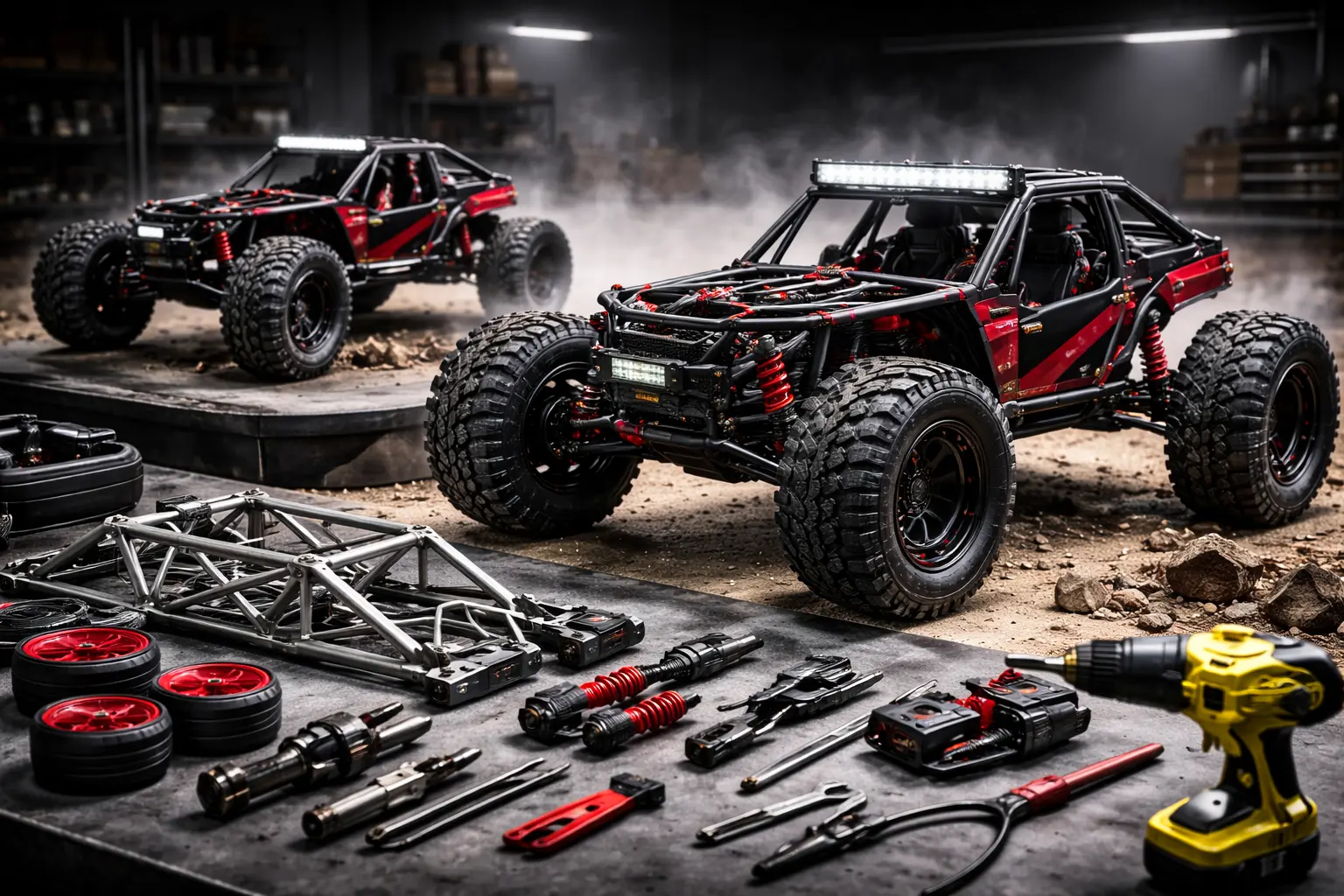
A tube chassis transforms a crawler from an out-of-the-box truck into something that looks like it was pulled straight from a full-size King of the Hammers competition. Lighter, lower center of gravity, and infinitely customizable — the open cage design is where crawling meets real fabrication culture. This guide covers the difference between tube and ladder frame chassis, the four main tube chassis styles, the best materials, and the best kits you can buy right now in 2026, from a $40 budget nylon cage all the way up to a $430 precision competition rig.
This post contains affiliate links. If you make a purchase through these links, we may earn a commission at no extra cost to you.
Tube Chassis vs. Ladder Frame — What’s the Difference?
The easiest way to understand tube chassis is to compare them side-by-side with the standard platform most crawlers ship on.
| Feature | Tube Chassis | Ladder Frame (Standard) |
|---|---|---|
| Structure | Open cage / tube frame | Flat rails with cross-members |
| Weight | Lighter (less material) | Heavier |
| Center of gravity | Lower (components sit inside the cage) | Higher (components mount on top of rails) |
| Protection | Cage protects electronics on rollovers | Electronics exposed, need skid plates |
| Customization | Highly customizable | Limited by rail geometry |
| Scale look | Rock bouncer, buggy, Ultra4, rat rod | Truck, SUV, traditional 4x4 |
| Body options | Open cage (no body) or cage-style body | Standard body shells |
| Complexity | More complex to build | Simple — bolt-on components |
| Cost | $40–$430 for kits | Included with most RTR crawlers |
| Best for | Comp crawling, rock bouncers, custom builds | Trail trucks, scale rigs |
Tube chassis are not objectively “better” — they serve a different purpose. If you want a realistic scale Toyota Land Cruiser with a detailed interior and a painted lexan body, a ladder frame is exactly right. If you want a stripped-down, low-CG machine that looks like it belongs at the Ultra4 pits and performs like it too, a tube chassis is your answer.
Something worth noting: most tube chassis builders didn’t start there. The typical path is buying a ready-to-run crawler like an SCX10 or TRX-4, running it for a season, and then gradually replacing components until the stock chassis becomes the limiting factor. The tube frame swap is usually the moment a casual hobbyist becomes a builder. If you’re not there yet, our crawlers guide covers the full spectrum of platforms.
Types of RC Crawler Tube Chassis
Rock Bouncer / Buggy Cage
This is the style most people picture when they hear “rc crawler tube chassis” — an open cage design with aggressive geometry that mimics full-size Ultra4 and King of the Hammers rock bouncers. There’s no body shell; the cage itself is the visual statement. Approach and departure angles are maximized because there’s nothing hanging below the frame rails. Electronics mount inside the cage where they’re fully protected on rollovers, which happens often in this style of driving. This is the dominant chassis style in comp crawling and the one most likely to get people stopping you at the trail to ask questions.
My first tube chassis was a bolt-together aluminum kit — the same category as what INJORA makes today — that I put SCX10 axles under. The weight savings over the stock SCX10 chassis were dramatic, nearly 200 grams, and the CG dropped noticeably. The truck went from competent to competition-ready with that one swap.
Scale Trail Cage (Roll Cage Over Ladder Frame)
Rather than replacing the whole ladder frame, a trail cage bolts onto the existing rails and replaces the upper body structure with a cage-style framework. You keep the tub chassis underneath but add the visual drama of an open cage on top — simulating a stripped-out trail truck that’s had its cab replaced with a roll cage. This is the easiest transition from stock, since you don’t need to rebuild the drivetrain and component layout. Compare this to the look of standard crawler bodies and you’ll quickly see why more builders are going the cage route.
Competition / MOA Chassis
Motor-on-axle and ultra-low-CG designs purpose-built for competitive crawling. Every gram and every millimeter of CG height is optimized. These are not trail trucks — they’re designed to score points in SORRCA-style comp courses, where stability and precision matter more than trail-worthiness. Often custom-fabricated or available as specialized kits from boutique builders. The Vanquish VRD Carbon sits at the accessible end of this category.
Custom / Scratch-Built
Built from raw tube stock — brass rod, aluminum tube, stainless steel — using soldered, welded, or epoxy joints. Unlimited creativity in terms of geometry, wheelbase, and proportions. I built a custom steel tube rock bouncer chassis once by bending 3/16-inch brass rod and soldering the joints. It took two weekends and looked incredible, but I’ll be honest — it was harder than I expected. The brass wanted to spring back after every bend, and the solder joints required careful heat management to avoid cracking. If you don’t love fabrication for its own sake, buy a kit. The bolt-together options available today are genuinely excellent, and a good crawler kits build gives you nearly all the visual payoff at a fraction of the effort.
Materials — What Tube Chassis Are Made From
Aluminum — The Standard
Lightweight, strong, corrosion-resistant, and available in anodized finishes (black, red, blue). Most commercial kits use CNC-cut aluminum plates combined with aluminum tube caging. This is the best balance of weight, strength, and cost for 95% of builders. When someone says “I built a tube chassis,” they almost always mean aluminum.
Steel / Stainless Steel
Heavier than aluminum but extremely strong, and unlike aluminum at this scale, steel can be properly welded. Some competition chassis and custom scratch-builds use steel specifically because the added mass lowers the CG through weight rather than geometry. For a rock bouncer chassis that needs to bite into terrain and stay planted, a little extra weight in the right places is an advantage, not a liability.
Carbon Fiber
Ultra-light and very stiff — the choice for high-end competition builds where every gram counts. Carbon fiber rails are standard in Class 1 and Class 2 competition crawlers. The tradeoff is brittleness: carbon fiber cracks on hard impact rather than bending. For a comp crawler that’s carried carefully and driven precisely, that’s acceptable. For a bashed trail rig, it’s not.
Brass Rod (Custom Builds)
Easy to bend, solder, and shape by hand, and it adds low weight — meaning you can use brass selectively to tune the CG. A brass tube chassis isn’t lighter than aluminum; it’s heavier, but the weight is concentrated low and centered, which improves stability on steep climbs. Brass rod from a hobby store is also very affordable, making it the go-to material for first-time scratch builders experimenting with their own geometry.
Best RC Crawler Tube Chassis Kits
INJORA Nylon Rock Buggy Chassis — Best Budget (~$40)
The INJORA Nylon Rock Buggy Roll Cage Body Shell Chassis Kit is the most accessible entry point into tube chassis crawling at around $40. It’s injection-molded nylon rather than CNC aluminum, which keeps the price low while delivering a functional open-cage structure. Compatible with Axial SCX10 II (90046), UTB10, and Capra axles across a 310mm wheelbase. Available in five colors — green, blue, red, orange, and yellow. Assembly is straightforward — no tools beyond a screwdriver — and battery fitment is designed for shorty LiPo packs. For a first rc crawler chassis build or a budget trail rig, this is hard to beat.
Vanquish VS4-10 Phoenix Portal — Best Overall Kit (~$390)
The Vanquish VS4-10 Phoenix Portal Kit (VPS09007) is the benchmark for rc crawler chassis kits, priced at $389.99. You get F10 molded portal axles with brass inner reinforcement tubes, a 313mm wheelbase, Incision S8E 80mm shocks, a steel C-channel chassis, and Falken Wildpeak MT tires. It’s an unassembled kit — you’ll need a steering servo, ESC, 540-size motor, radio, and 2S–3S LiPo — but every component that comes in the box is Vanquish quality. This is the crawler that shows up in comp build threads as the platform everyone else is measured against.
The visual impact of a finished VS4-10 is hard to overstate. The moment you complete the build and set it on the table, it looks nothing like a toy — it looks like a miniature Ultra4 car. People at the trail consistently stop and ask about it.
Axial UTB10 Capra 1.9 4WS — Best RTR Tube Chassis (~$560)
If you want the tube chassis experience without the build, the Axial UTB10 Capra 1.9 4WS (AXI-1543) is Axial’s factory answer at $559.99 RTR. The UTB10 is a significant upgrade over the original Capra: a 45% lower final drive ratio (45.37:1), separate Spektrum Firma 40A ESC and SR515 5-channel receiver, Pro-Line Mickey Thompson Baja Pro X tires with dual-stage foam inserts, improved Currie F9 portal axle housings, and two Spektrum S683 waterproof metal-gear servos for full four-wheel steering. It’s the fastest path to owning a running tube chassis rig — zero sourcing, zero assembly. Note that stock is currently limited heading into 2026. Once you’re out on a course, our crawler course ideas guide has plenty of terrain inspiration.
Vanquish VRD Carbon — Best Competition Kit (~$430)
For builders targeting competitive crawling, the Vanquish VRD Carbon Kit (VPS09015) at $429.99 is the platform dominating Class 1–3 competition discussions in 2026. It features 3mm carbon fiber rails, Vanquish F10 competition portal axles, and a Spec VFD transmission — a drivetrain combination that has become nearly standard at serious SORRCA events. The rc crawler carbon fiber chassis construction keeps the CG lower than any aluminum platform at this price point. Requires full electronics, just like the VS4-10.
Generic Metal Roll Cage / Tube Frame — Ultra Budget ($15–40)
For the absolute budget end, several brands on Amazon sell metal roll cage tube frame chassis compatible with SCX10 1/10 platforms for $15–35. Build quality is variable and fitment may require adjustment, but for a first-time builder who wants to understand rc crawler tube frame geometry before committing to a nicer kit, these are a low-risk starting point.
Search Tube Frame Chassis on Amazon
Building a Tube Chassis — What You Need
A tube chassis kit is just the frame. To build a complete, running crawler, you need to source or transplant the following components. The good news: if you’re converting an existing SCX10 or TRX-4, most of these are already in hand.
Axles (front + rear) — Axial AR44 locked axle sets were the standard donor axle for rc crawler buggy chassis builds for years at around $79. They’re now discontinued from Axial’s official channels but still findable through Amazon sellers and eBay. Budget $50–$100 for a pair on the secondary market. Search Axial AR44 Locked Axle Set on Amazon
Transmission / transfer case — Some kits include this, some don’t. Budget $20–$50.
Motor + ESC — For crawling, you want something in the 35T–55T brushed range or a low-KV brushless equivalent. The Holmes Hobbies TrailMaster Sport 540 35T (~$17) is a community favorite at an unbeatable price for the torque it delivers. For more on choosing power systems, see our brushed vs brushless guide. Budget $30–$70 for motor and ESC combined. Check Holmes Hobbies TrailMaster Sport 540 35T on Amazon
Servo — High-torque is non-negotiable for crawling. The ANNIMOS DS3225MG (25kg at 6.8V, metal gears, fully waterproof) is a go-to budget option at around $12–16 on Amazon, and it actually delivers close to its rated torque — which puts it ahead of most Chinese servos in this price tier. Budget $20–$60 depending on spec. Check ANNIMOS DS3225 25kg Servo on Amazon
Radio / receiver — $40–$80 for a quality 3-channel setup.
Battery — 2S LiPo, shorty format for most tube chassis. Budget $20–$35. Search Shorty 2S LiPo Battery on Amazon
Wheels and tires — 1.9 or 2.2 beadlock wheels with a crawler compound tire. Budget $30–$60. Our crawler tires guide covers every size and compound worth knowing. Search 1.9 Beadlock Crawler Wheels and Tires on Amazon
Links — Suspension links connecting axles to chassis. Some kits include them; many don’t. Budget $10–$30.
Total estimated cost for a complete rc crawler chassis build: $200–$500 depending on component quality. You can reduce that significantly by cannibalizing drivetrain parts from an existing SCX10 or Capra rather than buying everything new.
FAQ
Q: What is an RC crawler tube chassis?
A tube-frame structure that replaces the standard flat ladder-frame chassis on a 1/10 scale rock crawler. It uses an open cage design similar to a full-size rock bouncer or off-road buggy, with the goal of reducing weight, lowering the center of gravity, and fully exposing the mechanical components rather than hiding them under a body shell. The result is a more aggressive look and, in most cases, better climbing performance.
Q: Can I put a tube chassis on my SCX10 or TRX-4?
Yes — most commercial tube chassis kits are designed specifically to accept SCX10 II, SCX10 III, or TRX-4 axles and standard-size electronics. You transplant your existing drivetrain into the new frame. The INJORA kit, for example, is designed around SCX10 II and Capra axle geometry. Always verify wheelbase and axle compatibility before buying, as not all kits are interchangeable across platform generations.
Q: Is a tube chassis better for competition crawling?
Generally yes. The lower CG and reduced weight improve stability on steep climbs and during transitions. Most competitive crawlers in SORRCA Class 1–3 use some form of tube or cage chassis, with carbon fiber rails and portal axles as the current standard combination at the top of the field. For casual trail driving, the advantage is less pronounced — the open cage look matters as much as the performance gain at that level.
Q: How much does a tube chassis crawler build cost?
Frame kits run from about $40 for an INJORA nylon cage to $430 for a Vanquish VRD Carbon. A complete rc crawler chassis build with all components — axles, motor, ESC, servo, radio, battery, and tires — typically comes to $200–$500. You can cut that number significantly by reusing parts from an existing crawler rather than buying everything new.
Q: Do I need welding skills to build a tube chassis?
No. Every commercial kit in this guide is bolt-together using CNC-cut parts and standard hardware. Welding and soldering are only needed if you’re building a custom scratch chassis from raw tube stock — brass rod, aluminum tube, or steel. For a first rc crawler chassis build, start with a kit; the results are excellent and the assembly is manageable in a single weekend.
Conclusion
Tube chassis are where the RC crawler hobby becomes a fabrication hobby — the aesthetics, the engineering, and the performance all point in the same direction. Start with a bolt-together kit if you want the results without the complexity; the INJORA nylon cage at $40 is a genuine entry point, and the Vanquish VS4-10 Phoenix Portal at $390 is a complete step-up in quality and capability. Go custom if you love the process as much as the outcome.
New to crawling? Start with our RC Crawlers Complete Guide. Looking for a kit-build option? Check our best crawler kits guide. Need tires for your build? Our crawler tires guide covers every size and compound.