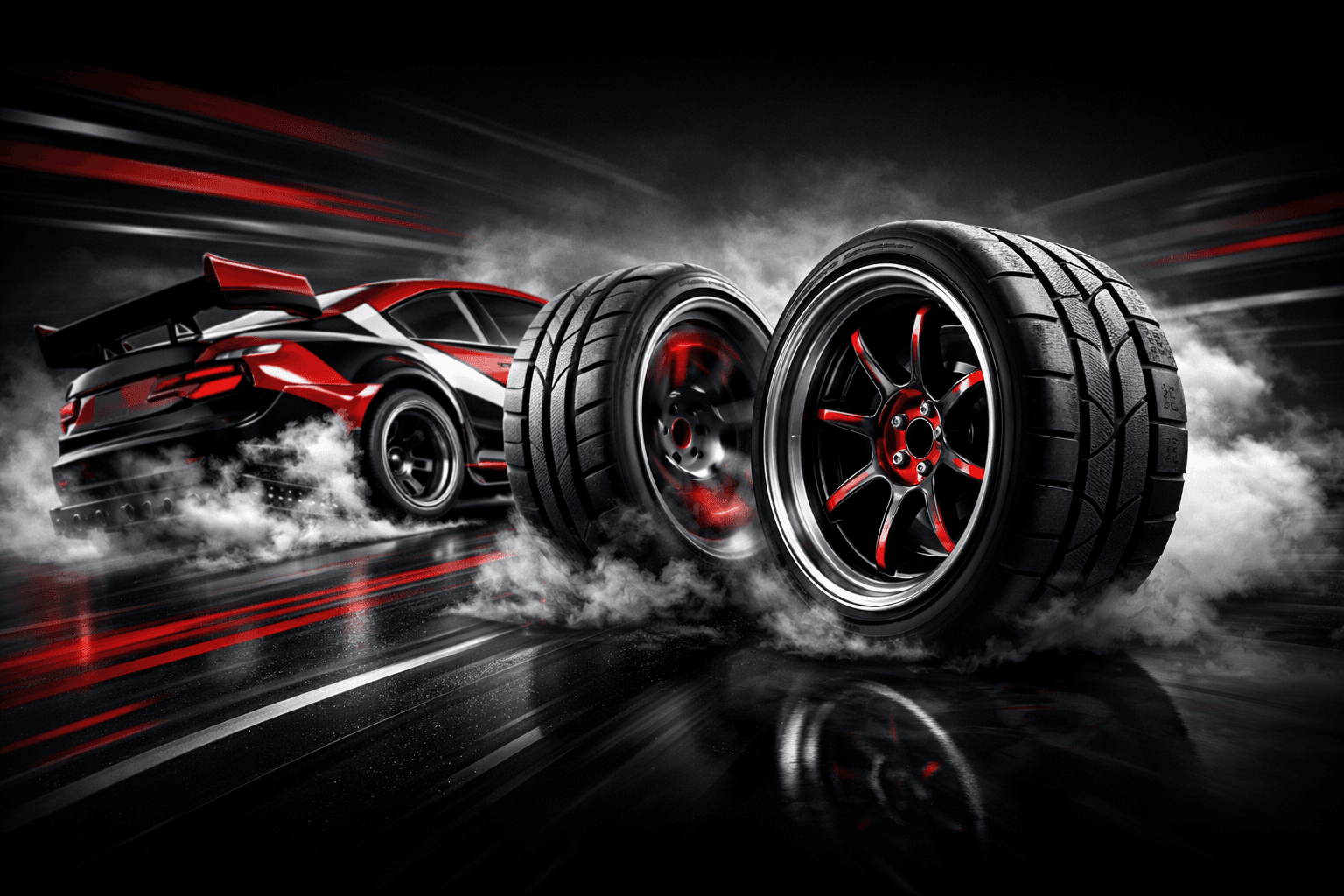
RC drift tires and wheels are the cheapest part of any drift build — and the one that changes everything. The wrong compound on the wrong surface means no grip, no angle, no fun. Mount the right tire for your track and your car transforms into something predictable, smooth, and genuinely satisfying to slide. This guide covers every major compound type, explains wheel offset in plain terms, walks you through surface matching, and recommends specific products across every budget from first-timer sets to competition-grade setups.
If you're still choosing a chassis, check out our drift guide first — most drift kits ship without tires and wheels, so knowing what to buy before you order saves a separate wait.
This post contains affiliate links. If you make a purchase through these links, we may earn a commission at no extra cost to you.
Drift Tire Types Explained
Not all RC drift tires are the same. The compound and construction of a tire determine how it interacts with a surface — and getting this wrong is the most common beginner mistake in the hobby.
Hard Plastic Tires
Hard plastic drift tires are the standard for smooth concrete, polished floors, and purpose-built drift mats. Made from rigid ABS or polycarbonate, they have essentially zero flex — the car slides because the tire completely breaks traction rather than managing slip. This makes them extremely predictable once you understand your surface.
They're inexpensive (generic sets run $5–$8 on Amazon, last a very long time because there's almost no material to wear away, and they're the default at most indoor drift tracks worldwide. Different hardness grades exist, but the differences between them are subtle enough that beginners won't notice.
I used to assume all hard plastic tires were interchangeable. Then I ran a set of brand-name competition tires on the same polished concrete I'd been using budget tires on — smoother initiation, more consistent slide angle, noticeably less wheel chatter when transitioning. The compound quality matters more than the price gap suggests.
Rubber / CS Compound Tires
Rubber and CS compound tires are designed for carpet tracks and rough outdoor surfaces. Unlike hard plastic, these tires work by managing slip rather than eliminating traction entirely — the car drifts by balancing controlled wheelspin against available grip.
CS compound (a marketing term used by MST, DS Racing, and others to denote their competition rubber formulations) is specifically engineered for carpet tracks. It provides enough grip to keep the car controllable while still allowing sustained angle. The driving feel is more realistic — closer to how a real car behaves when breaking rear traction — and it's grown significantly in popularity as carpet tracks have become more common across the US and Europe.
The trade-off: rubber and CS compound tires cost more ($10–$18 per set from major brands), wear faster than hard plastic, and require proper surface matching. Running them on concrete gives unpredictable results.
Grip Tires — Not for Drifting
A quick heads-up: standard rubber touring or on-road tires will not drift. They're engineered for maximum traction and simply won't break loose on any indoor surface. If someone accidentally orders touring tires for a drift build, the car will just push straight. Check the listing carefully — drift-specific tires will always say "drift" in the product name.
Which Tires for Which Surface?
This is the section that matters most. Matching compound to surface isn't optional — it determines whether your car is driveable.
| Surface | Recommended Tire | Grip Level | Notes |
|---|---|---|---|
| Polished concrete | Hard plastic | Very low | The classic drift surface |
| Smooth tile / laminate | Hard plastic | Very low | Indoor home drifting |
| Drift mat (RCP track) | Hard plastic | Low | Purpose-built drift surface |
| P-tile (Japanese vinyl) | Hard plastic (comp grade) | Low-medium | Used at most serious tracks |
| Carpet (low pile) | CS / rubber compound | Medium | Most indoor US tracks |
| Carpet (high pile) | CS compound or softer rubber | Medium-high | More resistance, need more grip |
| Rough concrete / asphalt | Rubber compound | Medium | Hard plastic chatters badly |
| Wood floor | Hard plastic (caution) | Very low | Slides extremely fast |
If you're not sure what surface your local club or track runs, ask the track owner before buying. Showing up with the wrong tires is a frustrating experience — especially if you're a two-hour drive from home. The first time I ran my RWD on a carpet track, I had hard plastic tires mounted and couldn't get a consistent angle to save my life. Carpet demands CS compound. It's not optional.
An RCP drift mat or high-density track surface (~$30–$60 per segment) creates a controlled low-grip surface at home that works well with standard hard plastic tires, making it an excellent investment for home practice sessions.
Wheel Offset Explained
Wheel offset is the measurement (in millimeters) from the wheel's mounting face to the center of the rim barrel. In RC drift, higher offset numbers push the wheel further outward from the chassis — the opposite of how real-car offset convention works, which trips up a lot of newcomers.
Every additional millimeter of offset adds 2mm to total track width: 1mm per side. A car running 8mm offset all around is 4mm wider per side than the same car on 4mm offset.
Common offsets across the 1/10 scale drift segment run from 0mm to 12mm:
- 0–3mm offset — wheels tucked close to the chassis, understated stance, maximum body clearance during full steering lock
- 6mm offset — the all-around standard; works with most 190mm and 200mm body shells
- 8–10mm offset — wider stance, more aggressive look, improved rear stability during high-angle transitions
- 12mm+ offset — extreme deep-dish fitment, maximum stance; requires careful body shell selection to avoid rubbing
Why offset matters for performance: Front offset directly affects scrub radius and steering feel. Too much front offset and the car gets twitchy under power; too little and transitions feel slow. Rear offset affects stability — a slightly wider rear creates a more planted feel during mid-drift transitions.
I run 6mm front and 8mm rear on my YD-2. That 2mm difference in the back gives just enough added width to stabilize the rear without making the car feel sluggish. It's a genuinely small change that made the car feel noticeably more consistent when chaining drifts together.
Why offset matters for looks: Proper fitment means the tire edge sits flush with the body's fender flare. When choosing wheels for a specific drift body shell, check the body width specification — 200mm bodies generally need more offset than 190mm bodies to fill the fender gap correctly.
The most common starting point is 6mm all around, then adjust from there based on how your body fits.
Wheel Diameter & Width
Standard 1/10 drift wheels use a 26mm-wide, 52mm-diameter format with a 12mm hex hub — this is universal across Yokomo, MST, DS Racing, Yeah Racing, and every other major brand. If you're buying separately from the drift category, verify these specs before ordering.
Tire width affects grip and drift initiation differently than compound does. Narrow tires (26mm standard) are easier to slide because there's less contact patch. Some builders run stretched tires on wider wheels for a JDM aesthetic, but this reduces performance consistency. Wider contact patches (non-standard setups) hold angle better but require more power and technique to initiate.
Most drifters stick with the 26mm standard and tune with compound instead of width.
Best RC Drift Tires — Our Picks
Best Hard Plastic Tires
Yokomo DRA Competition Drift Tire (~$14.99 for 4) is the benchmark for asphalt and smooth concrete. This is the control tire used at the FEMCA Cup at Yatabe Arena — about as strong a competitive endorsement as exists in RC drift. The DRA uses a polycarbonate compound that breaks traction cleanly without chatter, and the beadless design makes mounting straightforward. For parking-lot sessions and polished concrete tracks, nothing touches it at this price point.
Check Price on Amazon
Yokomo DRC Competition Drift Tire — Carpet Version (~$14.99 for 4) is the carpet-specific counterpart. PE/HDPE compound tuned for carpet and P-tile, consistent grip throughout its lifespan, and the same clean mounting experience as the DRA. For most indoor US tracks running carpet, this is the straightforward recommendation.
Check Price on Amazon
Yokomo DRPA Competition Drift Tire (~$19.00 for 4) is the newest and most advanced Yokomo compound, optimized specifically for P-tile. The standout feature is zero break-in period — consistent grip from the first lap, lasting a full season of regular sessions.
Check Price on Amazon
MST CS-R Drift Tire — Medium (~$12–$16 for 4) covers the all-surface middle ground. MST's color-coded compound system makes it easy to grab the right hardness at the track: Red dot for soft/asphalt, Gold for medium/versatile, Silver for hard/carpet, Green for hardest/intermediate tarmac. The Medium (Gold) is the safest starting choice if you're running multiple surfaces.
Check Price on Amazon
MST CS-R Drift Tire — Carpet (~$12–$16 for 4) is the carpet-specific MST option, comparable to the Yokomo DRC but typically a few dollars less. Solid choice for club-level carpet tracks.
Check Price on Amazon
Best CS / Rubber Compound Tires
DS Racing Competition III / Finix (~$13–$20 for 4) offers the widest compound selection in the market — ten options spanning from LF-1 Soft (smooth asphalt/tile) through LF-5C (carpet-optimized). The laser-engraved white sidewall lettering is a premium detail at a competitive price. LF-3 is the de facto P-tile standard at most US drift facilities; LF-5C is the carpet choice.
Check Price and Compounds on Amazon
DS Racing LF-1 Finix Treaded (~$13–$15 for 4) adds scale tire tread detail to the Finix compound range. Treaded drift tires don't affect compound behavior — the tread is cosmetic — but they look significantly more realistic mounted on scale replica wheels.
Check Price on Amazon
Budget Hard Plastic Tires
Generic hard drift tires (HIRCQOO, Chanmoo, similar brands) (~$5–$8 for 4 with wheels) are the starting point for anyone building their first drift car. Performance falls noticeably short of Yokomo or MST — less consistent compound hardness, more wheel chatter on transitions — but they work well enough to learn on, and the price makes experimenting risk-free.
Check Price on Amazon
Best RC Drift Wheels — Our Picks
Best Budget Wheels
Yeah Racing Spec D Pre-Mounted Set (~$17–$20 for 4 with tires and foam inserts) is the fastest path from box to track. You get wheels, tires, and inserts in a single purchase at less than the cost of name-brand wheels alone. Fixed offset (+3mm or +6mm), limited design choices, but perfectly functional for beginners or second practice cars.
Check Price on Amazon
Best Mid-Range Wheels
MST Offset Changeable Wheel Set (~$12–$20 for 4) is the most versatile wheel purchase in the category. The two-piece design lets you clock the wheel face into four offset positions (+3, +5, +7, or +9mm) before final gluing — four setups from one purchase. JDM-inspired designs including the GT 5-spoke, 501 mesh, and LM Y-spoke all feature molded lug bolt details.
Check Price on Amazon
Yokomo Racing Performer Drift Wheels (~$14 per pair / ~$28 for 4) are the competition-pedigree choice. Available in 6mm, 7mm, and 8mm offsets with 5-spoke and 6-spoke designs. The High Traction variant features deliberate rim flex that improves surface contact on low-grip tracks. Note that RP wheels require aluminum clamp-type hex hubs — they won't mount on standard composite hubs.
Check Price on Amazon
Best Premium Wheels
DS Racing Drift Element Wheels (~$16–$17 per pair / ~$32–$34 for 4) are the style standard for serious drift builds. Five-piece construction with adjustable offset from 4mm through 12mm — the widest range available without buying multiple sets. Available in 5-spoke, 6-spoke, and Mesh designs across dozens of color combinations. Assembly requires gluing the rivet rings before final installation, but the result is one of the best-looking wheels in the segment.
Check Price on Amazon | Mesh Series on Amazon
Iconic Wheel Styles
Wheel design is a major part of drift culture — as much personal expression as performance choice.
The TE37 is the most iconic JDM drift wheel, a Volk Racing 6-spoke monoblock that's appeared on virtually every significant Japanese drift car since the 1990s. MST produces TE37-inspired RC versions (~$16–$26 per pair) that are the best-selling design in the category. The BBS RS mesh brings European motorsport heritage and deeper barrel design. The Work Meister S1 offers dramatic spoke thinness and visible hardware bolts for a VIP-influenced look. The Watanabe 8-spoke is the vintage JDM choice for retro builds — Topline produces licensed versions in chrome and chrome-gold available at AMain Hobbies.
Tire & Wheel Maintenance
Hard plastic tires require almost zero maintenance — wipe them down with a dry cloth after sessions on dusty floors, and they'll look the same in a year as they do today. They simply don't wear.
Rubber and CS compound tires need more attention. Clean them after every session with a damp cloth to remove surface contamination that affects grip. Store them away from direct sunlight and heat — UV and heat accelerate compound degradation. Don't leave them in a car during summer.
Wheels: inspect hex hubs after crashes for cracks, especially at the pin hole. Clean any built-up dirt from the hub before remounting tires. For most drift setups, tire glue isn't needed — tires friction-fit onto wheels and stay in place under drift loads. If you're experiencing tires spinning on wheels at high throttle, a small dot of CA glue at two or three points around the bead is sufficient.
Frequently Asked Questions
Q: Can I use regular RC car tires for drifting?
No — standard rubber grip tires are engineered for maximum traction and won't slide on indoor surfaces. You'll end up pushing the car with full throttle and going nowhere useful. You need either hard plastic drift tires (for concrete/tile/P-tile) or CS compound drift tires (for carpet). These are sold specifically as "drift tires" by every major brand.
Q: How long do RC drift tires last?
Hard plastic tires are remarkably durable — expect months to years of regular use depending on surface abrasiveness. Rubber and CS compound tires wear faster, typically lasting weeks to a few months of weekly sessions on carpet. Surface texture is the biggest variable: rough concrete wears any tire faster than polished P-tile or smooth concrete.
Q: What wheel offset should I start with?
Start with 6mm all around — it works with most 190mm and 200mm body shells without rubbing and gives a reasonably aggressive stance. Once you're comfortable with your car's handling, experiment with 6mm front / 8mm rear for a slightly wider rear stance that improves mid-drift stability. Adjustable-offset wheels like the MST or DS Racing Drift Element series let you test multiple setups without buying additional wheels.
Q: Do I need different tires for carpet vs concrete?
Yes, and this matters more than any other setup decision. Hard plastic tires on carpet gives you almost no control — the car either spins out or doesn't slide at all depending on pile height. CS compound tires on polished concrete will grip too hard and make angle difficult to initiate. Always match your compound to your primary surface, and if you're running at a club track, ask what the track surface is before ordering.
Q: Are expensive drift tires worth it over cheap ones?
For casual home drifting, generic plastic tires work fine and the $5–$8 price point means you can replace them without thinking. For consistent practice sessions or competition, the quality gap is real — Yokomo and DS Racing competition tires give noticeably better slide initiation consistency, less compound variation from tire to tire within a set, and more predictable behavior across a full tank. If you're trying to improve your technique rather than just slide around, the extra $6–$10 per set for name-brand tires is worth it.
Q: What is the difference between a 26mm and 30mm drift tire?
26mm is the universal 1/10 drift standard — all major brands (Yokomo, MST, DS Racing) use it, and all the wheels in this guide are built around it. 30mm tires exist as a specialty option for stretched tire builds with aggressive camber setups, but they require specific wheels and are a niche choice. If you're building a standard drift car, 26mm is what you want.
Conclusion
Match your tires to your surface, dial in your offset for clean body fitment, and don't overthink the rest — drift tires are cheap enough that experimenting costs less than one coffee shop visit. The universal starting recommendation: Yokomo DRC for carpet (Check Price on Amazon or DS Racing LF-3 for P-tile (Check Price on Amazon, paired with MST offset changeable wheels (Check Price on Amazon so you can tune fitment without buying extra sets.
Building your first drift car? Start with our RC Drift Cars Ultimate Guide and pick a chassis from our best drift kits guide. Already rolling? Find your perfect body shell to complete the look.