Half a degree. That’s the camber change that turned my Yokomo YD-2 from a twitchy, uncontrollable mess into a car that held angle like it was on rails. RC drift setup is the single biggest lever you have over how your car drives — and most people either ignore it completely or get lost in a maze of parameters they don’t understand. This guide fixes that.
This post contains affiliate links. If you make a purchase through these links, we may earn a commission at no extra cost to you.
Why setup matters more than hardware
Here’s a truth that stings a little: a well-tuned $200 MST RMX 2.0 will out-drift a poorly set up $600 Yokomo YD-2SX every single time. Setup is the free performance multiplier. Before you drop money on aluminum upgrades or a new gyro, learn how to read what your chassis is telling you and dial it in. The geometry settings covered in this guide — camber, toe, caster, ride height, springs, and shock oil — interact as a system. Understanding that system is what separates the driver doing donuts in a parking lot from the one linking corners with consistent angle and speed. If you’re brand new to the hobby, start with our complete guide to getting started with RC drift cars and then come back here when you’re ready to tune.
Essential setup tools
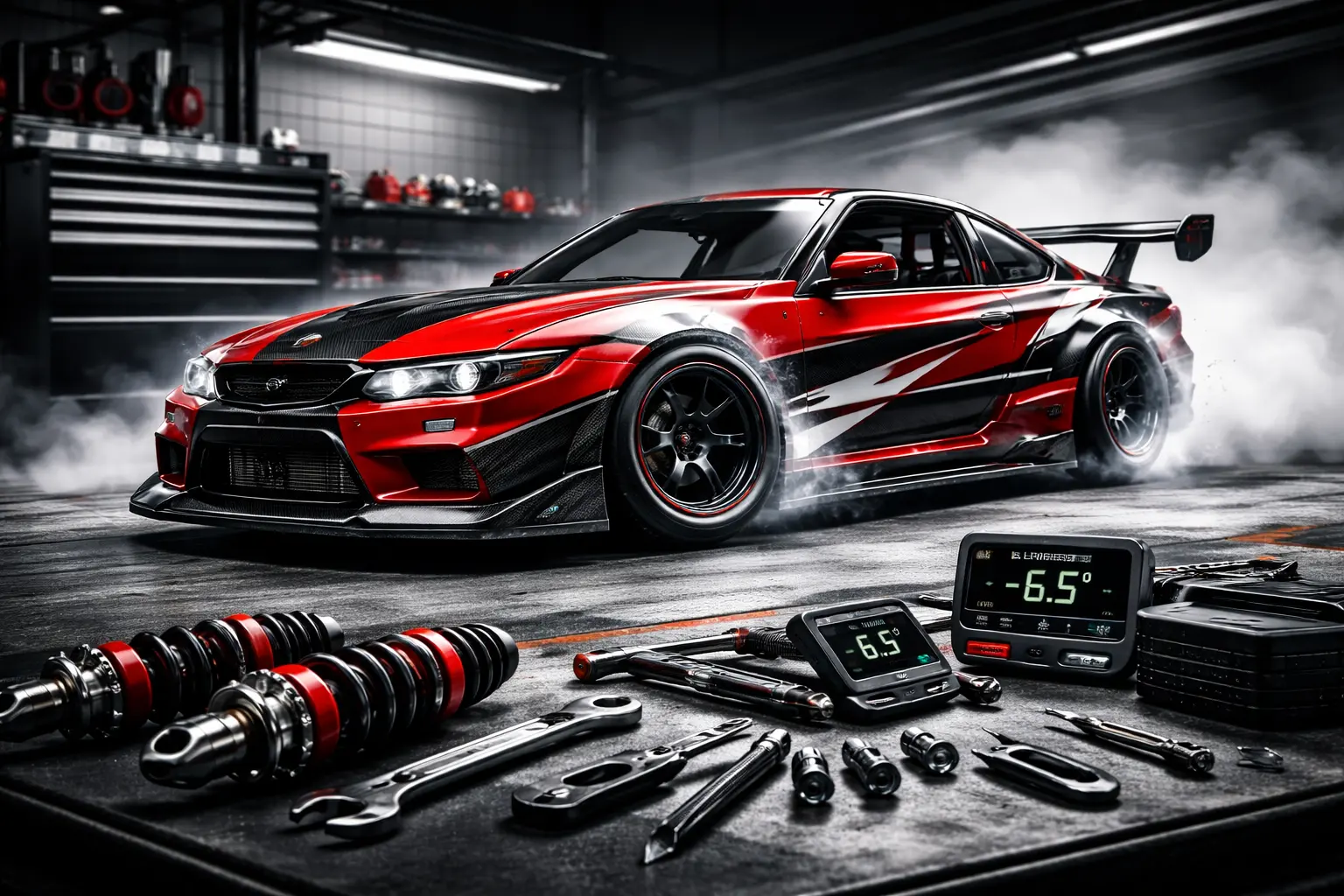
You wouldn’t try to tune a guitar by ear alone. Same logic applies here. Before you touch a single turnbuckle, get yourself at least the essentials from this list.
| Tool | What It Does | Price Range | Essential? |
|---|---|---|---|
| Ride height gauge | Measures chassis-to-ground distance in mm | $8–$15 | Essential |
| Camber gauge | Reads wheel tilt angle in degrees | $10–$15 | Essential |
| Setup board / droop gauge | Flat reference surface for accurate measurements | $30–$135 | Essential |
| Turnbuckle wrench set | Adjusts link lengths to change camber and toe | $6–$12 | Essential |
| Yeah Racing setup tool kit | All-in-one hex drivers, nut drivers, and gauges | $15–$104 | Nice-to-have |
Yeah Racing and 3Racing make affordable, reliable gauges that’ll last years. If you want to go premium, RC Maker’s digital camber gauge reads to 0.01° accuracy — overkill for most of us, but beautiful if you’re chasing competition setups. Budget around $50–$80 for a solid basic tool kit.
Understanding the key parameters
RC drift suspension tuning comes down to six core parameters: camber (wheel tilt front-to-back view), toe (wheel angle top-down view), caster (steering axis tilt side view), ride height (chassis distance from ground), spring rate (suspension stiffness), and shock oil weight (damping speed). Each one affects how weight transfers through the chassis during a drift — and weight transfer is everything. Change how weight moves, and you change how the car initiates, holds angle, transitions, and carries speed. Let’s break each one down.
Camber: the foundation of drift grip
What is camber?
Stand in front of your car and look at the wheels. If the tops of the tires lean inward toward the chassis, that’s negative camber. In drifting, we run negative camber on all four corners. The concept is straightforward: when the car rolls during a drift, a negatively cambered wheel plants more of its contact patch flat against the surface, increasing grip exactly when you need it.
Front camber settings
Front camber controls your steering bite and corner entry aggression. For RWD drift chassis like the Yokomo YD-2 or MST RMX 2.0 S, start at −6° front camber. The recommended range is −5° to −8°. More negative camber gives you sharper turn-in and more front grip under counter-steer — critical for RWD where the front wheels aren’t powered and steering grip is everything.
For AWD platforms like the MST FXX 2.0 or Tamiya TT-02D, you need far less: −2° to −3° front. AWD front wheels are driven, so they generate their own grip. Too much front camber on AWD actually creates excessive front-end bite that fights the drift.
Rear camber settings
Rear camber controls lateral grip on the driven wheels. For RWD, start at −3° rear (range: −3° to −5°). This gives enough side-grip to prevent the rear from washing out completely while still allowing controlled rotation. For AWD, run −2° to −3° rear, roughly matching the front.
The key rule: front camber should be slightly more negative than rear by 1°–3°, especially on RWD. This ensures the front end always has more lateral grip than the rear — exactly the grip balance that lets you hold a controlled drift rather than spinning out.
RWD vs AWD camber differences
RWD drift cars need dramatically more front camber than AWD because unpowered front wheels rely entirely on mechanical grip for steering. When I first started with RWD, I ran the same mild −2° camber I’d used on my AWD setup. The car wouldn’t hold angle for more than a second. Bumping front camber to −6° was a revelation — suddenly the front end bit hard during counter-steer while the rear stayed loose enough to rotate. It’s one of the fundamental differences between RWD and AWD drift setups, and getting it wrong makes everything else pointless.
Toe: fine-tuning stability and response
What is toe?
Look down at your car from above. If the fronts of the tires point toward each other, that’s toe-in. If they point away from each other, that’s toe-out. Toe controls directional stability and how eagerly the car changes direction.
Front toe settings
For RWD drift, run 0° to 2° toe-out on the front. Toe-out promotes oversteer initiation and gives you more steering angle at full lock — exactly what you want entering a drift. Never run front toe-in on an RWD drift car. Toe-in forces understeer and causes the car to “crab” sideways instead of rotating. This is one of the most common beginner errors, and it makes the car feel completely broken.
AWD setups are more forgiving: 0° to 1° toe-out works well. Some AWD drivers even run parallel (0°) front toe with good results.
Rear toe settings
Rear toe is almost always toe-in for both drivetrains — it acts like a stability anchor. Start at 2° toe-in for RWD (range: 1°–3°). The Yokomo YD-2 ships with 3.5° rear toe-in from the factory, which many drivers reduce to 2° with option parts for faster transitions. For AWD, 2°–3° toe-in keeps the rear planted.
More rear toe-in means more straight-line stability but slower transitions between left and right drifts. Less toe-in makes the rear livelier and transitions snappier, but too little makes the car nervous and unpredictable. Never run rear toe-out — it’s a recipe for instant spin.
Caster: steering feel and self-centering
What is caster?
Imagine looking at your car from the side. Caster is the tilt angle of the steering kingpin axis — the invisible line your front wheel pivots around. Think of a bicycle fork: it’s angled backward, which is why a bike self-centers when you let go of the handlebars. More caster angle does the same thing for your drift car’s steering.
How caster affects drift performance
Caster is critically important for RWD drift, and it’s one of the most under-tuned parameters. Start at 7° for RWD (range: 6°–10°). For AWD, 4°–6° is typical.
Here’s what makes caster special: it dynamically changes wheel camber as you steer. When you turn, the trailing front wheel gains significant negative camber while the leading wheel loses it. This creates a natural grip differential across the front axle that stabilizes the car during counter-steer. More caster also increases the self-centering force of the steering, which helps your drift gyro work more smoothly — a well-set caster angle is why some drivers can run gyro gain at 80%+ without wobble.
Less caster gives sharper, more aggressive turn-in but reduces stability. If your car loops (spins suddenly during entry), try adding 2° of caster before changing anything else.
Ride height: low and level
How to set ride height
Place your car on a flat setup board with the battery installed and body attached — you want race-ready weight. Use a ride height gauge to measure at the flat chassis sections behind the front gearbox and in front of the rear gearbox. Roll the car forward slightly before measuring to settle the suspension.
Target: 5–7mm for both front and rear on most surfaces. The critical factor isn’t the absolute number — it’s left-right symmetry. If your left side reads 6mm and your right reads 5mm, the car will drift differently in each direction and no amount of tuning will fix it. Adjust ride height using the spring collar (preload adjustment) on each shock.
Front vs rear ride height
For RWD drift, keeping the rear ride height equal to or 0.5mm lower than the front helps maintain rear traction by keeping weight biased rearward. If you’re struggling with the rear breaking loose too easily on a rear-motor chassis like the YD-2 S series, try dropping the rear 0.5mm. For AWD, keep front and rear equal as a starting point.
Springs and shock oil: controlling weight transfer
Spring rate selection
Springs determine how much weight transfers during a drift. The golden rule for RC drift suspension tuning: run stiffer front springs and softer rear springs. This promotes weight transfer to the rear under throttle (improving traction) and keeps the front end responsive.
For RWD, pair medium-stiff front springs with soft rear springs. For AWD, a more balanced setup works — medium front, medium-soft rear. Most manufacturers color-code their springs (Yokomo, MST, Yeah Racing all use different color systems), so always check the specific brand chart. A good drift spring set is one of the best $10–$15 upgrades you can make.
Shock oil weight
Shock oil controls how fast weight transfers. Thicker oil slows the suspension down; thinner oil speeds it up. For RWD drift, run heavier oil in front (25–35wt) and lighter oil in the rear (10–20wt). The lighter rear oil lets the rear suspension respond quickly to weight shifts, improving traction. For AWD, a more balanced 20–30wt all around works as a starting point.
A quality silicone shock oil set with multiple weights gives you room to experiment. Stick with one brand across all four shocks — oil weight numbers vary between manufacturers, so mixing brands makes consistent tuning impossible.
One critical note: springs and oil must be balanced. Soft springs with thick oil creates a car that compresses slowly but bounces back fast — a horrible combination. Set spring rates first, then find the lightest oil that still provides chassis control.
Droop and rebound settings
Droop measures how far the suspension extends above static ride height — it controls weight transfer when you lift off throttle or during transitions. More rear droop means more weight shifts forward during deceleration, which can help cure mid-drift understeer. Set droop using the droop screws in the lower A-arms, and always ensure left-right droop is perfectly equal even if front-to-rear differs. This is an advanced adjustment, so nail your baseline setup first before diving into droop tuning.
Baseline setup chart
This is the table you bookmark. Start here, drive, observe, and adjust one parameter at a time.
| Parameter | RWD Baseline | AWD Baseline | What to Adjust If… |
|---|---|---|---|
| Front Camber | −6° | −2° to −3° | Car won’t turn in → more negative. Twitchy in transitions → less negative. |
| Rear Camber | −3° | −2° to −3° | Rear washes out → more negative. Car won’t break loose → less negative. |
| Front Toe | 1° toe-out | 0° to 1° toe-out | Sluggish entry → more toe-out. Nervous in straights → reduce toward 0°. |
| Rear Toe | 2° toe-in | 2°–3° toe-in | Slow transitions → reduce toe-in. Unstable/spins → increase toe-in. |
| Caster | 7° | 4°–5° | Car loops on entry → increase. Steering feels dead → decrease. |
| Ride Height (F) | 6mm | 6mm | More front grip → lower. Less dive → raise. |
| Ride Height (R) | 5.5–6mm | 6mm | More rear traction → lower. Easier rotation → raise. |
| Spring Rate (F/R) | Med-stiff / Soft | Medium / Med-soft | Understeer → soften front or stiffen rear. Oversteer → opposite. |
| Shock Oil (F/R) | 30wt / 15wt | 25wt / 20wt | Feels sluggish → lighter oil. Bouncy/unstable → heavier oil. |
These baselines work across most popular chassis — the Yokomo YD-2, MST RMX 2.0 S, and Sakura D5 for RWD, and the MST FXX 2.0 and Tamiya TT-02D for AWD. Rear-motor RWD chassis (YD-2 S series, RMX 2.0 S) may benefit from slightly less rear camber since they already have more rear weight for traction, while front-motor layouts can run a touch more rear camber to compensate for the lighter rear end.
Common setup mistakes to avoid
Cranking camber to the max. More isn’t always better. On hard plastic drift tires, excessive front camber (beyond −8°) actually shrinks your contact patch and creates grip that appears and disappears unpredictably. Start conservative and add 0.5° at a time.
Skipping the setup board. I spent three frustrating sessions blaming my gyro for inconsistent behavior before I put the car on a board and discovered my left-side ride height was 1.5mm higher than my right. Every measurement flows from a flat, level surface — no exceptions.
Changing three things at once. You bump camber, swap springs, and adjust toe all before a test run. The car feels different, but you have zero idea which change helped or hurt. Discipline yourself: one change, one test, one observation. Keep a notebook.
Ignoring left-right symmetry. If the car drifts beautifully to the left but spins to the right, it’s almost certainly a tweak issue — unequal droop, camber, or ride height side-to-side. This is fixable in five minutes on a setup board but impossible to diagnose on the track.
Running too little caster. Many stock AWD-converted or budget chassis come with only 2°–3° caster. For RWD drift, this makes steering twitchy and the gyro unreliable. Increasing caster to 6°–8° immediately smooths out the driving experience and lets you run higher gyro gain.
Mismatching springs and oil. Soft springs paired with heavy shock oil creates a car that fights itself — slow to compress, fast to rebound, terrible to drive. Match your combinations: soft springs with light oil, stiff springs with heavier oil.
How to dial in your setup: step-by-step
The tuning process is simple in concept but requires patience. Here’s the exact methodology that works.
First, start from the baseline chart above — or from your chassis manufacturer’s recommended settings. These exist because engineers spent months developing them. Second, drive and observe. Don’t try to fix things on the first run. Instead, identify the single biggest handling issue: is the car understeering on entry? Spinning on throttle? Slow in transitions? Third, change one parameter that addresses that specific issue, using the “What to Adjust If” column as your guide. Fourth, test again with the same driving inputs on the same surface. Fifth, repeat. Setup is iterative. You’ll likely go through this cycle a dozen times before the car feels dialed, and that’s normal. Your tire choice also plays a significant role in how the car responds — if you switch tires, expect to re-tune several parameters.
A few meta-tips: always tune on the surface you’ll drive on most (polished concrete, carpet, and asphalt each demand different setups). Weigh your car with a digital scale to check weight distribution — 55–60% front weight bias is the target for most RWD builds. And consider brass weight placement as a tuning tool: a brass weight set on the front bumper area can add the front grip that geometry adjustments alone can’t provide.
FAQ
Q: What camber should I run on my RC drift car?
For RWD with standard hard plastic tires, start at −6° front and −3° rear. For AWD, −2° to −3° on both axles. With rubber compound tires (like Yokomo drift rings), camber is your primary grip tool — more negative camber means more rubber contacting the surface. Always ensure left and right camber match exactly.
Q: What’s the best shock oil weight for RC drifting?
There’s no single answer, but 30wt front / 15wt rear is a solid RWD starting point with soft-to-medium springs. For AWD, try 25wt all around. The key principle: set spring rates first, then use the lightest oil that prevents the chassis from bouncing. Heavier oil in front and lighter in rear promotes the rear weight transfer that drift driving depends on.
Q: Should I set up my drift car on a setup board?
Yes, without question. A setup board is the single most important tool for RC drift alignment. It’s the only way to verify left-right symmetry, get accurate camber and toe readings, and build a repeatable baseline. If your car drifts better in one direction than the other, the answer is almost always a tweak issue that only a setup board can reveal.
Q: What’s the difference between RWD and AWD drift setup?
RWD requires more extreme geometry — significantly more front camber (−6° vs −2°), more caster (7° vs 4°), and a stiffer front / softer rear spring split. RWD also demands a gyro for counter-steer assistance and benefits from heavier front weight bias. AWD is more forgiving with balanced settings across axles and works without a gyro. RWD is harder to master but rewards with more realistic, scale-accurate drift behavior.
Q: How do I know if my RC drift setup is wrong?
The clearest sign is asymmetric behavior — the car handles differently turning left versus right. Other red flags include sudden spin-outs (too little rear grip or too little caster), inability to initiate drift (understeer from too much rear grip), bouncy or nervous handling (spring/oil mismatch), and a gyro that wobbles even at moderate gain (usually a caster or steering geometry problem, not a gyro problem).
Start dialing
Setup isn’t a destination — it’s an ongoing conversation between you and your chassis. The baseline chart in this guide gives you a starting point that works, but the magic happens when you start making small, deliberate changes and learning what each one does to the car’s behavior. You’ll develop an instinct for it. Half a degree here, one weight of shock oil there, and suddenly the car does exactly what your thumbs are asking.
Don’t be afraid to experiment. The worst that happens is you write down what you changed and undo it. The best that happens is you find that one setting that makes everything click — and trust me, that moment is worth every minute spent on the setup board. Grab your gauges, pull up this chart on your phone, and start dialing.