A drift car without a livery is like a canvas without paint — it rolls, it slides, but it has no soul. The livery is the personality of your build: the moment you slap on that first HKS sticker or unfurl a full sponsor-heavy JDM wrap, the car stops being a chassis and starts being a statement. If you’ve been running a bare or stock-decal body and wondering why your build doesn’t get the same double-takes at the track, this guide is for you. We’ll cover every type of sticker and decal, the best places to buy at every budget, the most popular livery styles in the scene right now, and a step-by-step breakdown of how to apply them without ruining a body you spent three hours painting.
This post contains affiliate links. If you make a purchase through these links, we may earn a commission at no extra cost to you.
Types of RC Drift Decals & Stickers
Sponsor Sticker Packs
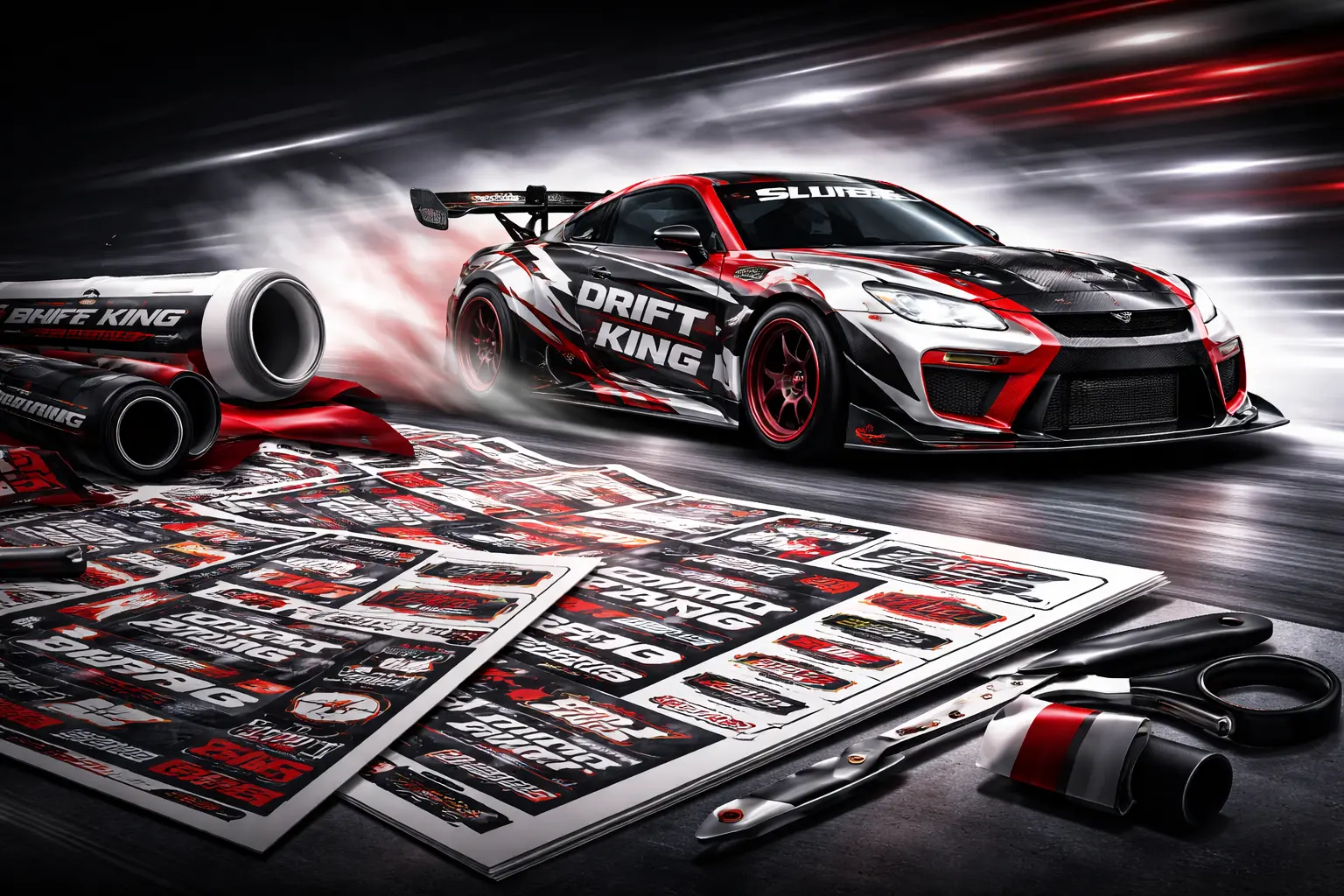
The fastest way to make any drift body look legitimate is a JDM sponsor sticker pack. We’re talking miniature logos for Yokohama, HKS, Advan, Bride, GReddy, NOS, Cusco, BN Sports, and a dozen other brands — all printed at 1/10 scale and pre-cut from clear vinyl. For around $8–$17, you get a full sheet of 40–70 individual logos that let you dress your car exactly like the D1 Grand Prix or Formula Drift machines they’re replicating.
The $8 JDM sponsor sticker pack from Amazon is honestly 80% of the look for 10% of the effort. Slap on some Yokohama and HKS stickers, add a number plate, and your drift car goes from generic to legit in 15 minutes. No painting, no masking, no airbrush. For new builders, this is always the starting point I recommend.
Generic multi-brand packs give you maximum flexibility; brand-specific sheets (a Yokohama-only sheet, for example) give you the clean, themed sponsorship coherence you see on real competition cars. Both approaches work — it depends on whether you’re going for a “worked by one team” look or the chaotic, car-show-winner covered-in-stickers aesthetic.
Check current JDM sponsor sticker packs on Amazon →
Full Livery Wraps
A full livery kit goes beyond sponsor logos — it includes side panel graphics, roof decals, hood pieces, windshield banners, door numbers, and a sponsor sheet, all designed as a unified package. These are the builds you see at drift meets that stop foot traffic. The tradeoff is complexity: a 47-sticker livery kit takes a full Saturday to apply correctly.
I once spent an entire Saturday applying a Formula Drift replica livery to an S15 body — 47 individual stickers from a Baka Drift RC kit. When I finally mounted the body on the chassis and rolled it across the table, it looked like a real drift car miniaturized. That was the moment I truly understood why people dedicate whole build sessions to body work. The result is genuinely stunning.
Pre-cut body-specific kits (designed for your exact shell) deliver the cleanest result but limit your flexibility. Universal kits adapt across different bodies but require more trimming and patience. For your first full livery, body-specific is far easier.
Browse RC drift livery decal sheets on Amazon →
Vinyl Stickers vs. Waterslide Decals
This is the question every RC drift builder eventually faces. Here’s the honest breakdown:
| Type | Durability | Ease of Application | Best For | Price Range |
|---|---|---|---|---|
| Vinyl adhesive | ★★★★★ | ★★★★☆ | Active drift builds, outdoor use | $8–$85 |
| Waterslide decal | ★★☆☆☆ | ★★★☆☆ | Display builds, tiny details | $5–$15 DIY |
Vinyl stickers are self-adhesive films that peel off a backing sheet and stick directly to the body exterior. They’re thick enough to feel slightly raised, but premium laminated versions are waterproof, UV-resistant, and handle the flex of polycarbonate without cracking. For any body that actually gets driven — especially one that tags walls during drift sessions — vinyl is the only sensible choice.
Waterslide decals are ultra-thin printed films that soak in water and slide onto the surface. When clear-coated properly, they produce a seamless “painted on” appearance that vinyl simply can’t match. The catch is fragility: polycarbonate bodies flex during crashes, and waterslide films crack under that movement. This failure mode is well-documented in the RC drift community. Use waterslide for display builds or for tiny details (inspection stickers, small badges) where the scale realism payoff is worth the risk.
Window Tints, License Plates & Small Details
The details are what separate a good build from a great one. Window tint strips ($5–$8) darkened at the right percentage give bodies a sinister, show-car look. Mini license plates at 1/10 scale are a surprisingly impactful touch — Wrap-Up Next’s REAL 3D plates ($6–8 per 2-pack) feature genuine relief printing for depth you can actually see from a few feet away. Racing number decals ($5–8 per sheet) are essential for competition builds or scale replication. Even tire brand decals for the sidewalls exist — RC World sells Michelin stickers for $5.49 per 8-pack.
See racing number decals on Amazon →
Window tint film for RC bodies →
Popular Drift Livery Styles
JDM Sponsor Style
The sponsor-heavy JDM look is the definitive RC drift aesthetic — it’s what you picture when you hear “drift car.” Yokohama, Advan, Nitto, Falken, HKS, Greddy, Origin Labo across every panel, a racing number on both doors, a windshield banner, and enough logos that you need to get close to read them all. This mirrors the actual D1 Grand Prix and Formula Drift paddock, where real cars are rolling billboards. Yokomo’s officially licensed replica bodies — the GReddy R35 SPEC-D, M7 ADVAN MAX ORIDO 86, Team TOYO GP Sports S15 — come with period-correct sponsor sheets straight out of the box.
Initial D & Anime Inspired
The Fujiwara Tofu Shop AE86 is probably the single most replicated RC drift build in the world. White over black “Panda Trueno” paint, the iconic 藤原とうふ店 kanji on the doors, and a set of mesh wheels — it’s instantly recognizable to anyone who watched Initial D. Pandora RC makes dedicated AE86 Sprinter Trueno shells in both 2-door and 3-door versions. The door decals are available from Amazon, eBay, and Spinnywhoosh Graphics, which also offers a complete Initial D line covering the Akina Speed Stars, Project D RX-7 RedSuns set, and Night Kids logos.
Itasha builds — where the body is wrapped in anime character artwork — are huge in Japanese RC drift culture and growing internationally. Sellers like Baka Drift RC and Screenprintdigital on eBay both offer purpose-built 1/10 scale itasha sets. If you have the artwork, DIY printing on waterslide paper opens up literally any character as a possible livery.
Clean & Minimalist
Sometimes less is more. A single pinstripe down the door, a two-tone color split with a clean number on the roof, and one or two understated sponsor logos can look sharper than a car drowning in stickers. This style is gaining traction among competitive builders who want their builds to look intentional rather than busy. It’s also significantly easier to execute — and far more forgiving of application errors when you have fewer decals to place.
Replica Real-World Drift Cars
Specific competition car replicas — Forrest Wang’s floral S14, Chelsea DeNofa’s Ford Mustang RTR, Daigo Saito’s JZX100 — command real respect at the track because they require research, precision, and commitment. Super-G R/C Drift Arena stocks TAKA Liveries specifically designed to replicate well-known Formula Drift and D1GP competition cars. Spinnywhoosh Graphics produces drift-specific livery kits covering both American and Japanese competition cars.
Where to Buy RC Drift Decals
Best Amazon Picks (Budget & Quick Shipping)
Amazon is the right move when you want JDM sponsor packs fast, at low cost, and with Prime shipping. Firebrand RC produces the most capable RC-specific product on the platform — 8-color printed clear vinyl sheets with metallic inks at $19.99–$23.00, including die-cut license plate sheets (28 plates, laminated and waterproof). For budget sponsor stickers, search for the 290-piece Racing Sponsor Decal Set or similar multi-logo packs in the $10–20 range; they’re not always labelled as drift-specific, but the logos overlap heavily with JDM culture.
JDM sponsor packs on Amazon →
RC drift livery sheets on Amazon →
Mini license plates on Amazon →
Best Etsy Sellers (Custom & Unique)
Etsy hosts over 1,000 RC drift decal listings, with RCCUTPASTE as the standout name. They print to order on UV-resistant Orajet clear adhesive vinyl — pre-cut, waterproof, and scratch-resistant — with designs spanning Formula Drift replicas, anime builds, JDM culture, and muscle car styles. Individual 1/10 scale livery kits run $40–50; the “Pick Any 2” bundle delivers two kits for $84.99. Processing is 5–7 business days. Other active sellers include ZeroGravityLiveries (custom design via phone consultation) and McNultyDesignsLLC.
The advantage of Etsy over eBay or Amazon is that you can commission something genuinely unique — a specific car, a specific color scheme, a specific character. For builders who want their build to be the only one in the room, this is where to look.
Specialty RC Shops (Premium & Scale-Accurate)
For authentic Japanese brands and competition-grade quality, specialty shops are irreplaceable.
Super-G R/C Drift Arena (supergdrift.com) carries 78+ livery products including the TAKA Liveries line (40+ designs), Wrap-Up Next REAL 3D decals, Pandora RC graphic sets, and Overdose details. It’s the single best US source for drift-specific decals.
rcMart (rcmart.com) is the top international source, shipping from Hong Kong with 300+ decal products across Wrap-Up Next (42 products), Tamiya (47), Overdose (52), Pandora RC (15), Xpress (16), and Blockhead Motors (82). The brand breadth here is unmatched anywhere else.
AMain Hobbies stocks 266+ sticker products with strong Firebrand RC and Yokomo representation. eBay via screenprintdigital (UK) is arguably the best pure value source — pre-cut clear vinyl JDM drift sheets at $12–17, with 85,000+ positive feedback. Their Liberty Walk, Rocket Bunny, gold sponsor, and itasha-themed sheets are consistently the community’s budget recommendation.
DIY — Print Your Own Decals
The DIY path is the ultimate customization option — and cheaper than you’d think. The process is: design your graphics in Photoshop or Canva, print on inkjet waterslide decal paper ($10–15 per pack of 10 sheets on Amazon), seal with 2–3 light coats of Krylon UV-resistant acrylic clear spray (this step is non-negotiable with inkjet — it prevents the ink from dissolving in water), soak each decal for 45–60 seconds, and apply.
For vinyl cuts, a Cricut or Silhouette Cameo vinyl cutter loaded with Oracal 651 film delivers professional die-cut stickers for pennies per decal after the initial machine investment. The community at DriftMission also recommends Avery TrueBlock labels with a color laser printer as a faster, no-soak alternative — lower scale realism but extremely durable and forgiving.
Waterslide decal paper on Amazon →
Need a body to stick them on? Our best RC drift bodies guide covers JDM, muscle, and Euro styles at every budget.
How to Apply Decals on an RC Drift Body
Tools You’ll Need
Assembly is half the battle. Before you open a single decal sheet, have these within reach: isopropyl alcohol in a spray bottle, a lint-free microfiber cloth, sharp scissors (Tamiya’s hobby scissors are ideal), a precision hobby knife for trimming and weeding, a squeegee or old credit card, a hair dryer or heat gun on low setting, and a clear coat spray compatible with your surface type. For waterslide decals, add a shallow water dish and a soft cloth.
Isopropyl alcohol spray on Amazon →
Hobby knife set on Amazon →
Tamiya clear coat spray on Amazon →
Step-by-Step Application
- Clean the body surface. Wipe every panel with isopropyl alcohol on a lint-free cloth immediately before applying decals. Do not touch cleaned surfaces with bare hands — skin oils destroy adhesion.
- Plan your layout before committing. Lay decals against the body without peeling the backing. Visualize overlap order — window trim goes over body panels, sponsor logos go over base graphics.
- Trim ALL excess clear material. Even on “pre-cut” sheets, trim right up to the design edge. Visible clear borders are the number one tell of an amateur application.
- Apply from the center outward. Peel the backing partially, position the center of the decal, then gradually peel and smooth outward toward the edges with a squeegee or card. This pushes air ahead of the sticker rather than trapping it underneath.
- Use heat for curved surfaces. A hair dryer on medium or a heat gun on low setting warms the vinyl and makes it pliable enough to conform to compound curves. For tight radius curves, make small relief cuts with a hobby knife so the film lays flat without wrinkling.
- Seal with clear coat — carefully. Apply 2–3 light mist coats with 30–45 minutes between each. Never apply a wet, heavy coat — dripping is irreversible. Wait 72 hours after the final decal is placed before clear coating.
- Let cure 24 hours before handling. Resist the urge to mount and drive immediately. Fresh adhesive needs time to fully bond to the surface.
Common Mistakes to Avoid
My first attempt at decals was a complete disaster. I applied vinyl stickers directly to a clear body that I’d already painted on the inside, without wiping the exterior first. Half of them bubbled within 24 hours. A microfiber cloth and 30 seconds of isopropyl alcohol would have saved me an hour of frustration — and one body I had to repaint from scratch.
Beyond dirty surfaces, the most common errors are using too much heat (vinyl melts and distorts above a certain threshold — keep the dryer moving), applying clear coat too thick in one pass (always build up in thin layers), and repositioning vinyl decals repeatedly until the adhesive stretches and the film wrinkles permanently. With vinyl, commit on the first placement — test the position without peeling, then peel and place decisively.
Complete the look with the right drift tires and wheels to match your livery — color-coordinated wheels make the whole build read as intentional. Got a 3D printer? You can print custom spoilers, mirrors, and body detail parts to complement your livery — see our 3D printed RC guide for exactly what’s possible. And if you’re still getting started with the basics, our ultimate guide to RC drift cars is the best first stop.
FAQ
Q: Where can I buy JDM stickers for RC drift cars?
The best sources depend on your budget and timeline. For fast shipping and low cost, search Amazon for JDM sponsor sticker packs in the $8–15 range, or check the screenprintdigital seller on eBay for pre-cut clear vinyl drift sheets at $12–17. For authentic Japanese brands and premium quality, Super-G R/C Drift Arena and rcMart stock Wrap-Up Next, Pandora RC, and Yokomo decal products. For custom one-of-a-kind liveries, Etsy — particularly the RCCUTPASTE shop — is the best option.
Q: How do you apply decals on a polycarbonate RC body?
Start by cleaning the exterior surface with isopropyl alcohol on a lint-free cloth. Trim all excess clear material from around each decal, plan your layout before committing, then peel and apply from center outward using a squeegee to remove air bubbles. Use a hair dryer on low to help vinyl conform to curves. For inside application (on clear bodies before painting), apply in mirror image to the interior surface, which gives maximum protection from crashes and wear.
Q: Do I need clear coat over RC stickers?
For vinyl decals on the exterior of polycarbonate bodies, clear coat is optional but extends life. The critical warning: never use lacquer-based clear coat (like Tamiya TS-series) directly on polycarbonate — it will craze or flake. Use PS-series Tamiya paint for Lexan, or Mr. Hobby Top Coat applied in ultra-light mist coats. For waterslide decals, clear coating is essentially mandatory — without it, the decals peel quickly. Always apply in thin layers.
Q: Can I make my own RC car decals at home?
Absolutely. The two main DIY methods are waterslide decal paper (print on inkjet paper, seal with Krylon UV acrylic spray, soak and apply — total cost around $0.50–1.00 per sheet) and vinyl cutting with a Cricut or Silhouette Cameo machine loaded with Oracal 651 film. The waterslide method requires a clear coat sealing step on the print before soaking, or the inkjet ink will dissolve in water. Both methods can produce genuinely professional results.
Q: What’s the difference between vinyl stickers and waterslide decals?
Vinyl stickers are self-adhesive films that stick directly to the surface and are durable enough for active drift use — they handle the flex of polycarbonate bodies, resist water and UV, and survive wall-taps. Waterslide decals are ultra-thin films applied via a water-soaking process that produce a seamless “painted on” appearance, but they crack when polycarbonate flexes during crashes. Use vinyl for anything that gets driven, waterslide for display builds or tiny scale details like inspection stickers.
Conclusion
For immediate impact, start with a $10–15 JDM sponsor sticker pack on Amazon — it’s the single highest return-on-investment move in RC drift building. Check the current best packs here. If you want something unique, Etsy’s RCCUTPASTE shop and Baka Drift RC offer made-to-order livery kits that will make your build the only one of its kind in the room. And if you’re feeling creative with a Sunday afternoon, waterslide paper and a home printer open up infinite possibilities for custom designs at almost zero cost. Whatever route you take, trim your excess clear vinyl and clean your surface first — those two steps alone separate the builds that look scale-realistic from the ones that look like a kid attacked them with craft stickers.