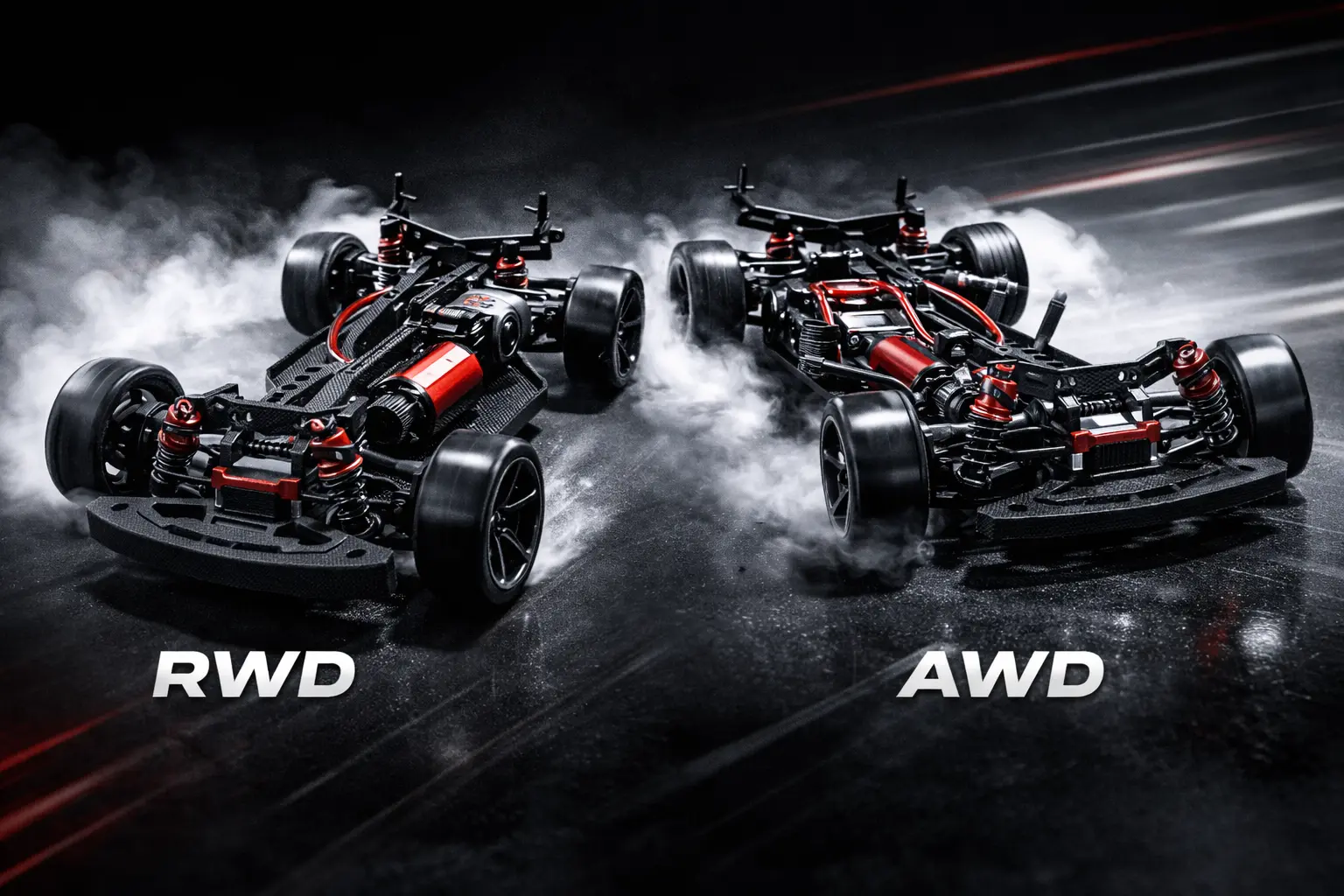
RWD or AWD — it’s the first question every serious drifter faces, and the answer changes everything: how the car drives, how you set it up, and how steep the learning curve is. This is a complete breakdown of both drivetrain types, motor layouts, and the best rc drift chassis at every budget so you walk away knowing exactly what to build.
This post contains affiliate links. If you make a purchase through these links, we may earn a commission at no extra cost to you.
RWD vs AWD at a Glance
| Feature | RWD | AWD |
|---|---|---|
| Realism | Very realistic — mimics real drift cars | Less realistic — all 4 tires slide equally |
| Difficulty | Steeper learning curve | Easier to learn |
| Counter-steer | Full counter-steer possible | Limited or no counter-steer |
| Gyro required? | Yes (essential for stability) | No (optional) |
| Speed | Slower drift speed, more angle | Faster drift speed, less angle |
| Competition | Standard in all modern competitions | Being phased out of most comp classes |
| Cost | Slightly more expensive (gyro, setup) | Generally cheaper to get started |
| Driving feel | Connected, technical, rewarding | Fun, forgiving, accessible |
| Tuning depth | Very deep — endless adjustments | Moderate |
| Best for | Serious drifters, competition, realism | Beginners, casual fun, learning basics |
How RWD Drift Chassis Work
A rear-wheel drive rc drift chassis powers only the rear wheels — exactly like a real drift car. The front wheels are free-spinning and exist purely for steering. That single design decision is what makes RWD drift look like drift.
The hallmark of RWD is counter-steer: when the rear of the car slides out, you turn the front wheels opposite to the direction of travel to catch the slide and hold the angle. At 1/10 scale, this happens fast — too fast for human reaction time alone. That’s where the gyro comes in. A rate-holding gyro detects yaw rotation and sends automatic counter-steer corrections to the servo, stabilizing the slide while you focus on throttle and angle. Without one, even experienced drivers can’t maintain a straight line under power. It’s not a crutch — it’s the technology that makes RWD drift at this scale possible.
Motor placement creates two distinct chassis philosophies. A rear motor layout puts the motor directly over the rear axle and connects it to the rear wheels through a short, simple gearbox. Power delivery is direct, build complexity is low, and the layout is what most people picture when they imagine an rc drift chassis — the Yokomo YD-2S and MST RMX 2.0 S both use rear motor designs. A front motor layout positions the motor at or near the front of the chassis and runs a long driveshaft back to the rear axle, mimicking the front-engine/rear-drive architecture of actual drift cars like the Nissan S15. The MST FXX 2.0 S uses this configuration, achieving near 50/50 weight distribution out of the box.
A mid motor layout — common on higher-end competition builds — places the motor in the center of the chassis and uses a belt or shaft to drive the rear wheels, optimizing fore-aft weight balance without the full complexity of a true front motor.
Weight distribution matters enormously in rc drift chassis setup. Front-heavy means more stability and predictability; rear-heavy means more angle and a looser, more aggressive feel. I spent weeks tuning the weight balance on a YD-2 — moving the battery forward by 10mm, adjusting the motor mount angle, swapping spring rates front and rear. When it finally clicked and the car held a constant 45-degree angle through a hairpin like it was on rails, that’s when I really understood why people obsess over chassis geometry. The car is the instrument. Setup is the music.
How AWD Drift Chassis Work
An AWD rc drift car powers all four wheels simultaneously. The car drifts by breaking traction on all four tires at once, usually by running low-grip drift tires on a smooth surface. There’s no differential bias between front and rear — power just goes everywhere.
The result is a naturally stable car. You don’t need a gyro, you don’t need to learn counter-steer, and you don’t spin out when you stab the throttle. The center-mounted motor drives front and rear axles through a shaft, keeping the layout simple and the build straightforward. For someone who’s never driven an rc car, AWD gets you drifting in your first session, which is genuinely a good time.
The limitation is also its core feature: because all four tires are loaded equally, achieving real counter-steer angles is very difficult. The car slides in a way that looks like drifting but doesn’t replicate the dynamics of a real car. It’s also historically where the RC drift hobby came from — AWD used to be the standard, and competitive tracks ran AWD classes for years. That era is now largely over. Almost every serious drift track and competition runs RWD-only classes, and the major Japanese chassis manufacturers have concentrated their development almost entirely on RWD platforms. AWD still has a lane for beginners and outdoor casual driving, but it’s increasingly a stepping stone rather than a destination. For the full picture on the drift scene, the drift ultimate guide covers its history and where the hobby is today.
Which Should You Choose? — The Honest Answer
The honest answer is RWD, and the sooner you start there, the better.
Choose RWD if you plan to drift at a track, if you want to drift with other people, if you’re interested in competing, or if you want the most realistic experience. The learning curve is real — expect your first few sessions to end in spins — but you’ll develop actual driving skill rather than just car management. Every hour on a RWD rc drift chassis makes you better in ways that transfer to anything else you drive.
Choose AWD if you’ve never driven an RC car and want immediate fun, if you drift alone outdoors on rough pavement or gravel, or if you need the cheapest possible entry point while you decide whether the hobby is for you.
I started on a Tamiya AWD and had a great time for about six months. The car slid easily, it looked good on video, and it was approachable enough that I could find a drift track near me and not embarrass myself completely on day one. Then I drove someone’s Yokomo and couldn’t go back. The difference isn’t just technical — it’s the feeling of actually catching a slide, of the car responding to what you’re asking it to do. AWD doesn’t give you that. If I’d started RWD, I’d have six additional months of skill built up.
The industry verdict: RWD has won. Go RWD from the start.
Best RWD Drift Chassis
Yokomo YD-2S — Best Overall RWD (~$220–$300 kit)
The Yokomo YD-2 is the chassis that every competitive rc drift build gets measured against. Its lineage runs through multiple D1-10 World Championships, and when you show up at any serious drift track, you’ll see more YD-2 variants than anything else combined. That community presence matters — parts are everywhere, setup guides are extensive, and the collective knowledge base for tuning this platform is unmatched.
The YD-2S uses a rear high-mount motor configuration with a 4-gear laydown transmission, a 256mm wheelbase, and a carbon fiber/composite hybrid chassis plate. The “S” designation targets low-grip surfaces — the polished concrete and P-tile that most indoor drift tracks use — and the geometry reflects that with a layout tuned for controlled slides at lower speed. The Plus variant adds refinements to the suspension and structural components, though availability fluctuates; always check current stock before assuming the specific version you want is in hand. The newer YD-2Z and YD-2SXIII offer updated motor mount flexibility and competition-spec components for those who want to go even deeper.
This is the chassis to buy if you want the best parts ecosystem, the most aftermarket support, and the platform that aligns you with the competitive drift community from day one.
Check Price at AMain Hobbies | Need electronics? Check the Hobbywing sensored combo on Amazon
MST RMX 2.0 S — Best Value RWD ($199.99 kit)
The MST RMX 2.0 S is my top recommendation for anyone building their first RWD drift car. It costs $199.99 at AMain Hobbies, it teaches you to drive properly, and it won’t hold you back when your skills improve.
The RMX runs a rear motor in an anti-torque configuration with a 257mm wheelbase. The chassis uses high-rigidity molded plastic dual vertical decking — not as premium as machined aluminum, but plenty rigid for anything below competition level. The dustproof bevel gear gearbox is solid, the CVD steel axles handle abuse, and the adjustable caster (6, 8, 10, or 12 degrees without extra parts) gives you genuine setup range for your surface and driving style. The main upgrade most people do early is swapping the stock plastic shocks for aluminum — everything else is competitive out of the box.
MST and Yokomo are what the drift community refers to as the two premium accessible brands — one step below boutique premium, one large step above budget. At the RMX’s price, you’re getting a chassis that competes directly with the YD-2 at around 60 cents on the dollar. The community is growing, parts support is excellent, and MST has also released the RMX 2.5 S+ (~$229.99) with updated geometry and a rear ESC mount — worth considering if it’s currently in stock when you’re buying.
Check Price at AMain Hobbies | Check MST RMX accessories on Amazon
MST FXX 2.0 S — Best Front-Motor RWD ($199–$220 kit)
The MST FXX 2.0 S doesn’t get talked about as much as the RMX, and that’s genuinely a shame. This is a front-motor RWD chassis — the motor sits up front and a full-length driveshaft runs back to the rear axle, replicating the FR (front-engine, rear-drive) layout of real drift cars like the Nissan Silvia or the Mazda RX-7. The result is near 50/50 front-to-rear weight balance without any additional tuning required.
The FXX uses CNC-machined chassis components, which gives it a more premium feel than the RMX at the same price point. Adjustable caster runs from 12 to 18 degrees, and the aluminum steering connection plate adds precise feel to the front end. Reviewers on AMain consistently rate it as “the best kit for the money currently available.” The tradeoff is that the front motor placement can cause the car to spin out at extreme angles until you’ve dialed in your gyro settings, and swapping the motor takes more steps than a rear-motor setup.
If you want the most realistic FR driving feel and you’re building your second car, the FXX is a genuinely compelling choice.
Check Price at AMain Hobbies | Also available with body: BMW E92 version
Sakura D5 S — Budget RWD Entry (~$120–$150 kit)
The 3Racing Sakura D5 S is the way into RWD drift if the MST or Yokomo options are above your budget. It’s a rear-motor RWD chassis with fiberglass (FRP) composite construction, a gear differential, and inboard front suspension — legitimate design choices for the price.
Community feedback is consistent: the D5 S is well-designed for what it costs, but it lacks the aftermarket depth and precision of MST or Yokomo. Servo fitment sometimes requires minor modification. Parts availability in the US is limited since 3Racing doesn’t distribute through major hobby retailers — expect to source through Friendly Hobbies, eBay importers, or rcMart. That supply chain reality means longer wait times and less certainty when something breaks.
If you’re in the $120–$150 budget range and you’re committed to RWD, the Sakura D5 S gets you there. Just go in knowing you’ll be on your own for parts sourcing more than with the top-tier brands.
Check Price on Amazon | Also available at 3Racing’s official store
Overdose GALM ver.2 — Premium RWD ($350–$370+ kit)
The Overdose GALM is what happens when the Japanese hobby industry applies boutique watch-making philosophy to an rc drift chassis. The chassis is 2.4mm plain-weave matte carbon fiber. The suspension components are machined aluminum. The curved slide steering rack is a proprietary design found nowhere else. The wheelbase adjusts across seven stages from 241 to 276mm with optional parts. It supports Overdose’s floating motor system, which uses Newton’s third law to convert motor reaction forces directly into rear axle traction.
Big Squid RC described Overdose as “the Koenigsegg of RC drift,” and the comparison holds. This is a chassis that doesn’t need any upgrades to be outstanding — it ships at a level that competitors reach only after hundreds of dollars in aftermarket parts. Overdose is not carried by AMain Hobbies and has very limited Amazon presence — the primary US retailer is Super-G R/C Drift Arena, with pricing at $350–$370 for the base kit, climbing past $1,500 if you add the full aluminum option set.
This is not a first car. It’s the car you build when you understand exactly what you want from a chassis and you’re ready to pay for perfection.
Check Price at Super-G R/C Drift Arena | Also available at rcMart
Best AWD Drift Chassis
Tamiya TT-02D — Best AWD for Beginners (~$120–$160 kit)
The Tamiya TT-02D is the entry point for AWD drift, and it’s been earning that reputation for over a decade. Shaft-driven 4WD with front and rear gear differentials, a 257mm wheelbase, CVA oil-filled shocks, and an ABS plastic bathtub chassis — it’s the affordable, simple platform that gets you sliding on day one. Tamiya parts are available at virtually every hobby shop in the country, which means you’re never stranded when something breaks.
The best value version is the TT-02D Honda Civic SiR kit (~$154 at AMain), which bundles a body shell and a Hobbywing THW-1060 ESC — more complete than the bare chassis kit at a better effective price. You still need a motor, servo, radio, battery, and tires, but you’re starting further along.
Build quality is honest rather than impressive. The plastic chassis flexes more than dedicated drift platforms, and upgrade options — while extensive from the aftermarket — add cost quickly. You will outgrow this car if you get serious about the hobby. That’s not a criticism; it’s the natural progression from a platform designed to be accessible.
Check Price on Amazon | Check Price at AMain Hobbies
The RWD Bridge for AWD Starters
A note on the original plan to include the MST FXX 2.0 S here as an AWD/RWD convertible: that information is incorrect. The FXX 2.0 S is a dedicated RWD chassis with a front-motor layout — it does not run AWD in any configuration. It’s reviewed above in the RWD section.
For someone who genuinely wants to start AWD and transition to RWD, the Tamiya TT-02 with an aftermarket RWD conversion kit is the practical path. Yeah Racing and a handful of other manufacturers produce RWD conversion sets for the TT-02 platform that lock out the front driveshaft, and the mod is relatively inexpensive. It won’t perform like a dedicated RWD chassis, but it bridges the gap and lets you develop gyro feel and counter-steer technique before committing to a full RWD build.
Check RWD Conversion Kits on Amazon
For a Pure RTR AWD Option
HPI Sprint 2 Drift is discontinued as of 2026. HPI Racing Limited dissolved in late 2025, parts availability has collapsed, and AMain Hobbies no longer stocks the car. Do not buy one.
If you want an AWD experience without a build — batteries in, running in 20 minutes — your best current option is picking up a Tamiya TT-02D body kit with included ESC (~$154) and pairing it with a basic brushless motor ($25–$35) and a Flysky radio. You’ll spend 2–3 hours building it rather than zero, but you’ll have a supported platform with available parts versus the dead-end parts situation of any RTR that’s left the market.
What You Need Beyond the Chassis (Kit Buyers)
A kit chassis is the rolling platform — the suspension, drivetrain, and structure. You still need electronics to make it move, and if this is your first build, that list can feel overwhelming. Here’s what everything does and what it costs.
A servo ($20–$50) controls steering. Drift servos need to be fast and have a tight center — a slow or loose servo makes precise angle control nearly impossible. A motor ($25–$45) spins the wheels. For drift, you want a brushless sensored motor — sensored operation gives you smooth, precise throttle response from zero RPM that sensorless motors simply can’t match. See our brushed vs brushless guide for the full breakdown. For turn count, 13.5T is the ideal beginner balance; experienced drivers move toward 10.5T. An ESC (Electronic Speed Controller, $30–$60) is the motor’s brain — it converts receiver signals into precise power commands.
The Hobbywing QuicRun 10BL60 sensored combo bundles motor and ESC in a pre-matched set and is the community’s near-universal entry-level recommendation.
For RWD, a gyro is non-negotiable. The Yokomo DP-302V4 (~$76 at AMain) is the benchmark mid-range gyro — four operating modes, remote gain adjustment, and a lineage that goes back to a platform that swept the RC Drift World Championship podium. Budget gyros exist at $15–$25, but the gap in performance is real.
Check Yokomo DP-302V4 on Amazon | Check Price at AMain Hobbies
A transmitter and receiver (~$55–$75) gives you control — the Flysky FS-GT5 is the consensus budget pick, offering 6 channels, 20-model memory, and a solid 2.4GHz signal for a price that most premium brands charge for the box alone.
Round out the build with a 2S LiPo battery ($20–$40), a body shell ($15–$50 — see our drift bodies guide for paintable options), and a set of drift tires and wheels ($10–$30 — matched to your surface type, covered in our tires & wheels guide).
Total complete build estimates:
- Budget RWD (Sakura D5S + basic electronics): ~$320–$380
- Mid-range RWD (MST RMX 2.0 S + Hobbywing combo + DP-302V4): ~$450–$530
- Premium RWD (Yokomo YD-2 + quality electronics): ~$580–$700
For a detailed breakdown of every kit and electronics combination, our drift kits guide covers each tier with specific product recommendations.
FAQ
Q: Is RWD or AWD better for RC drifting?
RWD is better for realism, skill development, and competition. AWD is better for instant fun with no learning curve. Nearly every serious drift track and competition is RWD-only — if you plan to drift with other people or enter events, RWD is the only practical choice. AWD is a legitimate starting point for absolute beginners or casual parking-lot driving.
Q: Do I need a gyro for RC drifting?
For RWD, yes — a gyro is essential. At 1/10 scale, there’s no physical feedback and no natural self-steer, so without a gyro, the car spins out the moment you apply throttle. The gyro detects yaw rotation and sends corrective counter-steer commands to the servo, stabilizing the slide. For AWD, a gyro is optional — the car is naturally stable — but it can sharpen steering response and improve the driving feel.
Q: What’s the best beginner drift chassis?
For RWD, the MST RMX 2.0 S or the newer RMX 2.5 S+ is the top pick — solid construction, excellent parts support, and competitive performance at $200–$230. For AWD, the Tamiya TT-02D is the standard. If budget allows at all, go straight to RWD — you’ll develop real skill faster and won’t be rebuilding around a new platform in six months.
Q: How much does a complete drift car build cost?
Budget RWD: $320–$380 total. Mid-range RWD: $450–$530. Premium RWD: $580–$700. AWD can start at $250–$350 with the TT-02D and basic electronics, though the lower limit assumes you’re comfortable hunting for deals and sourcing parts a la carte.
Q: What’s the difference between rear motor and front motor RWD?
Rear motor is the simpler layout — the motor sits directly over or near the rear axle and connects through a compact gearbox. It’s the most common design and the easiest to work on. Front motor (like the MST FXX 2.0 S) runs a full-length driveshaft from a motor near the front of the chassis to the rear wheels, replicating the FR layout of real drift cars and producing near 50/50 weight distribution. Front motor is more complex to service but offers a more realistic driving feel and better natural weight balance.
Conclusion
RWD is the future of rc drift — and the present of competitive drift. The MST RMX 2.0 S at $199.99 is the best value RWD rc drift chassis on the market, and the Yokomo YD-2S is the gold standard if you want to run the same platform as the people at the top of the hobby. Either way, start RWD, get the Yokomo DP-302V4 gyro, and accept that the first few sessions will humble you before they reward you.
Ready to build? Our drift kits guide covers the full breakdown of every kit tier with specific electronics pairings. Need everything from chassis to track day? The RC Drift Ultimate Guide covers it all.