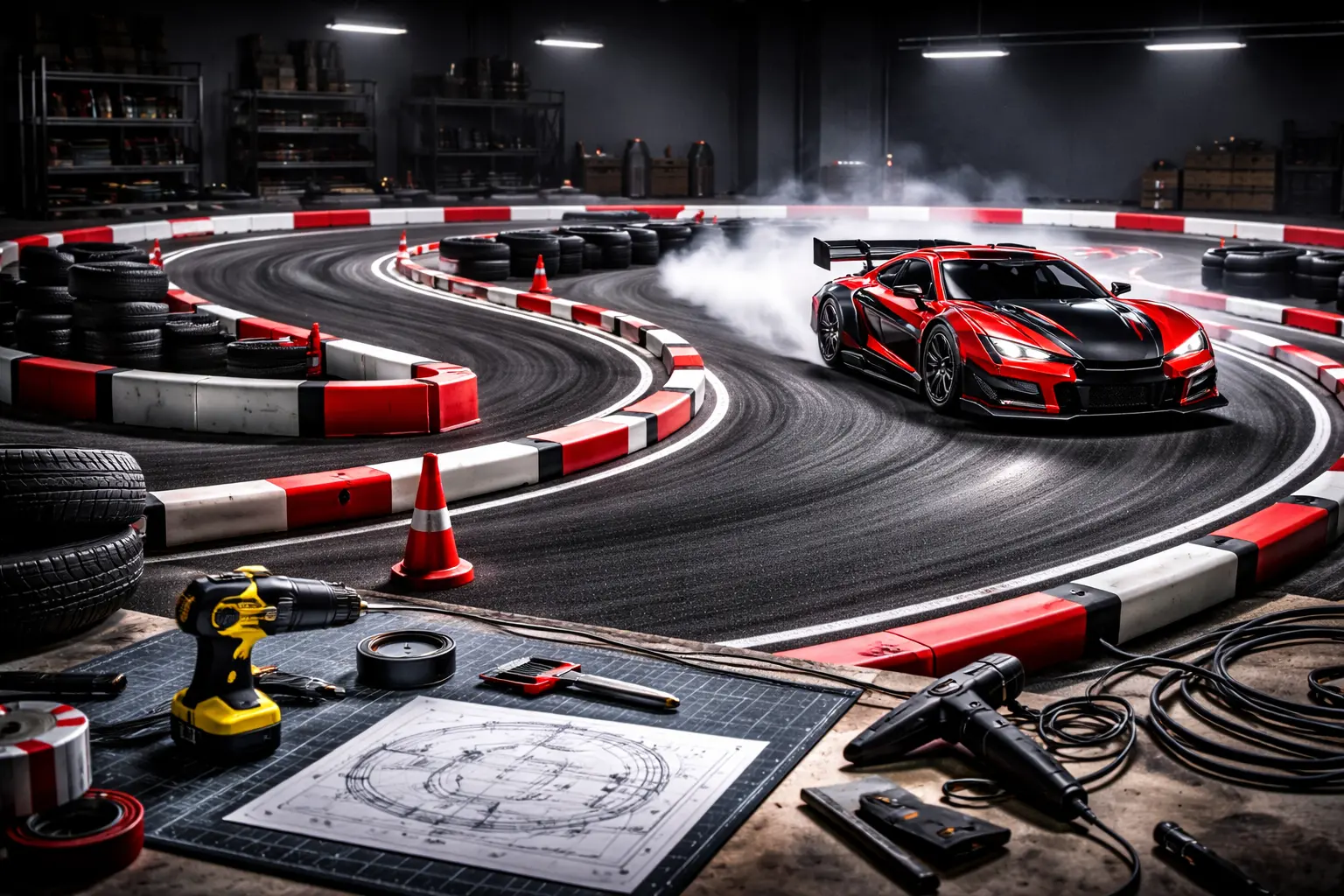
A 10×12 foot garage floor, $30 in pool noodles, and a smooth concrete surface is all it takes to build a functional RC drift track layout. You don’t need a warehouse, a commercial facility, or even a dedicated room. The drift community runs everything from bedroom carpet setups to full parking lot courses — and the barrier between “I want to drift” and “I’m drifting on my own track” is smaller than most people think.
Here’s everything you need to choose the right surface, design a layout that’s actually fun to drive, pick the right barriers, and figure out exactly what it’ll cost — from a $30 ultra-budget setup all the way to a proper 15×20 ft group track.
This post contains affiliate links. If you make a purchase through these links, we may earn a commission at no extra cost to you.
Choosing Your Surface — The Foundation of Everything
Surface choice determines which tire compound you run and how consistent your drift angle is. Get the pairing wrong and you’ll either spin out constantly or barely drift at all. Before you buy anything, figure out what surface you’re working with — or building toward.
RCP Track Panels — The Modular Solution ($365+ for a Starter Kit)
RCP Tracks (rcptracks.com) makes the most well-known modular drift track system on the market. Each tile is either 30 cm (~12 in) or 50 cm (~20 in) square, with a dual-surface design: one groomed side for grip racing, one smooth side for drifting. Tiles interlock via corner pins with no tools, no glue, and no permanent installation — you lay them out, drift, and stack them flat when you’re done.
The 50 cm tile line is the sweet spot for 1/10-scale cars. A practical starter layout — the Wide L / Oblong 40-piece kit — covers roughly 12×10 feet and runs $365–$428 depending on where you buy. Super-G R/C Drift Arena typically offers the best pricing. For serious home setups, most drifters run two Wide L kits (80 tiles) at around $800 total. That sounds steep, but you’re buying a portable, reconfigurable track you can take anywhere.
RCP tiles are sold exclusively through rcptracks.com and specialty retailers like Super-G R/C Drift Arena — they’re not available on Amazon.
One important note on tire matching: RCP’s smooth surface pairs with hard plastic drift tires or competition compounds like Yokomo CS-type slicks. Check our tires guide for the full breakdown on compound-to-surface matching.
Before I bought an RCP setup, I tried to talk myself out of it for two years. Too expensive, I figured. Then a friend brought his 40-piece kit to my garage and we drifted for six hours straight. I ordered a kit the next morning. The modular system means I’ve redesigned the layout probably fifteen times. It never gets old.
Polished/Sealed Concrete — The Best Free (or Cheap) Option
If your garage floor is smooth, uncoated concrete, you may already be 90% there. A coat of clear concrete sealant turns a standard slab into a consistent, fast drift surface that rivals dedicated track materials. Look for a high-gloss or satin-finish concrete sealer — the Americrete A-1300 Clear Glossy Concrete Sealer (around $30–35/gallon) covers roughly 400 sq ft with two coats.
The key is smooth concrete. Rough, pitted, or brushed concrete destroys plastic drift tires in about 25 minutes. If your slab has texture, the sealant won’t fix it — you’ll need to lay a surface over it instead.
Tire matching on polished concrete requires specific compounds — not all hard plastic slicks work equally. Super-G’s TSG-007 polished-surface tires are purpose-built for this substrate if you want a competition-oriented setup. If you’re also thinking about car setup for track driving, a gyro guide can help you dial in stability before your first session on a new surface.
Vinyl / Linoleum Tiles — Budget Indoor Surface ($90–$160 for 10×12 ft)
Peel-and-stick vinyl floor tiles laid over a flat substrate (plywood, existing flooring, a smooth concrete floor) create a slick, consistent drift surface for under $1/sq ft. Achim Tivoli self-adhesive tiles (~$28–40 for 45 sq ft) are the budget leader.
The Art3d 12×12 peel-and-stick tiles (~$35–50 for 30 sq ft) are thicker and more rigid, which reduces the joint-gap issue between tiles.
For a 10×12 ft area (120 sq ft), budget around $90–160 total in tiles. This surface works best for basement or dedicated-room setups. It’s not as fast or consistent as sealed concrete or RCP, but it absolutely works for regular home sessions and is far cheaper than a modular tile system.
MDF / Hardboard Sheets — Ultra-Budget ($20–$50)
Tempered hardboard or smooth MDF sheets from any hardware store are the cheapest way to build a defined drift surface over an unsuitable floor. A 4×8 ft sheet runs $10–15. Four sheets cover an 8×12 ft area for under $50. Lay them down, tape the joints with low-profile packing tape, and you have a smooth indoor surface in under an hour.
Available at Home Depot / Lowe’s — no affiliate link needed.
The downsides are real: MDF is not waterproof (indoor only, no humidity), the seams between sheets create a slight lip that can catch tires, and it’s not as slick as sealed concrete or vinyl. But for a first-season setup on carpet or rough concrete, it’s unbeatable on price. I used MDF sheets for an entire year before upgrading to vinyl tiles, and the main limitation was never the surface — it was my driving.
Surface Comparison
| Surface | Cost (10×12 ft) | Smoothness | Durability | Portability | Best For |
|---|---|---|---|---|---|
| RCP tiles (50 cm) | $365–500+ | ★★★★★ | ★★★★★ | ★★★★★ | Mini-Z, 1/10, competition |
| Sealed concrete | $30–40 | ★★★★☆ | ★★★★★ | ✗ (fixed) | Garage permanent track |
| Vinyl tiles | $90–160 | ★★★★☆ | ★★★★☆ | ★★★☆☆ | Basement/room setup |
| MDF hardboard | $40–60 | ★★★☆☆ | ★★☆☆☆ | ★★★☆☆ | Ultra-budget starter |
Track Layout Design
A good RC drift track layout is not about complexity — it’s about flow. Every corner should naturally set up the next one so drivers can link sections in a continuous, uninterrupted drift. A mediocre track with good flow beats a technically complex track where every corner kills your momentum.
Essential Corner Types
The hairpin (180°) is the most important element on any drift track. It forces a full initiation, rewards angle maintenance through the apex, and exposes throttle control weaknesses immediately. Every track, regardless of size, needs at least one hairpin.
The sweeper (long-radius arc) is the second most important. A wide, high-speed sweeper teaches you to hold drift angle without backing off — it’s where car setup and tire compound become obvious. Keep the radius generous; tight sweepers are just slow hairpins.
The S-curve (back-to-back transitions) is the most technically demanding and fun section once you’re past beginner level. Two opposing arcs linked together require a weight-transfer flick between corners and perfect throttle timing through the transition.
The chicane is a quick left-right direction change without a real apex — it tests raw throttle modulation and steering speed. Good for mid-layout variety.
Straights provide entry speed into corners. Keep them short — four to six feet is plenty. Long straights are boring on an RC track and waste space.
My best layout tip, learned after redesigning my garage track probably a dozen times: always include at least one tight hairpin and one long sweeper. Those two corners teach you 90% of drift technique. Everything else is decoration.
Layout Sizes
Micro (6×8 ft — garage corner): One hairpin at one end, one sweeper arc on the long wall. This is the minimum viable track — enough for solo practice and tuning sessions. Not suitable for tandem driving, but it’ll keep a beginner busy for months.
Standard (10×12 ft — single garage or basement): Hairpin at one end, medium sweeper on the long side, a shallow S-curve connecting them. Fits two to three cars for tandem practice. This is the sweet spot for home setups — my garage track is almost exactly this size, with RCP tile sections and PVC pipe barriers. I’ve been drifting on it most evenings for two years and the Saturday group has grown from three people to ten.
Large (15×20 ft — double garage or open parking area): Full layout with hairpin, sweeper, S-curve, and room for a dedicated straight. Fits four to six cars, allows for proper tandem practice with chase car positioning. Elevation changes become possible at this scale — foam ramps or plywood wedges under track sections add a completely new dimension.
Parking lot (20×30+ ft): Your barrier supply is the only limit. Eight or more cars, full competition-style layouts, spectator space. This is the meetup setup — if you’re organizing group sessions, check our guide on finding drift tracks near you and connecting with existing communities first.
Layout Tips
Design for flow above all else — after you’ve sketched a layout, trace the intended drift line mentally and check whether each corner exit naturally points into the next corner’s entry. Leave enough room for drivers to stand where they can see the full track. Start simple and redesign over time; your first layout will feel wrong once your driving improves, which is fine. Running the track clockwise one session and counter-clockwise the next exposes completely different driving challenges in the same space.
A free tool called RCTrackBuilder (rcgarage.info) lets you design and visualize layouts before committing to any physical setup — worth thirty minutes before you start laying barriers.
Barriers & Track Accessories
Barriers define the track edges, protect cars on runoff, and give drivers visual reference for the ideal drift line. The best barriers are cheap, visible, and forgiving on impact.
PVC Pipe Barriers — The Community Standard ($15–$30 total)
3/4-inch PVC pipe cut into six to eight-inch sections is the near-universal barrier solution used by home drift tracks and club setups alike. A ten-foot section costs $3–5 at any hardware store. Cut 20–30 sections, line them along both edges of the track, and you have a full barrier set for under $20. PVC rolls on impact instead of stopping a car dead, is immediately visible, and is easily repositioned when you reconfigure the layout. This is the first barrier system to build — everything else is an upgrade or supplement.
Available at Home Depot / Lowe’s (3/4” PVC pipe, 10 ft section, ~$3–5 each).
Pool Noodles — Soft & Silent ($15–$19 for a 6-Pack)
Pool noodles cut into six-inch sections are ideal for indoor and garage setups where noise matters. They’re nearly silent on impact, won’t scratch car bodies, and the hollow core can be slid onto a dowel or wire to keep sections in place. The Oodles of Noodles 6-Pack (~$15–19) provides enough foam to border a full home track perimeter. Buy the rainbow packs — color-coding inner versus outer barriers helps drivers track their line at a glance.
Foam Pipe Insulation — Alternative Budget Option ($10–$20)
Pre-slit tubular foam insulation from the plumbing aisle is another soft, cheap option. It comes in long sections that you cut to length, is slightly more rigid than pool noodles (holds its position better on smooth floors), and runs around $10–20 for enough to border a standard home track. Not as durable long-term, but a solid option for a first build.
Available at Home Depot / Lowe’s (foam pipe insulation, 3/4” ID, ~$0.50–1.00/ft).
Track Accessories Worth Adding
RC drift cones for clipping points are the single biggest upgrade to a bare-barrier layout. The RC4WD 1/10 Scale Traffic Cones (~$9–13 for 10 pieces) are the community standard — proper scale rubber construction that won’t hurt cars on impact. Place them inside corners to define the ideal drift line and give drivers a consistent reference point.
LED strip lights for evening and night sessions transform the atmosphere. The DAYBETTER 32.8 ft Waterproof RGB LED Strip Light Kit (~$15–20) is enough to border an entire home track with color-changing capability, a remote control, and a 12V power supply included.
A lap timing system is the competitive track upgrade — dedicated RC lap counters with IR sensors run from $30 to $100+ and add a completely different dimension to group sessions.
Budget Breakdowns
| Setup Level | Surface | Barriers | Area | Total Cost |
|---|---|---|---|---|
| Ultra-Budget | Sealed concrete + $35 sealant | Pool noodles | 10×12 ft | $35–$60 |
| Budget | MDF sheets | PVC pipe | 10×12 ft | $50–$80 |
| Standard | Vinyl tiles | PVC pipe + cones | 10×12 ft | $150–$220 |
| RCP / Modular | 40-piece RCP kit | PVC + LED lighting | 12×10 ft | $400–$480 |
| Parking Lot Meetup | Bare concrete | PVC pipe (portable) | 20×30+ ft | $30–$50 (barriers only) |
The honest version of this table: you can start drifting tonight for under $50 if you have a smooth garage floor. Apply the sealant, cut some pool noodles, lay out a hairpin and a sweeper, and you have a functional track. Upgrade to vinyl tiles or RCP when you know you’re hooked — and you will be.
Indoor vs. Outdoor Considerations
Indoor tracks (garage, basement, dedicated room) offer year-round access, controlled surface conditions, and weather independence. The main limitations are space and noise — brushless motors at full throttle in an enclosed garage are genuinely loud, and a group session with five or six cars will test neighborly patience. Cold garages also affect LiPo battery performance and cause hard plastic drift tires to stiffen, which changes handling noticeably.
Outdoor tracks (parking lots, driveways, open spaces) offer more room to grow and the flexibility to run larger car counts. The tradeoffs are weather dependency, variable surface quality (cracks, debris, moisture all affect drift behavior), and permissions. If you’re setting up in a shared or commercial parking lot, get explicit permission and be respectful about cleanup and noise — RC drift groups that treat public spaces well tend to keep access; those that don’t lose it fast. Portable PVC barriers break down flat and load into a bin, making outdoor setups and teardowns quick.
If you’re interested in building outdoor natural-terrain tracks rather than drift-focused surfaces, the same creative DIY principles apply — our guide on crawler course building covers the obstacle-based equivalent.
FAQ
Q: How much space do I need for an RC drift track?
The minimum for a solo practice setup is around 6×8 feet — enough for a hairpin and one sweeper arc. For a home track where you can run two or three cars in tandem, 10×12 feet is the practical sweet spot. Bigger is always better for groups, and 20×13 feet is the recommended minimum if you want a proper flowing layout with multiple distinct corner types.
Q: What is the best surface for RC drifting?
For 1/10-scale cars, smooth sealed concrete and P-tile vinyl flooring are the community standards at competitive venues. RCP track panels are purpose-built for Mini-Z (1/28 scale) but work well for 1/10 scale too. The critical factor is tire-to-surface matching — each surface requires a specific compound. Hard plastic slicks on polished concrete, CS-type compounds on vinyl tiles. Wrong pairing and the car won’t drift at all. Our full tires guide covers every combination.
Q: How much does it cost to build an RC drift track?
As little as $35–60 with a sealed concrete garage floor and pool noodle barriers. A proper vinyl tile surface with PVC barriers and cone markers runs $150–220 for a 10×12 ft track. A modular RCP tile setup starts around $365–428 for a usable 40-piece layout. The barriers and accessories are almost always under $30 regardless of which surface tier you choose.
Q: Can I drift RC cars on carpet?
Yes, but standard hard plastic drift tires won’t work on carpet — you need rubber compound or CS-type tires instead. Low-pile commercial carpet works better than thick residential carpet. The softer the carpet pile, the more tire grip you need. Most serious home drifters avoid carpet precisely because it locks you into specific tire compounds and feels slower and less satisfying than a hard surface.
Q: Do I need RCP tiles or can I use something cheaper?
RCP tiles are excellent but not required — and for 1/10-scale cars, polished concrete and vinyl tiles are what the competitive community actually runs at serious venues. Start with sealed concrete or a vinyl tile base, get your driving dialed in, and upgrade the surface when you’ve outgrown what you have. The track surface matters far less than the layout design and your tire setup, especially in the first year.
Conclusion
Start with what you already have. A smooth sealed garage floor and $30 in PVC pipe barriers is a real drift track — not a placeholder, not a compromise. Build a hairpin and a sweeper, tune your car to the surface, and you’ll be running consistent laps within a session or two.
Surface upgrades — vinyl tiles, RCP panels — come later, when you know exactly what you want from your setup and who you’re sharing it with. Need a drift car first? Start with our drift kits guide or the complete RC Drift Ultimate Guide. Ready to find people to drift with? Our guide on finding RC drift tracks near you covers communities, meetups, and how to connect with local groups.